PART 1
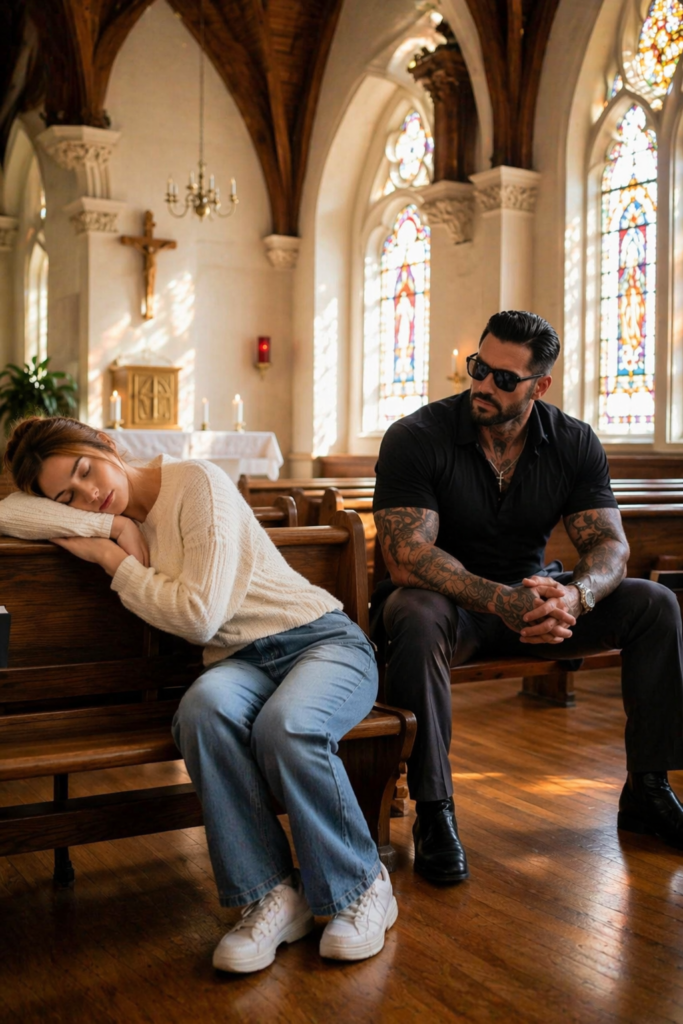
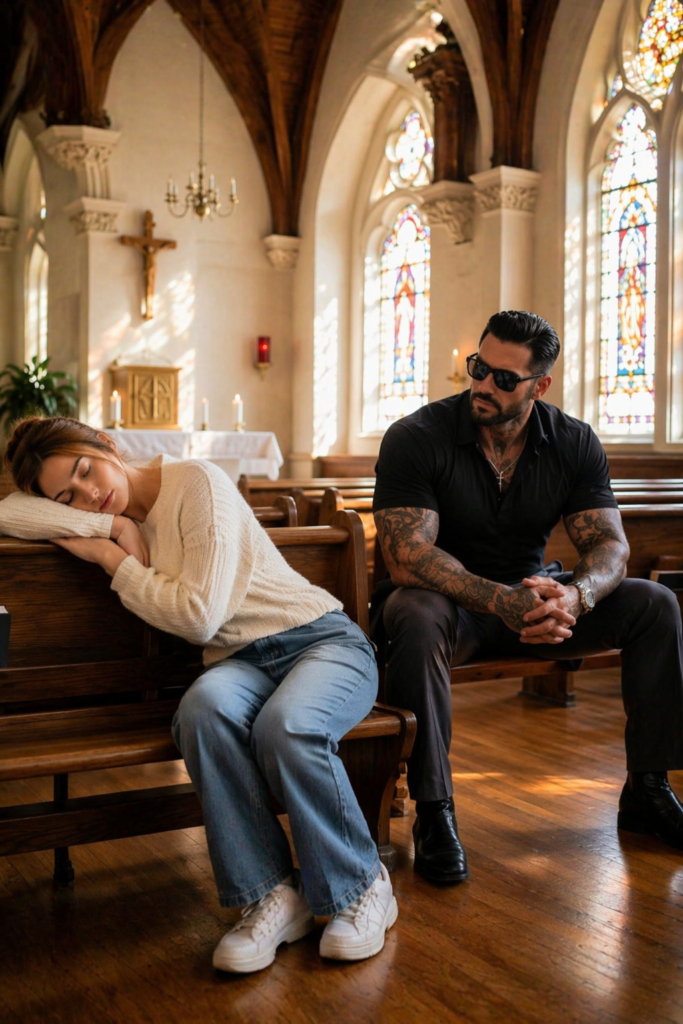
At 2:17 a.m., Mariana Ríos awoke in the chapel of Santa Lucía Hospital to find a stranger sitting behind her.
The rain pounded against the stained glass as if someone were trying to force their way inside. In Roma Sur, the city remained awake, but inside the hospital, everything sounded more sorrowful: monitors beeping, hurried footsteps, hushed prayers, and families waiting for miracles that no one promised.
Mariana was 29 years old and worked in respiratory therapy. She had been on duty for 18 hours, her blue scrubs wrinkled, hair haphazardly tied up, and eyes red from fatigue. She had entered the chapel for just five minutes to breathe.
But her body demanded everything back at once.
She dozed off on the third pew, a cup of cold coffee clasped in her hands.
When she opened her eyes, she saw the man.
He was tall, dressed in a dark suit, a black coat soaked from the rain, and an unsettling calm that didn’t fit the hospital atmosphere at that hour. He didn’t appear to be a patient’s family member or a doctor. He looked like someone accustomed to having doors open before he knocked.
Mariana straightened, embarrassed.
—Sorry… I didn’t know anyone was here.
The man barely glanced at her.
—No need to apologize. You seemed like you needed to sleep.
His voice was low, serious, but not aggressive. Still, Mariana felt a shiver creep down her spine.
In the hospital, everyone whispered about him without saying his name too loud: Sebastián Aranda, owner of construction companies, private clinics, and public contracts. Some called him a businessman. Others said he was the head of a mafia of white coats, lawyers, and politicians.
Mariana didn’t know what to believe.
—Do you have a family member admitted? —she asked.
He took a second to respond.
—Not exactly.
That answer unsettled her even more.
Her pager vibrated. Emergencies, fourth floor. Mariana jumped up, grabbing her coffee and adjusting her backpack.
—Good night.
—Good night, Mariana.
She stopped at the sound of her name.
He didn’t smile. He just lowered his gaze to her ID badge, as if that explanation were enough.
Mariana left with her heart racing.
For the next three days, she tried to forget him. The hospital was large, filled with weary faces. But on Thursday, after another grueling shift, she returned to the chapel and found a hot coffee waiting for her on the same pew where she had fallen asleep.
On the cup, it read:
For Mariana.
She looked around.
No one.
She only caught a glimpse of the elevator doors closing in the distance.
From that night on, Sebastián began to appear like an elegant shadow: in the cafeteria at 4:40 a.m., by the large windows, in the covered parking lot when the rain turned the floor into a mirror.
One early morning, Mariana found him sitting in the empty cafeteria with a cup of coffee and an old photograph on the table.
—You again —she said, feigning calmness.
—It seems so.
—You never told me your name.
He flipped the photo face down.
—Sebastián Aranda.
Mariana wasn’t surprised. She had already looked him up online. Photos with governors, inaugurated hospitals, unproven accusations, cold smiles.
—And what does someone like you do here at this hour?
Sebastián gazed at his coffee.
—The same as you. Enduring the night.
For the first time, Mariana offered a slight smile.
But when he stood up, he forgot the photograph on the table.
Mariana didn’t want to touch it. She just stared.
Air escaped her chest.
In the photo was a young woman, by a lake, with large eyes, dark hair, and a sweet smile that Mariana recognized all too well.
She looked like Isabel.
Her sister.
Dead for eight years in an accident on the way to Cuernavaca.
That afternoon, Mariana found Sebastián in the parking lot next to a black sedan.
—Who is the woman in that photo?
He slowly closed the car door.
—Someone important.
—She looks like my sister.
Sebastián’s face barely changed.
It wasn’t surprise.
It was fear.
—What was your sister’s name?
Mariana swallowed.
—Isabel Ríos.
The silence weighed like a sentence.
Sebastián stared at the rain falling on the avenue.
—Then it has begun.
—What thing?
He didn’t answer.
And Mariana understood, with a knot in her throat, that this man hadn’t found her by chance.
He had been looking for her.
PART 2
For a week, Sebastián disappeared.
Mariana tried to convince herself it was for the best. A man like him didn’t bring peace. He brought secrets, discreet bodyguards, closed doors, and problems a hospital worker didn’t need.
But every night, passing by the chapel, she glanced toward the third pew.
There was no coffee.
No black coat.
No longer that uncomfortable presence that, for some absurd reason, made her feel less alone.
On Saturday, close to midnight, Mariana went down to the clinical archives to help Doña Elvira, an old employee who had spent 34 years caring for files as if they were saints.
—Help me with this scanner, dear. This machine hates me more than my ex-husband —the lady said.
Mariana let out a tired laugh and sat at the desk.
As she sorted through some old folders, a box opened, spilling papers onto the floor. Among them slipped a yellowed photograph.
Mariana bent down.
And froze.
It was the same woman from Sebastián’s photo.
But this time it was attached to a medical form with a name written above:
Isabel Ríos Salgado.
Donor patient. Date: 8 years ago.
Mariana felt her blood run cold.
—Doña Elvira… why is there a file for my sister here?
The woman paled.
—Oh, Mariana… I didn’t know she was your sister.
Mariana opened the folder with trembling hands. Many pages were crossed out. Others were incomplete. But there was one intact document, signed in Isabel’s handwriting.
Donation authorization.
Mariana covered her mouth.
Her mother had always said everything happened too fast, that Isabel died almost upon arrival, that there was no time for goodbyes or questions. She never spoke of donation. Never mentioned authorization. Never talked about anything.
And there was Isabel’s signature, firm, clear, generous.
At the back of the folder was a note:
Urgent recipient. Confidential case. High priority.
Below it, almost erased, appeared a handwritten name:
Mateo Aranda.
Mariana needed no more to feel the blow.
Aranda.
Her phone vibrated in her pocket.
Unknown number.
The message read:
“We need to talk. Rooftop. Now.”
No signature was necessary.
Mariana climbed up with the folder clutched to her chest. The rain had stopped, but the city remained damp, bright, enormous. From the rooftop, the lights of Reforma looked like an open wound.
Sebastián was by the railing.
No bodyguards.
No arrogance.
Just him.
—Who was Mateo? —Mariana asked without greeting.
He closed his eyes.
—My younger brother.
She raised the folder.
—And why is my sister’s name linked to his?
Sebastián took a deep breath.
For the first time, his voice didn’t sound powerful.
It sounded broken.
—Because Isabel saved his life.
Mariana felt her legs wobble.
Sebastián stepped toward her but stopped before touching her.
—Mateo was 23. He needed an urgent transplant. My family had money, contacts, doctors, lawyers… everything people think buys life. But there was no compatible donor. My dad offered millions. My mom prayed. I made frantic calls. And nothing.
Mariana cried silently.
—One day the hospital called. There was an opportunity. Someone had authorized donation. They never told us her name. The law didn’t allow it. We only knew that thanks to her, Mateo was going to live.
Mariana pressed the folder to her chest.
Isabel had always been like that.
The one who brought food to sick neighbors. The one who picked up injured dogs. The one who gave away sweaters even if it meant she’d be cold. The one who said doing good didn’t count if one flaunted it.
—How long did he live? —Mariana asked.
Sebastián swallowed.
—8 more years.
The answer split her in two.
—He graduated. He fell in love. He traveled to Oaxaca. He opened a café in Coyoacán because he said coffee was a beautiful way to care for people. Every birthday, he toasted to “his invisible angel.”
Mariana covered her face.
She didn’t know whether to feel pride, pain, or rage.
—Why did you look for me?
Sebastián lowered his gaze.
—Because Mateo died six months ago.
The silence fell heavy.
—Before he died, he left behind a notebook. He wrote that he didn’t want to leave without knowing who had given him those 8 years. I started looking. Incomplete files, erased names, old favors. Everything brought me to this hospital. Everything brought me to Isabel. And then I saw you sleeping in the chapel.
Mariana glared at him in anger.
—You could have told me the truth from the start.
—I didn’t know how to tell a woman that her dead sister was the reason my brother had lived.
—And the coffees? The photo? Appearing like a ghost?
Sebastián clenched his jaw.
—At first, I wanted to confirm it was you. After that… I didn’t know how to leave.
Mariana wanted to hate him.
She truly wanted to.
But before her stood not the man from the newspapers. He was a brother who had lost someone and was searching for a clumsy way to show gratitude.
So she opened the folder again.
On the last page was a torn photograph.
Isabel appeared in the hospital courtyard, wearing a volunteer’s gown. Beside her, someone had been ripped from the image.
Mariana flipped the photo.
On the back was a phrase written by Isabel:
“Today I met someone who reminded me that living is not a right, it’s a gift.”
Mariana looked up.
—Sebastián… I think Isabel met Mateo before the transplant.
That possibility changed everything.
For four days, Mariana and Sebastián searched through cardboard boxes, volunteer records, accompaniment lists, and albums from Christmas campaigns. Doña Elvira secretly helped them, although she kept repeating that if the director found out, she would be fired before her shift ended.
Santa Lucía Hospital had changed owners, agreements, and administrations. But some things survived the disaster: old photographs, forgotten badges, letters left undelivered.
On the fifth day, they found a box marked:
Volunteering, fifth floor, 8 years ago.
Mariana opened it with apprehension.
Inside were photos of young people bringing books, blankets, and pastries to patients.
Then Sebastián froze.
In one image, Isabel sat next to a thin boy, wearing a gray hat, a huge smile, and holding a cup of hot chocolate.
Below it read:
Isabel and Mateo. Sunday shift.
Sebastián took the photo as if it were a relic.
—They did meet —he whispered.
Mariana began to cry before fully understanding.
But the real bombshell was at the bottom of the box.
An undelivered letter, addressed to Mateo’s family.
It was from Isabel.
Mariana recognized her handwriting immediately.
The letter said that she had met a patient named Mateo during her volunteer shifts. It said he was scared of dying, but still made jokes so others wouldn’t cry. It said that if something ever happened to her, she wanted her medical decisions to be respected.
And then came the phrase that shattered both of them:
“If my life can give Mateo time, then my departure won’t be completely empty.”
Sebastián brought a hand to his face.
Mariana couldn’t stand any longer.
Isabel hadn’t been an anonymous donor by accident.
She had chosen.
She had chosen from love, from compassion, from that way of carrying others' pain as if it were her own.
But there was still one more wound left.
That night, Mariana went to her mother’s house with copies of the folder. Doña Carmen sat in the kitchen, preparing chamomile tea as if she could soothe any tragedy with hot water.
—Why didn’t you ever tell me that Isabel donated? —Mariana asked.
The cup fell to the sink.
Doña Carmen didn’t ask how she found out.
She just sat down.
—Because I didn’t want you to remember her open on an operating table.
Mariana felt disgust and pity at the same time.
—She signed. She wanted to do it.
—She was 24, Mariana. She was my daughter. I didn’t want them to touch her.
—But you allowed it.
The mother began to cry.
—Because a social worker came with the letter. She told me Isabel had already decided. That she could save someone. That denying it would be a betrayal.
Mariana clenched her fists.
—Then you betrayed her afterward by hiding it.
Doña Carmen wiped her face with her apron.
—I didn’t know how to live knowing a part of my daughter remained in someone from that family.
—From that family?
Doña Carmen looked out the window.
—The Arandas arrived at the hospital that night. There were SUVs, lawyers, men in suits. I thought they had pressured everything. I thought for them, my girl was just an opportunity. They scared me, Mariana. And I felt rage.
The revelation hurt, but it also explained eight years of silence.
Doña Carmen hadn’t hidden the truth out of malice.
She hid it because she confused love with confinement, grief with resentment, and protection with lies.
—Isabel knew Mateo —Mariana said.
Her mother raised her face.
Mariana showed her the photo.
Doña Carmen crumbled.
—Oh, my girl…
For the first time in eight years, the mother cried without holding back. She didn’t cry like a strong woman. She cried like a mother who had just understood that her daughter had left a will greater than her own death.
The next day, the hospital director tried to seize the file from them.
He summoned them to a cold room with two lawyers and a superior air.
—These documents are confidential. They cannot circulate. There are legal risks for the institution.
Mariana looked at him without bowing her head.
—What’s hidden here is a story.
The director adjusted his glasses.
—Miss Ríos, you work here. It would be wise to think carefully about what you’re doing.
Sebastián, sitting beside her, didn’t raise his voice.
But his presence filled the room.
—Threaten her again, and tomorrow you’ll have a federal audit, six reporters outside, and my legal team reviewing every contract of this hospital for the past ten years.
The director turned pale.
Mariana looked at him, astonished.
Sebastián added:
—And this time, I won’t use my last name to open doors. I’ll use it to knock down the ones that hid the truth.
No one touched the folder again.
Three months later, Santa Lucía Hospital inaugurated a small rest room for families of critical patients.
It didn’t bear the name of any politician.
It didn’t bear the name of any businessman.
On the light wood plaque read:
Isabel and Mateo Room.
A place to breathe when life hurts.
Mariana arrived wearing a simple blue dress. For the first time in years, she didn’t look like a woman surviving on nothing but caffeine. She had cut back on her shifts, resumed Sunday meals with her mother, and started sleeping without guilt.
Doña Carmen came too.
She stood in front of the plaque, holding a photograph of Isabel in her hands.
Sebastián arrived later, in a gray suit, carrying two coffees.
He handed one to Mariana.
—For Mariana.
She smiled through tears.
—You still think coffee fixes everything.
—Not everything. But it helps a lot.
Before the ceremony, they entered the chapel together.
The same chapel where it all began.
Morning light streamed through the stained glass, painting the floor in soft colors. Mariana sat in the third pew. Sebastián sat beside her.
Neither spoke for several minutes.
It wasn’t necessary.
They had found a painful truth, yes. But they also found something neither expected: a way to remember without sinking.
—Do you think Isabel and Mateo knew how important they would be to each other? —Mariana asked.
Sebastián gazed at the altar.
—I believe some people save us before we understand who they are.
Mariana rested her head on his shoulder.
He took her hand gently, as if still learning that happiness could also stay.
Outside, families began to enter the new room. A mother wept silently. A child slept in his father’s arms. Doña Elvira arranged sweet bread by the coffee maker as if it were part of a sacred ceremony.
Life went on.
Fragile.
Unjust.
Beautiful.
Mariana thought of Isabel.
Sebastián thought of Mateo.
And for the first time, neither felt they had lost them completely.
Because some farewells don’t end at a grave.
Sometimes they end in a signature, in a hidden letter, in a cup of coffee, in a chapel pew where two broken people discover that love can also travel from one body to another, from one life to another, from one pain to another.
That morning, when they discovered the plaque, Mariana didn’t cry out of sadness.
She cried because she finally understood that her sister hadn’t gone alone.
She had left a light on.
And that light, eight years later, had guided the most feared man in the hospital to the third pew of a chapel, just in time for both to learn how to live again.