PART 1
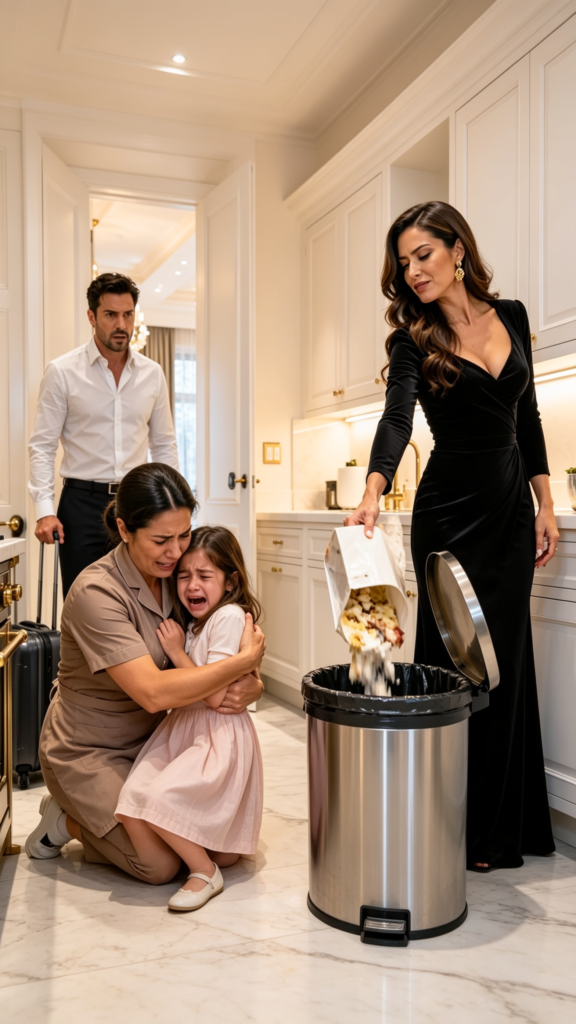
—If your little girl is so hungry, tell her to learn from a young age that in this life, nothing comes for free.
Sofía Reyes stood frozen in front of the service refrigerator, an empty yellow lunchbox in her hands, her face burning with shame.
Beside her, Valentina, just 3 years old, clutched her belly over her faded pink dress. She wasn’t throwing a tantrum. She wasn’t screaming. She just looked at her mother with those big eyes that still couldn’t understand why asking for food could bother adults so much.
The kitchen in the residence in Lomas de Chapultepec looked like something out of a magazine.
There were fresh pastries, trays of cut fruit, imported coffee, fine cheeses, green juices, and cakes that would remain untouched until evening. But the food Sofía had brought for her daughter vanished as if someone hated it.
Mariela Santillán, fiancée of Leonardo Ibarra, sat at the black granite bar, checking her nails. Her engagement ring glittered, huge and almost offensive, under the bright lights.
—Mrs. Mariela —Sofía said, struggling to keep her voice steady—, I left some beans, rice, and one mandarin here. It was all my little girl was going to eat until the evening.
Mariela slowly raised her gaze.
—Well, it’s not here. And I’m not a mind reader.
Valentina tugged at her mother’s apron.
—Mommy, it hurts a lot.
Sofía closed her eyes for a moment.
She had been working in this house for 2 years. She cleaned enormous bathrooms, washed expensive sheets, cooked dinners for guests who barely took two bites, and ironed shirts that cost more than everything in her closet.
She lived in Iztapalapa, in a rented room behind a stationery store. Every morning, she made almost a 2-hour journey with Valentina asleep in her arms because she had no one to leave her with.
The girl’s father had left when Valentina was 9 months old. He said he was fed up with diapers, crying, and responsibilities.
He never sent a single peso.
Leonardo, the owner of the house, had never treated Sofía poorly. He was reserved, serious, owner of a medical technology company and a foundation that provided breakfasts to public schools. He was almost always away, between Monterrey, Guadalajara, and Querétaro, but when he saw Valentina, he would ask if she had eaten.
Once, he brought her a little rag doll from Oaxaca.
Everything went downhill when Mariela moved in 6 months ago.
In front of Leonardo, Mariela spoke softly, smiled sweetly, and said she admired working women. But when he wasn’t around, she looked at Sofía as if dirt had entered the living room.
—The help now also comes with a family package —she said one day in front of the gardener.
Sofía swallowed her humiliation.
She needed the job. She needed to pay rent, buy milk, bus fares, medicine for Valentina’s cough, and the supplies for the kindergarten she hoped to enroll her in soon.
So she taught her daughter to sit still, not touch anything, not ask for water without permission.
But hunger doesn’t understand rules.
First, a bread went missing. Then some cookies. After that, the soup that Sofía had prepared at 4:40 in the morning.
That day, when she opened the trash can, she found the yellow lunchbox crushed among napkins.
The rice was still inside.
So were the beans.
Mariela approached, smiled shamelessly, and said:
—This house isn’t a community kitchen.
Sofía hugged Valentina tightly, feeling the girl tremble against her chest.
Then the front door opened.
Leonardo had come back from Monterrey unannounced.
And he heard every word.
PART 2
Leonardo stood frozen in the hallway, still with his travel backpack slung over one shoulder.
He didn’t speak right away.
He looked at the scene as if his own home had turned into a foreign place. Sofía held Valentina against her chest. The girl had dry lips. Mariela, on the other hand, was calm and comfortable, as if she had just ordered another coffee.
Mariela was the first to react.
Her face changed in an instant.
—My love, what a surprise. I didn’t know you were coming today.
Leonardo didn’t respond.
His eyes dropped down to Valentina.
—Why is she crying?
The girl wasn’t crying loudly, but she had the wrinkled face of someone who was too drained to even complain.
—My food went to the trash —she whispered.
Mariela let out a chuckle.
—Oh, Leo, please. Kids say weird things when they’re tired. Besides, Sofía has been very sensitive lately.
Sofía lowered her head.
—Sir, I did bring your food. I didn’t take anything from your kitchen, I swear. I would never steal.
Leonardo felt a dry blow to his chest.
No one had mentioned the word steal. But Sofía was already defending herself, as if that accusation had been living on her shoulders for months.
—No one said you stole —he replied.
Mariela crossed her arms.
—That’s how it starts. First, they bring their kids, then they get comfortable, then they want you to support them. I was just putting things in order.
Leonardo dropped his backpack to the floor.
—Putting things in order is throwing away a little girl’s food?
Mariela hardened her face.
—Don’t speak to me like that in front of her.
—In front of whom? Sofía or the hungry little girl?
Silence fell heavily over the kitchen.
Valentina hid behind her mother’s skirt.
Leonardo walked over to the trash can. He bent down, picked up the yellow lunchbox, and saw the rice stuck to the plastic walls.
It wasn’t old.
It didn’t smell bad.
It was just thrown away.
—I’m going to check the cameras —he said.
Mariela froze.
—What cameras?
—The kitchen, service entrance, hallway, and pantry cameras. I installed them after some equipment went missing from my office. They record for 30 days.
Sofía looked up, surprised.
Mariela let out a dry laugh.
—Are you going to make a scene over rice and beans? Seriously, how embarrassing. I’m your fiancée, Leonardo. Not a stranger.
He looked at her with a calm that was frightening.
—Then you won’t have a problem with me seeing them.
That night, the residence had no peace.
Sofía stayed in the laundry room with Valentina asleep on her lap. She stroked the girl’s hair gently, trying not to cry loudly so as not to wake her.
She was scared.
Scared of losing her job. Scared that Mariela would make up something worse. Scared of going back to Iztapalapa without money for rent. Scared that Valentina would remember that house as the place where she learned that eating could be a luxury.
Meanwhile, Leonardo locked himself in his office.
He turned on the computer, accessed the security system, and searched for the kitchen.
The first video was from 12 days earlier.
Sofía went out to the patio carrying a bucket of clothes. Valentina sat on a little bench, hugging an old doll.
Mariela entered the kitchen, opened the small staff refrigerator, took out a green lunchbox, looked at it with disdain, and emptied everything into the sink.
Then she turned on the faucet.
Leonardo clenched his jaw.
He moved on to the next file.
There was Mariela taking 2 cookies wrapped in a napkin. She broke them with her fingers and threw them in the trash. Then she wiped the counter as if she had done something fancy.
The third video chilled his blood.
Valentina stood by the door, looking at a basket of bread.
Mariela walked past her and said:
—Don’t you dare touch it. You’re not a guest here.
The girl stepped back.
She didn’t cry.
She just sat down again.
Leonardo took off his glasses and rubbed his face.
He kept watching.
There was more.
Mariela stained a light carpet with coffee to make Sofía clean it on her knees.
Mariela hid Valentina’s shoes behind a flowerpot so that Sofía would be delayed in leaving.
Mariela told the driver not to let the girl into the truck when it rained because “she would get used to comfort.”
And then something appeared that Leonardo hadn’t expected.
In the service entrance camera, a white truck with no logo was seen entering the house on a Tuesday morning.
Mariela went out to meet it wearing dark glasses, expensive sweats, and holding a black folder.
Boxes labeled “Dignified Breakfast,” Leonardo’s foundation, were unloaded from the vehicle.
Leonardo leaned closer to the screen.
This foundation wasn’t a rich man’s whim.
He had created it for his mother, a nurse from IMSS who often came home with swollen feet and still managed to cook eggs with sauce for her children. When there was no food, she would say she had already eaten at the hospital.
Leonardo took years to understand that it was a lie.
That’s why, when he had money, he began distributing breakfasts in schools in neighborhoods where children arrived with empty stomachs.
He fast-forwarded the video.
The audio was low but clear.
—Half goes to the warehouse in Naucalpan —Mariela said—. The rest is reported as delivered. Leonardo never checks route by route, he trusts like a child.
The driver asked something.
Mariela replied:
—Have them bill it all. My cousin takes care of it.
Leonardo felt anger rise from his stomach to his throat.
It wasn’t just the cruelty against Valentina.
Mariela was stealing food intended for poor children.
At 12:18 AM, he called Jimena, the administrative director of the foundation.
—I need reports, invoices, and routes from the last 6 months. Everything.
Jimena didn’t seem surprised.
—I was just about to look for you. There are significant discrepancies. In some schools, 250 breakfasts are reported delivered, but directors report only 140. They also changed suppliers without going through the committee.
—Who authorized it?
There was silence.
—Mariela.
Leonardo closed his eyes.
By 2:30 AM, he already had emails, screenshots, inflated invoices, and deposits to a company linked to Mariela’s cousin. There were also messages from the driver, photographs of boxes entering a warehouse, and altered lists.
The food was ending up sold in small stores and private cafeterias.
The breakfasts meant for elementary school children had turned into a family business.
And the woman doing this was planning a wedding costing 4,000,000 pesos in San Miguel de Allende.
When dawn broke, Leonardo left the office.
Sofía jumped up.
—Sir, if you want me to go, I will. I just ask that you don’t deduct this week’s pay. I really need to buy milk for my girl.
Leonardo swallowed.
—You’re not leaving, Sofía.
She blinked, confused.
—Then?
—I saw everything.
Sofía covered her mouth with her hand.
For the first time in months, someone wasn’t demanding proof to believe her. Someone had seen.
—I didn’t want to cause problems —she said—. I endured because I thought it was better to stay quiet. But my daughter… she wasn’t to blame.
Leonardo shook his head slowly.
—Staying quiet to survive doesn’t make you guilty. Guilty is the one who uses hunger to control another.
Sofía cried silently.
At 9 AM, Mariela came down flawless.
She wore a beige dress, heels, perfect makeup, and the ring shining like it was a crown.
But upon entering the kitchen, she stopped.
There were Leonardo, Jimena on a video call, a lawyer, 2 guards, and Sofía holding Valentina’s hand.
On the counter was an open laptop.
—What number is this? —Mariela asked.
Leonardo pointed to a chair.
—Sit down.
—Don’t talk to me like a rancher boss.
—Sit down, Mariela.
She looked at Sofía with disdain.
—Oh, of course. The drama queen has put on her little show.
Leonardo pressed a key.
On the screen appeared Mariela throwing Valentina’s food away.
Then another video.
And another.
The kitchen filled with images that needed no explanation.
Valentina hiding.
Sofía cleaning on her knees.
Mariela throwing rice, bread, fruit, soup.
Mariela paled, but tried to smile.
—That looks horrible without context.
Leonardo stared at her.
—Explain to me the context of throwing away a 3-year-old girl’s food.
She raised her voice.
—Because this house was becoming filled with abuses! You’re never here. You don’t know how they take advantage. Today it’s a lunchbox, tomorrow it’s needing a room, school, a doctor. I was just setting boundaries.
Sofía took a step.
—My daughter never took anything.
Mariela pointed her finger at her.
—You should be grateful we let you breathe here.
Leonardo closed the laptop for a moment.
Then opened another folder.
—Now let’s talk about the foundation.
Mariela stopped breathing for an instant.
The video of the white truck appeared on the screen.
Her own voice sounded in the kitchen:
—Leonardo never checks route by route, he trusts like a child.
The silence was brutal.
Jimena spoke from the video call.
—We have altered invoices, false routes, deposits to your cousin’s company, and reports from schools that never received what you signed off as delivered.
The lawyer placed a folder on the counter.
—The complaint is being filed today. The driver has already agreed to testify.
Mariela dropped the mask.
Her face was no longer that of a refined lady.
It was that of someone cornered.
—Leo, listen to me. My family was broke. My dad owed money. I was going to pay it back after the wedding. You have too much. It’s nothing for you.
Leonardo looked at her with sadness.
—You didn’t steal from me. You stole breakfasts from children who arrived hungry at school.
She cried, but not out of guilt.
She cried out of fear.
—You can’t do this to me. My family will sink. Everyone knows we’re getting married.
Leonardo took the engagement ring off the chain where he kept it out of habit when traveling and left it on the counter.
—There is no wedding anymore.
Mariela’s eyes widened.
—You can’t cancel everything for a maid and a kid.
That phrase shattered any doubt.
Sofía tightened Valentina’s hand.
Leonardo took a deep breath.
—Get out of my house today.
Mariela looked at Sofía with hatred.
—You provoked this.
Sofía, for the first time, didn’t look down.
—No, ma’am. You provoked this when you thought a hungry child was worthless.
Mariela tried to approach but the guards stepped forward.
She was escorted upstairs. She came down 35 minutes later with 2 suitcases, dark glasses, and her pride in tatters. The ring remained on the counter, shining like an expensive lie.
But the fall was just beginning.
The Naucalpan warehouse was raided 4 days later. They found boxes of “Dignified Breakfast,” duplicate lists, fake receipts, and notebooks with names of suppliers.
They also found messages from Mariela.
One read:
“As long as the maid is afraid of losing her job, she will endure everything.”
Another said:
“The girl is useful to me. With hunger, the mother obeys.”
When Leonardo read that, he didn’t shout.
He just sat there, the paper in his hands, understanding that Mariela’s malice hadn’t been a fit of rage.
It had been a strategy.
The following weeks changed the house.
Leonardo converted a room in the back into a dignified space for Sofía and Valentina: a bed, bathroom, kitchenette, and a window overlooking the garden.
Sofía tried to refuse.
—Sir, I don’t want you to think I came to take advantage.
—It’s not a favor —he replied—. It’s repairing what happened under my roof.
He also reformed the foundation.
He audited suppliers, reported those responsible, and opened a program for working mothers: safe meals, daycare, legal advice, and psychological support.
When Jimena asked him why he wanted to focus so much on women with children, Leonardo replied:
—Because no mother should have to choose between keeping a job and watching her daughter go hungry.
Valentina took time to feel safe.
She hid bread in her pockets.
She stashed cookies under her pillow.
Before taking a glass of water, she would ask:
—Can I?
Every time Sofía heard her, her heart broke.
Slowly, the girl began to run in the garden. She laughed again. She left her doll on the couch without fear that someone would throw it away.
One afternoon, Leonardo found her in front of a plate of noodle soup.
Valentina wasn’t eating.
She just stared at the plate.
—What’s wrong, little one? —he asked.
The girl looked up.
—Don’t they get mad if I finish it all?
Leonardo turned towards the window so she wouldn’t see his moist eyes.
—In this house, nobody gets mad because a little girl eats.
Months later, Sofía found a notebook hidden behind some fine glasses Mariela had left behind.
She handed it to Leonardo unopened.
Inside were debts, names, and notes written long before the engagement.
Mariela spoke of the wedding, her last name, maintaining appearances, and saving her family at all costs.
Then she spoke of Leonardo.
Not as a man she loved.
As an escape.
The last line read:
“He’s noble, trusts too much, and wants to save everyone. If I play my part well, he’ll save me.”
Leonardo closed the notebook without anger.
He felt relief.
He hadn’t lost a woman who loved him. He had escaped someone who saw his kindness as an unlimited credit card.
That night, Sofía prepared red rice, chicken in green sauce, and warm tortillas.
Valentina ate sitting at the big table, her feet dangling and her mouth smeared with sauce.
No one rushed her.
No one took her plate away.
No one told her she didn’t belong.
And in that house where marble once shone brighter than compassion, everyone learned something many prefer to ignore: a child’s hunger is not a whim, not abuse, not a lack of education.
It is a truth that points fingers.
Mariela thought a ring gave her the right to humiliate. She thought a poor employee had no voice and that a 3-year-old girl didn’t matter.
But there are cameras that aren’t always on the walls.
Sometimes they are in the memory of those who were forced to be silent.
And when that truth finally comes to light, not even the most expensive diamond can cover such misery.