PART 1
Emiliano Arriaga said he would leave for Chicago for five days, but in reality, he remained in Mexico City, hidden in an apartment that almost no one knew about, just twenty minutes from his mansion in Las Lomas.
At 42, he had hotels, construction companies, a chauffeur, bodyguards, and a house so large it felt like a museum.
But since his wife Mariana died in an accident two years ago, his daughters, Renata, 6, and Sofía, 4, lived like two frightened little birds in marble cages.
Patricia, his fiancée, insisted the girls were “too attached” to Clara, the housekeeper.
“That woman is getting too involved, Emi,” she said sweetly. “A servant can’t become a mother.”
Emiliano didn't want to believe it, but he wasn't home to know the truth.
He lived between meetings, calls, and flights.
He thought that paying for expensive schools, private therapists, and a weekend nanny was enough.
Then he decided to fake the trip.
On the morning he supposedly left for the airport, he got out of the truck at a corner, changed cars, and returned through the service entrance.
From the security room, he saw something that squeezed his chest.
Renata was trembling in the kitchen because Patricia had taken her blue cup.
“You’re too grown up for such nonsense,” Patricia said. “If you keep this up, Clara will leave because of you.”
The little girl began to cry silently.
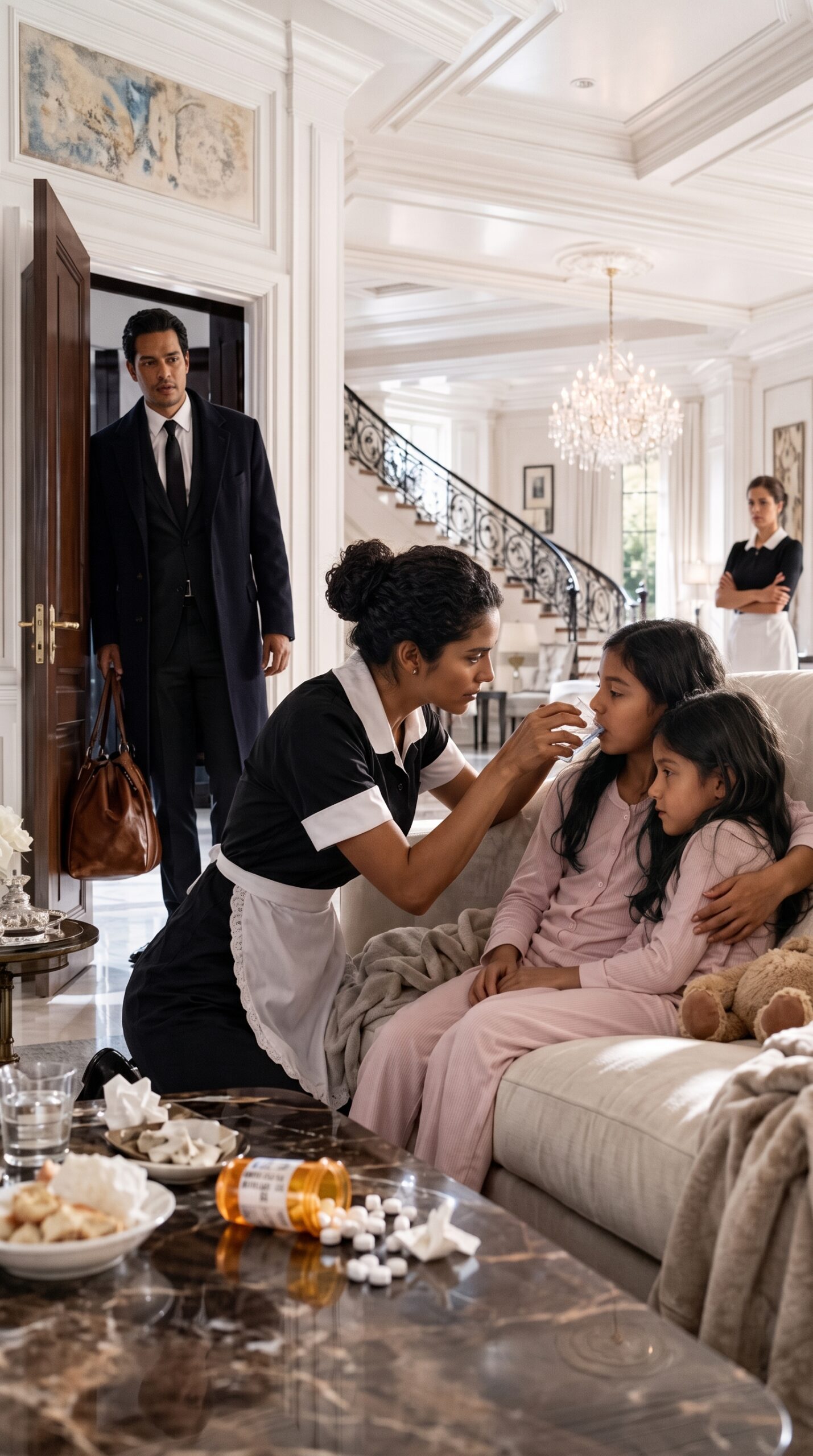
Clara, in her gray uniform with her hair tied back, approached slowly. She didn't challenge Patricia. She didn’t shout. She simply grabbed the orange juice before Sofía knocked it over with her trembling hand.
“Breathe with me, my little one. Look at my hand. 1, 2, 3, 4.”
Sofía obeyed.
Renata clung to her skirt as if the world still existed there.
Emiliano felt shame. Not rage yet. Shame.
That night, Patricia called, feigning concern.
“Everything’s perfect, love. Clara is doing her job, although every day she becomes more possessive.”
Emiliano watched the cameras.
Clara was sitting on the floor of the girls' room, softly singing the song Mariana used to sing to them before she died.
Renata slept with one hand on Clara's knee.
Sofía hugged an old rabbit, finally breathing without fear.
Then Emiliano saw Patricia enter with a yellow envelope.
She opened it in front of Clara and said something the cameras didn’t record.
But they did capture Clara turning pale.
And they recorded Renata getting up crying when Patricia pointed to the door.
That night, Emiliano understood he hadn’t pretended to leave to catch a thief.
He had pretended to leave to discover that in his own house, his daughters were being destroyed.
PART 2
The next day, Emiliano returned as if he had just landed from Chicago.
Patricia waited for him in the living room with a glass of white wine, perfect, perfumed, smiling as if she were the owner of everything that still didn’t belong to her.
“How was it, love?”
“Good,” he replied, leaving his jacket on the sofa.
“Great. Because we need to talk about Clara.”
Emiliano looked up.
Patricia placed the yellow envelope on the table.
Inside were printed photos from the security cameras. Clara entering the girls' room at night. Clara carrying Sofía down the hallway. Clara sitting next to Renata after hours.
In each photo, Patricia had written phrases in red pen.
“Emotional dependence.”
“Crossing boundaries.”
“Risk to the family.”
“Manipulation.”
Emiliano slowly flipped through the pages.
A month earlier, he might have seen what Patricia wanted him to see.
Now he saw something else.
He saw Sofía asleep after a panic attack. He saw Renata clutching a storybook. He saw Clara opening the closet where they kept the blue lamp that helped Sofía sleep.
“Do you have proof she stole something?” he asked.
Patricia blinked.
“This is more serious than stealing.”
“Do you have proof she hurt my daughters?”
“Don’t be naive, Emi. That’s how manipulation works. It looks like affection, but it’s not.”
He fell silent.
From above, a brief giggle was heard. Then Clara’s voice, soft, asking them not to run down the stairs.
Patricia pressed her lips together.
“See? They don’t even need you anymore. That woman is replacing you.”
The phrase hurt because it touched a rotten truth.
His daughters didn’t seek him first.
But not because Clara had intruded.
But because he had stepped out.
That night, Emiliano decided to stay home. He canceled a dinner with investors and went up to the girls' room before bed.
Renata looked at him as if he were a guest.
“Weren’t you in Chicago?”
“I came back early.”
Sofía hugged her rabbit.
“Is Clara leaving?”
The question came out so quickly he didn’t know how to answer.
Clara was by the nightstand, folding a blanket.
She didn’t ask for help. She didn’t look at him pleadingly. She just waited.
“No,” Emiliano finally said. “Clara isn’t leaving.”
Renata didn’t smile. She continued to watch him, as if she needed several days to believe him.
Then the hallway light flickered.
Sofía tensed up.
Emiliano turned on all the lights.
“See, nothing’s happening.”
But the little girl cried harder.
Clara crouched several steps away.
“Butterfly hand, Sofi. Inhale 4. Hold 2. Exhale 4. Here you are. Here we are.”
Sofía copied her.
Renata sat on the rug.
Emiliano stood next to the light switch, useless, with his heart in his throat.
There, he understood something truly awful: being a father wasn’t about showing up with expensive gifts when his schedule allowed.
Being a father was learning the secret language of his children's fears.
Patricia watched from the stairs.
And on her face, there was no tenderness.
There was rage.
Two days later, the storm arrived.
The rain beat against the mansion's windows as if someone wanted to break them from the outside. At 7 PM, the power went out.
Sofía screamed.
Emiliano ran upstairs, but Clara was already there, with a lamp under her chin and the two girls clinging to her.
“Listen to the rain,” she whispered. “It’s not coming for you. It’s just making noise. Like the trucks on Reforma, remember?”
Renata cried, but she breathed.
Sofía counted the numbers on her fingers.
When the lights came back on, Emiliano saw Patricia in the hallway.
She didn’t move to help.
She just watched the scene as if she were looking at an enemy winning a battle.
Later, when the girls fell asleep, Emiliano went down to the kitchen and found a notebook on the table.
On the cover, it read:
“Renata and Sofía. Routines, crises, and care.”
Below, in neat handwriting:
“So no one has to guess what they need.”
He knew he shouldn’t open it.
But he did.
There were no gossip. No complaints. No resentment.
There were dates, times, meals, nightmares, progress.
“Sofía slept with 1 light on. Cried less.”
“Renata asked about her mother’s yellow scarf. Don’t change the subject.”
“Patricia mentioned a new nanny. Both girls regressed.”
“When they miss Mariana, don’t deny it. Accompany them.”
Emiliano sat down as if the air had been taken from him.
This notebook didn’t accuse.
But every line left him bare.
Clara had been raising the broken pieces of his daughters while he signed contracts believing that money was presence.
At dawn, Clara entered through the service door and stopped when she saw him in the kitchen.
“Mr. Arriaga.”
“We need to talk.”
She looked down.
Her face became serene, that sad way people look when they expect a blow.
“After the girls have breakfast,” she said. “Not before.”
It wasn’t insolence.
It was priority.
For an hour, Emiliano watched her prepare warm milk, separate Sofía's fruit because she couldn’t stand certain textures, place the blue cup next to Renata’s plate, and explain that thunder makes noise but doesn’t command.
The girls followed her with their eyes.
They also looked at their father, as if wondering whether this man was real or just passing through.
After breakfast, Clara entered the study.
The same study where Emiliano had hidden from birthdays, illnesses, drawings, and songs.
“I want to hear your version,” he said.
Clara clenched her hands.
“With respect, sir, I’m not going to defend myself against rumors made by people who’ve never sat with Sofía when she thinks her mom is going to come back if she cries hard enough.”
Emiliano swallowed.
“But I can answer any questions about my work. I have notes, references, schedules. Whatever you need.”
She took a deep breath.
“I just want to say one thing first.”
“Go ahead.”
“If the fear of those girls is going to be used as a weapon among adults, I don’t want to be part of it. I need this job; I really do. But they need a home where loving them doesn’t feel like a crime.”
The door opened.
Patricia walked in with another envelope in hand.
“How convenient,” she said. “Just talking about emotional crimes.”
Clara didn’t respond.
Patricia threw more photographs on the desk.
“Look at her. She sits on the bed, sings Mariana’s songs, touches family things. This isn’t normal. She’s paid to clean, not to get involved in the grieving process.”
Clara paled but remained standing.
Emiliano looked at Patricia.
“Who told you I only pay her to clean?”
Patricia was silent for a moment.
“Sorry, but don’t tell me you’re saying the girl is a therapist now.”
“No. But she has done more for my daughters than several adults with names and money in this house.”
Patricia’s face changed.
She was no longer pretending to be sweet.
“She’s manipulating you.”
“No. You are.”
At that moment, the door cracked open.
Renata appeared, hugging Sofía. Behind her was Mrs. Tere, the cook, nervous.
“Sorry, sir. They heard voices.”
Renata looked at the photos.
Then she looked at Clara.
“Are you going to fire her?”
No one answered quickly enough.
Sofía started to cry silently.
That was worse.
Patricia took a step.
“My love, no one wants to hurt anyone. We’re just looking out for healthy boundaries.”
Renata frowned.
“You always use big words when you want something sad to happen.”
The phrase fell like a slap.
Emiliano knelt slowly before his daughters.
For the first time in two years, he didn’t try to appear strong.
“I'm sorry,” he said.
Sofía looked at him through tears.
“I thought giving you a safe home meant making you feel safe. I was wrong. I thought working all the time was taking care of you. But many times, I was just hiding because I missed your mom and didn’t know how to cry with you.”
Renata began to cry.
“I let them speak badly of Clara when I should have asked you what you needed. That was my fault. Not yours. Not hers.”
“Is Clara leaving?” Sofía asked.
Emiliano looked at Clara.
Clara didn’t save him. She let him answer as a father.
“No. Clara isn’t leaving. And no one is going to use your fear to decide things behind your backs.”
Sofía ran to hug Clara.
Renata hesitated.
Then she approached Emiliano and rested her forehead on his shoulder.
He didn’t squeeze her. He didn’t force her to forgive him.
He just stood still, allowing his daughter to decide how close it was safe to be.
Patricia let out a cold laugh.
“What a lovely performance. Now does the servant also sit at the table?”
Clara flinched.
Just for a second.
But Emiliano saw it.
And then the rage rose cleanly, late but necessary.
“You’re leaving this house today.”
Patricia’s eyes widened.
“Excuse me?”
“Pack your things. My lawyer will talk to you. You will no longer speak to my daughters. You will no longer speak to Clara. And you will not disguise your contempt as concern in my house.”
“You’re making a mistake.”
“I’ve made many,” Emiliano said. “This one isn’t.”
Patricia looked at the girls, hoping to see confusion.
But Sofía was breathing on Clara’s shoulder.
Renata was still with her father.
And the truth was too simple to argue.
Patricia left without screaming.
People like her don’t give the gift of scandals when they lose. They just walk away in high heels, as if dignity could be faked to the door.
That afternoon, Emiliano gathered the staff in the kitchen.
Clara felt uncomfortable next to the cupboard.
Mrs. Tere was crying silently.
The chauffeur, the gardener, and the cleaning lady listened with their heads down.
“I allowed suspicion to grow in this house without evidence,” Emiliano said. “That ends today. Clara Mendoza has my trust and my respect. And no one here is worth less because someone has more money.”
Clara turned red.
“If there’s a problem, let’s talk about it directly. No traps. No gossip. No humiliating anyone.”
Renata and Sofía listened from the stairs.
They didn’t understand everything.
But they understood that their father had said Clara’s name with respect in front of everyone.
That night, the routine changed.
Not like in a movie.
Healing doesn’t come with music and applause.
Sofía still asked for the blue lamp. Renata still asked if her mom could see them from heaven or if heaven was too far away.
Clara sat close to the bed.
But Emiliano didn’t stay at the door.
He sat on the floor.
The girls looked at him strangely, as if they didn’t know what to do with a dad without a cellphone in his hand.
Renata asked for Mariana’s song.
The room fell still.
For two years, Emiliano had avoided that song.
Clara had sung it because the girls needed it, but he treated that melody like a closed room.
Now he started.
He sang poorly. His voice cracked. He forgot a word.
Clara said it softly.
The girls didn’t mock him.
They listened as if that imperfection was proof that he was finally there.
When he finished, Sofía took two fingers from his hand.
Renata fell asleep looking at him, not at the wall.
In the hallway, Emiliano said to Clara:
“I don’t know how to fix what I did.”
“It doesn’t get fixed with one apology,” she replied. “Safety is repaired by being predictable.”
He nodded.
“They don’t need a hero, sir. They need adults who won’t abandon them from within.”
From then on, Emiliano changed without announcement.
He reduced trips. He rescheduled meetings. He placed his cellphone in a wooden plate during dinner.
He learned that Sofía drank more water from the blue cup and that Renata shut down when someone said, “Get over it.”
Clara remained Clara.
She didn’t become the lady of the house. She didn’t want to take Mariana’s place.
She accepted a new contract, better salary, health insurance, and a real position: family care coordinator.
But she continued wearing old sneakers because she said expensive shoes didn’t work when a child spilled juice in the middle of a crisis.
Weeks later, Emiliano took a box of photos from Mariana.
He had kept it sealed with tape since the funeral.
The girls sat on the rug.
Clara brought hot chocolate and wanted to go back to the kitchen.
“Stay,” Renata said.
Clara froze.
Emiliano looked at her.
“Please.”
So they opened the box together.
Mariana laughing on the beach in Veracruz.
Mariana holding the newborn girls.
Mariana dancing barefoot in the kitchen while Emiliano looked at her like a man who still didn’t know that the future also steals.
Renata cried first.
Sofía followed.
Emiliano did too.
Clara didn’t intrude on that pain.
Nor did she flee.
That was her gift: not taking ownership of what wasn’t hers, but making the room safe enough for others to feel.
Months later, a drawing appeared on the refrigerator.
There were four people holding hands in front of the house: Emiliano, Renata, Sofía, and Clara.
Above, among clouds and yellow butterflies, was Mariana.
“Mom is in the part of heaven,” Sofía explained.
“And Clara is in the part of the house,” Renata said. “Because she stays.”
Emiliano took a marker and wrote the date in one corner.
Below, he wrote five words:
“We care for each other.”
People kept talking.
That the millionaire had been manipulated by the housekeeper.
That Patricia was too refined for that house.
That a man with money shouldn’t let a domestic worker have so much importance.
Emiliano never responded to those rumors.
He responded where it mattered.
In the breakfasts without shouting.
In the nights when Sofía called and someone went.
At the school festival, when Renata searched the audience and found him before singing.
Clara was two seats away, with her hands on her lap.
Emiliano looked at her once.
Not with romance.
Not with possession.
With respect.
With the bitter certainty that the woman who had almost been thrown out had cared for the most sacred part of his life while he had been too broken to see it.
Because pretending to leave for Chicago didn’t destroy his family.
It destroyed the lie that his family was fine.
And sometimes, only when a lie breaks, a house starts to become a home.