PART 1
Alejandro Altamirano arrived at the Santa Esperanza Orphanage with a check for $1,000,000 and a rehearsed smile in the mirror of his armored truck.
He wasn't there out of kindness.
He was there for a photo.
His real estate company, Grupo Altamirano, had been under fire on social media for months because a luxury project in Doctores had displaced families who had lived there for 40 years.
The newspapers dubbed him "the king of empty towers."
His partners were nervous.
His mom, Doña Regina, had told him over breakfast:
—People forgive everything, son, if they see you hugging poor children.
Alejandro didn't respond.
He merely adjusted his navy blue blazer, took the envelope with the check, and stepped down in front of the chipped green gate of the orphanage, on a quiet street in Coyoacán.
There were cameras.
There were reporters.
There were children lined up in clean t-shirts with shy smiles.
The director, Mother Teresa, greeted him with a calmness that didn't seem impressed by his expensive watch or the chauffeur waiting outside.
—Thank you for coming, Mr. Altamirano. Your support will help us a lot.
Alejandro smiled like men do when everything is a negotiation.
—It’s an honor for me.
But it sounded hollow.
They took him to tour the dormitories, the kitchen, the courtyard where tomatoes and mint grew in recycled paint cans.
Alejandro calculated roofs, pipes, costs.
His mind turned poverty into budget.
Until he entered the playroom.
There were kids running, others assembling puzzles, and two siblings fighting over a plastic ball.
But he only saw one girl.
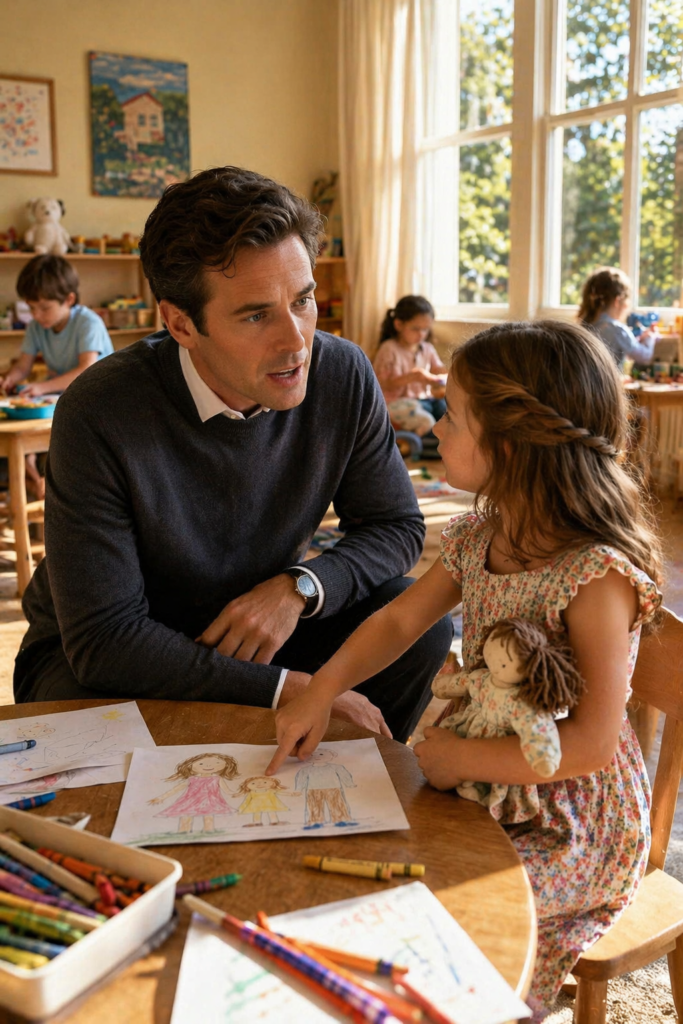
She sat at a corner table, crayons scattered around her, a sheet of paper in front of her.
She had light brown, wavy hair falling over her shoulders.
Her face was serious, as if drawing a house was a vital mission.
When she looked up, Alejandro felt the ground shift beneath him.
Those green eyes.
That tilt of her head.
That way of pressing her lips together when she focused.
Julia.
For eight years, Alejandro had avoided saying that name.
Julia Márquez, the architect who argued with him over every project, who said buildings should hold memories, not crush lives.
The woman who one night left his apartment in Polanco crying because he told her he couldn't halt his future for "an emotional drama."
The woman who vanished after three calls he never answered.
—Who is she? —Alejandro asked, not taking his eyes off her.
Mother Teresa lowered her voice.
—Her name is Isabella. She's seven years old. She came here two years ago, after her mom passed away in an accident.
Alejandro felt a blow to the chest.
—Her mom?
—Julia Márquez.
The envelope with the check nearly slipped from his grasp.
Alejandro walked toward the girl as if approaching a truth that could destroy him.
He knelt beside her.
—Hi, Isabella. What a beautiful drawing.
The girl looked at him warily.
—It’s my house.
—Who lives there?
She pointed to three figures.
—Me, my mom... and my dad. But I haven’t found him yet.
Alejandro swallowed hard.
Next to the paper was an old doll, with yarn hair and a patched dress.
—What’s your doll's name?
The girl hugged it to her chest.
—Julia. Just like my mom.
Then Isabella looked at Alejandro's face, furrowed her brow as if she had just recognized something impossible, and said a line that froze his blood:
—My mom had a picture of you hidden in a box.
PART 2
Mother Teresa asked the reporters to leave the room.
Alejandro didn't even see them go.
The girl continued to stare at him with that mix of fear and hope only children who have learned not to trust too quickly possess.
—A picture of me? —he asked, almost breathless.
Isabella nodded.
—My mom said it was of a prince in a suit. But then she cried and put the box away.
Alejandro had to lean a hand on the table.
In his world, nothing could bring him down.
Not lawsuits.
Not furious partners.
Not million-dollar losses.
But a seven-year-old girl, with a broken doll and the eyes of the woman he had loved, had just shattered him.
Mother Teresa took him to her office.
She pulled out an old brown folder, with Isabella's name written by hand.
—I can’t give you documents without legal process —she said—, but I can tell you the basics. The mother was Julia Márquez. The father is listed as unregistered.
—I need a DNA test.
The mother watched him carefully.
—Do you think Isabella is your daughter?
Alejandro closed his eyes.
He remembered the last night with Julia.
He remembered her trembling, her red eyes as she said:
—Alejandro, I need to talk to you about something serious.
He had replied, looking at his phone:
—Tomorrow. I can’t handle more pressure today.
Then they argued.
He was cruel.
She left.
And the next day, out of pride, he didn’t answer.
—I think I was a coward —he said—. And my daughter paid for it.
That same day he called his lawyer, Esteban Rojas.
Not his communications director.
Not his partners.
Not his mom.
The lawyer.
—I need to start a paternity and custody claim —he ordered.
—Custody of whom?
Alejandro looked out the hallway window.
Isabella had returned to her table.
Now she was drawing a tall man next to the house.
—Of my daughter.
For the first time in years, that word didn’t sound like a distant idea.
It sounded like a debt.
The test would take 48 hours.
Alejandro wanted to pay to speed everything up.
The lab explained that it wasn’t a matter of money.
That humiliated him in a necessary way.
He had built half of Mexico City believing everything could be solved with a transfer.
But lost time took no bribes.
The next day he returned to the orphanage without cameras.
He brought drawing books, colors, jackets, shoes, toys.
Mother Teresa stopped him at the door.
—Don’t try to buy her heart.
Alejandro stood still.
—I don’t know how to approach her.
—Start by sitting down. Listen. Don’t promise what you can’t yet fulfill.
So he did.
He sat in the courtyard, on a concrete bench, with his expensive suit wrinkling under the sun.
Isabella was drawing castles.
She explained that princesses didn’t need to be rescued, but they did deserve big windows and breakfasts with sweet bread.
—And the king? —Alejandro asked.
—The king doesn’t command much. The king arrives when he says he will.
That phrase hurt more than any insult on social media.
For several days, Alejandro returned.
Sometimes they played bingo.
Sometimes he read stories.
Sometimes he just watched her color in silence.
Isabella began to wait for him near the gate, pretending to be casually there.
On the fourth day, she ran toward him.
—Alejandro!
He knelt to receive her carefully.
The hug was small, awkward, and real.
That night, in his penthouse in Reforma, Alejandro opened a box he hadn’t touched in eight years.
Inside were letters from Julia.
Photographs.
A red scarf.
A blueprint she had drawn on a napkin.
And at the bottom, a sealed envelope.
He didn’t remember seeing it.
It had his name written in Julia’s handwriting.
Alejandro opened it with trembling hands.
The letter said she was pregnant.
That she didn’t want money.
That she only wanted to talk.
That if he decided not to be there, she wouldn’t beg him, but their child deserved to know the truth someday.
At the end was a phrase:
“If your mom gives you this letter, it means there’s still hope that you won’t become the cold man you’re turning into.”
Alejandro felt nauseous.
That letter had been in his house.
But he never received it.
It went straight to Doña Regina's residence in Las Lomas.
He found her having coffee in a silk robe, as if the world still obeyed her.
He placed the letter on the table.
—Did you hide it?
Doña Regina didn’t pretend to be surprised.
She just sighed.
—that girl was going to ruin you.
—She was pregnant.
—She said she was.
—She is my daughter.
The cup clashed against the plate.
—What did you say?
—The girl exists. She’s seven years old. Her name is Isabella.
Doña Regina paled, but her pride reacted first.
—You don’t know if she’s yours.
—In two days, I will.
—Alejandro, for God’s sake, think. An orphanage girl, a dead mother, a scandal just when the company needs stability. Are you going to put your name and fortune in the hands of a sad story?
He looked at her as if he were seeing her for the first time.
—It’s not a sad story. It’s my daughter.
—Your fiancée won't accept this.
Alejandro let out a dry laugh.
—Claudia can leave.
—Are you going to lose everything for a girl you don’t even know?
—No. I'm going to lose whatever is necessary for the girl I should have known since she was born.
The argument exploded that night.
Claudia, his fiancée, arrived furious at the penthouse.
She already knew everything because Doña Regina had called her.
—Are you really going to bring that girl into this house? —she demanded—. An orphan? And what will happen when the media finds out?
—She’s not "that girl." She’s Isabella.
—You still don’t know if she’s yours.
Alejandro pulled out a photo of Julia.
—She has her eyes. She has my dimple. She’s seven years old. And her mom tried to warn me before my mom buried the letter.
Claudia crossed her arms.
—We can handle it. You recognize her, pay for school, a house, a tutor. But you don’t have to change your life.
He realized then that Claudia wasn’t bad for shouting.
She was worse.
She was practical.
Just like he had been.
—My daughter is not going to be a monthly expense.
—And what about our wedding?
—Canceled.
Claudia fell silent.
—Excuse me?
—I’m not going to marry someone who thinks a broken girl can be fixed with money away from the family table.
Claudia cried, screamed, called him impulsive.
Doña Regina threatened to move to the company board.
But Alejandro was no longer negotiating.
At dawn, the results arrived.
Probability of paternity: 99.99%.
Esteban, the lawyer, put a hand on his shoulder.
—Congratulations.
Alejandro read the paper three times.
The first as proof.
The second as a condemnation.
The third as a father.
That day he went to Santa Esperanza.
He found Isabella in the courtyard, holding Julia the doll in her arms.
He sat beside her.
—I need to tell you something important.
She looked at him seriously.
—Are you leaving?
The question pierced him.
—No. On the contrary.
Alejandro took a deep breath.
—The test said you and I are family.
Isabella’s eyes widened.
—Family how?
—I’m your dad.
The girl didn’t move.
It seemed that if she breathed too hard, the news could shatter.
—Really?
—Really.
—My dad, really?
—Yes, my love.
Then Isabella dropped the doll and threw herself into his arms.
She cried with a sound that didn’t seem like a girl’s but like all the years she had waited.
—I knew it —she repeated—. I knew someone would come.
Alejandro hugged her, not caring that Mother Teresa was crying at the door.
—Forgive me —he whispered—. Forgive me for taking so long.
—My mom said that even grown-ups get lost —Isabella said against his chest—. Were you lost?
Alejandro closed his eyes.
—Very much.
The legal process wasn’t easy.
Doña Regina tried to intervene with lawyers, claiming Alejandro was "emotionally unstable."
Claudia leaked rumors to a gossip magazine, suggesting a family from the orphanage was seeking money.
The story went viral.
“Millionaire recognizes orphan girl just amid image crisis.”
“Fatherly love or public relations strategy?”
Mexico had opinions without knowing.
Some said Alejandro was an opportunist.
Others said no girl should be exposed.
But no one expected what happened in the family hearing.
Mother Teresa presented records of Julia.
Esteban presented the DNA test.
And Alejandro presented the letter hidden for eight years.
Doña Regina, sitting in the back, looked down when the judge read the end.
—Mrs. Regina —the judge said—, did you withhold information about a pregnancy?
The woman tried to justify herself.
—I was protecting my son.
Alejandro stood up.
—No. You were protecting your name.
The room fell silent.
Isabella, in a yellow dress with Julia the doll in her hands, looked at the judge.
—I don’t want to take anything from anyone —she said softly—. I just want to live with my dad. Because when he is with me, he does come back.
The judge took off her glasses.
Even Esteban had to look down.
After reviewing the socioeconomic study, the new house, the school plan, grief therapy, and Alejandro’s formal commitment, she granted permanent custody.
Isabella didn’t scream.
She only asked:
—Can I go home now?
Alejandro cried in front of everyone.
In front of his mom.
In front of the lawyers.
In front of a judge.
In front of the man he had been.
—Yes, daughter. We’re going home now.
He didn’t take her to the cold penthouse in Reforma.
He bought a house in San Ángel, with bougainvillea at the entrance, a patio with trees, and a room with a big window.
He decorated it with bookshelves, a desk for drawing, a special shelf for Julia the doll, and a whole wall for pinning drawings.
When Isabella entered, she stood frozen.
—Is all this mine?
—All of it.
—Even if I make a mess?
Alejandro smiled.
—Especially if you make a mess.
That first night they had noodle soup and poorly folded quesadillas.
Alejandro burned two tortillas.
Isabella taught him how to flip them.
—My mom said no one should brag if they can’t make a quesadilla.
—Your mom was right about many things.
Before sleeping, Isabella asked him the question he feared the most.
—Did my mom know you were my dad?
Alejandro sat on the edge of the bed.
—Yes.
—And why didn’t you come?
He didn’t hide.
—Because I was proud. Because I didn’t listen. Because someone hid a letter from me, but also because I should have looked for it. I should have answered. I should have come back.
Isabella hugged her doll.
—Are you mad at my mom?
—No. I’m sad about what we lost. But I’m not mad. She loved you. And I will help you remember her.
The girl thought for a moment.
—Then she also lives here.
Alejandro felt his heart breaking and mending at the same time.
—Yes. Her memory lives here too.
The following months weren’t perfect.
They were real.
Alejandro learned that being a father meant waking up early, making lunch, checking homework, going to school meetings, learning impossible hairstyles, and not getting mad when a girl asked the same thing four times just to ensure the answer remained.
He resigned from the operational presidency of Grupo Altamirano and remained as a principal partner.
His advisors called him crazy.
His mom stopped talking to him for three months.
Claudia married another businessman before the year ended.
But Alejandro discovered something no building had ever given him.
Peace.
Fridays became father-daughter days.
They went to Chapultepec, to Papalote, to the Cineteca, to eat churros in Coyoacán.
Isabella always carried a notebook.
She drew houses.
But she no longer drew her dad as an empty silhouette.
She drew him with crooked glasses, messy hair, and a huge smile.
A year later, Alejandro returned to Santa Esperanza.
Not with cameras.
With Isabella.
Together they announced a foundation to seek families, pay for lawyers, therapy, and education for children without support.
They called it “Hearts That Return.”
Doña Regina appeared that day.
Thinner.
Older.
Less sure.
She asked to speak with Isabella.
Alejandro wanted to refuse, but the girl looked at him.
—It’s okay, Dad. You stay here.
Doña Regina knelt in front of her.
—Forgive me. I did something very wrong before you were born.
Isabella looked at her with a maturity that hurt.
—You didn’t just do it to me. You did it to my mom and my dad.
The woman began to cry.
—I know.
—Then don’t ask me to forget quickly. Children are not erasers.
Alejandro felt pride and sadness at the same time.
Isabella took her doll Julia and added:
—But my mom said that old houses can be repaired if you don’t hide the cracks.
Regina nodded, destroyed.
That was the beginning of a slow, uncomfortable reconciliation, without applause.
Because not all forgiveness is an immediate embrace.
Sometimes forgiveness starts with a chair on the other side of the patio and an adult learning not to demand affection as if it were a right.
Years later, when people told the story, they always chose the most dramatic part.
The millionaire went to an orphanage for a photo.
He saw a girl with the eyes of his lost love.
The doll was named Julia.
The DNA test confirmed everything.
But the strongest truth came later.
When the cameras turned off.
When Alejandro had to explain his mistakes.
When Isabella cried for her mom.
When a grandmother had to accept that protecting a name can destroy a family.
And when a man who only knew how to build towers understood that the most important home of his life wasn’t made of concrete or glass.
It was sitting on a bed, hugging an old doll, asking every night:
—Dad, are you coming back tomorrow?
And he always answered the same:
—Tomorrow, the day after, and every day that I have left.