PART 1
Alejandro Montes was one of those men who graced business magazines, clad in a sharp suit, with a cold gaze and a smile that no one could tell was genuine or merely obligatory.
In Mexico City, they called him “the king of Polanco.” He owned buildings, construction companies, restaurants, had connections in the government, and a massive mansion in Lomas de Chapultepec where silence reigned.
No music.
No laughter.
No family.
For five years, Alejandro lived as if he breathed out of mere habit.
His wife, Mariana, had died one rainy dawn in a private hospital in Santa Fe after a complicated delivery. She had been expecting four babies, four little boys who came as a miracle after years of treatments, prayers, and tears.
But that same night, he was told the children hadn’t survived either.
Alejandro never saw them.
His mother, Doña Regina Montes, had taken his hand in the hospital corridor and told him firmly:
—Don’t look at them, son. They’re too damaged. Keep the image of your little angels.
He was so broken that he obeyed.
There were four white coffins, four floral arrangements, four names engraved on small plaques. Alejandro knelt before them and felt life slip away with every shovel of dirt.
Since then, he had closed off the children's wing of the mansion.
The room that Mariana had decorated with wooden cribs, blue blankets, and star mobiles was now covered with white sheets. No one entered. No one spoke of it.
Doña Regina took care of everything.
The paperwork.
The funeral.
The doctors.
Silencing questions.
And Alejandro, turned into a ghost with a chauffeur, whiskey, and endless meetings, allowed silence to swallow the house.
Until an ordinary Tuesday.
An investor meeting was canceled. His flight to Monterrey was delayed. Alejandro decided to return home three hours early to pick up a forgotten folder.
He didn’t notify anyone.
He had no reason to.
The mansion was always the same: clean, cold, mute.
But as he crossed the foyer, he heard something impossible.
A spoon clinking against porcelain.
A whisper.
Then a small, quick laugh, like that of a child who knows they shouldn’t make noise.
Alejandro froze.
The sound came from the main dining room, that place where Mariana used to host dinners and where no one had sat for five years.
He walked slowly.
Each step tightened his chest.
As he reached the door, he saw something that took his breath away.
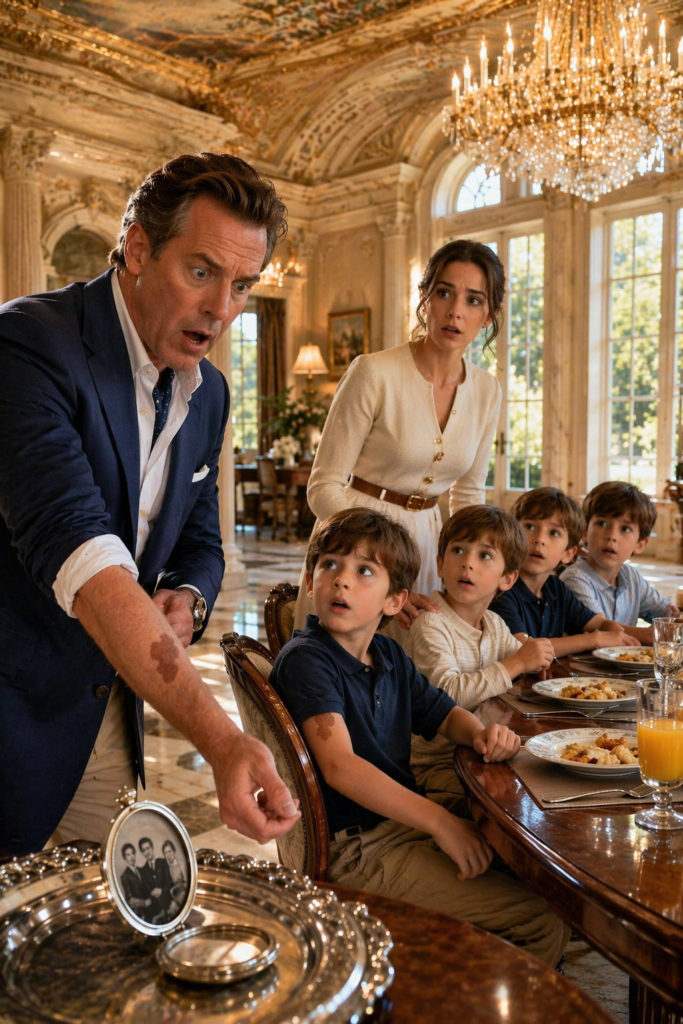
At the long walnut table, the same table where businessmen, politicians, and aristocratic families had once gathered, there were four skinny children eating yellow rice from plates bearing the Montes crest.
They wore old clothes, oversized sweaters, tight pants with shoelaces. Their little faces were clean, but their arms were too thin.
And beside them was Lucía, a young domestic worker whom Alejandro barely acknowledged in the mornings.
She served the rice carefully, as if she were giving away treasure.
—Slowly, my children —she whispered—. Today, there’s enough for everyone.
Alejandro stepped onto the wooden floor.
Lucía turned.
She turned pale.
The four children stopped eating simultaneously.
One hid behind her. Another clutched a piece of bread to his chest as if someone might snatch it away.
—Sir… —Lucía said, trembling.
Alejandro looked at the plates.
Then at the children.
Then at their clothes.
—What the hell is going on in my house?
Lucía stood in front of them.
—They were hungry.
—And that’s why you brought them into my dining room?
—They did nothing wrong.
Alejandro was about to shout, but one of the children lifted his face.
A smile barely curled at the corner of his mouth.
Alejandro felt the ground shift beneath him.
That smile didn’t belong to a stranger.
It was his.
Then he noticed the brown mole under the elbow of the oldest boy. An irregular mole, almost identical to the one he had carried since childhood, one that his father had also had.
Alejandro rolled up his sleeves with trembling hands.
The same mole.
The same place.
The same shape.
—Tell me the truth —he pleaded, his voice shattered.
Lucía began to cry.
She pulled a cheap chain from around her neck. From it hung an old, battered silver locket, unmistakable.
Alejandro opened it.
Inside was a tiny photo of him and Mariana on their wedding day.
That locket had been unique.
He had commissioned it himself.
Lucía looked him in the eye and said the phrase that shattered five years of lies:
—They are your children, sir. All four are alive.
PART 2
Alejandro fell to his knees without realizing it.
The dining room, the table, the rice, the children, everything seemed to spin around him.
—No… —he murmured—. It can't be. I buried them. I saw their coffins.
Lucía wiped her tears with the back of her hand.
—You saw closed boxes, sir. You never saw your children.
The phrase pierced him like a knife.
Because it was true.
He had never held them.
He had never kissed their foreheads.
He had never touched their hands.
He had only cried in front of four white coffins that his mother had chosen, paid for, and sealed.
The boy with the mole looked at him with a seriousness far too great for his age.
—What’s your name? —Alejandro asked, almost voiceless.
The little one looked at Lucía before answering.
—Mateo.
The other three shrank back even more.
Lucía quietly named them.
—This is Santiago. This is Emiliano. And the smallest is Nico.
Alejandro closed his eyes.
Mariana had chosen those names.
He had them written in a blue notebook next to the main crib.
—Where did you find them? —he asked.
Lucía swallowed hard.
—Seven months ago, I was late coming home from work. I was at the back of a restaurant in Roma Norte, near where you sometimes dine with your partners. It was pouring rain. I heard crying in an alley.
Alejandro clenched the locket in his fist.
—I thought it was a cat. But it was them. They were inside a trash bin, soaked and shivering. Mateo was trying to break off a piece of hard bread to give to his brothers. Nico was so weak he couldn’t even cry.
Alejandro's face broke.
—My children were in the trash...
Lucía nodded, crying.
—I took them to my service room. I gave them soup, bathed them, dressed them in clothes I found among old things. At first, they didn’t speak. They were scared to ask for water. They were scared to sleep with the light off.
—Why didn’t you come to find me?
Lucía let out a bitter laugh.
—And who would believe me? A maid telling the owner of half the city that his dead children were alive? Seriously, sir, your own people would have kicked me out before you heard a word.
Alejandro wanted to deny it.
But he couldn’t.
The mansion wasn’t a home. It was a fortress filled with employees obeying orders, cameras, administrators, and lawyers who protected the Montes name above any truth.
Mateo took a timid step toward Alejandro.
—Are you our dad?
The question shattered him.
Alejandro extended his hand, but didn’t touch him. He didn’t want to scare him.
—Yes —he said—. I am your dad.
The boy frowned.
—But dads don’t come back.
Alejandro didn’t know how to respond.
Because for those children, the word “dad” didn’t mean protection. It meant absence.
Then, outside, the sound of tires screeched.
The front door swung open with force.
Heels on marble.
Lucía stiffened.
The four children went pale.
Nico crawled under the table and whispered:
—She can’t… she can’t…
Alejandro slowly turned.
Doña Regina Montes appeared in the doorway of the dining room, dressed in a pearl-colored suit, emerald necklace, and the perfect face of a woman used to commanding.
But upon seeing the children, her expression froze.
It wasn’t surprise.
It was fear.
—Alejandro —she said quickly—. Son, listen to me before you do something stupid.
He stood up slowly.
—Did you know?
Regina looked at Lucía with contempt.
—This girl is manipulating you. They’re street kids. Look at how they’re dressed.
—They have my family’s mole.
—Coincidence.
—They have the names Mariana chose.
Regina clenched her jaw.
—Lucía could have heard them in the house.
Alejandro lifted the locket.
—They have this.
For the first time, Doña Regina didn’t respond.
That silence was the most horrible confession.
Alejandro took a step toward her.
—Who helped you?
—Lower your voice.
—Who helped you steal my children?
Regina took a deep breath, as if she still believed she could control the scene.
—I didn’t steal anything from you. I saved you.
Lucía let out a sound of horror.
Alejandro froze.
—You saved me?
—They were four premature, weak, sickly babies. Mariana died from that absurd delivery. You were shattered, but you were still young. You could rebuild your life, marry someone of your status, have healthy heirs.
Alejandro looked at her as if he had never seen her before.
—They were my children.
—They were a burden.
Mateo hugged Santiago.
Emiliano began to cry silently.
Nico remained under the table, covering his ears.
—Where were they? —Alejandro asked.
Regina raised her chin.
—In a safe place.
—Don’t lie to me anymore.
—A house near the border. Paid for. Away from the press. Away from you. Away from scandal.
Lucía stepped forward.
—Safe? Is that how you call it when a child hides bread under their pillow because they think they won’t eat tomorrow?
Regina shot her a deadly glare.
—Shut up. You’re nobody.
Alejandro positioned himself between them.
—She did what you never did. She protected them.
Regina let out a dry laugh.
—Protect them? She brought them in like rats to my house.
—This is not your house.
Regina’s face changed.
—Excuse me?
—The house is mine. The company is mine. And those children are mine.
—I made you who you are.
—No. You buried four empty boxes and left me to die in front of them.
Doña Regina lost control.
She lunged at Lucía and grabbed her arm.
—Say you lied. Say you brought them to get money. Say they’re street trash.
Santiago screamed.
Mateo ran to defend Lucía and pushed his grandmother with his frail little hands.
Regina reacted with a slap.
The sound was sharp.
Mateo fell against a chair.
A trickle of blood appeared on his lip.
The dining room fell silent.
Alejandro saw his son on the floor.
And something inside him, something that had been dead for five years, awakened with fury.
He didn’t raise his hand against his mother.
He wouldn’t allow himself to become another monster in front of his children.
But he grabbed Regina by the arm and dragged her to the foyer.
—Security —he ordered.
Two guards appeared, confused.
—Get this lady out of my house.
Regina shouted:
—I’m your mother!
Alejandro looked at her without blinking.
—My mother died the day she decided my children didn’t deserve to live.
—You’ll regret this!
—No. I will regret for the rest of my life believing you.
The door slammed behind her with a bang that made the stained glass tremble.
Alejandro returned to the dining room.
Lucía was kneeling beside Mateo, cleaning his lip with a napkin. The other three children were huddled against her, like frightened chicks.
Alejandro approached slowly.
He knelt before them.
—No one will touch you again. Not her. Not anyone.
The children didn’t believe him.
He saw it in their eyes.
And he understood that a promise doesn’t erase five years of abandonment, hunger, and fear.
He had to become proof.
That very night, he opened the children’s wing.
When he removed the sheets from the cribs, he found intact the world Mariana had prepared: four small beds, four teddy bears, four embroidered blankets, four names written in wood.
Lucía took the children to the bathroom.
Alejandro saw the marks on their bodies.
He didn’t need to ask much.
Old scars.
Ankles marked as if they had been tied.
Shoulders too bony.
Eyes that dimmed whenever a door slammed.
He gripped the sink until his knuckles turned white.
Lucía looked at him.
—Not now, sir. Don’t go into a rage. They need you to be here.
She was right.
Alejandro rolled up his expensive shirt and sat on the bathroom floor.
—Can I help?
Lucía handed him a sponge.
—Be careful. Nico is afraid of soap.
Alejandro washed the back of his youngest son with a tenderness so clumsy that Lucía had to look away to avoid crying.
For the first time in five years, laughter echoed in that house.
Small.
Fragile.
But real.
Later, they had soup, shredded chicken, fruit, and warm milk in the big bed because the children were afraid to return to the dining room.
They ate quickly, as if the food might disappear.
Nico hid half a roll under the pillow.
Alejandro saw him.
—Why are you doing that, champ?
The boy froze.
—In case there isn’t any.
Alejandro felt his heart break.
He sat in front of him.
—Tomorrow there will be breakfast. Then lunch. Then dinner. The day after tomorrow too. In this house, you’ll never have to hide bread.
Nico looked at him distrustfully.
Then, very slowly, he pulled out the roll and took a bite.
That bite was more powerful than any contract Alejandro had ever signed in his life.
At dawn, the war began.
Doña Regina hired lawyers. She called journalists. She claimed her son was deranged. Accused Lucía of kidnapping poor children to keep the Montes fortune.
But Alejandro responded with proof.
The locket.
The names.
The moles.
Reopened medical records.
Secret payments to a clandestine house near Reynosa.
Testimonies from retired nurses.
And finally, a DNA test.
When the envelope arrived, Alejandro opened it alone in his study.
The paternity probability was 99.9999%.
He already knew.
But seeing the number made the five stolen years impossible to deny.
Mateo.
Santiago.
Emiliano.
Nico.
His children.
Alive.
Hungry.
Hiding.
While he slept surrounded by marble and security.
He didn’t return to the company for weeks.
The partners were worried.
The press invented rumors.
But Alejandro no longer lived to demonstrate coldness.
He learned that Mateo stayed awake watching over his brothers.
That Santiago talked a lot when he was scared.
That Emiliano couldn’t stand loud noises.
That Nico laughed loudly only when Lucía was near.
He learned that being a father wasn’t about a DNA test.
It was sitting on the floor during a nightmare.
It was repeating “you’re safe” until he was hoarse.
It was not being offended when his children called Lucía “Mama Lu” and him “Mr. Alejandro.”
The first time Mateo called him “Dad” was by accident.
Alejandro was teaching him how to tie his shoelaces before going to therapy.
Mateo made a crooked knot and smiled.
—I did it, Dad.
As soon as he said it, he turned pale, as if expecting a scolding.
Alejandro knelt in front of him.
—Yes, son. You did it.
Mateo hugged him.
Not tightly.
Not confidently yet.
But enough for Alejandro to understand that life was giving him a second chance he didn’t deserve.
Months later, a judge legally recognized the identity of the four children and removed Regina’s right to approach them.
The clandestine house was investigated.
Doctors lost their licenses.
Employees were arrested.
Regina lost her social circle, her privileges, and the only power she truly loved: deciding over other people's lives.
Alejandro didn’t celebrate.
Some injustices are too painful to celebrate.
At the final hearing, when the judge mentioned that Lucía had saved the children, Alejandro stood up and said before everyone:
—She is not an employee. She is family.
Lucía lowered her gaze, overwhelmed.
But the four children ran to hug her.
And in that embrace, it became clearer than in any document.
Two years later, the mansion in Lomas no longer resembled a museum.
There were drawings stuck to the walls.
Toy cars under the piano.
Juice spilled on expensive carpets.
Small shoes at the entrance.
Shouts, laughter, toy disputes, and questions before bed.
The dining room was used again.
Not to impress businessmen.
But to have pancakes, fruit, eggs with ham, and sweet bread on Sundays.
Sometimes Nico still hid food.
Sometimes Emiliano cried if a door slammed too hard.
Sometimes Mateo stood between his brothers and any unknown adult.
But fear no longer ruled.
Love made more noise.
Alejandro stepped down from the daily presidency of the company and appointed a professional team. The city said he was crazy.
He preferred to take his children to school.
One night, after watching a movie, the four children fell asleep together in the living room.
Lucía was picking up blankets when Alejandro called her to the balcony.
The city sparkled below, distant.
—I used to think money could fix everything —he said.
Lucía smiled sadly.
—And now?
—Now I know that money only shows who stays when there are no masks left.
She didn’t respond.
Alejandro looked at her with a clarity he hadn’t had before.
—You didn’t just save my children. You saved me with them.
Lucía shook her head.
—I just did what was right.
—No. Many people saw something wrong and turned away. You saw four children in the trash and decided to carry a truth that could destroy you.
He took a breath.
—Stay. Not as an employee. Not out of obligation. Not because they need you, though they do need you. Stay because this is your home too. Because I love you. Because everything I have left in life began the day you didn’t abandon them.
Lucía cried silently.
She looked out the window at the sleeping children.
Then turned back to him.
—Yes.
The wedding was small.
No press.
No politicians.
No gossiping guests.
Just the children, a few sincere friends, and a table with Mariana's photo next to the silver locket.
Alejandro didn’t erase his dead wife.
He honored her.
Because without her love, that house would never have had a second chance.
When Lucía became Alejandro’s wife, Santiago shouted:
—Now Mama Lu is an official mom!
Emiliano corrected him:
—She was already a mom before, dude.
Everyone laughed.
Even Alejandro.
And somewhere, far from that table full of life, Regina remained alive but unable to touch what she had wanted to erase.
That was her greatest punishment.
To see that the four children she had sent to disappear grew up.
That the son she thought she could control awakened.
That the girl she called “nobody” ended up taking the most sacred place in the family.
Years later, people still told the story of the millionaire who arrived early and found four children eating rice in his dining room.
But the real story wasn’t about money.
It was about four children who survived abandonment.
About a humble woman who chose not to look away.
And about a father who learned too late that blood can be hidden, papers can be forged, and coffins can be closed.
But when a hungry child sits in front of you with your same smile, the truth always finds a way to come home.