PART 1
Alejandro Larios thought he knew exactly what a desperate woman would do if someone handed her a limitless card.
He was dead wrong.
At 37, Alejandro was the CEO of Larios Laboratories, one of the most powerful pharmaceutical companies in Mexico. He lived in a penthouse in Polanco, traveled by private jet, and his last name opened doors before he even knocked.
But he also carried an idea planted in his mind since childhood.
His father, Don Octavio Larios, had repeated it like a law:
—Poor people don’t want help; they want to take advantage. You give them a little and they’ll strip you bare.
Alejandro grew up believing it.
That’s why his donations always went through lawyers, contracts, foundations, and cameras. He never helped anyone without control. He never gave trust without a way to get it back.
Until that freezing morning at the Buenavista station in Mexico City.
He was late for an urgent meeting with the board. His assistant walked behind him, speaking quickly on her cell phone, when Alejandro stopped.
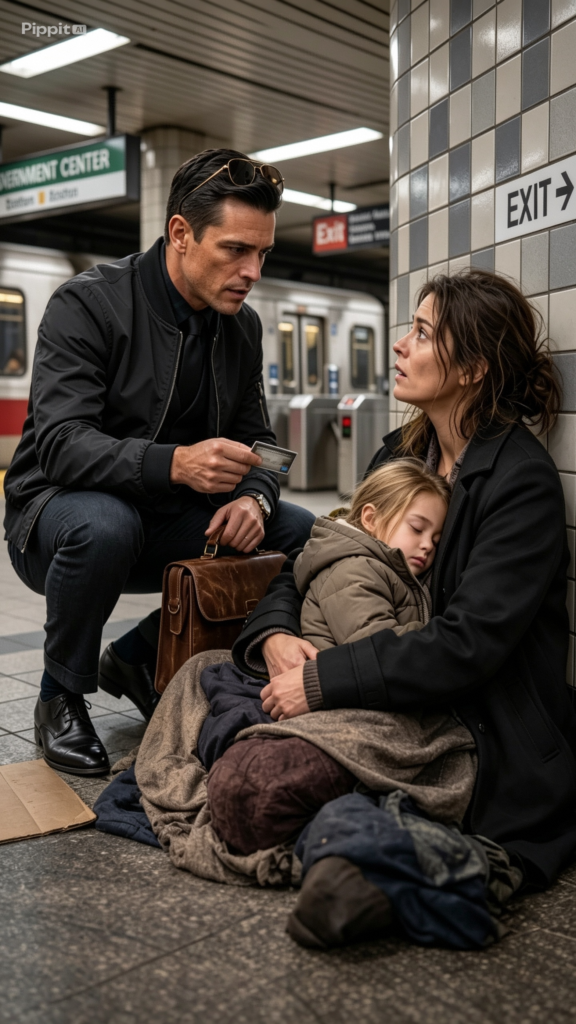
By a wall, near the entrance to the Suburbano, sat a woman about 32 years old on a thin blanket. She wore a worn jacket, her hair tied carelessly, and her lips cracked from the cold.
In her arms, a six-year-old girl slept, wrapped in a pink hoodie that was too big.
Beside them was a cardboard sign written in black marker:
Single mother. We lost our home. Any help is welcome. God bless you.
People passed without looking.
A man nearly stepped on the girl’s shoe.
A couple read the sign, lowered their gaze, and moved on.
The woman noticed Alejandro watching her and hugged her daughter tighter.
—Sorry, sir. We’re not bothering anyone. We’ll move in a moment.
That phrase hit him harder than he expected.
She was apologizing for existing.
—What’s your name? —he asked.
She blinked, distrustful.
—Marisol.
—And your daughter?
—Sofía.
Alejandro looked at Marisol’s clean hands, though they trembled. He saw the pale face of the girl. He looked at the cardboard sign.
His father’s voice returned like poison:
Don’t be an idiot. This is how traps start.
Then he did something even his assistant couldn't believe.
He pulled out his black card and placed it in her hand.
Marisol froze.
—No, sir. I can’t accept that. I just asked for a breakfast… maybe a cheap room for her to sleep warm.
—You have 24 hours —Alejandro said—. Buy whatever you need. Food, clothes, a hotel, a doctor, whatever.
—What’s the limit?
—There isn’t one.
Marisol looked at him as if it were a threat.
—What do you want in return?
Alejandro didn’t answer immediately.
—I want to see what a person does when no one is watching.
Pain crossed Marisol’s face.
—You think I’m going to steal from you.
Alejandro’s silence was an answer.
She lowered her gaze to the card.
—I won’t do it.
Alejandro also left a card with his number and walked away.
47 minutes later, in the boardroom on the 44th floor of the Larios Tower, his phone vibrated.
The first purchase had gone through.
It wasn’t a hotel.
It wasn’t expensive food.
It wasn’t brand-name clothing.
It was a children’s medical supply store in the Doctores neighborhood.
$3,280 pesos.
Then another alert popped up.
Pharmacy.
$742 pesos.
Then another.
Emergency pediatric consultation.
$900 pesos.
Alejandro stood up so fast his chair hit the wall.
Everyone in the room fell silent.
—What’s going on? —his financial director asked.
Alejandro stared at the screen, his throat constricted.
Marisol hadn’t used the card to save herself.
She had used it to save her daughter.
And if Sofía needed medical supplies before a bed or hot food, then there was something he hadn’t seen.
Something serious.
Something that was about to explode in his face.
PART 2
Alejandro left the meeting without explaining anything.
His assistant tried to follow him, but he barely raised his hand.
—Cancel everything.
—Sir, the board is waiting for a decision on the lawsuit regarding—
—I said to cancel everything.
He took the truck and requested to be taken to the Doctores neighborhood. During the ride, he opened the banking app and reviewed each charge as if they were clues to a crime.
Medical store.
Pharmacy.
Pediatric clinic.
No luxuries.
Nothing for Marisol.
Not even a coffee.
When he arrived at the clinic, he found her sitting on a plastic bench, with Sofía resting on her legs. The girl had a nebulization mask on and her eyes were half-closed.
Marisol looked up at him and stood up abruptly.
—Please don’t take her away.
Alejandro frowned.
—What do you mean take her away?
—The card. I know I spent too much, but she couldn’t breathe properly. I swear I didn’t do it to take advantage.
The doctor emerged before Alejandro could respond.
—Are you a family member?
—No —said Marisol.
—Yes —said Alejandro at the same time.
The doctor looked at them confused but didn’t argue.
—The girl has severe bronchitis, mild malnutrition, and needs continuous treatment. This didn’t start today. She’s been unwell for weeks.
Alejandro felt the floor shift beneath him.
—Why didn’t you take her to a hospital before?
Marisol pressed her lips together.
—Because at the public hospital they told me to come back with paperwork. Because we lost our documents when we were evicted. Because I had no money for transportation. Because when you’re poor, sir, even getting sick seems like a crime.
Alejandro didn’t know how to respond.
Marisol lowered her voice.
—I used to clean offices in Santa Fe. They fired me when I started missing work to take her to the doctor. My daughter has had a respiratory condition since she was a baby. She used to take a medication I can’t afford anymore.
—What medication?
Marisol pulled out a crumpled box from her bag.
Alejandro took it.
The name hit him like a slap.
Respiraliv.
It was a medication made by Larios Laboratories.
His company.
His last name.
His fortune.
—Who prescribed this?
—A pulmonologist from the Children’s Hospital. They used to give it to us in a support program. Then it disappeared. They said there was no more agreement. Later I found out they were selling it for an exorbitant price at private pharmacies.
Alejandro felt a strange coldness in his back.
That agreement had been canceled 8 years ago, during his father’s management.
The doctor checked the box and sighed.
—The medication is good, but there were batches with complaints years ago. Many poor patients stopped receiving it when the price went up.
Marisol looked at Alejandro.
—I didn’t know who you were when you gave me the card. But when I saw the name, I almost lost my breath.
—Why?
She took a moment to respond.
—Because my mom died waiting for that same medication.
Alejandro stood frozen.
The clinic seemed to fall silent.
—What was your mom’s name?
—Teresa Rivas.
The name pierced Alejandro like a bullet.
Teresa Rivas.
He had only heard it once, when he was 15. One night, his parents had argued in the library. His mother cried. His father shouted that this woman wouldn’t destroy the Larios name.
The next day, Alejandro asked who Teresa was.
His father slapped him.
He never asked again.
—What does Teresa Rivas have to do with me? —Alejandro said, though his voice no longer sounded firm.
Marisol opened her old backpack and pulled out a folded folder, protected with a plastic bag.
—Nothing, according to your family. Everything, according to these papers.
Alejandro took it with trembling hands.
There were copies of letters, prescriptions, laboratory receipts, and one old birth certificate.
In the space for Marisol’s father, a name was crossed out with black ink. But beneath it, something could still be read.
Octavio Larios Aranda.
Alejandro looked up.
Marisol had tears in her eyes, but she wasn’t begging.
—My mom worked in the laboratories when she was young. She got pregnant with me. Your father promised her help, then kicked her out and accused her of wanting money. She never asked for mansions, sir. She only asked not to lose her health insurance when she got sick.
Alejandro felt nauseous.
—That doesn’t prove that…
—There’s more.
Marisol pulled out a USB drive.
—My mom saved recordings. Letters. Deposits. And one document signed by your father where he acknowledged that I was his daughter but then it disappeared from the notarial file.
Alejandro could hardly breathe.
The girl coughed, and Marisol immediately turned to adjust her mask.
That gesture broke him completely.
His whole life had taught him that the poor always wanted to take something from him. But that woman, who might be his sister, had his unlimited card and only bought medicine for her daughter.
She hadn’t even sought him out.
She hadn’t even demanded anything from him.
She had slept in a station with his niece in her arms.
—Why didn’t you ever come? —Alejandro asked.
Marisol let out a bitter laugh.
—I went three times to Larios Laboratories. At reception, they told me to leave my papers. The last time, a lawyer warned me that if I came back, I’d be accused of extortion. Do you think a woman with a sick child can fight against a family like yours?
Alejandro closed his eyes.
He remembered his father saying, “Desperation turns anyone into a thief.”
No.
Desperation hadn’t turned Marisol into a thief.
Greed had turned his father into a monster.
He requested to speak with his personal lawyer that same afternoon. He also requested to review internal files, canceled agreements, and secret payments made from the company’s old accounts.
What they found in the next 48 hours was worse than he had imagined.
Don Octavio had ordered the withdrawal of Respiraliv from several public programs to sell it at a higher price through private distributors. He had also created a legal office dedicated to silencing complaints from poor patients.
Among those files was Teresa Rivas’s.
There were unanswered letters.
Denied prescriptions.
One desperate request where Teresa asked for support to stay alive because she had a minor daughter.
The response from Larios Laboratories was cold:
Not applicable.
Teresa died six months later.
When Alejandro read that, he locked himself in his office and cried like he hadn’t cried since he was a child.
The next day, he called a press conference.
The board tried to stop him.
—This will sink the stocks —the financial director said.
Alejandro looked at him with icy calm.
—Then let them sink. What can’t keep sinking is the truth.
In front of cameras, journalists, and employees, Alejandro publicly acknowledged the damage caused by his father and by the company. He announced a reparations fund for affected families, the free reinstatement of Respiraliv in public hospitals, and an independent audit.
Then he did something no one expected.
He introduced Marisol.
She didn’t want to stand next to him like a trophy. She walked alone, holding Sofía’s hand, and took the microphone.
—I didn’t come for money —she said—. I came because my daughter deserved to breathe. My mom deserved it too.
The silence was brutal.
Alejandro didn’t try to embrace her for the photo. He didn’t fake closeness. He just lowered his head.
—Marisol Rivas will be legally recognized as the daughter of Octavio Larios if the evidence confirms it —he said—. And Sofía will have complete medical care, not as a favor, but as a right.
The DNA tests arrived two weeks later.
99.99% familial compatibility.
Marisol was his half-sister.
The news exploded throughout Mexico.
Some said Alejandro only acted because he was discovered. Others said that at least he had the courage his father never had. On Facebook, thousands debated whether the guilt of a dead father should fall on the living son.
But Marisol didn’t celebrate.
She moved to a simple apartment in Coyoacán with Sofía. She accepted medical care, accepted that her mother’s case would be reopened, but refused to live in a mansion.
—I don’t want to inherit anyone’s cage —she told Alejandro—. I want my daughter to grow knowing that her dignity can’t be bought.
Months later, Sofía started to breathe better.
The first time she ran in a park without stopping because of a cough, Alejandro watched from a bench and had to turn away.
Marisol sat next to him.
—My mom used to say that the truth takes time, but it arrives without asking for permission.
Alejandro watched the girl laughing among the trees.
—My dad used to say that trusting was for idiots.
Marisol looked at him sadly.
—Well, it’s good that for one day he decided to be an idiot.
Alejandro smiled faintly, with wet eyes.
The black card was back in his wallet, but it no longer meant power. It meant shame. Memory. Debt.
Because sometimes the first purchase doesn’t reveal the ambition of a poor person.
Sometimes it reveals the soul poverty of those who always had everything.