PART 1
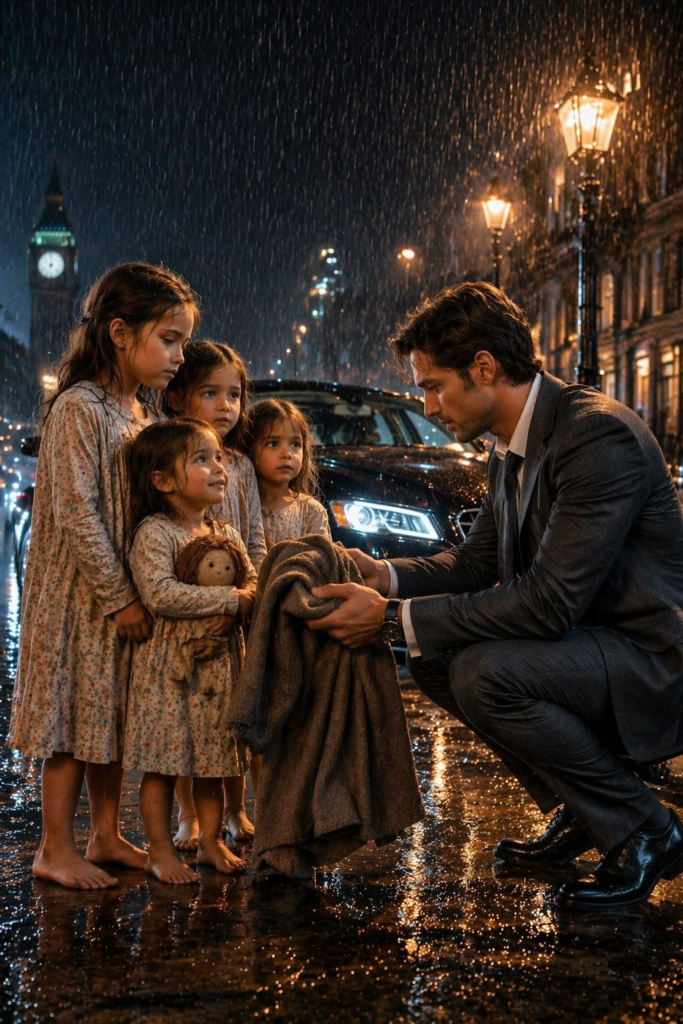
At 11:47 PM, Santiago Velasco saw four girls crying under a streetlight in the Doctores neighborhood, caught in the pouring rain.
He had just come from a gala dinner in Polanco, wearing a black suit, expensive shoes, and a fake smile that had lasted the entire night in front of the cameras.
The newspapers called him "the most generous young businessman in Mexico." That very night, he had handed over a huge check to support children's shelters.
But no one knew that Santiago returned each night to a massive house in Lomas de Chapultepec where no one was waiting for him.
They also didn’t know that he had grown up in temporary homes from the DIF, with an old backpack and the cruelest phrase etched in his memory:
"Let's try with another child."
As if children could be returned for not fitting in.
His driver, Don Ramiro, drove in silence when Santiago asked to take another route.
"I'm tired of seeing the same streets all the time," he said, watching the raindrops slide down the glass.
Don Ramiro didn’t ask questions. He turned onto less bright avenues, where the small eateries were closed, taco stands were dark, and the old buildings looked sadder under the rain.
Then Santiago saw them.
Four small shadows, huddled together.
The oldest looked about six. The youngest, perhaps three. They were all soaked, wearing thin clothing, dirty sneakers, and their eyes were red from crying.
"Stop," Santiago ordered.
"Sir, it’s raining very hard."
"Stop now."
Santiago stepped out before Don Ramiro could open the door. His expensive suit was drenched in seconds, but he didn’t care.
He crouched several steps away to avoid scaring them.
"Hello. I’m not going to hurt you. Are you lost?"
The oldest girl hugged the others and stepped in front, as if with her little body she could stop the whole world.
"Don’t separate us," she said.
Santiago felt a punch to his chest.
"I don’t want to separate you. I just want to know if you’re cold, if you’re hungry, and where your parents are."
The smallest one clutched a doll missing one eye. Her lips were purple.
"No one wants us," she whispered.
Don Ramiro got out with emergency blankets from the car. Santiago slowly spread them out.
"You can take them. No one will take you away."
The oldest hesitated. Then she let her sisters wrap themselves in the blankets.
"My name is Santiago," he said. "And you?"
The girl answered in a trembling voice.
"I’m Sofía. They are Luna, Marisol, and Inés."
Santiago repeated their names as if they were sacred.
He called 911, requested support from the DIF, and documented everything. He explained that he found four minors alone, under heavy rain, with no adults nearby.
The patrol took time. The child protection line asked them to remain in a safe place until a social worker arrived.
Santiago opened the back door of the car.
"You can come to my house to eat something and warm up while the authorities arrive. Don Ramiro has already informed. No one is hiding anything."
Sofía looked at him with suspicion.
"What if they want to take us to four different houses?"
Santiago swallowed hard.
"Not today. Today you stay together."
The girls climbed in, shivering.
When they arrived at the mansion, Marisol looked at the columns, the lights, and the huge garden as if she had entered another planet.
"Do you live here alone?" Luna asked.
Santiago looked at the lit and empty house.
"Yes."
The kitchen smelled of toasted bread, cheese, and hot chocolate. The girls ate quickly, as if someone would take their plates away.
Inés hid half a roll under the blanket.
Santiago pretended not to see it.
"There’s more," he said softly. "Here, no one is punished for being hungry."
Sofía looked down. For one second, she stopped looking like a six-year-old and seemed like a weary mother.
At 2:13 AM, the social worker arrived.
She reviewed the report, spoke with the girls, confirmed their names, and opened a case file from her tablet.
When she read the file, her expression changed.
The parents of the four had died five months earlier in a Mexico-Puebla accident. No relatives had accepted to take all of them in.
And the next day, they were going to separate them.
Sofía heard that from the doorway, hugged her sisters, and shouted something that left everyone frozen:
"Then we’d rather die together than be split up!"
PART 2
Sofía's words hit the house like a broken plate.
No one moved.
The social worker, Clara Méndez, took a deep breath. She had seen children in crisis for 18 years, but that six-year-old girl was defending her sisters with a desperation that didn’t match her age.
Santiago took a step toward them, but stopped.
He had learned in his own childhood that an adult who approaches too quickly can seem like a threat, even if they have good intentions.
"Sofía," he said in the calmest voice he could muster, "no one is going to die tonight. No one is going to take your sisters away without explaining it to you."
"That’s what everyone says," she replied. "And then they do what they want."
Clara looked at Santiago seriously.
"Legally, tomorrow I must present the case. But because of the storm, the hour, and the emotional state of the girls, I can authorize a temporary stay supervised for 24 hours. With a full report, photographs of the place, identification of all adults, and a medical check-up early on."
"Do what you have to do," Santiago said. "All transparent."
Don Ramiro, who had seen Santiago close million-dollar deals without blinking, saw him tremble when Inés asked:
"Are they going to take us out of here tomorrow?"
Santiago didn’t lie.
"I don’t know. But I’m going to do everything right so that no one decides about you as if you were luggage."
That night, the four rejected the individual rooms. They were afraid to sleep separated.
Santiago requested mattresses, blankets, and lamps. In the middle of a huge room, he set up a camp on the floor with them.
"Can we leave the light on?" Marisol asked.
"Of course."
"And the door open?"
"Also."
"What if we scream?"
Santiago felt a lump in his throat.
"Then I’ll come."
The girls lay down together. Sofía slept at the end, after checking that Luna, Marisol, and Inés had their feet covered.
Santiago sat by the door until all four breathed evenly.
In that mansion, there were works of art, Italian marble, and wines that cost more than the rent of many families.
But that night, for the first time, it felt like a home.
The next day, the disaster began.
Lawyers.
Officials.
Reports.
Questions.
A medical check-up.
An inspection of the house.
Clara was clear from the beginning:
"Mr. Velasco, you have money, contacts, and a secure property. That helps, but it doesn’t automatically make you family."
Santiago nodded.
"I know."
"Besides, you’re single, travel a lot, and have no experience raising girls with trauma."
"Then I’ll learn."
"It’s not a weekend course."
"Neither was it a weekend for me to grow up without anyone."
Clara looked at him differently.
Santiago wasn’t playing the savior. He didn’t want a viral photo or a pretty story for the press. In fact, when his communications team found out, they wanted to turn it all into a campaign.
"Don’t even think about it," Santiago said, with a coldness that silenced everyone. "These girls are not publicity."
The 24-hour temporary stay turned into a week under supervision.
Then a month.
The house changed slowly.
First came the drawings stuck on the refrigerator.
Marisol drew five figures holding hands under a yellow sun. When Santiago asked who the tall man was, she lowered her voice.
"You."
He pretended to examine the drawing calmly, but had to step into his study to cry.
Then Luna discovered the piano. She played three notes over and over when she felt nervous. Santiago hired a patient teacher, one of those who don’t force, who wait.
Inés talked to her doll, Lupita, and saved cookies for her.
Sofía still ate last, checking doors, hiding bread, and waking up at any noise.
One night, Santiago found Sofía in the kitchen, stuffing yogurts into a bag.
"I’m not going to scold you," he said.
She tightened the bag.
"Just in case there isn’t any tomorrow."
Santiago opened the refrigerator, then the pantry, then the freezer.
"Look closely. There will be food tomorrow. The day after tomorrow too. And if something runs out, we’ll buy more."
Sofía looked at him as if that idea were impossible.
"What if you get tired of us?"
The question pierced his soul.
"Then I remember that adults don’t have the right to get tired of children and disappear."
Sofía didn’t respond. But that night, she left the bag on the table.
It was a small step.
In these stories, people always think love heals like magic.
It’s not true.
Real love comes with psychologists, hearings, tantrums, nightmares, fear, paperwork, patience, and promises kept on time.
If Santiago said there would be pancakes at eight, there were pancakes at eight.
If he promised to return in ten minutes, he returned in ten minutes.
If he said he wouldn’t separate them, he sat in every meeting and repeated the same thing:
"All four together. Or we keep fighting."
The problem was that the maternal family showed up when they knew who he was.
An aunt named Leticia arrived with dark glasses, an expensive bag, and an indignation that seemed rehearsed.
"They are my nieces. I have a right," she said in front of Clara.
Santiago remained silent, although his blood burned.
Leticia had rejected the girls five months earlier because, according to the report, "four minors were too much of a burden."
But now that they were in the house of a millionaire, she wanted to "interact."
Clara requested interviews.
On the second visit, Sofía hid under the table and vomited from fear.
Luna stopped playing the piano.
Marisol tore up three drawings.
Inés wet the bed again.
Then Clara delved deeper.
The twist came from an old notebook that Sofía kept inside her backpack. There, she had written phrases she had heard at Leticia's house.
"One is enough, let the others go."
"The little one is a pity, she can be useful."
"If they separate, better, less hassle."
Clara also found audio messages where Leticia told another relative:
"Let’s see if that rich guy loosens up with monthly help. At least he should pay, right? If he loves them so much."
When those audios were presented in the hearing, Leticia stopped crying.
She became furious.
"It’s not fair! I’m their blood!"
Sofía, from Santiago’s side, lifted her face and said:
"Blood also abandons."
No one in the room knew how to respond.
From that day on, the case changed.
Santiago began the adoption process for the four sisters. It wasn’t quick or easy.
They reviewed accounts, schedules, mental health, history, house, staff, travels, friendships, everything.
The newspapers partially caught wind and started with horrible headlines.
"Millionaire wants to adopt four girls."
"Noble act or rich man's whim?"
"The sisters who conquered a mansion."
Santiago sued two magazines for publishing photos of the minors. He won protective measures and ordered to reinforce privacy.
"Never say they conquered anything again," he told his lawyer. "They survived."
The final hearing came nine months after that night under the rain.
The girls arrived in simple dresses, bows in their hair, and Lupita, Inés’ doll, permitted after a serious discussion with court security.
Santiago wore a dark blue suit. He adjusted his tie five times.
He had faced corrupt businessmen, banks, lawsuits, and meetings where everyone wanted to destroy him with smiles.
But he had never felt so afraid.
The judge listened to Clara, the child psychologist, Santiago’s lawyer, and the DIF representative.
Then she asked to speak with the girls.
"Do you know why we’re here?" she asked.
Sofía stepped forward.
"Because you’re going to decide if we can stay with Santiago forever."
"And do you want that?"
Marisol responded first:
"Yes, very much."
Luna squeezed Sofía’s hand.
"He doesn’t rush us when we’re scared."
Inés lifted Lupita.
"And he also wants my doll."
There was a soft laugh in the room.
The judge looked at Sofía.
"And you?"
Sofía swallowed hard.
"I want to stop taking care of my sisters alone. I want someone to help me."
Santiago lowered his head. That phrase hurt him more than any insult.
The judge signed the resolution minutes later.
"The full adoption of Sofía, Luna, Marisol, and Inés by Mr. Santiago Velasco is granted, with therapeutic follow-up and family support."
For one second, no one understood.
Then Inés screamed.
Marisol jumped.
Luna hugged Santiago around the waist.
Sofía stood still, as if her body needed permission to believe.
Santiago knelt before her.
"It’s done, little one. No one is splitting you up anymore."
Sofía broke down.
She hugged him so tightly that he felt her fingers sink into his jacket.
"So you did want us?" she sobbed.
Santiago cried without shame, in the middle of the courtroom.
"Since before a piece of paper said so."
Life afterward was not perfect.
There were fights over homework, fears during storms, difficult therapies, birthday celebrations with unexpected tears, and days when Sofía felt responsible for everything again.
But Santiago stayed.
He stayed when Inés cried because she thought her biological mom would be angry if she called him dad.
He stayed when Luna tore a sheet of music before her first recital.
He stayed when Marisol painted a very expensive wall and then said, trembling:
"Are you going to kick me out?"
Santiago looked at the wall, breathed, and replied:
"No. But you’re going to help me clean it, artist."
He stayed when Sofía, now a teenager, yelled at him:
"You’re not my real dad!"
He didn’t respond with wounded pride.
He just said:
"Maybe you feel that way today. But I’ll be here when you get over the anger."
Sofía cried in her room for three hours. Then she came down, left a note on the table, and left without saying a word.
The note read:
"I’m sorry. I got scared of loving you too much."
Years later, the four were women.
Sofía studied law to defend children in family processes.
Luna played piano on stages where she would have been afraid to breathe strongly before.
Marisol illustrated children’s books full of houses with open doors.
Inés worked as a play therapist, always with a doll in her office, because she said children sometimes speak better when someone small listens to them.
Santiago had gray hairs at his temples.
He was still rich, yes.
But what he was most proud of didn’t appear in Forbes.
He boasted of good morning messages, old drawings, recordings of recitals with shaky hands, school photos, and four voices shouting "dad" from different rooms.
On a Father’s Day, the four summoned him to the kitchen.
It was the same kitchen that once seemed like something out of a magazine, cold and perfect.
Now it had magnets, coffee stains, plants, mismatched cups, and a refrigerator full of photos.
Santiago thought there would be breakfast.
But Sofía placed a folder on the table.
"Don’t be scared," she said.
He raised an eyebrow.
"When you start like that, I always get scared."
Marisol pulled out a frame wrapped in kraft paper. Luna left a small box. Inés took his hand.
Sofía opened the folder.
"For months, we’ve been processing something."
Santiago felt his chest tighten.
"What processing?"
"We want to legally change our last names," Luna said. "Not to erase our biological parents. They gave us life.
Marisol continued:
"But you taught us to live without fear."
Inés smiled with tears.
"We want to be called Martínez Velasco. All four of us. If you agree."
Santiago couldn’t speak.
He had signed million-dollar contracts without his hand trembling. But that folder left him weak.
Sofía slid the frame toward him.
It was Marisol’s first drawing.
Five figures holding hands under a yellow sun.
The paper was old, worn at the corners. Below, in adult handwriting, Sofía had written:
"You told us we were loved before the world made it official."
Santiago read the phrase once.
Then again.
Then he covered his face with both hands.
And cried.
Not like the businessman who hid his pain to avoid looking weak.
He cried like the child who once heard they would try with another.
He cried for the four girls in the rain.
For the empty house that was filled with laughter.
For Sofía stopping being a mother to return to being a daughter.
For Luna finding music.
For Marisol drawing suns.
For Inés teaching other children that dolls could also be hungry.
The four hugged him at the same time, like that morning in court.
"So, yes?" Inés asked.
Santiago let out a broken laugh.
"Yes. Of course, my girls."
Sofía corrected, smiling:
"Your daughters."
He nodded.
"My daughters."
People always told the story wrong.
They said a millionaire saved four poor girls one rainy night.
But the truth was much deeper.
Four girls who believed no one loved them found a man full of money and empty of family.
And they taught him that a home is not built with blood, fortune, or pretty photos.
It’s built by staying.
With honest promises.
With legal papers done right.
With burnt dinners.
With lights on during fear-filled nights.
With hugs that arrive when someone no longer knows how to ask for help.
And with one truth no child should have to beg for:
You are loved.
You are safe.
You’ve come home.