PART 1
—If you open that door, girl, you won’t just lose a job… you’ll lose your peace forever.
That was the first thing Camila Cruz heard upon entering the Arriaga residence, on a discreet street in Las Lomas, where the walls were so high even gossip couldn’t leap over.
The woman who welcomed her was named Ofelia Rivas. She had been the housekeeper for twenty years and wore the hard gaze of someone who had seen too much and preferred to swallow it down.
Camila tightened her folder of papers. —I'm here for the cleaning position. The agency sent me.
Ofelia sized her up from head to toe. —The last eight didn’t last even three weeks.
The house looked like a luxury hotel, but without joy. Shiny marble, costly paintings, fresh flowers, and a heavy silence that felt like a wake that never ended.
Camila needed this job more than pride. Her grandmother Petra had diabetes, the rent in Neza was already overdue, and she had dropped out of nursing school to care for her.
—Rules — Ofelia said —. No questions asked. Don’t touch Mr. Arriaga’s office. Don’t answer the family phone. And that door on the second floor should never be opened.
At the end of the hallway was a light blue door, locked tight. A faded pink ribbon hung from the handle, old, almost gray.
—What’s behind there? — Camila asked.
Ofelia didn’t blink. —First question. Bad sign.
Mateo Arriaga arrived before lunch. Everyone in the house tensed up, even the guards stopped murmuring.
He was the owner of real estate developments, shopping plazas, and hotels in the Riviera Maya. But his face didn’t display the joy of a happy millionaire. It bore the weight of a grave in his chest.
Black suit, discreet watch, tired eyes.
—Is she the new one? — he asked without greeting.
—Camila Cruz, sir.
Mateo looked at her for a second. —They all say they come to work. Then they go through drawers, take photos, or ask questions that are none of their business.
Camila lifted her chin. —I came to clean, not to intrude into your life.
He let out a dry laugh. —That’s what they say at first.
The first day felt like an exam. Camila cleaned rooms that no one sat in, an enormous kitchen where hardly anything was cooked, and immaculate bedrooms that smelled of confinement.
Mateo didn’t eat. He just drank cold coffee and flipped through papers without reading them. No one spoke to him directly.
In the afternoon, while Camila was cleaning the library, she found a little rag doll dressed in yellow under an armchair. It had a broken braid and a blue paint stain on its face.
She carefully lifted it to place it on a shelf.
—Don’t touch it!
Mateo appeared at the entrance as if he had heard a gunshot.
He snatched the doll and pressed it against his chest. His hand trembled.
—I wasn’t stealing it — Camila said, hurt.
—I didn’t ask for an explanation.
—It was on the floor.
—Some things need to stay where they fall.
Ofelia rushed in.
—Sir, she didn’t know...
—Get her out — Mateo ordered —. Today.
Camila took off her apron. She wanted to cry, but swallowed her tears instead. She was already used to wealthy people confusing need with permission to humiliate.
As she crossed the library, she heard Mateo murmur:
—It was my daughter’s.
That night, Camila arrived at her room in Nezahualcóyotl with swollen feet and a soul knotted up.
Doña Petra was sitting by the table, sorting her pills.
—You’re home early, dear.
—I think I got fired.
—Why?
—For touching a doll.
The old woman froze.
—The Arriaga girl.
Camila frowned. —You know about that?
Petra lowered her voice. —Three years ago, there was an accident on the way to Cuernavaca. That man’s wife died. They said the girl died too.
—They said?
—In this country, when money’s involved, even death can have helpers.
The next day, Camila returned to the residence.
Ofelia opened the door and froze. —I thought you wouldn’t come back.
—I have a schedule.
—You also lack prudence.
Camila entered without replying.
Mateo watched her from the stairs. He didn’t apologize. He didn’t smile. He just had the doll in hand, as if he had spent the night awake with it.
Camila worked all day without looking at the forbidden hallway.
But by nightfall, when she went upstairs for some towels, she heard something behind the blue door.
A light knock.
Then another.
After that, a small, broken child’s voice whispered:
—Daddy… don’t leave me again.
PART 2
Camila stood frozen, the towels pressed against her chest.
Ofelia appeared behind her like a shadow. —You didn’t hear anything.
But her voice trembled.
—Of course I heard.
—Then learn to be deaf. That’s how we survive here.
Camila descended the stairs with her heart pounding against her ribs. That house no longer felt cold. It felt watched.
In the following days, Mateo tested her in painfully obvious ways. He left a gold watch on the entry table. An envelope full of bills next to the vase. An unlocked cellphone on the sofa.
Camila touched nothing.
She cleaned, picked up, washed abandoned cups, and pretended not to notice Mr. Arriaga's eyes following her from every door.
On Friday, a tremendous storm hit Mexico City. Lightning illuminated the windows, and the house creaked as if it were old, even though everything there cost a fortune.
Camila was folding sheets when she heard a thud in the office.
She ran.
Mateo was sitting on the floor, pale, one hand on his chest, breathing in fragments.
—Get out — he said.
—You’re having trouble breathing.
—Get out.
—I studied nursing. Don’t waste my time with your pride.
He tried to get up, but his legs wouldn’t respond. Camila took his pulse, loosened his tie, and forced him to breathe slowly.
Ofelia called the doctor.
It wasn’t a heart attack. It was panic.
The storm, the road, the memory.
When the doctor left, Mateo remained silent, sitting on the sofa in the office. Camila was picking up the broken cup from the floor.
—Why did you leave nursing? — he asked.
—For my grandmother.
—And you ended up cleaning houses?
—I ended up doing what I had to do so she wouldn’t die.
Mateo had no cruel response. For the first time, he lowered his gaze.
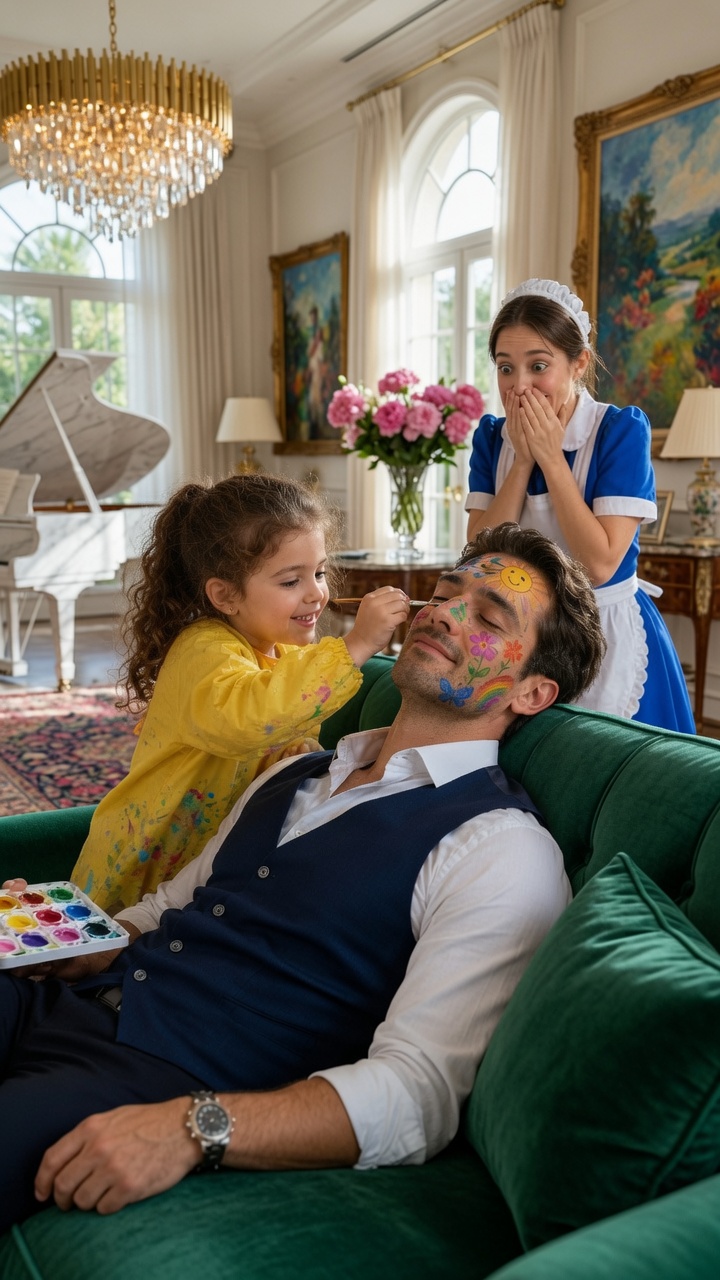
The next morning, Camila entered the office with breakfast. Mateo was reclined on the sofa, a book opened on his chest.
Asleep.
Or pretending.
He was breathing too evenly.
On the desk were 10,000 pesos in cash and a silver key.
Camila knew immediately which door it opened.
The temptation lay like bait.
She looked at Mateo. He was wearing his shoes, his shirt wrinkled, and the face of someone who couldn’t rest even when he closed his eyes.
Camila took a blanket from the couch and draped it over him.
—You’ll get a crick in your neck pretending to sleep, sir.
Mateo opened his eyes.
He didn’t seem annoyed. He seemed defeated.
—I knew you were awake.
—Yes.
—And you didn’t take the key.
—It wasn’t mine.
—Weren’t you curious?
Camila looked up at the ceiling, at the hallway.
—Yes. But some doors aren’t opened for gossip. They open when someone can no longer bear what they hold.
Mateo sat up slowly.
—You heard something.
—A girl.
He closed his eyes.
—Mariana died with her mother.
—Are you sure?
The question fell like a knife.
—Don’t say that again.
—Then open the door.
The silence was so heavy that even the rain seemed to pause.
That afternoon, Mateo went upstairs with the key in hand. Ofelia followed behind, crying softly. Camila walked alongside him.
—You don’t have to do this alone — she said.
Mateo inserted the key.
The blue door creaked open.
Inside was an untouched children’s room: walls painted with clouds, stories, small dresses, white shoes, and a bed with a pink quilt.
On the pillow was a rag doll just like the one in the library, but new.
Mateo picked it up. It had a note tied around its neck.
He read it, and his face crumbled.
—“Daddy, I waited for you.”
Ofelia covered her mouth.
—That doll wasn’t there.
Suddenly, a children’s song played from inside the closet. The same melody Camila had hummed days before while cleaning the kitchen.
Then came the sound of a girl’s laughter.
Mateo took a step toward the closet, white as paper.
—Mariana…
Camila stopped him.
—Wait.
She flung the closet door open.
There was no girl.
There was a small speaker taped behind a box of toys. Next to it, an old cellphone played the audio.
Mateo’s sadness turned to fury.
Camila checked the note.
—This wasn’t written by a 4-year-old.
Mateo swallowed hard.
—Mariana had just begun to write her name.
Ofelia collapsed into a chair.
—I’m sorry, sir. I didn’t know they would come this far.
—Who? — Mateo asked, with a calmness that was frightening.
Ofelia cried louder.
—Your brother Diego. And your mother, Doña Leonor. They told me it was for your own good. That you were sick. They needed to prove you heard things.
Mateo clenched the doll in his hand.
—For what?
—Today a notary is coming. They want you to sign the temporary transfer of the Arriaga Group. If you get agitated, if you talk about voices, they will ask for you to be declared incompetent.
Camila felt rage. Not fear. Rage.
—They were deliberately driving you mad.
Mateo looked at his daughter’s room.
—Tell me the truth. Did Mariana die?
Ofelia shook her head slowly.
—I only know that that night they didn’t find her body. Then Diego came with papers. He said no one should ask.
Camila remembered her grandmother.
She called Petra.
An hour later, the old woman arrived by taxi, with her bag of medicines and a dignity that didn’t fit in that mansion.
She entered the room and saw the doll.
—I saw a similar one.
Mateo stopped breathing.
—Where?
—In a hospital in Cuernavaca, three years ago. I was still doing support shifts. A little girl arrived, beaten, with a fever, crying for her dad. She didn’t say her last name. She had a yellow doll.
—What was her name?
—They named her “Marisol Pérez.” But that name was given by a suited man before taking her away.
—Do you remember who?
Petra looked at Mateo with sadness.
—I don’t know the face. But I remember one phrase. He said: “As long as my brother believes she’s lost, the business will be safe.”
Mateo clenched his fists.
Diego.
His own brother.
They sifted through files for hours. Camila found a folder hidden behind a panel in the service room. There were receipts from a foster home in Puebla, transfers made by a ghost company, and a blurry photo of a seven-year-old girl with curly hair, holding a yellow doll.
Mateo sank to the floor.
He didn’t cry immediately. He touched the photo as if afraid it too was a lie.
—Mariana — he whispered.
At six in the evening, the Arriaga family arrived.
Doña Leonor entered with pearls, expensive perfume, and a coldness that hurt more than a scream. Diego followed, in a gray suit, black briefcase, and a false saintly smile.
A notary and two private doctors also arrived.
Everything was prepared.
—Son — Doña Leonor said —, we are worried about you.
Mateo stared at her without blinking.
—How curious. I’m worried about what you did.
Diego sighed like a soap opera actor.
—Again with the suspicions, brother. You’ve spoken of voices, of Mariana, of things that don’t exist.
Camila entered with the speaker, the cellphone, and the note inside a transparent bag.
—This exists.
Diego’s smile vanished.
Doña Leonor looked at Camila with disdain.
—And who is this?
—The person you couldn’t buy — Mateo replied.
Camila played the audio. The sound of child laughter filled the room. Then she placed the photo, the receipts, and the transfers on the table.
The notary paled.
—Licenciado Diego, this is very serious.
Diego tried to laugh. —They can fabricate anything. My brother isn’t well.
At that moment, the front door swung open.
Two police officers entered with a social worker.
And behind them appeared a thin girl, with huge eyes, clutching a yellow doll to her chest.
Mateo stood still.
The girl did too.
For a few seconds, there were no millions, no mansion, no surname.
—Daddy… — she whispered.
Mateo fell to his knees.
Mariana ran toward him.
The embrace was clumsy, desperate, full of tears. He repeated her name as if each time he said it a piece of life was returned to him.
Diego tried to walk toward the exit.
An officer stopped him.
—Diego Arriaga, you are under arrest for child abduction, forgery, fraud, and whatever else results.
—I saved the company! — Diego shouted —. He was destroyed. He would have sunk everything.
Mateo lifted his gaze with Mariana clinging to his neck.
—You saved nothing. You buried my daughter alive to sit in my chair.
Doña Leonor tried to approach.
—I just thought it was best for the family.
Mariana hid against her father.
Mateo looked at her with a sadness that no longer had fear.
—Which family, Mom? The girl who waited three years in a foster home? Or the son you tried to drive mad to steal everything from him?
Doña Leonor didn’t respond.
Because some silences confess more than any signature.
Months later, the Arriaga residence no longer resembled a mausoleum.
There were drawings on the refrigerator, laughter in the kitchen, and a stray dog that Mariana found outside a bakery and refused to let go.
The blue door was no longer locked. The windows opened every morning, and the little yellow doll rested on a shelf beside the old one, as two proofs that the truth also survives.
Mateo didn’t heal overnight. Some nights he woke up sweating and walked to Mariana’s room just to hear her breathe.
Camila continued working there for a while, but no longer as someone invisible. Mateo paid for Doña Petra’s treatment and offered Camila a scholarship to finish nursing.
—I don’t want favors disguised as debts — she said.
—Then it will be a scholarship you earned — he replied.
Mariana was the one who clung to Camila the most. She said that Camila had opened the right door.
One afternoon, the girl drew three people: a suited man, a girl with a doll, and a young woman in a blue apron.
—Who is she? — Mateo asked.
Mariana smiled. —The one who didn’t steal the key… but did give us back our lives.
Mateo looked down the hallway where it all began.
For years he believed that pain should be locked away to avoid destroying it. But the truth was different: sometimes what kills isn’t opening a door, but keeping it closed to protect the lies of those who say they love you.
Would you forgive a mother and a brother capable of hiding a girl alive just for money?