PART 1
The receptionist smiled at Elena Robles as if she were a confused lady who had wandered into the wrong building.
It wasn’t a rude smile.
It wasn’t even a mockery.
It was worse.
It was the calm smile of someone absolutely certain they were right.
"Excuse me," Elena said, adjusting the bag on her shoulder. "I’m here to see my husband, Ricardo Vargas. I wanted to surprise him."
The man glanced at the screen, then turned back to her.
"Engineer Vargas is on the executive floor, ma'am."
Elena felt a fleeting relief for one second.
Until the guard added:
"But Mrs. Vargas went up a while ago."
The lobby noise cut off abruptly.
The click of heels.
The buzzing elevators.
The voices of employees greeting one another with coffee in hand.
All faded away, as if someone had slammed a door between her and the world.
"Excuse me?" she asked slowly.
The guard blinked, uncomfortable.
"The wife of Engineer Vargas. She comes almost every day."
Elena didn’t raise her voice.
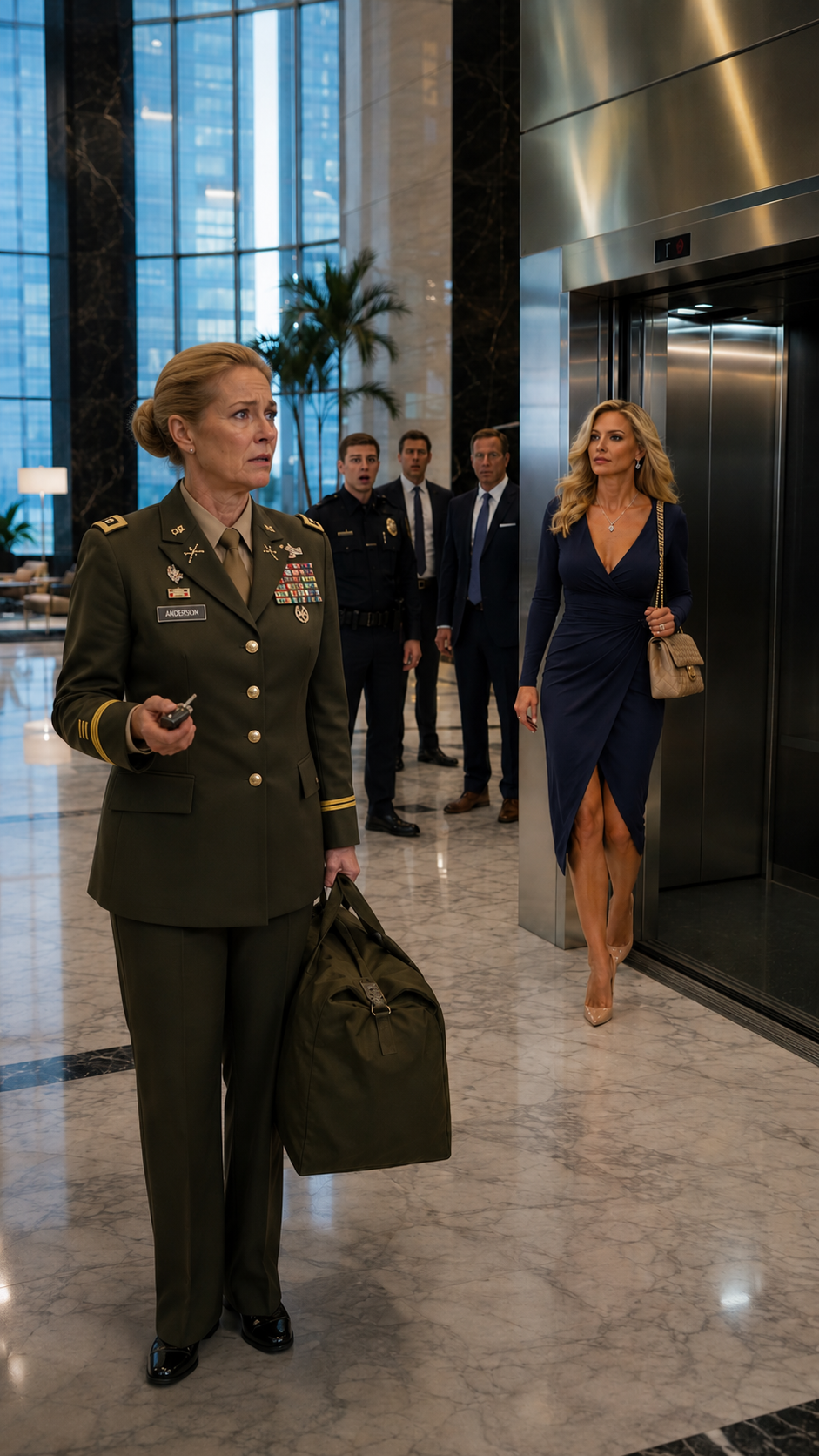
After 29 years in the Mexican Army, she had learned that when a grenade falls nearby, the last thing you do is scream.
First, you breathe.
Then you look.
Then you decide.
She had driven from a base in Chiapas to Monterrey, nearly 800 kilometers, because she had been granted an unexpected leave.
She hadn’t notified him.
She wanted to surprise Ricardo after months apart.
They had spent anniversaries over video calls.
Christmas with audio messages.
Birthdays with cakes split in front of a screen.
She imagined walking into his office, seeing him rise, hearing his voice say, "My Elena."
But in that elegant building in San Pedro Garza García, with shiny floors and the scent of expensive coffee, another woman had just been called “wife.”
"There must be a mistake," Elena said, though her body already knew otherwise.
The guard pointed to the private elevators.
"Look, here she comes."
Elena turned.
A woman stepped off the executive elevator as if the building belonged to her.
Light brown hair, beige dress, dark glasses in her hand, designer handbag, and a confidence that doesn’t just appear overnight.
Employees greeted her with respect.
"Good morning, Mrs. Vargas."
Mrs. Vargas.
The last name Elena had carried on documents, military letters, hospitals, and farewells.
The woman smiled just slightly.
And then Elena saw the pendant.
A small silver medal, with an eagle engraved on the front and the initials E.R. on the back.
Ricardo had given it to her when he was promoted to colonel.
He told her it was so she would remember that, even from afar, her home was always waiting for her.
Now it hung around a stranger's neck.
The woman locked eyes with Elena.
She showed no fear.
Didn’t ask who she was.
Didn’t look surprised.
She simply regarded Elena as if recognizing someone she hadn’t wanted to see.
Then she continued walking.
As if nothing.
As if Elena were the intruder.
Elena felt the urge to rip the medal off right there.
But she didn’t.
She returned to the counter, feigned a smile, and said:
"I think I’m in the wrong office."
She stepped outside with legs steady and a heart shattered into pieces.
The dry heat of Monterrey hit her face.
Cars continued passing.
People kept entering the building.
The world didn’t stop.
Only her life had just split in two.
She sat in her truck and looked at her phone.
There was a message from Ricardo.
"My love, it won’t be long before you’re back. I miss you so much."
Elena read those words three times.
He thought she was still serving far away.
He didn’t know she had just seen another woman using his name.
At first, she thought of a mistress.
But a mistress hides.
That woman did not.
That woman was greeted.
Obeyed.
Waited for.
That woman was, to everyone, Mrs. Vargas.
That night, Elena checked into a hotel using her maiden name.
Elena Robles.
From the window, she watched the lights of the city and opened her laptop.
Vargas Transport of the North.
General Director: Ricardo Vargas Medina.
A recognized businessman.
Donor at events for military families.
Photos appeared one after another.
Galas.
Inaugurations.
Charity dinners.
And in almost all of them, she was there.
"Ricardo and Camila Vargas."
"His wife, Camila."
In one photo, Camila was inside the living room of Elena’s house.
Her house.
Her fireplace.
Her curtains.
Her pearl earrings.
Elena stopped breathing.
Then she found another image.
Gala for Veterans.
Ricardo smiled in front of cameras.
Camila held his arm.
And around her neck shone Elena’s medal.
The caption read:
"Ricardo and Camila Vargas, an example of support for the families of Mexican soldiers."
Elena closed the laptop.
At that moment, her phone rang.
It was Natalia, her daughter.
"Mom… are you in Mexico?"
Elena froze.
"Why do you ask that?"
Natalia took a moment to answer.
"Dad called me. He sounded really strange. He asked if you called me… to let him know right away."
Elena looked at the hotel door.
And then she understood that the betrayal wasn’t the worst part.
What Ricardo feared wasn’t that she had found Camila.
What was really killing him with fear was everything Elena still hadn’t discovered.
PART 2
Elena asked Natalia not to call her father back.
It was one of the most painful decisions she had ever made.
She never wanted to involve her daughter in adult problems.
Natalia was 31, had two small children, a calm husband, and a life in Querétaro that Elena had always wanted to protect.
But that night, the lie had crept into everyone’s living room.
"Mom, tell me what’s going on," Natalia pleaded, her voice trembling.
Elena glanced at her uniform hanging by the hotel window.
The medals shone under the lamp.
She had survived operations, transfers, threats, and sleepless nights.
But nothing had prepared her for seeing her own home occupied by another woman.
"I still don’t know the whole truth," she replied. "But listen carefully. If Ricardo asks you about me, tell him you don’t know anything."
There was silence.
Then Natalia said something that shattered her more than any photo.
"You said Ricardo… you didn’t call him Dad anymore."
Elena closed her eyes.
Children always hear what you try to hide.
"Just give me time, sweetheart."
After hanging up, she called the only person who could help her without asking silly questions.
Marta Salcedo.
Former military investigator, widow, stubborn as a mule, and smarter than any expensive lawyer.
She lived in Saltillo but answered on the first ring.
"You were supposed to be in Chiapas."
"I was."
Marta fell silent.
"You sound like someone who just stepped on a landmine."
Elena told her everything.
The guard.
Camila.
The medal.
The photos.
The house.
The call to Natalia.
Marta listened without interrupting.
When she finished, she simply said:
"Don’t confront him yet. A scared man invents a story before you ask. First, let the truth be careless."
The next morning, Elena rented a gray car, bought a cap, and parked two blocks away from the company.
At 9:12, Camila arrived in a white SUV.
An employee opened the door for her.
Another handed her coffee.
At 12:30, Ricardo came out with her.
They walked together.
Not as boss and assistant.
Not as nervous lovers.
As a couple at ease.
He placed his hand on her lower back to guide her to the car.
It was a small gesture.
But it hurt Elena more than a slap.
Photos can lie.
Customs do not.
For four days she observed.
Camila entered meetings.
Received suppliers.
Gave opinions in discussions.
Lunched with the wives of other executives.
Even signed documents with confidence.
On the fifth day, Marta arrived at the hotel with coffee, pastries, two cheap cell phones, and a folder.
"Now we’re going to see how rotten this is," she said, dropping everything on the table.
The first thing they found was strange.
Camila didn’t have the last name Vargas.
Her full name was Camila Arriaga Cárdenas.
She had been an image consultant for various companies.
There was no registered marriage with Ricardo.
But she had appeared at events as his wife for six years.
Elena felt nauseous.
Six years.
While she slept in military dormitories, Ricardo was opening the door of his house to another woman.
While she sent gifts from afar, Camila was wearing her jewelry.
While Elena defended her country, someone was erasing her from her own life.
But Marta found something worse.
"Elena, come see this."
In the folder were documents from an association called Hands of Honor.
It supposedly supported widows and families of fallen soldiers.
Ricardo was the honorary president.
Camila appeared as the coordinator.
Elena recalled the photos.
The galas.
The speeches.
The medal around Camila’s neck.
Elena reviewed the names.
There had been enormous donations.
Subsidies.
Corporate sponsorships.
Money destined for scholarships, medical treatments, and housing assistance.
But many beneficiaries did not exist.
Others did exist but never received anything.
"No way," Elena whispered.
Marta clenched her jaw.
"They used your image, your career, and your medal to sell trust. Camila didn’t just steal your place as wife. She sold everyone the idea that she was the military woman inspiring the project."
Elena felt her blood run cold.
It wasn’t just infidelity.
It was fraud.
And her name was being used as a shield.
That afternoon, she called Natalia again.
But this time her daughter didn’t sound confused.
She sounded furious.
"Mom, Dad came to my house."
Elena straightened up.
"What did he want?"
"He asked me to sign some papers. He said they were to protect the company if you came 'altered.'"
Elena clenched her fist.
"Did you sign them?"
"No. And there’s something else."
Natalia took a deep breath.
"Three years ago, when Mateo needed surgery, Dad told me the foundation couldn’t help because there were no resources. I believed him."
Elena felt a blow to her chest.
Mateo, her grandson, had been sick for months.
She had sent almost all her savings from afar.
Sold a truck.
Accepted extra shifts.
Ricardo had told her he was contributing too.
"Mom," Natalia continued, "I checked my emails. I found an old invitation from the foundation. It said they had raised money 'for the children and grandchildren of military families.' There’s a picture of Mateo."
Elena couldn’t speak.
Her grandson had been used to raise money.
And that money never arrived.
That was the end of her patience.
Marta contacted a lawyer and an investigative journalist who had covered cases of corporate corruption in Nuevo León.
Elena didn’t want scandal out of revenge.
She wanted proof.
For two weeks, they gathered false invoices, photographs, testimonies from ignored widows, and internal emails where Camila approved payments to phantom companies.
The cruelest twist appeared in an old email from Ricardo.
"As long as Elena remains away, no one will question anything. Camila functions better as Mrs. Vargas than she does. The colonel is only useful for credibility."
Elena read that line without crying.
That was what scared Marta the most.
"Cry, comadre," she told her quietly. "Because if you don’t cry, you’re going to explode."
Elena shook her head.
"Later. First, I need to finish this."
The opportunity came at the annual gala of Hands of Honor.
Ricardo had organized the event in a luxurious hotel in Monterrey.
Businessmen.
Politicians.
Retired soldiers.
Cameras.
Tables decorated with white flowers.
At the entrance, a huge banner showed Ricardo and Camila smiling.
Beneath it read:
"A marriage in service to those who serve Mexico."
Elena arrived late.
Not in a dress.
Not in jewels.
She walked in wearing her gala uniform.
The medals on her chest.
Hair tied up.
Eyes steady.
The murmur spread like wildfire.
Ricardo saw her from the stage.
He turned pale.
Camila, by his side, instinctively touched the medal around her neck.
Elena’s medal.
The master of ceremonies froze.
Elena walked to the front.
Each step sounded like a verdict.
Ricardo tried to smile.
"Elena… my love… what a surprise."
She didn’t respond.
She looked at Camila.
"Take that off."
Camila pretended not to understand.
"Excuse me?"
"My medal. Take it off."
The hall fell silent.
Ricardo rushed down from the stage.
"Let’s not do this here, Elena."
She looked him in the eyes for the first time.
"Not here? Then where? At my house, where she wears my earrings? At your office, where everyone calls her Mrs. Vargas? Or in front of the widows whose support was stolen?"
The murmur exploded.
Camila lost color.
Ricardo tried to grab her arm, but Elena pulled away.
The journalist, seated at a table in the back, turned on the broadcast.
Documents began projecting on the screens in the hall.
Invoices.
Emails.
Event photos.
Names of false beneficiaries.
Ricardo's email appeared huge.
"The colonel is only useful for credibility."
Someone shouted, "What a scumbag."
A widow stood up crying.
"I was told there was no money for my son’s prosthesis."
Another woman shouted:
"They used my dead husband’s photo."
The gala turned into a public trial.
Ricardo tried to blame Camila.
Said she managed the funds.
That he trusted.
That he didn’t know.
But then Marta delivered the last document.
A transfer to Ricardo’s personal account, made on the same day Natalia requested help for Mateo's surgery.
Elena looked at him.
Not with hatred.
With something worse.
With clean disappointment.
"You stole using my name. You used our grandson. You let my daughter beg while you toasted with other people’s money."
Ricardo began to cry.
"I made a mistake, Elena. I love you."
She took a deep breath.
"No. You loved the version of me that served you from afar, quiet and obedient."
Camila shakily removed the medal and left it on the table.
But Elena didn’t take it immediately.
"That medal isn’t valuable for its silver," she said. "It's worth the absences, the exhaustion, for the families who truly wait for someone who might not return. And you used it as an ornament."
The investigation became national news.
Ricardo lost contracts, partners, and prestige.
Camila tried to negotiate, but several victims testified.
The foundation was intervened.
Families began receiving the recovered money.
Natalia took months to say "Dad" again without feeling anger.
Elena filed for divorce and reclaimed her house.
She didn’t throw a party.
Didn’t post vague statements.
She simply changed the locks.
One afternoon, while packing her things, she found an old photo.
She and Ricardo young, in front of a small house, believing that love was enough to survive everything.
She stared at it for a long time.
Then she left it in a box.
Not for nostalgia.
But because even lies have a birth date.
Months later, Elena attended an event for military families.
This time there was no banner with false smiles.
No speeches from businessmen seeking applause.
There were mothers, widows, children, retired soldiers, and people who knew what it cost to wait.
Natalia arrived holding Mateo’s hand.
The boy hugged his grandmother and touched the medal she wore around her neck again.
"Is that the one they took from you, Grandma?"
Elena smiled sadly.
"They didn’t take it from me, my child. They just borrowed it from those who never understood what it meant."
Mateo scrunched his nose.
"Then it’s good it came back to you."
Elena hugged him.
Some betrayals don’t destroy because another person takes your place.
They destroy because they force you to see how much time you accepted living in a story written by someone else.
And maybe that’s why so many people commented on that news.
Some said Elena should have shouted from day one.
Others said she did well to wait.
But everyone agreed on one thing.
There’s no theft more cruel than occupying the place of a woman who sacrificed for her family… and still using her name to appear as a hero.