PART 1
—Camila, I need you to stay with me tonight.
The water pitcher nearly slipped from her hands.
Camila Reyes stood frozen by the enormous bed, unsure if she had heard correctly. Outside, the rain pounded against the mansion’s windows as if trying to force its way inside.
Don Aurelio Monteverde, one of the richest businessmen in Guadalajara, looked at her from the pillows, his face sunken and his lips dry.
He was 82 years old, battling advanced cancer, with three children waiting downstairs, not out of love but for inheritance.
—Sir… —Camila murmured—. I think I should call the nurse.
He slowly shook his head.
—I don’t want nurses. I don’t want lawyers. I don’t want my children pretending to care about my suffering. I want you.
A knot tightened in Camila’s stomach.
She had worked as a domestic worker in this Zapopan house for four years, a mansion adorned with Italian marble, a Japanese garden, and cameras even in the kitchen.
Everyone called her “the girl.”
Doña Renata, the eldest daughter, snapped her fingers at her.
Mauricio, the ambitious son, wouldn’t even meet her eyes.
And Esteban, the youngest, treated her as if poverty were a contagious disease.
But Don Aurelio was different when they were alone.
He had never been affectionate, but he was attentive. He would ask if she had eaten. He slipped envelopes with extra money for “the buses.” Once, when she fell ill with dengue, he hired a private doctor without telling anyone.
Still, that request felt dangerous.
—Don Aurelio, people might think badly.
The old man smiled sadly.
—The people in this house think badly, no matter how one breathes.
He coughed hard. Camila rushed to hold the glass for him.
He took only two sips.
—I’m not asking you for anything dirty, my child. I just need to not die without saying what I’ve held back for 29 years.
Camila shuddered.
Downstairs, a glass clinked.
Don Aurelio’s children had been arguing since the afternoon about the will, the shares of the construction company, and a house in Valle de Bravo.
None had come upstairs to ask if he was afraid.
—Why me? —she asked.
Don Aurelio turned his eyes toward an old portrait on the nightstand.
In the picture stood a young woman in a yellow dress, curly hair, and a radiant smile. She held a baby wrapped in a white blanket.
—Because you have her eyes —he said.
Camila looked at the photo.
—Who is she?
The old man tightened the sheets.
—My daughter Elena.
Camila furrowed her brow.
—I thought you had three children.
—That’s what everyone thinks, dear.
The word struck her oddly in the chest.
Don Aurelio took a deep breath.
—Elena left this house when she was 21. She fell in love with a musician from Tlaquepaque. I told her that if she crossed that door, she would cease to be my daughter.
His eyes filled with tears.
—And my girl obeyed too well. She never came back.
A chill washed over Camila.
Her mother was also named Elena.
Elena Reyes.
A woman who washed other people’s clothes, sold tamales, and raised a girl alone who never knew who her family was.
—What happened to her? —Camila asked, her voice barely a whisper.
Don Aurelio looked at her intently.
—She wrote me a letter. It said she had a baby. That her husband had died. That she wasn’t asking for forgiveness for herself, but for help for her daughter.
Camila touched her neck.
Under her uniform, she wore an old silver pendant: a bougainvillea flower.
It was the only thing her mother had left her before she died.
Don Aurelio saw the pendant.
His face changed as if he had seen a ghost.
—Where did you get that?
Camila stepped back.
—It belonged to my mom.
—What was your mother’s name?
She wanted to stay silent.
Something inside her already knew the answer, and it terrified her.
—Elena Reyes.
Don Aurelio closed his eyes and let out a dry sob.
At that moment, the door swung open.
Renata rushed in, her face flushed.
Behind her were Mauricio and Esteban, the latter filming with his cellphone.
—How lovely —Renata said, venom dripping from her words—. Daddy dying and the maid putting on a show.
Don Aurelio raised his head with impossible strength.
—Never call her a maid again.
Mauricio laughed.
—Then how do you want us to call her?
The old man took a deep breath.
—Call her by her name. Camila Monteverde. My granddaughter.
The word exploded in the room.
Camila felt the world tilt beneath her.
Renata turned pale.
Esteban stopped recording.
Mauricio stepped toward the bed.
—Dad, shut up. You don’t know what you’re saying.
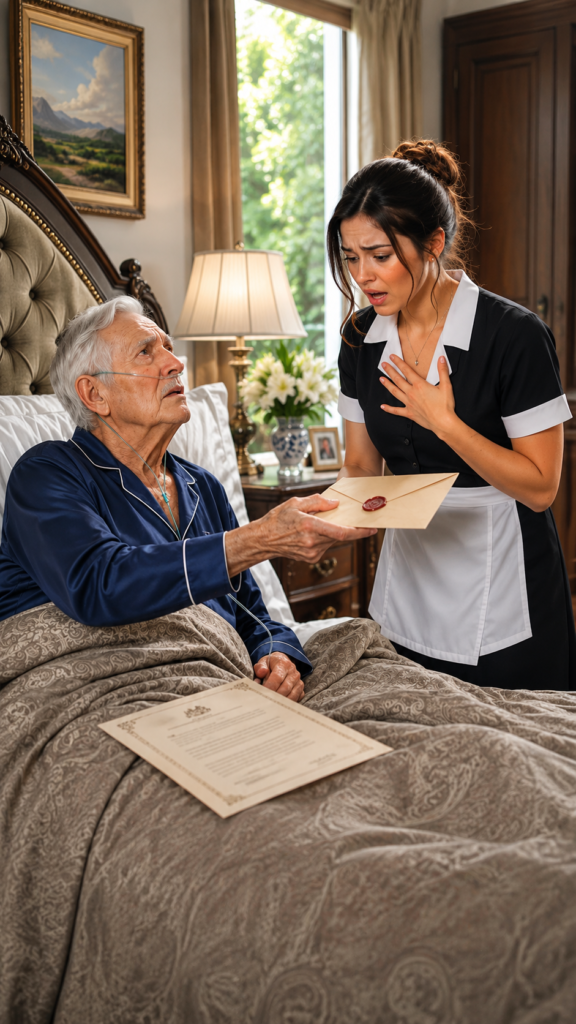
Don Aurelio opened the nightstand drawer with trembling hands and pulled out a yellowed envelope.
On the front, it read:
Dad, if you still love me a little, read this.
Camila recognized her mother’s handwriting from the old recipes she kept in a shoebox.
And when Don Aurelio placed that letter in her hands, Camila understood that she had not been called that night to serve tea.
She had been called to unearth a truth that this family was willing to kill once more.
PART 2
—That letter proves nothing —Mauricio said.
His voice sounded calm, but his eyes were daggers.
Camila clutched the envelope to her chest. She still wore her gray uniform, hair pinned back, hands rough from the bleach. In front of her, Don Aurelio’s three children looked at her as if her mere existence were an offense.
Renata locked the door.
—Dad is medicated. He has a fever. Tomorrow he could say the gardener is his brother, and we’d believe that too, right?
Esteban tried to laugh, but it didn’t come out.
Don Aurelio slapped the bed with his palm.
—I’m sick, not an idiot.
Camila opened the envelope.
The first line took her breath away.
Dad, I’m not writing to you for forgiveness. I’m writing because my daughter isn’t to blame for my choice to love someone poor.
Elena’s handwriting trembled across the page.
She told of Daniel, the musician, who had died in a car accident. That Camila was four months old. That they lived in a rented room in Tonalá. That she worked making meals and washing for others.
She asked for no jewels.
She asked for no house.
She only asked that her father meet his granddaughter before pride became bigger than blood.
Camila had to pause.
Her throat ached.
—My mom waited for a response —she said.
Don Aurelio looked down.
—I know.
—Did you reply?
The old man cried silently.
—I wrote a horrible letter. I tore it up. Then I said I’d call the next day. A week passed. Then a month. Then I was too ashamed to seek her out.
Camila felt a clean rage that nearly held her upright.
—My mom died believing you hated her.
—And that’s why I’m dying without peace.
Renata crossed her arms.
—How convenient. Just when the will is to be read, a granddaughter shows up from the kitchen.
Camila glared at her.
—I didn’t show up. You all kept me here for four years cleaning your dishes.
Esteban swallowed hard.
Mauricio pointed at her uniform.
—Look, we can fix this. We’ll give you money, a modest house, something decent. But don’t meddle with a family you don’t understand.
—Yes, I do understand —Camila replied—. I understand that you prefer to buy silence rather than ask for forgiveness.
Don Aurelio breathed heavily.
—Camila, behind the portrait.
She turned toward Elena’s picture. She carefully lifted it.
Behind it was a USB drive taped with black tape.
Renata’s eyes widened.
—Dad...
—Put it on the TV —he ordered.
Camila plugged the USB into the room's television. The screen flickered.
A recording appeared from the study.
Mauricio sat with a lawyer.
Renata stood by the window.
Esteban held a folder.
Mauricio’s voice filled the room.
—If the old man insists on the girl, we’ll accuse her of breach of trust. We can plant something in her room.
Camila felt her hands freeze.
Then Renata spoke:
—We can also say she seduced him. A young maid with a sick old man, the press will eat that up.
Esteban let out a nervous laugh.
—What a low blow, but it’ll work.
The video ended.
Silence was brutal.
Don Aurelio looked at his children with a sorrow that was no longer surprising.
—I raised you to win. I forgot to teach you to have a soul.
Mauricio lost control.
—You spied on us!
—No —the old man replied—. I protected myself.
At that moment, there was a knock on the door.
Renata didn’t move.
On the other side, a firm voice called out.
—Attorney Vera Armenta. Please open the door.
Don Aurelio looked at Camila.
—I called her before asking you to come upstairs.
Mauricio cursed under his breath.
Esteban opened the door with trembling hands.
A woman in a blue suit, short hair, and a black briefcase entered. Two security guards Camila had never seen followed her.
—Good evening —the attorney said—. Everything that has occurred in this room is being recorded by order of Mr. Monteverde and with prior medical authorization.
Renata lunged at her.
—My father isn’t in a condition to authorize anything.
The attorney Vera pulled out a folder.
—Six months ago, he was evaluated by three independent specialists. His legal capacity is intact. The will was also modified before a notary.
Mauricio turned pale.
Camila looked at Don Aurelio.
—Did you already know who I was?
He nodded slightly.
—I suspected when I saw your pendant. I had you investigated to keep you safe. The genetic test confirmed that you are Elena’s daughter.
Camila felt the floor shift again.
—And why didn’t you tell me before?
—Because I was a coward twice. First with your mother. Then with you.
That confession didn’t sound like an excuse.
It sounded like a sentence.
The attorney placed another folder on the bed.
—Mr. Monteverde left two options for you, Camila. You can receive the mansion and part of the personal goods. The main shares can remain in your name or become a trust to create the Elena Reyes Monteverde Foundation.
Camila lifted her gaze.
—Foundation?
Don Aurelio took a breath.
—For single mothers. For women who asked for help and no one opened the door for them.
Renata let out a bitter laugh.
—What a drama. Are you going to give away what we worked for all our lives?
Camila watched her.
—you didn’t work for this. You inherited it too soon in your mind.
Renata wanted to respond but couldn’t.
Mauricio approached the bed.
—Dad, think this through. You're going to give the Monteverde name to a woman who cleaned your bathrooms.
Don Aurelio took Camila's hand.
—Yes. And yet she has cleaner hands than you.
The phrase landed like a slap.
Esteban looked down.
Then the twist no one expected happened.
Attorney Vera pulled out a second letter.
—There’s something else. This letter isn’t from Elena to Don Aurelio. It’s from Renata to Elena.
Camila slowly turned to Renata.
The woman lost her color.
—That has nothing to do with this.
Vera read aloud.
Elena, stop writing to Dad. He has already chosen. If you insist, you will destroy what little is left of this family. Don’t come back. Your daughter doesn’t belong here.
Camila felt her heart shatter once more.
—Did you write that to my mom?
Renata gasped for air as if she were suffocating.
—I was 23. Mom had just died. Dad was heartbroken. Mauricio said Elena was coming for money. I… I thought I was protecting the house.
—No —Camila said—. You were slamming the door on a baby.
Renata broke down crying, but her tears cleaned nothing.
Don Aurelio closed his eyes.
—I did the first damage. You all made it a habit.
Camila stared at her mother’s letter.
She thought of Elena serving plates in fondas, hiding her exhaustion, telling her daughter that family wasn’t always blood but who stayed when everything went bad.
And now blood was there.
Late.
Rotten from pride.
—I don’t want your shares to get rich —Camila said.
Mauricio laughed.
—Of course, now you’re going to play the saint.
—I’m not a saint, dude —she replied, her voice cracked but firm—. I’m really angry. But my mom didn’t teach me to become like you.
The room fell silent.
Camila took the folder.
—The mansion will bear Elena’s name. And the big money will go to the foundation.
Renata covered her mouth.
Mauricio kicked a chair.
—You’re going to destroy the family legacy.
Camila faced him.
—No. I’m going to rescue the little that doesn’t stink yet.
Don Aurelio let out a weak laugh that ended in a cough.
Camila approached him.
—I don’t know if I can forgive you.
—I’m not asking you to.
—But I can stay until morning.
The old man’s eyes filled with painful gratitude.
In the following hours, Don Aurelio spoke of Elena.
He told of how she would sneak off to Parián to listen to mariachis as a child. How she hated long last names. That once she sold a gold bracelet to pay for the cook’s daughter’s medicine.
Camila cried while smiling.
—She was my mom.
Then she told him what he hadn’t seen.
That Elena sang while making tortillas. That she kept a yellow dress in a bag because she said it belonged to another life. That she never spoke ill of her father, although at night she would gaze at the door as if someone would knock.
Don Aurelio wept silently.
—I killed her little by little with my silence.
Camila didn’t contradict him.
At 6:18 in the morning, Don Aurelio Monteverde died holding the hand of the granddaughter he had had before him for four years without daring to name her.
The news exploded throughout Mexico.
“Millionaire leaves fortune to domestic worker and reveals a 29-year-old family secret.”
Mauricio contested the will.
He lost.
Esteban tried to sell interviews.
The video sunk him.
Renata disappeared for three months and returned with boxes full of Elena’s photos.
—I should have given you these before —she said.
Camila accepted them.
—Yes. You should have.
There were no hugs.
There was no easy forgiveness.
Because some damages can’t be fixed with pretty tears.
But there was truth.
And the truth, even if it arrives late, at least stops rotting the house.
A year later, the Monteverde mansion opened its doors as the Elena Reyes Foundation.
The elegant dining room became a community kitchen.
The party hall turned into a daycare.
The study where million-dollar contracts were once signed now offered free legal advice for abandoned women.
On the first night, a 19-year-old girl arrived with a sleeping baby and a torn backpack.
She stared at the marble.
—I don’t belong here —she whispered.
Camila remembered when she used to enter through the service door, lowering her head so as not to inconvenience anyone.
She took the backpack.
—You do belong. That’s exactly why we opened.
Later, they hung a phrase from Elena at the entrance:
“May no closed door teach a daughter that she is worth less.”
Camila read it every morning before work.
People said she was lucky.
That she went from cleaning floors to running a mansion.
That life paid her well.
But the truth was different.
Camila didn’t inherit a fortune.
She inherited a wound.
And she decided not to use it for revenge, but to open doors.
Because sometimes a family boasts a name, money, and education, but doesn’t know how to do the most basic:
answer a letter,
ask for forgiveness in time,
and recognize that the person who serves the table might also be the only one with dignity sitting in the whole house.