PART 1
—Sir, with all due respect, this is not a place to come and seek pity.
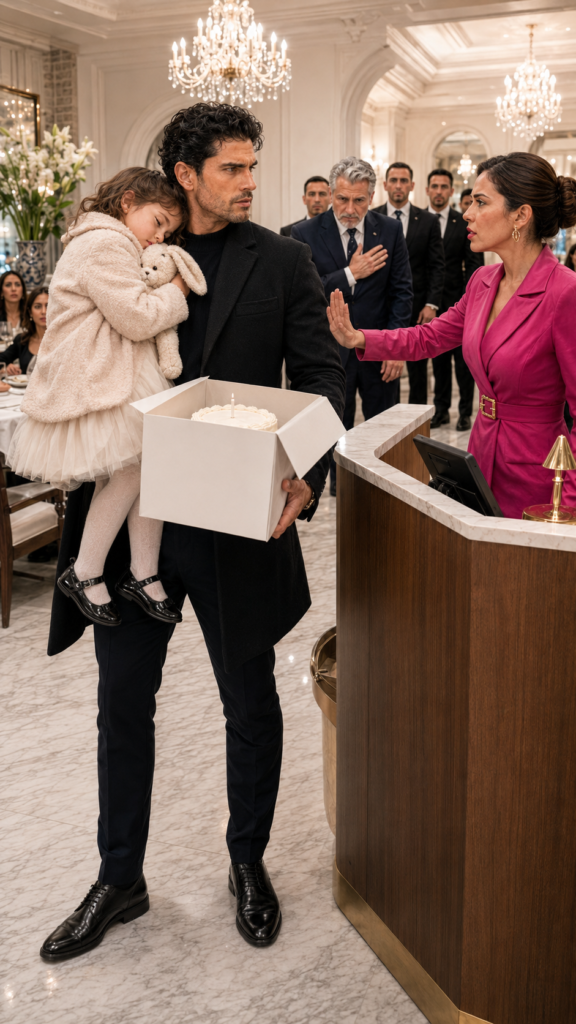
The words slipped from Mariela Robles’s mouth before over 30 customers, in the middle of a rain-soaked night on Avenida Presidente Masaryk, in Polanco.
The man she spoke to did not respond immediately.
He simply tightened his hold on the 5-year-old girl sleeping against his shoulder, cold and soaked, a stuffed bunny wedged between her little arms and a small cake box in her hand.
He wore an old brown coat, clean but frayed at the cuffs. His shoes were polished, yet it was clear they had seen far too many years.
For Mariela, manager of the restaurant El Mirador de Castilla, that was enough to decide that this man did not deserve to sit there.
The place shone as if to boast that it wasn’t for everyone: fine glasses, crystal lamps, impeccably uniformed waiters, soft music, and customers discussing trips, contracts, and expensive wines.
—I just need a small table —the man said in a calm voice—. My daughter is tired. We won’t take long.
Mariela smiled, but her eyes were anything but kind.
—We’re full.
The man looked toward the dining area. There were three empty tables by the window.
—I see empty tables.
—Reserved —she replied curtly—. Besides, our customers come for an experience. I can’t allow someone to ruin the atmosphere.
Several customers pretended to look at their phones. Others lowered their voices, but no one intervened.
The little girl stirred in her father’s arms.
—Daddy… are we there yet?
He stroked her wet hair.
—Yes, my angel. Sleep a little longer.
A few steps away, Renata Cruz watched with a tray in her hands.
She was 27, worked double shifts, and had endured months of Mariela’s screams because she needed to pay the rent on a tiny room in the Portales neighborhood. That very week, her tips had been docked for a bottle broken by a drunken customer.
Renata recognized that look. The look that says: “you’re worthless.”
But when she saw the girl trembling from the cold, something lodged in her chest.
She approached slowly.
—Sir, I can seat you at a table in the back. The girl can have something warm.
Mariela turned as if she had been insulted.
—Renata, come here. Now.
She dragged her to the service hallway and squeezed her arm.
—Are you crazy? If you sit that man, you’re out today. And forget about your tips, your Sundays, and any recommendations. Seriously, don’t provoke me.
Renata felt fear. A lot of it.
She thought about her nearly empty fridge, her landlord collecting rent, the broken sneakers she hid beneath her uniform.
But then she looked back at the father. Still standing there, silent, carrying his daughter as if she were his whole world.
Renata swallowed hard.
—You can fire me if you want —she said—, but I won’t leave a sick little girl at the door just because her dad doesn’t wear expensive clothes.
Mariela’s eyes widened with fury.
Renata returned to the dining area, heated a cup of milk in the staff kitchen, and prepared a table behind a column.
—This way, sir.
The man looked at her with silent gratitude.
He seated the girl with a tenderness that made Renata lower her gaze to avoid crying.
—Thank you —he said.
—Don’t thank me. It was the right thing to do.
The little girl barely opened her eyes.
—Is it for Mommy?
The man placed the cake box on the table.
—Yes, Camila. It’s to sing to Mommy.
Renata felt a chill.
She didn’t know that night was the birthday of that man’s deceased wife.
And she also didn’t know that in five minutes, lawyers would walk through the door with documents capable of sinking Mariela in front of everyone.
PART 2
For a few minutes, that hidden table seemed to exist far from the restaurant’s noise.
Camila drank her warm milk with both hands, still sleepy. Her stuffed bunny, whom she called Nico, sat beside the cake as if waiting for the candle.
The man carefully opened the cake box.
Inside was a simple vanilla cake, with a single white candle. It wasn’t an expensive dessert. It had no elegant decorations. But he looked at it as if it held something sacred.
Renata didn’t ask anything.
Some sorrows shouldn’t be touched unless invited.
—If you need anything else, let me know —she murmured.
The man nodded.
—You’ve already done too much.
—No, sir. The minimum.
He looked at her for the first time with attention.
—What’s your name?
—Renata Cruz.
—Thank you, Renata.
She returned to the hallway with a tight chest, unsure if in a few minutes she would have a job or if she’d leave with her things in a black bag.
Mariela did not take long to appear.
She came walking with firm heels, her face red with rage and a smile that announced nothing good.
—I told you not to serve them —she spat in front of Renata, raising her voice on purpose.
The dining room fell silent again.
Camila shrank in her chair.
The man placed a hand on her shoulder.
—It’s okay, my angel.
Mariela pointed at Renata.
—Take off your apron. You’re fired. And you, sir, you need to leave. This restaurant is not a refuge for just anyone.
Some customers exchanged uncomfortable glances. An elderly lady with silver hair pursed her lips but said nothing.
Renata felt the ground shift beneath her.
—Mariela, please...
—Please what? —the manager interrupted—. I’m in charge here. And if I say someone doesn’t fit the image, they don’t come in. It’s that simple.
The man raised his gaze.
Until that moment, he had been patient. Too patient.
—Is this how you always treat people?
Mariela let out a short laugh.
—I treat everyone according to how they deserve it.
—And what do you think I deserve?
She looked him up and down.
—You deserve to understand there are places where you don’t belong.
Confused, Camila hugged her bunny.
—Daddy, are we going to sing to Mommy now?
The question fell like a stone in the middle of the silence.
The man closed his eyes for a moment.
Renata covered her mouth with her hand.
Mariela blinked, uncomfortable, but she didn’t back down.
—Don’t use the child to manipulate the situation —she said.
Then something changed in the man’s face.
He didn’t shout. He didn’t insult. He didn’t stand up abruptly.
He just took out his phone from his old coat, checked a message, and said:
—Come in.
The restaurant’s main door opened almost immediately.
Four people appeared: two lawyers, an accountant, and a man in a gray suit carrying a thick folder. They didn’t ask for a table. They didn’t look at the menu. They walked straight toward him.
The older lawyer nodded his head.
—Mr. Valdivia, we have everything ready.
The surname made several customers turn.
Mariela froze.
—Valdivia? —she whispered.
The man stood up slowly.
—Diego Valdivia —he said—. Owner of Grupo Bruma. And also of this restaurant for the past eight years.
The color drained from Mariela’s face.
Renata’s eyes widened in disbelief.
The man in the old coat, the man who had just been humiliated for looking poor, was the owner of the place.
Diego placed the white candle from the cake next to Camila.
—Renata, can you take my daughter to a quiet place? I don’t want her to hear what comes next.
Renata nodded, still trembling.
—Of course.
Camila took her plate with a small piece of cake.
—Can I take Nico?
—Yes, my love —Diego said—. Nico can come too.
Before leaving, the girl looked at Mariela with innocence.
—My mommy said you shouldn’t treat sad people badly.
No one said anything.
Renata took her to the private lounge.
When the door closed, Diego stopped seeming like a tired father. His gaze turned firm, cold, precise.
—Now, Mariela. Sit down.
She tried to smile.
—Mr. Valdivia, this is a misunderstanding. I didn’t know you were...
—That’s the point —he cut her off—. You didn’t know who I was. That’s why you showed me who you are.
The lawyer placed the folder on the table.
Diego didn’t open it right away.
—For six months, we’ve been reviewing this restaurant. Complaints from employees, withheld tips, fabricated discounts, unpaid overtime, strange dismissals, and customers turned away for “not looking appropriate.” I just came to spend a quiet evening with my daughter for her mother’s birthday.
He paused.
—But you decided to give me the final proof.
Mariela swallowed hard.
—I’m just protecting the restaurant’s prestige.
—No. You were protecting your ego.
The accountant opened the folder.
—We have records of withheld tips for the past two years. Deposits that don’t match what was reported. Punishments applied without authorization. And transfers to a personal account linked to Mrs. Robles.
A murmur swept through the dining area.
Mariela leaned against the back of a chair.
—That doesn’t prove anything.
The lawyer pulled out several sheets.
—We also have 14 signed testimonies. Cooks, waiters, busboys, and cleaning staff. All describe threats, humiliations, and illegal deductions.
Diego looked toward the employees, who had gathered near the kitchen.
—No one is obligated to speak. But anyone who wants to, this is the moment.
For a few seconds, no one moved.
Fear doesn’t disappear just because someone powerful opens a folder.
Then a young waiter named Toño stepped forward.
—I had three days of tips taken from me because a customer left without paying for a bottle. I wasn’t even serving that table.
A cook raised her hand.
—I was made to stay until 2 in the morning. When I asked to be paid for those hours, she told me there was a line of women looking for work at the Central de Abasto.
Another waitress spoke from the hallway.
—My mom came once to bring me medicine. Mariela wouldn’t let her in because she looked like a market woman.
The testimonies began to pour out like water held back for too long.
They weren’t scandals. They were wounds.
Every phrase took a piece of authority away from Mariela.
She looked at everyone with rage, as if the betrayal were theirs and not hers.
—You’re all ungrateful! —she shouted—. I built this place. I made important people come.
Diego shook his head.
—You confused elegance with disdain. And confused authority with cruelty.
Mariela wanted to respond, but her voice cracked.
—Please... I need this job.
The silence became heavy.
Many employees lowered their gazes. Not because they forgave her, but because they also knew what it was like to be afraid of losing a paycheck.
Diego didn’t smile. He didn’t enjoy watching her fall.
—You also knew they needed their jobs —he said—. And yet you took their money, dignity, and peace. You’re not losing everything today because of a mistake. You’re facing a consequence.
The lawyer closed a folder.
—From this moment, Mrs. Robles is suspended from all duties. Tomorrow, a complaint will be filed for fraudulent management and wrongful withholding of tips. A full audit of the past three years will also be conducted.
Mariela covered her face with her hands.
—You can’t do this to me.
Diego looked at her with painful calm.
—We’re not doing this to you. You did it. We just turned on the light.
No one applauded.
No one insulted her.
Mariela left her badge on the counter and walked toward the exit. When she opened the door, the night’s rain hit her face as if the city were collecting something from her too.
When she left, Diego turned to the staff.
—Everyone owed money will be paid. Those who were unjustly fired will be sought out. This restaurant will change, or it will close. It’s that clear.
Toño wiped his eyes with his sleeve.
A cook began to cry silently.
Diego lowered his voice.
—And one more thing. No one who works here will ever be treated like they’re disposable again.
He then walked toward the private lounge.
Upon entering, he found Camila sitting with Renata. The girl was explaining to him that wishes for moms in heaven must be made with great strength because the clouds sometimes make noise.
Renata held the bunny Nico carefully.
When she saw Diego, she stood up abruptly.
—Sir, I’m sorry. I didn’t know who you were. I didn’t mean to get involved where I shouldn’t have.
Diego raised a hand.
—Don’t apologize. You were the only one who got involved where you should have.
Renata lowered her gaze.
—I was scared.
—But you did it.
She let out a sad laugh.
—Well, yes. I was more afraid of becoming someone like her.
Diego fell silent for a few seconds.
—Renata, I could give you money as thanks. But that would be little for what you did. You didn’t help my daughter expecting something. You helped her because you saw her.
Renata pressed her lips together to hold back tears.
—I was just a little girl with cold.
—To you, yes. To others, she was a bad image.
Camila raised her hand.
—Renata also fixed Nico’s little ear.
Diego smiled sadly.
—Then Nico knows how to recognize good people.
The girl nodded seriously.
—Yes. Nico doesn’t stay with just anyone.
Renata covered her mouth, moved.
Diego took the white candle and placed it on the cake.
—Before we talk about work, we have something more important.
He lit the candle.
The tiny flame illuminated the faces of the three.
Camila clasped her hands.
—Can I wish that Mommy doesn’t forget about us?
Diego knelt beside her.
—Your mommy would never forget you.
—And you won’t either?
Diego’s eyes watered.
—I won’t either, my angel.
Camila closed her eyes tightly.
—Mommy, we’re still coming. And I brought Nico. And Renata was good to us.
Then she blew.
The candle went out.
The smoke rose slowly, as if carrying the message to a place where pain no longer hurt.
Renata cried silently.
Diego stared at the cake.
His wife, Julia, had died two years earlier. Every year on her birthday, he took Camila to a different place to light a candle. It was their way of saying she was still sitting with them, even though they could no longer see her.
That night, however, Julia seemed to have left another lesson.
Diego looked at Renata.
—I want to offer you a position.
She blinked.
—As a waitress?
—No. I want you to be part of the team that will remake the service for the entire group. Restaurants, cafés, hotels. I need people who can teach others to see people the way you saw my daughter.
Renata opened her mouth, astonished.
—I didn’t study for that.
—There are people with degrees who never learned what you did in one minute.
—But I...
—You’ll be trained. You’ll be well paid. You’ll be supported. What can’t be taught is the heart.
Renata cried now, unable to hide it.
—My whole life, I’ve been told I’m replaceable.
Diego gently shook his head.
—Tonight, you proved you’re not.
Camila offered her a piece of cake.
—You have to eat. It’s from my mommy. She liked to share.
Renata accepted it as if it were something sacred.
—Thank you, sweetheart.
The girl placed the bunny in her hands.
—Nico can stay with you for a little while. Just a little.
—Are you sure?
—Yes. Because you don’t see him as old. You see him as loved.
That phrase broke something inside Renata, but not to hurt her. It broke to let in light.
Months later, El Mirador de Castilla was no longer the same.
Back pay tips were paid. Damaged employees were compensated. The entire management was changed. Some customers stopped coming because, according to them, the place “no longer had the same atmosphere.”
Diego didn’t miss them.
Renata became one of the most respected voices of the group. She didn’t speak with elegant words or textbook phrases. She spoke from life.
She told new employees:
—Honestly, you never know who arrives broken, tired, or with a story behind them. Don’t treat nicely only those who look rich. Treat well because you’re human too.
In her office, she always kept Nico, Camila’s old bunny, with the ear sewn back on.
Years later, Camila understood that night better.
She asked her dad why he never sought revenge with shouting, if he could have destroyed Mariela in an instant.
Diego looked at Julia’s photo on his desk.
—Because your mommy taught me that power is not for humiliation. It’s for stopping those who humiliate.
Camila smiled with nostalgia.
—So Mommy did hear my wish.
Diego nodded.
—I’m sure she did.
Because that night, not only did an abusive manager fall.
It also became clear that many prefer to forget: a person’s dignity is not measured by their coat, their shoes, or the table they sit at.
It’s measured by how they treat those they believe can give them nothing in return.