PART 1
The first time Renata called Mateo Landa useless, everyone pretended not to hear.
The second time, Mateo decided to let them laugh.
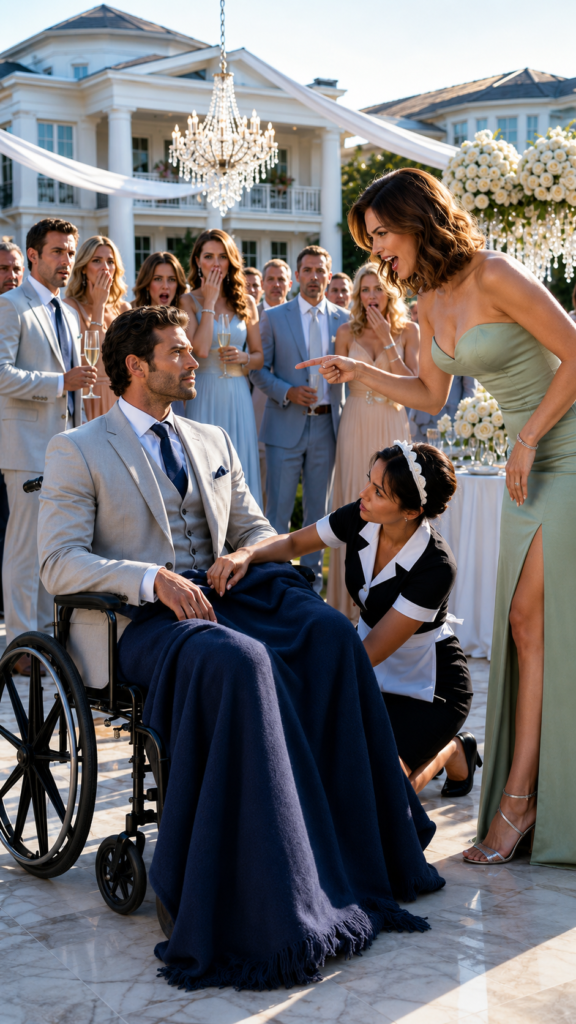
He was seated in a wheelchair, in the middle of the grand hall of the family mansion in Las Lomas, covered with a gray blanket that hid his legs. Above him, enormous lamps shone, the kind his father boasted about every Christmas, while guests raised their champagne glasses as if they were at a wedding and not at the return of a man everyone believed was broken forever.
The accident had indeed happened.
The injury, no.
Mateo could walk.
Only his trusted doctor, his lawyer, and the head of the company's security knew. To the rest of the world, the heir of Grupo Landa had lost mobility after his truck overturned on the road to Valle de Bravo.
And Mateo wanted them to believe it.
Especially Renata.
She appeared in a silver, tight, expensive dress, with her engagement ring shining like a crown. She moved among the guests with a smile so perfect it was frightening.
She approached the wheelchair and leaned down to him.
"Just look at you," she whispered, but loud enough for several to hear. "Everyone used to fear you. Now you're nothing, Mateo. A hindrance."
Some let out an uncomfortable laugh.
Others looked at the floor.
No one said anything.
His uncle Arturo, who had been eyeing a position in the company's presidency for years, pretended to check his phone. Daniel, his supposed best friend since college, clenched his jaw and poured himself more tequila. Renata's mother smiled as if she had just heard a refined joke.
Mateo kept his face calm.
"We're still engaged," he said in a low voice.
Renata let out a dry laugh.
"For now, pal. Until the board realizes you can't even walk into a meeting. Do you really think I'm going to spend my life pushing your chair?"
That phrase confirmed what he suspected.
Renata didn't suffer for him.
Renata hoped he'd sink.
Then someone knelt next to the chair.
It was Alma, the housemaid who had been working there for 3 years. She wore no jewelry, no elegant dress. Just a simple blue uniform and hands trembling with anger.
She adjusted the blanket that Renata had accidentally kicked.
"You still deserve to be treated with respect, Mr. Mateo," she murmured.
The room went cold.
Renata looked her up and down.
"How sweet. The maid defending the invalid."
Alma lowered her gaze but didn't step back.
And just when Mateo was about to respond, Renata raised her glass and said in front of everyone:
"Let's toast to Mateo… because at least now he won't be a hindrance in important decisions."
PART 2
The toast hung in the air like a slap.
No one moved.
Some guests pretended to cough. Others brought their glass to their lips to hide their embarrassment. But none, not a single one, dared to tell Renata to shut up.
Mateo watched every face.
He didn't need to shout.
He didn't need to stand up yet.
That night he wasn't there to defend his pride, but to discover who celebrated his downfall.
Renata clinked her glass with her mother's.
"Oh, don't make those faces," she said, laughing. "If everyone is thinking it. Mateo used to rule like a king. Now we need to be practical."
Uncle Arturo seized the silence.
"Renata's just being realistic," he commented gravely. "The group needs stability. Investors are nervous. No one wants a president who depends on nurses."
Mateo slowly turned the wheelchair towards him.
"Is that what you think, Uncle?"
Arturo raised his hands, feigning pain.
"Son, don't take it personally. Your father would agree. He always put the company first."
The mention of his father tightened something inside Mateo.
Don Ernesto Landa had died 2 years prior, leaving Mateo a fortune, an immense company, and a family full of false smiles.
Since then, everyone had wanted something.
Arturo wanted power.
Daniel wanted contracts.
Renata wanted the name.
And Alma, the only one who asked for nothing, was the one kneeling next to him.
"Leave," ordered Renata, looking at Alma. "You're not paid to involve yourself in family conversations."
Alma swallowed hard.
"I'm not paid to witness humiliation either."
A murmur swept through the room.
Renata's face changed.
"Excuse me?"
"You heard me, miss," said Alma, with a voice low but firm. "It's one thing to serve dinner, and another to let you treat someone like trash."
Renata let out a venomous laugh.
"And who are you? The heroine of some novel? Get real, girl. If it weren't for this house, you'd still be cleaning motel rooms."
Alma paled.
Mateo noticed her fingers were trembling.
He knew part of her story. He knew Alma had come from Puebla with her sick mom, that she worked double shifts and sent money for medicine. He knew she never stole a peso, never asked for favors, never complained even though Renata treated her like she was invisible.
But that night he learned something else.
Renata knew her too well.
"What did you mean by that?" Mateo asked.
Renata straightened up.
"Nothing. Just that the servants sometimes forget their place."
Alma lowered her gaze once more, but this time not out of fear.
Out of pain.
Mateo looked towards the corner of the room. His head of security, Ramiro, waited by the door, dressed like any other guest. He barely nodded.
Everything was ready.
But one piece was still missing.
Daniel approached Mateo, nervous.
"Brother, seriously, don't make a scene. Renata's upset. We all are. The accident was tough."
Mateo stared at him.
"Do you also think I'm a hindrance?"
Daniel didn't answer.
That was answer enough.
Renata stopped pretending.
She got so close that her perfume masked the smell of the flowers.
"Look, Mateo, I'll be clear. The engagement stays until the restructuring is signed. After that, we'll see what's convenient. My mom has contacts, Arturo knows the board, and Daniel can handle the transition without scandals."
Mateo felt an ancient chill run down his spine.
"Daniel?"
Daniel closed his eyes.
Renata smiled.
"Oh, don't act surprised. Your best friend has more vision than you. And, to be honest, more future."
The room filled with murmurs again.
Renata's mother tried to stop her.
"Daughter, enough."
"No, mom. I'm tired of pretending. I was going to marry a powerful man, not someone who needs help to climb a ramp."
Alma stood up abruptly.
"Enough!"
Her voice came out cracked but strong.
Renata pushed her shoulder.
"Shut up."
Alma lost her balance and hit the side table. A glass fell to the floor and shattered.
That sound made Mateo grip the wheels of the chair.
For the first time that night, his face changed.
"Don't touch her again."
Renata looked at him mockingly.
"Or what? Are you going to stand up?"
The room went completely silent.
Mateo took a deep breath.
Alma looked at him, confused, as if sensing something impossible.
Then Ramiro closed the doors of the room.
Arturo frowned.
"What is this?"
Mateo raised his hand.
On one of the room's screens, a recorded phone call appeared.
Renata's voice sounded clear.
"Don't kill him. Just make sure he's out for a few months. That'll be enough for Arturo to move the board."
Then Daniel's voice was heard.
"The mechanic already did his part. The brakes will fail at the curve."
Someone screamed.
Renata turned white.
Daniel stepped back.
Arturo dropped his glass to the floor.
"That's fake," he said. "It's edited."
Mateo did not respond.
The screen changed.
A security video from the company's parking lot appeared. Daniel handed an envelope to a man in a workshop uniform. Then, another clip showed Arturo signing documents to convene an extraordinary board meeting 24 hours after the accident.
Renata began to tremble.
"Mateo, I didn't know it would be so serious."
"But you knew," he said.
The words fell heavy.
Renata opened her mouth but found no lie sufficient.
Mateo turned the chair towards Daniel.
"You were with me since we were 18. You ate at my house, my father paid for your master's degree, I gave you shares when you had nothing. Why?"
Daniel cried, but not out of guilt.
Out of fear.
"Because you always had everything, dude. Everything. And I was always 'Mateo's friend.' Renata told me that if Arturo took control, I'd be CEO."
Mateo nodded slowly.
"Thank you for saying it in front of everyone."
Daniel raised his gaze.
Then he saw the microphones placed among the floral arrangements.
Renata's mother covered her mouth with her hands.
Renata whispered:
"This can't be."
Ramiro opened one of the doors.
Two lawyers, a notary, and three police officers entered.
The room exploded in screams.
Arturo tried to approach Mateo.
"Nephew, we can resolve this as a family."
Mateo let out a bitter laugh.
"That's what they said when my dad died and you all fought over his watches before the funeral."
Arturo stopped.
"Don't exaggerate."
"I'm not exaggerating. I'm learning."
Renata fell to her knees next to the chair.
The same woman who 10 minutes ago called him a hindrance now held his hand desperately.
"Love, listen to me. I was manipulated. Arturo filled my head. Daniel too. I was scared. I didn't want to lose my life."
Mateo looked at her hand on his.
He felt no love.
No anger.
Just a dry sadness.
"What you were afraid of losing wasn't your life, Renata. It was my money."
She began to cry harder.
"Don't say that. I did love you."
Alma, from the side, wiped a silent tear.
Mateo saw her.
And remembered something none of the guests knew.
The night of the accident, when he awoke in the hospital, the first person outside the medical team who asked about him wasn't Renata. It wasn't Daniel. It wasn't Arturo.
It was Alma.
She arrived with her uniform stained with bleach, after taking two buses, and stayed in the waiting room until dawn. No one let her in because "she wasn't family." Still, she left a bag with clean socks and a note written in crooked handwriting:
"I don't know if you can read this, but you're not alone."
Mateo had kept that note.
That was why he decided to wait.
He wanted to know if Alma's kindness was real or just pity.
And that night it was clear.
Renata didn't cry for him.
Alma did.
But the final blow hadn't yet arrived.
One of the lawyers took out a blue folder and placed it on the table.
"Mr. Landa," he said, "as per your instructions, an internal audit was conducted. We found irregular transfers amounting to 18 million pesos from supplier accounts linked to Mr. Arturo Landa."
Arturo lost his color.
"That has nothing to do with the accident."
"It has everything to do with it," Mateo replied. "You wanted to sit in my chair because you knew that as soon as I reviewed the accounts, I'd find the theft."
The notary opened another document.
"Also, due to a clause of fraudulent conduct, the prenuptial agreement with Miss Renata Escobar is canceled. She loses all rights to assets, shares, trusts, and properties of Mr. Landa."
Renata raised her head.
"You can't do this to me."
Mateo looked at her one last time.
"You did this to yourself."
The police approached Daniel.
He didn't resist.
Renata tried to run to her mother, but Ramiro blocked her path. Arturo began shouting that it was a trap, that no one could prove anything, that the Landas didn't expose themselves like this in front of strangers.
Mateo let him shout.
Then he removed the gray blanket from his legs.
The entire room stopped breathing.
He placed one hand on the armrest.
Then the other.
And stood up.
Renata let out a choked scream.
Daniel's eyes widened as if he'd seen a ghost.
Arturo backed away.
Mateo was pale, thinner, with pain in his body from weeks of therapy and confinement. But he was standing.
Not as a miracle.
As a verdict.
"The accident didn't leave me paralyzed," he said, looking at everyone. "But it did show me who had already buried me."
No one clapped.
No one dared.
Because everyone understood they had been part of the cruelest spectacle: not that of a man pretending weakness, but of a family showing its true face.
Mateo walked slowly towards Alma.
She stepped back, nervous.
"Sir, I didn't know…"
"I know."
"I didn't do this for a reward."
"I also know."
He took out from his jacket the note she had left him in the hospital. It was folded, worn, cared for like something precious.
Alma covered her mouth.
Mateo showed it to her.
"When everyone treated me like a problem, you treated me like a person."
Renata, already handcuffed, shouted from the door:
"Don't tell me you're going to fall for the maid now! How ridiculous!"
Mateo didn't even turn.
"The ridiculous thing was believing that the name, the money, and a table full of hypocrites were worth more than dignity."
Alma cried silently.
Mateo didn't touch her, didn't hug her in front of everyone, didn't turn her kindness into a spectacle. He just told her something she'd never heard in that house:
"Thank you, Alma."
And those two words weighed more than all the toasts of the night.
Months later, Grupo Landa survived.
Arturo faced charges of fraud and attempted murder. Daniel confessed to reduce his sentence. Renata sold her jewelry to pay lawyers and discovered that many of her "friends" only answered when there were parties, trips, or money involved.
The mansion in Las Lomas stopped hosting ostentatious receptions.
Mateo changed several things.
He fired those who had humiliated the staff, created a medical fund for employees, and converted part of the family house into offices for a foundation supporting working women caring for sick relatives.
Alma continued working there for a while, but no longer as a domestic worker.
Mateo paid for her administration studies, though she only accepted after signing a contract stating it wasn't charity, but a work scholarship. "Seriously, sir, I don't want anyone to say I was bought," she said.
He smiled for the first time in a long time.
"Then let them tell the truth: you earned it."
Over the months, their relationship changed slowly and carefully. It didn't stem from a rich-poor fantasy or an emotional debt. It was born from respect, conversations without masks, silences where no one had to pretend strength.
One Sunday, during a simple meal with pozole, Alma asked if he regretted pretending.
Mateo looked at his legs, then the house, then the garden where everyone used to pose with expensive glasses.
"I regret needing a ruse to see the truth," he said. "But not seeing it."
Alma set down her spoon.
"People show who they are when they think you can't offer them anything anymore."
Mateo nodded.
That phrase lingered between them.
Because in the end, the question many commented on afterward wasn't whether Mateo was right to pretend.
The real question was more uncomfortable:
How many people love you for who you are… and how many just hope you'll keep standing so they can keep taking advantage of you?