PART 1
Itzel Ríos had been told the same rule since her first day in the Arriaga house:
Don’t ask.
Don’t look too hard.
Don’t open any doors in the north wing after midnight.
The mansion was in Las Lomas, in Mexico City, hidden behind high walls, perfectly trimmed bougainvillea, and cameras that spun like metal eyes. On the outside, it seemed like the home of an elegant businessman. On the inside, everyone knew that it was ruled by the man whom many called “Don Mateo Arriaga” in public, but referred to as “the boss” in hushed tones.
Itzel was 23, came from Chalco, and worked as a live-in maid. She sent almost all of her salary to her mom, who sold tamales outside the metro, and to her younger brother, who was still in high school.
For two years, her life had been a precise routine.
Get up at 5:20.
Iron the uniform.
Prepare unsweetened pot coffee.
Take the tray to the office.
Knock twice.
Enter without raising her gaze.
Serve.
Leave.
Don Mateo almost never spoke to her. He was tall, serious, with the cold gaze of someone used to having everyone step aside. His suits looked freshly pulled from a Polanco display, but his hands bore scars no ordinary businessman would have.
In that house, there were cooks, drivers, gardeners, and armed men pretending to be bodyguards. No one spoke the truth, but everyone understood it.
Mateo Arriaga didn’t sell insurance.
No matter what the magazines said.
One morning, Itzel entered with the tray as usual. The marble floor was so polished it almost seemed like water. As she approached the desk, the tip of her shoe got caught in the carpet.
The coffee pot tilted.
The hot coffee was about to spill onto some documents.
But before it could happen, Mateo’s hand caught her wrist.
Firm.
Warm.
Precise.
Not a drop fell.
Itzel froze.
He didn’t even rise. He just held her long enough to save the tray… and two seconds more.
“Be careful,” he said, without fully looking at her.
She lowered her gaze, set down the coffee, and left with her heart pounding against her chest.
In the kitchen, Lupita, the cook, looked at her as if she could read her face.
“What’s wrong, girl?”
“I almost spilled the coffee.”
“And?”
“He grabbed my hand.”
Lupita placed the knife on the cutting board.
“Look, sweetie… if that man touched you to save the coffee, it’s nothing. But if he held you a second longer, watch out. With guys like him, an extra second is never free.”
Itzel wanted to laugh, but she couldn’t.
That night, it rained heavily. The city roared outside, with thunder, distant sirens, and the wind banging against the windows. Itzel couldn’t sleep. Her wrist still burned where Mateo had touched her, as if her skin remembered.
At 4:50 AM, she went down for water.
As she crossed the hallway of the north wing, she saw something impossible.
The office door was ajar.
A yellow light spilled out, and a low, broken sound came from inside, like someone struggling to breathe.
The rules screamed in her head: go, Itzel.
But her feet moved forward.
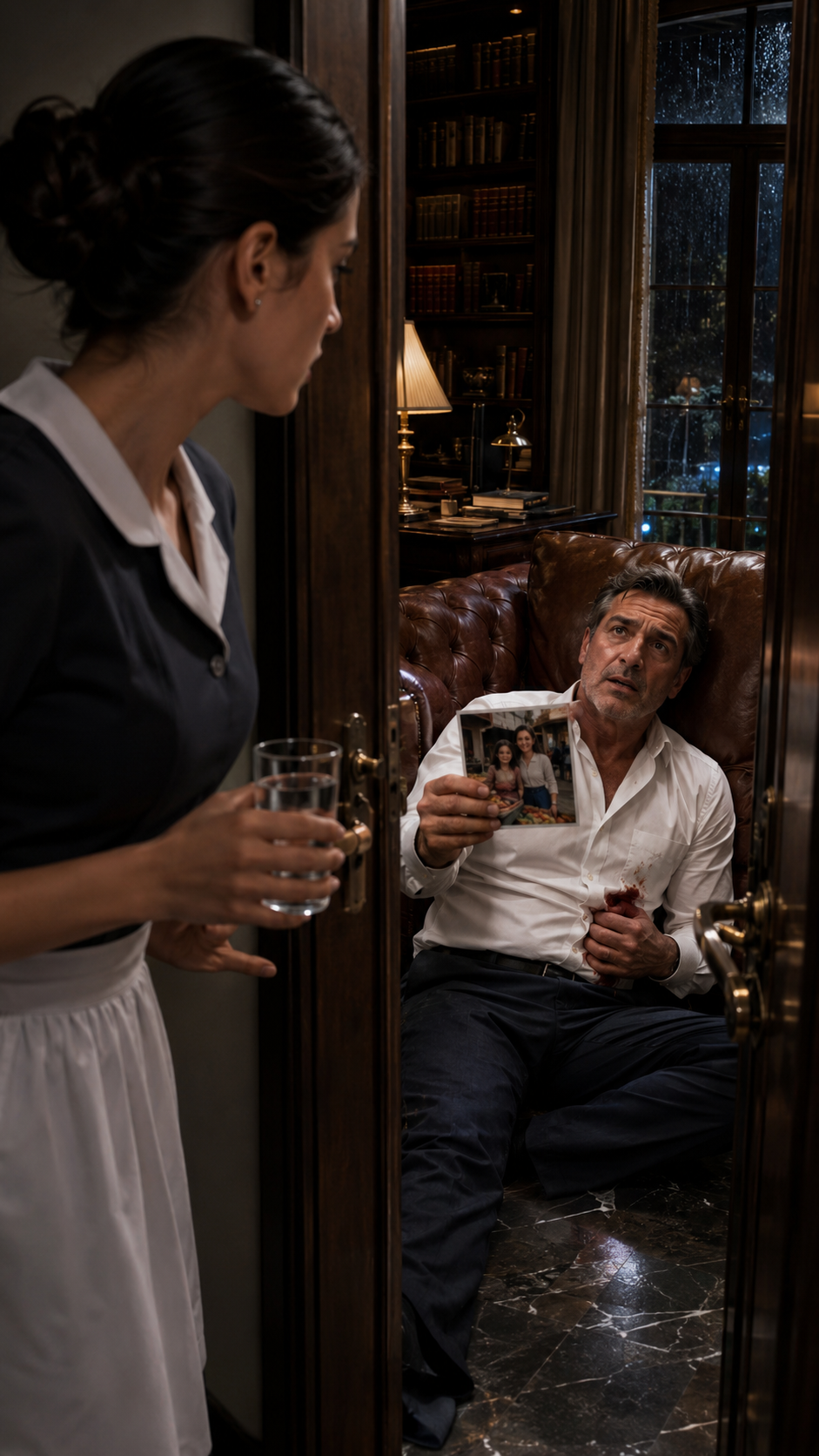
She pushed the door open just a bit.
And there he was.
Mateo Arriaga lay on the floor, propped against the leather sofa, his white shirt soaked in blood. One hand pressed against his side, his lips pale, and his body trembling.
He didn’t look like the boss.
He didn’t look untouchable.
He looked like a man dying.
Then he opened his eyes, just barely, and whispered a word that froze her blood:
“Itzel…”
He didn’t call her “girl.”
He didn’t call her “maid.”
He said her name as if he had held it in for years.
And when she took another step, she saw in his bloodied hand an old folded photo… a photo of her coming out of the market with her mom.
PART 2
Itzel felt the world tilt sideways.
The blood on the floor.
The storm outside.
The most feared man in the house uttering her name.
And that photo.
A photo she had never given to anyone.
“Why do you have that?” she asked, her voice breaking.
Mateo tried to hide it, but he had no strength. His hand fell heavily on the marble, and the photo was stained red.
“Go,” he growled. “If they find you here, they will kill you.”
“Who?”
Mateo gritted his teeth. His breathing became shorter.
“The same ones who did this.”
Itzel wanted to run. She wanted to scream. She wanted to wake Lupita, call an ambulance, flee through the service door, and never come back.
But she saw the open wound in his side and understood that if she left, he wouldn’t make it to dawn.
Her mother had taught her to sew since she was a child. She had also taught her never to let anyone die when she could still do something.
She knelt beside him and pressed her hands against the wound.
Mateo let out a choked moan.
“You don’t know what you’re getting into.”
“I really don’t care right now,” she replied, trembling. “Tell me where the first aid kit is.”
He looked at her as if she were the first person in years brave enough to disobey him without fear.
“Black cabinet. Second drawer.”
Itzel ran, pulled out gauze, alcohol, surgical thread, and bandages. There were more things in there than should be in a normal house: needles, antibiotics, sealed packages, unlabeled jars.
When she returned, Mateo’s eyes were almost closed.
“Don’t fall asleep,” she ordered him. “If you die here, you’ll ruin my life, boss.”
A weak, dark chuckle escaped his throat.
“You’ve never talked to me like that.”
“I’ve never seen you lying on the floor.”
Itzel cut his shirt with scissors. The wound was deep, but it didn’t look like a bullet. It was a stab wound. Someone had gotten close enough to betray him.
That scared her more.
Because a man like Mateo wasn’t hurt by just any enemy.
He was hurt by someone from his own table.
As she cleaned the blood, she saw something else: a silver chain around his neck, with a medal of the Virgin of Guadalupe. It wasn’t new or expensive. It looked worn, as if someone had worn it many years before him.
Mateo noticed her gaze.
“It belonged to my mother.”
“And what does that have to do with me?”
He closed his eyes.
“Everything.”
Itzel froze.
“Don’t give me mysteries, sir. You’re losing blood.”
Mateo took a deep breath, but the pain doubled him over.
“Two years ago, I asked for you to be hired.”
She felt a cold jab in her stomach.
“What?”
“You didn’t come here by accident.”
Itzel pressed the gauze against the wound harder.
“You investigated me?”
“Yes.”
“Why?”
Mateo opened his eyes. There was no ice in them now, just old guilt.
“Because your father died because of me.”
The silence grew so heavy that even the rain seemed to stop.
Itzel knew only one version of her father’s death. She had been told he was robbed leaving a construction site in Iztapalapa when she was seven. Her mother never wanted to talk much about it. She only cried every October 12 and kept a blue shirt in a shoebox.
“My dad was a construction worker,” Itzel said. “You’re delirious.”
“His name was Samuel Ríos. He worked as a driver for my family before you were born.”
Itzel shook her head.
“No.”
“The night he was killed, he tried to get my mother out of an ambush. He saved me too.”
She wanted to pull away, but if she took her hands off, the blood would flow again.
“Shut up.”
“I promised your mother that they would never be alone. But she didn’t want money. She didn’t want to see me. She told me that if I really felt ashamed, I should stay away.”
Itzel felt tears welling up in her eyes.
“Then why did you bring me here?”
Mateo swallowed hard.
“Because two years ago, someone asked about Samuel Ríos’s daughter. Someone from my own circle. If I left you outside, they would find you. If I brought you in here, I could keep an eye on you.”
The word “keep an eye on you” hurt more than his wound.
“So you kept me as your maid because you decided to lock me up nicely?”
“It wasn’t like that.”
“And the photo? Was that also to protect me?”
Mateo didn’t answer.
Itzel understood too much.
The photo wasn’t just surveillance.
It was obsession.
It was guilt.
It was a twisted form of affection he had never allowed himself to express.
Before she could confront him, footsteps echoed in the hallway.
Heavy.
Multiple.
Mateo’s eyes snapped open.
“Hide.”
“No.”
“Itzel, damn it, hide.”
She barely managed to grab a pair of scissors when the office door swung open.
Efraín, Mateo’s trusted man, entered. He always smiled in the kitchen, always called Itzel “shorty,” always carried a gun under his jacket.
Now he came with two bodyguards.
Seeing Mateo on the floor and Itzel kneeling beside him, he slowly smiled.
“What a sweet scene.”
Mateo tried to rise but couldn’t.
“Efraín.”
“Don’t even bother, boss. With that stab, you should be dead.”
Itzel was left breathless.
Efraín looked at the blood on her hands.
“But the little girl turned out to be more useful than expected.”
Mateo spoke in a low voice.
“She has nothing to do with this.”
“Of course she does. It all started because of her.”
Itzel frowned.
“Because of me?”
Efraín let out a dry laugh.
“Oh, girl. Do you really not know? Your dad didn’t die saving anyone. Your dad died because he had a notebook with names, accounts, and payments. A notebook that could sink the entire Arriaga family.”
Mateo froze.
“That’s a lie.”
“No, Mateo. What happened is that your dad lied to you before he died. Samuel wasn’t just a driver. He was the man who kept the secrets. And before they killed him, he hid something.”
Efraín looked at Itzel as if he had just found a safe.
“Something that his widow received unknowingly.”
Itzel thought of her house in Chalco.
Of the shoebox.
Of the blue shirt.
Of the things her mother never allowed her to touch.
“No…” she whispered.
Efraín smiled.
“Yes. And that’s why we wanted the daughter close. So Mateo could lead us right to the correct memory.”
The twist was brutal.
Mateo hadn’t protected her from strangers.
He had thrown her into the wolf’s mouth without knowing his own men were using her as bait.
Efraín raised the gun.
“Move, Itzel. The boss has lost. You can still cooperate.”
She looked at Mateo.
For the first time, the powerful man looked genuinely scared. Not for himself. For her.
“Forgive me,” he murmured.
Itzel wanted to hate him. And part of her did.
But she also saw the blood, the guilt, the shattered truth in his eyes.
Then she remembered Lupita.
The cook always said that big houses had more ears than walls. And that night, before going down for water, Itzel had left her phone charging in the kitchen with the audio activated to record a message from her mom.
But upon entering the office, she had turned it on without thinking when she saw the blood.
Everything was recorded.
Itzel took a deep breath.
“The notebook?” she said, pretending to surrender. “It’s in my mom’s box.”
Efraín smiled.
“Good girl.”
“But if you kill me here, you’ll never find it. My mom changes everything every week. She’s very distrustful.”
One of the bodyguards laughed.
“That does sound like a Mexican lady.”
Efraín lowered the weapon just a bit.
That second was enough.
Mateo, with the little strength he had left, kicked the floor lamp. The room plunged into semi-darkness. Itzel hurled the scissors at Efraín’s hand. The gun fell. Outside, screams erupted.
Lupita burst in with three house workers and an old gardener carrying a machete.
“Now, you bastards!” the cook shouted. “Let’s see if you’re so tough!”
The chaos lasted less than two minutes.
The bodyguards fled through the back door, but the cameras recorded everything. Efraín tried to escape, slipped on the blood, and fell to the ground. The gardener pressed the machete against his back until patrols from the National Guard arrived, called by Lupita from the kitchen.
Mateo was rushed to a private hospital in Santa Fe.
Itzel didn’t go with him.
She went to Chalco.
She arrived soaked, with dried blood on her hands and her soul in pieces. Her mom opened the door and, upon seeing her, didn’t ask anything. She just embraced her as if she had been waiting for that moment for 16 years.
That morning, they opened the shoebox together.
Inside the blue shirt was the notebook.
Names.
Dates.
Payments.
Photographs.
And a letter from Samuel Ríos.
In it, he explained that he had worked for the Arriagas, that he knew too much, and that if anything happened to him, his wife had to protect Itzel above all.
But in the end, there was a line that shattered both of them:
“Mateo wasn’t to blame. He was a child. If one day he seeks to make amends, don’t forgive him easily… but listen to him.”
The notebook not only sank Efraín. It also revealed dirty dealings, internal betrayals, and the network the mansion had exploited for years. There were arrests, searches, discreet news, and many names that stopped answering their phones.
Mateo survived.
But when he left the hospital, he no longer found Itzel in her black uniform or with the silver tray.
He found her three weeks later, outside a prosecutor’s office, accompanied by her mom and a lawyer. She wore jeans, a light jacket, and her head held high.
Mateo approached slowly.
“Itzel.”
She didn’t lower her gaze.
“I no longer work for you.”
“I know.”
“And I owe you nothing.”
“I know that too.”
He pulled out an envelope. It wasn’t money. It was paperwork: the deed to a new house in Itzel’s mom’s name, a paid scholarship for her brother, and a letter signed accepting to testify against the men from his own family.
“This doesn’t buy forgiveness,” he said.
Itzel took the papers but didn’t smile.
“No. It doesn’t buy it.”
Mateo nodded.
For the first time, the boss of Las Lomas seemed like an ordinary man. Tired. Hurt. Alone.
“So, what does it buy?”
Itzel looked at her mother, then at him.
“Nothing. But it serves to start paying.”
Mateo bowed his head.
Justice didn’t arrive perfectly. It never does in Mexico, especially when there’s power, money, and heavy surnames involved. But it came enough for Efraín to end up in prison, for Samuel’s truth to stop being a secret, and for Itzel to understand something many families prefer to silence:
Sometimes the one who says they protect you also locks you up.
Sometimes the one who seems a monster carries a debt.
And sometimes the only way to save someone is to stop obeying them.
Months later, Itzel opened a small café with her mom. They named it “The Blue Box,” after the box where the truth had slept for so many years.
One afternoon, Mateo appeared at the door. He didn’t enter. He just left a medal of the Virgin of Guadalupe on an empty table and walked away.
Itzel stared at it for a long time.
She didn’t forgive him that day.
Maybe never completely.
But she understood that some wounds don’t heal with love or money, but with truth, memory, and consequences.
And the question lingered among all who knew the story:
Did Mateo deserve a second chance… or are there damages that no regret can erase?