PART 1
The afternoon turned gray over Lomas de Angelópolis, and Ana Morales swept the marble steps of the Herrera mansion before the rain began.
She had been working there for 9 years. She knew the sound of every door, the staff's schedules, and even how Don Alberto left the keys when he arrived in a foul mood.
So, she knew immediately that something was off when she saw a small shadow pressed against the gate.
It was a boy about 8 years old, barefoot, wearing a torn sweatshirt and with purple lips. He looked at the house as one would look at a church when there’s no one left to ask for help.
Ana approached slowly.
—Are you lost, kid?
The boy shook his head. He didn’t speak. He just clutched his stomach with both hands, and that gesture was enough for Ana to understand everything.
Don Alberto was in a meeting in Mexico City. The driver had left, and the kitchen manager was out shopping for groceries. No one had to find out.
Still, Ana knew she was breaking the strictest rule of the house: no unknown person could cross the gate.
She glanced again at the boy's hurt feet.
—Come in quickly —she whispered—. Before I change my mind.
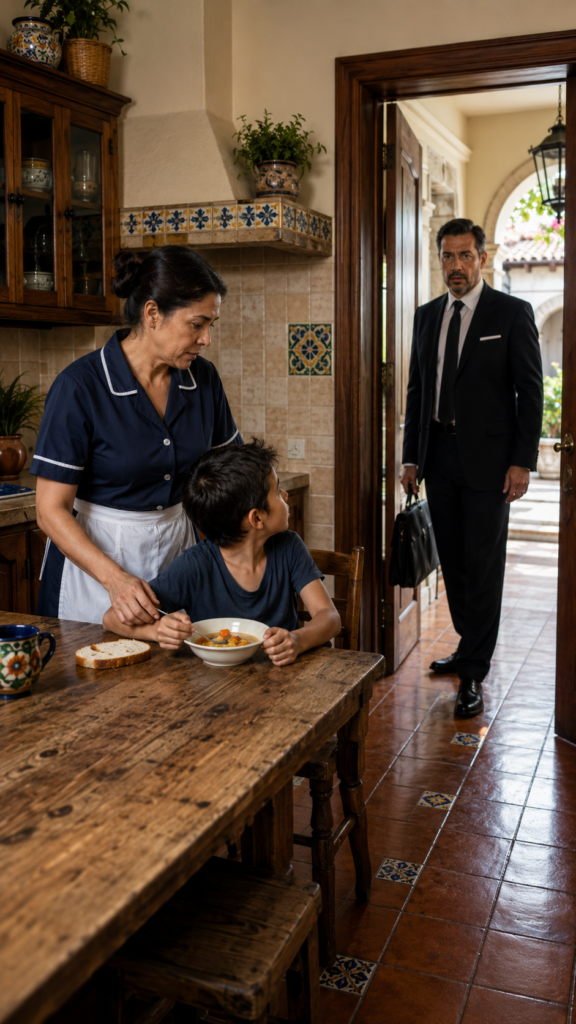
She led him through the service entrance, sat him at the kitchen table, and heated a plate of beef broth with rice. When the smell filled the room, the boy began to cry silently.
He ate with such desperation that Ana had to tell him to slow down.
—You’re going to choke, sweetheart. No one here is going to take your plate away.
The little boy looked up, as if that phrase were something he had never heard before.
—My name is Diego —he finally said.
Ana was just about to ask him where his parents were when a loud bang shook the house.
Then the sound of footsteps echoed on the marble.
Don Alberto had returned 3 hours early.
Ana felt her legs go weak. She thought of the rent, her medications, and the money she sent every month to her sister in Atlixco. Losing this job would leave her on the street.
The kitchen door swung open.
Don Alberto appeared with a wet coat and a hard expression. First, he looked at Ana. Then he took in the ragged child eating from one of the porcelain bowls of his late wife.
—Sir, I can explain…
He raised his hand.
Diego dropped his spoon and shrank back in the chair, bracing himself to be thrown out.
For several seconds, nothing was heard except the rain beating against the windows.
—What’s your name? —Alberto asked.
—Diego.
—Finish eating, Diego.
Ana looked at him in confusion.
Don Alberto sat down in front of the boy and asked where he had slept. Diego lowered his head.
—Behind a store. But I didn’t steal anything, I swear.
The businessman’s toughness cracked just a bit.
—You’re not going to sleep outside tonight.
Ana thought the worst had passed. She didn’t know that when she removed the wet sweatshirt to give him clean clothes, she would find a letter sewn inside the lining.
On the envelope, written in faded ink, was a name that made Don Alberto pale: “For Alberto Herrera.”
PART 2
Alberto took the envelope with stiff hands.
—Who gave you this? —he asked Diego.
The boy hugged the clean clothes to his chest.
—My mom. She told me that if she didn’t wake up, I should look for the big house with the black gate. She said someone here owed us an answer.
Don Alberto opened the letter.
The letter was from Marisol Vega, a former employee of a packing company in the Herrera Group. Her husband had died 2 years earlier in a boiler explosion due to lack of maintenance, and the promised compensation never arrived.
Marisol had sent documents and visited the offices 6 times, but she was always met by Rodrigo Herrera, Don Alberto’s nephew and the group’s administrative director.
According to the letter, Rodrigo had demanded she sign away her rights in exchange for a miserable amount. When she refused, the threats began.
Ana watched as Alberto clenched his jaw.
—I never received these letters.
On the last page, Marisol explained that she suffered from kidney failure. She had sent Diego to the mansion because she feared dying in the room they rented.
The letter ended with a brief sentence: “I don’t ask for charity. I ask you to find out what they did with the money that bore my son’s name.”
Diego looked at Alberto with fear.
—Did my mom do something wrong?
Alberto knelt before him.
—No, son. We adults let you down.
That same night, they located Marisol in a hospital in Puebla, unconscious for 2 days. Although Alberto paid for her transfer, the damage was irreversible.
Diego managed to see her for a few minutes.
Marisol opened her eyes at the feel of her son’s hand. Then she looked at Ana, who was beside the bed, and then at Alberto.
—Don’t let them take him away —she murmured—. Rodrigo knows Diego has proof.
Alberto leaned in.
—I promise you.
Marisol died before dawn.
Diego didn’t scream. He remained motionless, lost in thought, until Ana hugged him. Then he clung to her and cried as if his small body would break.
The following days, the mansion changed.
Diego began sleeping in a room near Ana’s because he woke up screaming. She made him hot chocolate and sat with him until he fell asleep again.
Alberto stopped going to the office. He hired external auditors and reviewed old files.
What he found was worse than he imagined.
Rodrigo had diverted a fund intended for families of injured workers for 5 years. He forged signatures, pressured widows, and funneled money to shell companies.
Diego’s compensation had been approved. It amounted to 1,800,000 pesos in insurance, compensation, and scholarships.
Rodrigo had kept it all.
When Alberto summoned him to the mansion, Rodrigo arrived accompanied by his mother, Beatriz, Alberto’s older sister.
Beatriz stormed in, furious, without even greeting Ana.
—Are you really going to destroy your nephew over the word of a dead woman and a street kid?
Diego listened from the hallway.
Ana wanted to take him to his room, but he stood still.
Alberto slammed copies of transfers, forged signatures, and recovered recordings from the offices onto the table.
—It’s not just a word. These are 63 families robbed.
Rodrigo didn’t deny anything. He adjusted his watch and let out a nervous laugh.
—Don’t be naive, uncle. You never asked questions. You loved appearing in magazines as the exemplary businessman while we cleaned up your problems.
The phrase hit Alberto because it contained a part of the truth: he had delegated everything and signed reports without reading them.
Beatriz pointed at Ana.
—This is her doing. She brought the boy in, invented a tragedy, and now she wants to keep the house.
Ana felt her face burn.
—I just fed him.
—Your kind always starts that way —spat Beatriz—. First, they elicit pity, and then they feel like family.
Don Alberto slammed his palm on the table.
—Ana has been more family to me in these weeks than you have in 15 years.
Beatriz paled.
Rodrigo looked towards the hallway and saw Diego.
—You don’t belong here, kid. It’s your fault your mother died alone.
Diego recoiled as if slapped.
Ana crossed the room and stood in front of Rodrigo.
—You speak to him like that again, and I’m the one who will throw you out of this house.
Rodrigo smiled disdainfully.
—You? You’re the maid.
—No —Alberto said from behind her—. She’s the person who had the courage I lacked.
Then he called the officers waiting outside.
Rodrigo was arrested for fraud, extortion, and forgery. Beatriz followed him out, screaming that Alberto would regret it when that “brat” took away his inheritance.
But the scandal was just beginning.
When the news reached the press, several families reported the Herrera Group. Partners advised him to pay quietly and protect the family name.
Alberto refused. He publicly acknowledged that he had ignored the signs and announced he would sell 2 properties to make amends. Many called him a hypocrite, and he didn’t argue.
—Maybe they’re right —he confessed to Ana that night—. Helping now doesn’t erase that I didn’t want to look before.
—It doesn’t erase it —she replied—. But facing it is where repair begins.
In the meantime, social services were investigating Diego’s situation.
There was no registered father. His only local relative was a second cousin who appeared 3 weeks later, just when the recovered compensation became public.
The woman claimed to love Diego and demanded custody.
Ana had been suspicious from the first minute.
During the interview, the supposed aunt couldn’t name the school Diego had attended nor remember that he was allergic to peanuts. However, she asked 4 times when they would release the money.
Diego hid behind Ana.
—I don’t want to go with her.
That night, Diego left a backpack by the door.
—What are you doing, champ? —Alberto asked.
—I’m leaving before they take me away. That way, I won’t cause any problems.
Alberto knelt in front of him.
—Listen to me carefully. You are not a problem. The problem was that too many adults decided that your pain was none of their business.
Diego pressed his lips together.
—What if the judge says I have to go?
—Then we’ll fight for you without lying, without bribing anyone, and without giving up.
Ana sat next to him.
—All three of us.
At the hearing, the aunt presented old photographs to prove kinship. She seemed to have the advantage until Alberto’s attorney showed messages obtained with judicial authorization.
The woman had written to Beatriz 2 days before showing up at social services.
Beatriz offered her money to seek custody, to take Diego out of the mansion, and to force Alberto to abandon the adoption to prevent “a stranger from tainting the family succession.”
The room fell silent.
Beatriz, sitting at the back, began to cry and claimed she only wanted to protect her parents’ heritage.
Alberto looked at her with deep sadness.
—You didn’t protect the family. You showed that you never understood what that word means.
The judge denied the aunt’s request and ordered an investigation into the attempt at manipulation.
However, it was still unresolved who would legally care for Diego.
Alberto requested to adopt him.
During the evaluation, he acknowledged his negligence and stated that Ana was the main figure of emotional security for the boy.
The psychologist asked Diego who he felt at home with.
He pointed at Alberto.
—With him, I feel like someone is defending me.
Then he took Ana’s hand.
—And with her, I feel like I still have a mom, even though I know my real mom is in heaven.
Ana broke down in tears.
Months later, the adoption was approved.
Upon leaving the courthouse, Alberto knelt to embrace Diego. The boy said “dad” for the first time without asking for permission.
Then he ran to Ana.
—And are you going to stay?
Ana looked at Alberto. Until then, she was still in uniform and being paid as an employee, although that relationship had long ceased to be merely professional.
Alberto handed her a folder.
It was a proposal for her to become Diego's substitute guardian and the director of a foundation funded with Alberto’s personal assets, dedicated to supporting children of workers affected by workplace accidents.
—I don’t need you to stop working —he said—. I need your work to have the place and respect it should have always had.
Ana accepted with one condition: that no assistance bore the Herrera name and that families participated in every decision.
Alberto smiled.
—Deal.
The mansion ceased to be a silent place.
Diego filled the hallways with toys, schoolwork, and muddy shoes. Ana no longer ate hidden in the service table. The three of them had dinner together, though some relatives stopped visiting.
Rodrigo was sentenced and returned part of the money. Beatriz covered her civil liability but never apologized to Diego.
Some said Ana had taken advantage of the situation. Others accused Alberto of turning guilt into publicity.
They stopped caring.
Each anniversary of Marisol’s death, Diego brought flowers to the cemetery. Alberto stayed a few steps away, respecting the place of the woman who had fought to the end.
Ana remained beside the boy.
Everything had begun with a broken rule, a plate of broth, and a maid who decided that obeying could not be more important than saving a child.
Blood had created several surnames within that story.
But only compassion, truth, and the courage to stay transformed three lonely people into a family.