PART 1
Elena's first video call came just as Mateo was presenting the most important project of his career.
He was working as an architect in Mexico City and had spent weeks sleeping poorly, eating in front of the computer, and responding to messages even in the early hours of the morning. That morning, he had the firm’s director, two investors, and a client from Monterrey connected.
Then his phone started vibrating.
"Mom."
Mateo silenced it.
A few seconds later, it rang again.
He thought perhaps something serious had happened, so he answered with a tense face. The screen showed the ceiling of a house, then a curtain, and finally an ear.
—"Mateo? Can you see me?" —Elena asked, her voice nervous.
He felt all eyes on him.
—"Mom, I’m working. You can’t just call me like this."
He hung up without waiting for a response.
Minutes later, he received a message:
"Sorry, son. I just wanted to practice."
Elena was 67 and had lived alone in Puebla since her husband died. Mateo was her only son. She knew how to use her phone to call, send short messages, and send "Good morning" stickers, but video calls confused her.
A neighbor had told her she could see her grandchildren in Guadalajara thanks to the camera.
Elena had no grandchildren.
She only had Mateo.
Every Sunday she asked him to explain.
He would do it quickly, pointing at buttons as if they were obvious.
—"Press here, then here. Seriously, Mom, it’s super easy."
But she would always mess it up. Sometimes she would mute the microphone. Other times, she’d only show her forehead. Once, she spent four minutes talking to the rear camera without realizing it.
At first, Mateo laughed.
Then he began to get frustrated.
—"I've already taught you."
—"Just press the green button."
—"It’s not that big of a deal."
Elena never argued.
She would lower her gaze and reply:
—"Alright, son. I didn’t want to take up your time."
As months went by, she stopped calling.
Her messages changed too.
"Did you eat yet?"
"Let me know when you can."
"Don’t worry, everything’s fine."
Mateo interpreted that silence as an improvement.
He thought his mother had finally learned to handle the phone.
The truth was different.
She had learned to miss him in silence.
One Friday, Mateo traveled to Puebla to supervise a construction project. After finishing, he decided to visit her unannounced.
When Elena opened the door, she froze.
—"Is it you, son?"
She hugged him with desperate strength.
Mateo noticed she was thinner, that she walked slowly and her hands trembled. The house was immaculate, too orderly, as if no one really lived there.
On the table, there was bread covered with a napkin and two clean cups. One seemed reserved for a visitor who never arrived. The silence was so perfect that Mateo could hear the refrigerator humming.
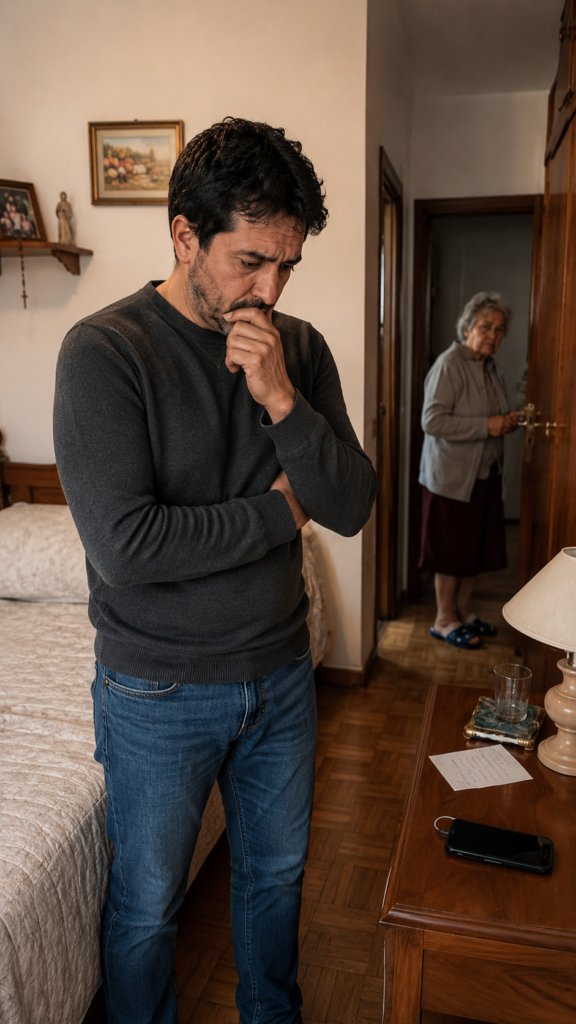
That night he searched for a blanket in the bedroom.
Next to his mother’s phone, he found a folded piece of paper.
The shaky handwriting said:
"1. Press the green button.
Wait for them to answer.
Wait for them to answer.
Don’t talk too much.
Don’t talk too much.
Smile so she doesn’t worry.
Smile so she doesn’t worry.
If she gets mad, say it was a mistake."
If she gets mad, say it was a mistake."
Mateo felt a knot in his chest.
But when he turned the paper over, he found one last sentence, written in more recent ink:
"Try it on Sunday, because it might be the last time."
PART 2
Mateo remained seated on the edge of the bed, the paper in his hands.
That sentence didn’t seem like an instruction for using the phone.
It felt like a goodbye.
He left the bedroom and found Elena in the kitchen, heating mole poblano and arranging tortillas on an embroidered napkin.
—"Mom, what does this mean?"
She looked at the paper and paled.
—"Nothing, son. Just my stuff."
—"It says 'it might be the last time.'"
Elena lowered her gaze.
—"I didn’t want to worry you."
That phrase, which she had used so many times to calm him, now sounded unbearable.
Mateo insisted until she confessed that weeks earlier she had fainted at the market. The neighbor took her to the doctor, and they detected an arrhythmia. It wasn’t an immediate sentence, but she needed tests, treatment, and monitoring.
Elena hadn’t told him.
—"Why didn’t you call me?"
—"I called you three times that day."
Mateo felt his body freeze.
He remembered the rejected calls while he was discussing a budget.
—"Then I thought the doctor would inform you if it was serious. I better learned to use the camera. I wanted to see you, even if it was for a few minutes."
Mateo clenched the paper.
—"And why did you write it could be the last time?"
Elena took a while to answer.
—"Because one never knows, son. Your dad left one morning. He had breakfast, left, and never came back. Since then, I understood that sometimes the last moment arrives without announcing itself."
Mateo didn’t know what to say.
The next morning, his aunt Lupita arrived with sweet bread. As soon as Elena went for coffee, Lupita closed the kitchen door and faced her nephew.
—"Your mom doesn’t want to learn technology. She wants to learn to enter your life without being pushed away."
Mateo swallowed hard.
—"I’m not pushing her away."
Lupita looked at him with sadness.
—"You hang up, you answer with a thumbs-up, you say everything is urgent except her. What do you call that?"
Lupita recounted that Elena practiced video calls with her every Tuesday. She rehearsed where to place her finger, how to lift the phone, and even how to smile so Mateo wouldn’t notice her exhaustion.
—"Once she told me: 'Just seeing him breathe calms me down.'"
Mateo glanced toward the kitchen.
His mother was walking with two cups, focused on not spilling the coffee.
He no longer saw the woman sending repeated messages, but a widow dining alone, asking for permission to love her own son.
That afternoon, Mateo left the phone face down and sat with her.
Elena talked about small things: the humidity in the patio, a neighbor selling tamales, a rose bush that wouldn’t bloom, and a recipe that had gone wrong.
Mateo understood that this was his mother’s life and that he had missed it.
He took Elena’s phone, increased the font size, and added his contact to the home screen with a photo of them both.
Below he wrote:
"Call Mateo. No permission needed."
Elena smiled, but her eyes filled with tears.
—"You don’t have to answer all the time. I know you work a lot."
—"I work a lot, Mom, but not so much that I can let you grow old alone."
She covered her son’s hand with hers.
Mateo felt how small she had become.
From then on, they agreed on a call every Sunday at 6 PM.
The first one lasted 17 minutes.
The camera first showed a lamp, then half an eyebrow, and finally Elena’s full face.
—"Can you see me now?"
—"Yes, Mom. I can see you now."
She showed him a pot of basil. Mateo could only see dirt, but he didn’t correct her.
—"It looks really nice."
—"Liar. You’re not even looking."
They both laughed.
For 17 minutes, they talked about the weather, a light bill, and how Mateo was still eating too much takeout.
When they hung up, neither of them felt alone.
The calls became routine.
Then, a necessity.
On Wednesdays, he sent her a picture of his meal. Elena replied:
"That needs vegetables."
"That rice is undercooked."
"You won’t make it to old age like this."
On Fridays, Mateo called while driving home.
—"I just left the office."
—"Text me when you get home."
That phrase restored the certainty that someone was waiting to know he was safe.
In December, Mateo planned to spend Christmas Eve with work colleagues. The trip to Puebla felt like a drag, and he still had pending tasks.
The Sunday before, Elena appeared on screen wearing a red apron.
—"I made romeritos and buñuelos."
—"Who did you cook so much for?"
She fell silent.
—"In case someone comes."
She didn’t say, "In case you come."
And that way of not asking for anything ended up asking for everything.
Mateo bought a ticket that same night.
On the 24th, he arrived unannounced. When he knocked on the door, Elena asked who it was.
—"The technician for the green button."
When she opened, she covered her mouth.
—"Son…"
He hugged her.
This time Mateo didn’t look at the clock.
On the table, there were two plates.
—"Were you expecting someone?"
Elena wiped her eyes with the apron.
—"No. But you never know."
They had dinner together. The mole was spicier than usual, and the buñuelos broke when touched, but Mateo heard stories he had never asked about.
He got to know Elena before she became his mother.
The little girl who sold jell-o with her grandmother.
The young woman who wanted to study nursing.
The wife who endured difficult years without telling anyone.
The widow who learned to sleep with the TV on to drown out the silence.
After dinner, Elena took out a metal box full of photos.
In one, she was 21, with long hair and a radiant smile.
—"You were stunning."
—"Oh, come on."
She blushed as if no one had told her that in decades.
Mateo realized he knew her medications and favorite foods, but not the complete woman.
Months later, Elena fell in the patio.
It wasn’t serious. Just a scraped knee.
But when Lupita called, Mateo felt the air leave his lungs.
He took the first bus to Puebla.
During the journey, he recalled all the times he had thought, "I’ll call later, I’ll go later." He understood that time never warns when it starts to run out.
He stayed three days with her. He did the grocery shopping, organized her medications, and changed a burnt-out bulb.
Elena watched him with a mix of tenderness and annoyance.
—"You don’t have to do everything."
—"I want to take care of you."
—"Taking care of me doesn’t mean treating me like I can’t decide anymore."
Mateo fell silent.
She continued:
—"Don’t erase me while you take care of me."
That sentence forced him to change again.
His guilt had driven him to the opposite extreme: wanting to solve everything and turn her into someone fragile. But Elena didn’t need a guardian; she needed a son.
Mateo began to ask her what she wanted. He accompanied her to appointments but let her speak with the doctors. He also set up an alarm for her pills without watching her every hour.
He proposed moving to Mexico City, and when she said no, he respected her decision.
In the summer, he invited her to spend a week at his apartment.
Elena brought a huge suitcase, three pairs of shoes, food for half the building, and napkins “just in case.” One afternoon, fruit appeared on the table and the smell of soup filled the kitchen.
One night, they went for a walk in Coyoacán. Elena held onto Mateo’s arm as people rushed past.
—"Everyone runs here," she said.
—"Yes."
—"You used to run too."
Mateo looked at the cars, the lights, and the people glued to their screens.
—"I still run. But now I know where to return."
Elena rested her head on his shoulder.
Before returning to Puebla, she asked for a photo.
She didn’t want to take it in front of a fountain or in a museum.
She chose the kitchen.
—"To remember that I was also in your house."
The phrase pierced Mateo.
For years, his mother had only been able to peek into his life through a screen.
Now, at last, she had a place inside.
They printed the photo: it came out crooked, poorly lit, with a pot behind.
Elena placed it next to her husband’s portrait.
—"Now both of you are with me," she said.
Over time, the calls stopped starting with fear.
Elena no longer asked if she was bothering him.
She’d call and say:
—"I have a silly thing to tell you."
—"I love your silly things."
One Sunday, she showed him a flower, and another time, she bragged that she already knew how to turn up the volume.
One night she said:
—"I wanted to see you for a bit. I sleep better that way."
Mateo closed his eyes.
He no longer felt guilt.
He felt gratitude.
Two years had passed since he found the paper next to the bed. Elena had more gray hair, repeated some stories, and walked slower.
Mateo no longer interrupted her.
He listened, even when he knew the ending.
Because perhaps she wasn’t repeating a story.
Perhaps she was asking him to stay just a little longer.
During a video call, Mateo saw a new piece of paper next to the phone.
—"What does that say?"
—"Nothing important."
—"Show me."
Elena brought the camera closer, and for the first time, she focused perfectly.
The paper said:
"If I want to see my son, I call."
Mateo smiled with wet eyes.
—"Just like that, Mom."
She lifted her chin.
—"I’m not ashamed anymore."
—"You should never be ashamed to need me."
Elena paused.
—"And you shouldn’t be ashamed to need your mother."
Mateo didn’t respond.
For years, he believed that growing up meant not depending on or asking for help. Now he knew that maturing also meant recognizing the voices that held him up.
That’s why he kept answering.
Because he still could.
Because Elena still asked if he had eaten.
Because they still laughed when he cooked poorly.
Because there were still Sundays.
And as long as there was a green button, a poorly focused camera, and a voice saying, "Can you see me now?" Mateo would never hang up again.
He had understood, before it was too late, that a mother doesn’t always ask for gifts, money, or grand promises.
Sometimes she just asks that her son doesn’t force her to learn how to love him without bothering.