PART 1
Elena's video call came in just as Santiago was presenting the most important project of his career.
From his apartment in the Del Valle neighborhood of Mexico City, he spoke with executives from a hotel chain. He wore a shirt and blazer, while off-camera, he sported a pair of old flip-flops.
The phone vibrated on the desk.
"Mom."
Santiago rejected the call.
Just ten seconds later, it rang again.
He thought it might be an emergency and answered with the computer microphone on. On the screen appeared the yellowed ceiling of a house in Puebla, followed by the trembling voice of Elena.
—"Can you see me now, son? I think I finally pushed the right button."
One of the executives chuckled.
Santiago turned crimson, hung up, and texted:
"Mom, I'm working. Don’t video call me without warning. You've put me in a huge mess."
The reply took several minutes.
"Sorry, son. I was just practicing."
Elena was 68, a widow, and had lived alone since her husband passed away. Santiago was her only child and had been saying for nearly four years that he would visit her “when he had time.”
She barely knew how to use a cell phone.
She typed with one finger, sent incomplete voice messages, and accompanied every question with a red heart. One Sunday, she asked him to teach her how to make video calls.
—"So now you’re going to be an influencer, huh, Mom?" —he joked.
Elena smiled, embarrassed.
—"Mrs. Lupita uses it to see her grandchildren. I thought I could see you from time to time too."
Santiago explained it three times.
The first time, Elena pointed the camera at the lamp.
The second, she spoke with the microphone off.
The third, she accidentally hung up and called back six times.
At first, he laughed. Then he began to feel desperate.
—"Seriously, Mom, it’s not that hard."
—"Just touch the green button."
—"I already explained that to you."
Elena never argued.
She fell silent and replied:
—"Okay, son. I didn’t mean to take up your time."
As the weeks went by, the calls dwindled.
So did the messages.
"Have you eaten yet?"
"Is everything okay?"
"Let me know when you can."
Santiago responded with a thumbs up, sometimes the next day. He repeated to himself that he wasn’t a bad son, just a busy man.
Until one Thursday, he traveled to Puebla for work and decided to visit her unannounced.
When Elena opened the door, she stood frozen.
—"Santi? Is it really you?"
She hugged him with desperate strength.
He noticed she had lost weight. Her hands trembled, and there was a yellow bruise near her wrist.
—"What happened to you?"
Elena hid her hand under her sweater.
—"Nothing. I bumped into the door. Come in, I'll heat up some mole."
The house was spotless, with that sad cleanliness of places where no one moves a chair.
On the table were two plates.
—"Were you expecting company?"
—"No," she said. "But you never know."
That night, Santiago stayed over.
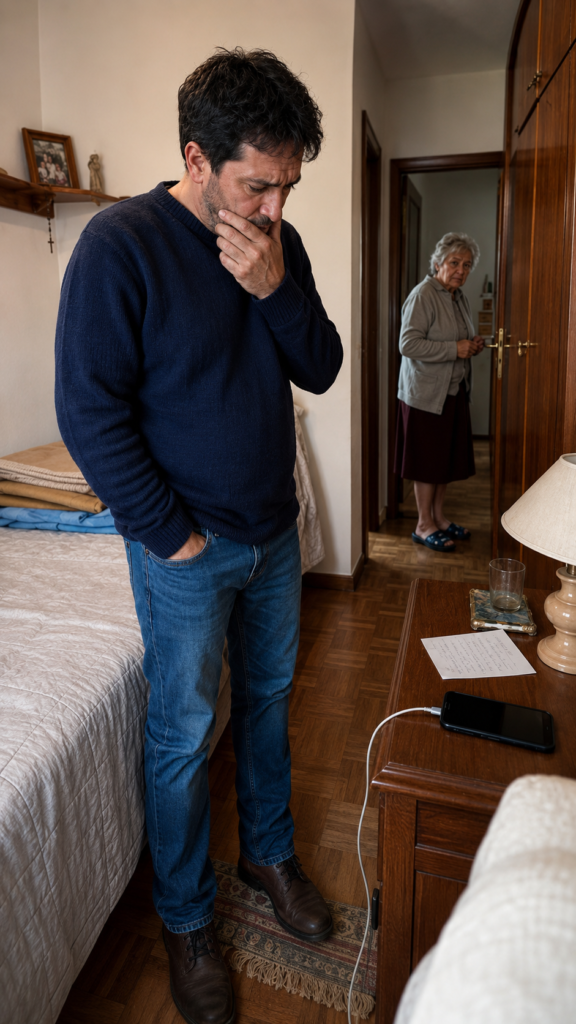
While looking for a blanket, he saw the cell phone plugged in next to the bed. Underneath was a folded paper, written in shaky handwriting.
"1. Touch the green button.
Wait for it to answer.
Wait for it to answer.
Don’t talk much if he’s busy.
Don’t talk much if he’s busy.
Smile so he doesn’t worry.
Smile so he doesn’t worry.
If the chest starts to hurt again, don’t call him. He’s very busy."
If the chest starts to hurt again, don’t call him. He’s very busy.
Santiago felt as if the air had been sucked from the room.
Then, behind him, his Aunt Rosa said something that froze his blood:
—"She wrote that after your mother fell alone in the kitchen and decided it was better to die here than to bother you again."
PART 2
Santiago spun around so fast he knocked over the coffee table.
—"What did you say?"
Rosa closed the bedroom door so Elena wouldn’t hear from the kitchen.
—"Three weeks ago, she fainted. Mrs. Lupita found her lying by the refrigerator. She had been there for almost 20 minutes."
Santiago looked at the bruise on his mother’s wrist and understood.
—"Why didn’t anyone tell me?"
—"I wanted to. She begged me not to. She said you were working on an important project and that the last time she called, she got you into a mess."
Each word fell like a stone.
Santiago left the room and found Elena serving coffee. The cup rattled against the saucer from the tremor of her hands.
—"Mom, did you faint?"
She stood still.
—"It was just a little dizziness."
—"You were lying down for twenty minutes."
—"Don’t exaggerate."
Santiago held up the paper.
—"And the chest pain? How many times has that happened?"
Elena’s face lost color.
—"Lower your voice, son. The neighbors will hear."
—"I don’t care what they hear! Why didn’t you call me?"
She pressed her lips together.
—"Because you were working."
—"I’m your son!"
—"And I didn’t want to be one more burden."
The silence was brutal.
Santiago wanted to hug her and apologize, but Elena took a step back.
—"Don’t look at me as if I’m already dead."
He took her to the emergency room that night.
The tests revealed an arrhythmia that needed treatment and monitoring. It wasn’t a death sentence, but it was also not just a little dizziness.
While waiting outside the doctor’s office, Santiago checked his mother’s cell phone.
There were 17 canceled video calls before she dialed.
In the calendar, he found notes like “Better tomorrow” and “Don’t bother him.”
Guilt closed his throat.
Rosa looked at him sternly.
—"Feeling like the worst son in the world does nothing. That would also be just thinking of yourself. Change while you still can."
Santiago stayed in Puebla for four days.
He organized her medications, installed an emergency button, and placed his contact on the home screen in huge letters:
"CALL MY SON."
When he tried to hire a nurse without asking her, Elena got upset.
—"I’m not useless."
—"You need help."
—"I need company, not someone taking my life away."
He fell silent.
In trying to fix the damage, he started treating her like a fragile object.
—"I’m sorry."
Elena shook her head.
—"Don’t apologize for taking care of me. Just don’t erase me while you do it."
That phrase hurt more than any reprimand.
Santiago returned to Mexico City, but his routine changed.
Every Sunday at 6 PM, he called Elena.
At first, she answered with fear.
—"Aren’t you busy?"
—"I’m busy talking to you."
—"Don’t be silly."
—"Seriously, Mom. Show me what you did today."
Sometimes the camera showed half her forehead. One afternoon, Elena wanted to show off a flower, and all Santiago saw was moist dirt.
—"It’s beautiful," he said.
—"You’re not even looking."
—"I’m admiring its roots."
Elena laughed with a small joy, rusted from disuse.
The calls stopped feeling like an obligation.
They became routine, then a necessity.
She told him neighborhood gossip, and Santiago shared stories about his meetings, a leaking roof, and the reheated food he pretended to enjoy.
They weren’t extraordinary conversations.
But during those minutes, neither of them was alone.
One Sunday, Elena showed an old photograph.
She appeared with her husband and a seven-year-old Santiago in Acapulco. The boy held a red bucket, looking at the camera with a ridiculous seriousness.
—"Your dad burned his whole back that day," she said. "He thought he could handle the sun."
—"Dad was so stubborn."
—"Just like you."
They both laughed, but Elena slowly lowered the photo.
—"If he were still here, maybe I wouldn’t have felt so desperate to call you."
It wasn’t a reproach.
That’s precisely why it hurt more.
Santiago realized that for years he had only seen “his mom”: the woman who cooked and asked if he had eaten.
He had never looked at Elena: the young woman who danced danzón, the widow who turned on the television to hear another voice.
—"I haven’t known how to be present," he admitted.
Elena lifted her eyes.
—"You are now."
Just those two words were enough to break something inside Santiago.
In December, he planned to spend Christmas Eve with his friends.
The trip to Puebla felt like a chore. There would be traffic, cold, and things to do.
The old excuse returned, disguised as tiredness.
During the Sunday video call, Elena appeared with an apron covered in flour.
—"I made buñuelos."
—"Who are all these for?"
She arranged the tray.
—"Just in case someone comes by."
Santiago bought his ticket that very night.
On December 24th, he rang the doorbell with a box of sweets under his arm.
—"Who is it?" —Elena asked from inside.
—"Technical support for video calls."
When she opened the door and saw him, she covered her mouth.
—"Oh, son…"
Santiago hugged her slowly, without checking his phone.
On the table were two plates.
—"You said you weren’t expecting anyone."
Elena wiped her eyes with her apron.
—"I wasn’t expecting. But I had hope, which is not the same thing."
They dined on mole, rice, and buñuelos.
Elena talked for hours about her childhood in Atlixco and the first time she saw her husband at a fair.
Then she took out a metal box full of letters and photographs.
In one image, she was 20 years old, with long hair and a daring smile that Santiago had never seen.
—"You were gorgeous."
—"Was?"
—"You are. Don’t get mad."
She blushed like a young girl.
That night, Santiago understood that getting to know a mother wasn’t just knowing what medicine she took or what her favorite dish was.
It was discovering the complete woman who existed before he came along.
The next morning, they practiced video calls from different rooms.
The first showed the lamp.
The second ended when Elena hung up by accident.
The third worked.
When she saw Santiago on the screen, she raised her hand.
—"Hello, son."
—"Hello, Mom."
Before leaving, he stuck a note on the refrigerator:
"Sunday, 6:00 PM. Call with Santiago. No fear."
Elena read it aloud.
—"What if I want to call another day?"
The question came out so small that he felt shame.
—"Then you call. If I can’t answer, I’ll call you back. But never decide again that you’re not worth five minutes of my time."
She watched him.
—"You also shouldn’t decide that your work is worth more than your life."
Months later, Elena spent a week in Mexico City.
She arrived with a huge suitcase and food "just in case." Within hours, the apartment smelled of chicken broth.
Before returning to Puebla, she asked for a photo.
Santiago suggested they go out to the garden, but she chose the kitchen.
—"Here, next to the pot."
—"Why here?"
—"To remember that I was also in your home, not just on your phone."
The phrase pierced him.
The photo turned out crooked, but weeks later, Santiago found it framed next to his father’s portrait.
—"Look," said Elena. "Now both of them are with me."
The hardest blow came almost a year later.
Rosa called one early morning.
There hadn’t been another crisis. She had found a folder with medical studies dated before the fainting and an urgent recommendation to consult a cardiologist.
Elena already knew something was wrong.
She had canceled two appointments.
Santiago arrived in Puebla furious and scared.
—"Why did you do that?"
Elena held his gaze.
—"The first appointment was the day of your presentation. The second, when you said you were about to close the contract."
—"You could have gone with Rosa!"
—"I didn’t want anyone to call you."
Santiago felt nauseous.
That rejected video call during the meeting hadn’t just been a practice.
Elena had received the results that morning and wanted to see his face before deciding what to do.
But after the scolding, she put away the papers, canceled the appointment, and wrote the instructions next to her bed.
—"You could have died," he whispered.
—"Yes."
—"Because of me."
Elena shook her head firmly.
—"No. I made a bad decision because I was afraid of bothering you. But that fear didn’t just come from me. We built it together."
That response didn’t absolve him.
Nor did it condemn him forever.
It gave him something harder: responsibility.
Santiago accompanied her to subsequent appointments, but he stopped making decisions for her.
He asked.
He listened.
He respected when Elena said she could walk by herself and was close when she needed his arm.
The treatment worked.
She regained strength, returned to mass, met with her neighbors, and learned to send outrageous stickers at seven in the morning.
One Sunday, during a video call, Santiago saw that the old paper was no longer next to the bed.
There was another one, written in firmer handwriting.
—"What does it say?"
Elena adjusted the camera.
This time she focused perfectly.
"If I want to see him, I’ll call."
Santiago fell silent.
—"Very good, Mom."
—"I’m no longer ashamed."
—"You should never have felt ashamed to call your son."
Elena lifted her chin.
—"And you shouldn’t feel ashamed to need your mother."
Santiago’s eyes filled with tears.
For years he believed that growing up meant not needing anyone. Now he knew that it also meant recognizing which voices gave meaning to life.
Today, Elena has more gray hair, walks slowly, and repeats some stories.
Santiago no longer interrupts her.
The second time, he listens differently, because maybe she isn’t repeating an anecdote.
Maybe she’s asking him to stay a little longer.
Every Sunday, when “Mom” appears on the screen, Santiago answers.
Sometimes he sees a plant.
Sometimes a pot.
Sometimes just the ceiling.
But he never hangs up out of embarrassment or hurry.
Because he understood late, though not as late as it could have been, that a mother doesn’t always ask for money, gifts, or promises.
Sometimes she gathers the courage for hours to touch a little green button.
And when she does, she isn’t interrupting her son’s life.
She’s checking that she still has a place inside of her.