PART 1
Mariana Solís always said she would never seek out Sebastián Arriaga again, not even if the world came crashing down around her.
She had loved him in silence, when she worked as a waitress in a restaurant in Polanco, and he would arrive late, in an expensive suit, with tired eyes and a sadness that didn’t match his millions.
When Mariana discovered she was pregnant, she wrote him a letter.
She told him she didn’t want his money if it came with humiliation. She said if it was a girl, she would name her Amparo, after her grandmother, because that name meant protection.
She also wrote a line that shattered her soul:
“I don’t want my daughter to grow up believing that her father didn’t want to know her.”
The letter was delivered to the private offices of Grupo Arriaga, in Santa Fe.
Six days later, Mariana received an envelope without a return address.
Inside was a check for 200,000 pesos and a letterhead with corporate insignia.
“Miss Solís: Mr. Arriaga does not wish to be involved. If you accept this payment, it will be understood that you will not contact him regarding this matter again.”
Mariana stared at the check as if it were trash wrapped in elegant paper.
Then she tore it to pieces and cried on the floor of her kitchen.
When Amparo was born, she gave her her last name and vowed she would never again utter Sebastián Arriaga's name.
For three years, she worked double shifts at a diner in colonia Roma, washed uniforms in the early morning, and learned how to stretch a soup to last two days.
Amparo grew up asking about “daddy far away.”
Mariana always answered the same:
“He’s very far away, my love.”
But one night, at 11:38, her phone rang.
It was Elena Montes, Sebastián’s lead attorney.
“Mr. Arriaga had an accident. He survived, but upon reviewing personal documents, we found irregularities related to you and a girl named Amparo.”
Mariana felt the blood drain from her face.
Elena continued:
“I believe someone intercepted your letter three years ago. And I believe documents were falsified.”
The next day, Mariana agreed to go to Torre Arriaga just once.
Not for Sebastián.
For Amparo.
The girl insisted on accompanying her because she had heard a word impossible to ignore:
Daddy.
When they arrived on the executive floor, an assistant took them directly to a huge room.
Mariana realized too late that it was a trap.
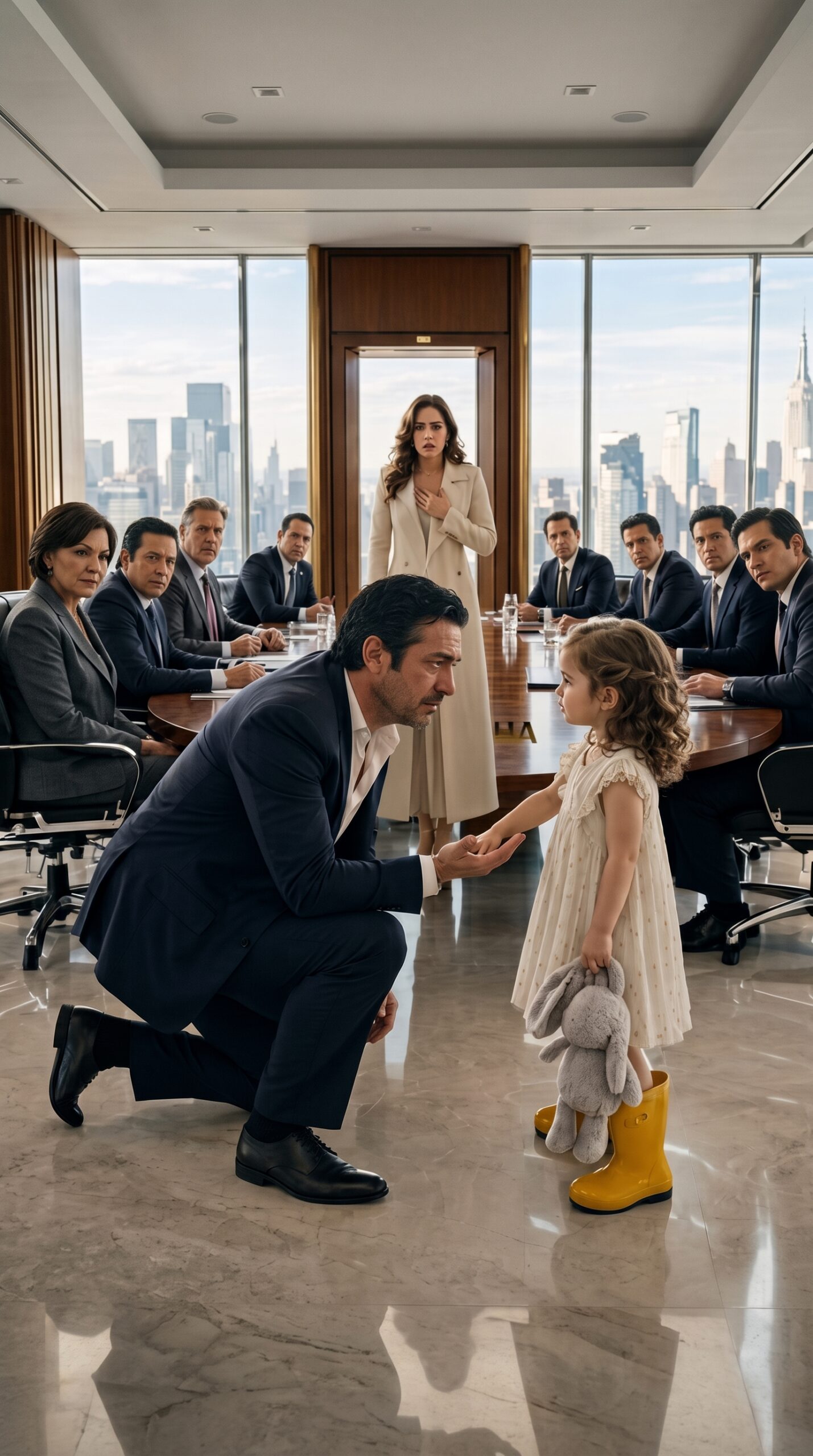
The doors opened, and inside was the entire board of directors.
And at the back, pale, injured, with his eyes fixed on the girl, was Sebastián Arriaga.
Amparo let go of her mother’s hand, walked toward him, and asked in a tiny voice:
“Daddy… can I hold your hand just once?”
PART 2
No one in that room dared to breathe.
The board members who had seen Sebastián destroy entire companies with a single signature looked at the floor, uncomfortable, as if a millionaire's tears were something forbidden.
Sebastián stretched out his trembling hand.
Amparo placed her little hand on top.
And in that moment, Celia Aranda, chairwoman of the board and Sebastián’s trusted woman for 20 years, lost control of the story she had crafted.
“What a touching scene,” Celia said, with a cold smile. “But this does not resolve the issue of a potential claim against the company.”
Mariana clenched her fists.
“My daughter is not a claim.”
Sebastián raised his gaze.
“Celia, shut up.”
The silence grew heavier.
Celia blinked, offended.
“This board deserves transparency. We cannot allow a woman to show up with a girl and jeopardize a multi-million dollar sale.”
Sebastián continued holding Amparo’s hand.
“What jeopardizes this company is not my daughter. It’s the forgery of documents.”
The word fell like a stone.
Mariana felt the floor shift beneath her.
Elena Montes closed the door and placed a folder on the table.
“We have a preliminary forensic report. Mariana Solís’s signature was forged. The check she tore up was registered as a rejected agreement, but then a document appeared supposedly stating she agreed not to contact Mr. Arriaga again.”
Mariana glared at Sebastián with rage.
“And you believed that?”
Sebastián lowered his eyes.
“I was shown another version.”
“How convenient, right? For a man with so much power, you stayed very quiet.”
Amparo looked at her mother.
“Are you mad at my daddy?”
Mariana took a deep breath.
“I’m mad at what they did, my love. And with the one who allowed it to happen.”
Sebastián closed his eyes as if that phrase hit him harder than the accident.
Celia attempted to rise.
“The matter must be addressed without the slightest emotional intervention.”
“The matter,” Sebastián said, “is that you hid my daughter.”
The room exploded in murmurs.
The group’s accountant, Ernesto Balcázar, opened an old folder. His face changed as he read the family clause.
“According to the Arriaga trust, the existence of a biological heir suspends any sale, merger, or removal of the president until the minor’s patrimonial protection is reviewed.”
Celia turned pale.
Mariana didn’t understand everything, but she understood enough.
Amparo was not just a hidden child.
She was the key that stopped a multi-million dollar sale.
That’s why they had erased her.
Elena called for a recess and took Mariana, Sebastián, and Amparo to a small room.
The girl climbed onto a chair and placed her one-eared teddy bear on the table.
“His name is Captain Pancho,” she announced.
Sebastián looked at it with absurd seriousness.
“Nice to meet you, Captain Pancho.”
Amparo scrunched her nose.
“He’s missing an ear because the washing machine ate it.”
“Even the best of us have that happen,” he replied.
Mariana almost smiled, but the pain wouldn’t let her.
When Amparo moved closer to the window, Sebastián spoke softly.
“I did receive your letter, Mariana. But months later. Celia showed me a clipped version. It said you wanted money, silence, and that you weren’t even sure the girl was mine.”
Mariana felt nausea.
“That’s a lie.”
“I know now.”
“No. Don’t come at me with that. While you doubted from your tower, I counted coins to buy her medicine when she had a fever.”
Sebastián didn’t defend himself.
“I know.”
“No, you don’t know. I cleaned bathrooms in buildings where your logo shone at the entrance. I worked with back pain. I told my daughter her father was far away because I couldn’t bear to tell her he might be a coward.”
Sebastián broke down.
“I was scared.”
Mariana let out a dry laugh.
“Of a baby?”
“Of passing on my heart condition. My brother died from the same thing. When Celia told me you wanted distance, I clung to that because it was easier than facing the possibility of giving a girl a life marked by hospitals.”
Mariana looked at him as one looks at someone who cannot yet be forgiven.
“Your fear left us alone.”
The paternity test results arrived ten days later.
99.99%.
Amparo was Sebastián Arriaga’s daughter.
The investigation uncovered everything.
Celia had bribed an internal courier to intercept Mariana’s letter. She sent the cruel check. She forged the signature. She hid the medical file Sebastián had wanted to open for the girl.
But the real twist was worse.
Celia didn’t do it just out of pride.
She had secretly negotiated the sale of Grupo Arriaga’s real estate division to a foreign fund. If Amparo was acknowledged, the family trust would freeze the operation.
And that sale concealed lawsuits for poorly constructed buildings in Puebla, Toluca, and Ecatepec.
If the sale went through, Celia and several partners would receive private bonuses.
If Amparo appeared, everything would collapse.
The girl who slept with a broken rabbit hadn’t been hidden out of shame.
She had been hidden because she protected a fortune that others wanted to steal.
The final confrontation took place in the same board room.
This time, Mariana arrived alone, in a green dress bought at a flea market and altered by herself.
She wore no jewelry.
She wore no fear.
Celia entered as if she still commanded.
“You don’t understand what you’ve done. That girl doesn’t belong in this world.”
Mariana stood up.
“My daughter belongs in a world where she is loved. Not in a world where she is used.”
Elena laid emails, transfers, access logs, and signed statements on the table.
Ernesto Balcázar, the accountant, began to sweat.
“I didn’t know the documents were incomplete,” he murmured.
Celia looked at him with disdain.
“Of course you did. You just thought no one would check.”
Sebastián pulled out the final sheet.
It was Mariana’s original letter.
He read it aloud.
“I’m scared of your world, Sebastián, but I’m trying not to be afraid of you.”
For the first time, Celia found nothing to say.
Sebastián looked at her as if he had just truly seen her.
“You took three years away from my daughter.”
Celia coldly replied:
“I saved you from a woman who was going to complicate your life.”
Mariana stepped forward.
“No. You took away my chance to decide. You took away my daughter’s chance to be loved. And you took away his chance not to fail.”
The room fell silent.
Celia resigned that same week under the threat of criminal charges.
The sale was canceled.
Several partners were investigated.
The press spoke of corporate fraud, trusts, and a secret heiress, but by court order, Amparo’s name remained protected.
Mariana accepted child support, medical insurance, a college fund, and reimbursement for expenses incurred since birth.
She did not accept a house.
She did not accept a car.
She did not accept living in any place Sebastián could use as a disguised luxury excuse.
She also imposed rules.
No visits without notice.
No huge gifts.
No cameras.
No assistants raising her daughter.
No buying affection.
“If you want to be her dad,” Mariana told Sebastián, “you’re going to have to learn to show up on time.”
The first Saturday they met at Parque México.
Sebastián arrived 20 minutes early with a bag of conchas because Amparo had asked him if daddies liked sweet bread.
The girl ran to the ducks, then returned to Mariana, and then slowly walked toward him.
Sebastián didn’t pressure her.
He simply knelt down and showed the bag.
“I brought a concha for you. And an apology for Captain Pancho because I don’t know if rabbits eat bread.”
Amparo looked at him seriously.
“Rabbits don’t eat conchas, dude.”
Mariana’s eyes widened.
Sebastián let out a broken laugh.
“You’re right. What a careless thing for me.”
The girl laughed.
It was a small sound.
But to Sebastián, it felt like the biggest forgiveness in the world, even though it wasn’t yet.
The visits grew.
First two hours.
Then three.
Then full afternoons.
Sebastián learned that Amparo hated peas, which she called “elevators that go up,” and that she fell silent when adults argued.
Once he arrived 12 minutes late because of a board call.
Amparo was sitting on a bench, hugging Captain Pancho.
“I thought you had gone far away again,” she said.
Sebastián sat on the ground, his expensive suit on the sidewalk.
“I didn’t go away on purpose. But for you, it felt that way. I’m sorry. I’ll do better.”
Amparo handed him the rabbit.
“Hold it while I’m mad.”
And he held it for 20 minutes without checking his cell.
That’s when Mariana began to believe that maybe change wasn’t always about action.
Months later came the heart tests.
Amparo hadn’t inherited Sebastián’s illness.
Mariana received the call in the kitchen and sat on the floor because her legs wouldn’t respond.
When Sebastián arrived, she opened the door before he could knock twice.
“It’s clear,” she said. “Her heart is fine.”
Sebastián covered his mouth with one hand.
He didn’t make a scene.
He just cried silently, standing in the humble living room where he finally understood everything that money hadn’t been able to protect.
Amparo appeared in moon pajamas.
“Dad sad?”
Sebastián wiped his face.
“No, my love. Dad is grateful.”
“What does grateful mean?”
Mariana picked her up.
“That your heart goes boom-boom, and that makes us happy.”
Amparo placed her hands on her chest.
“My heart says boom-boom.”
Sebastián smiled through tears.
“It’s my favorite sound.”
But real life didn’t turn everything into romance.
Mariana and Sebastián never became a couple again.
There was too much pain.
Too many years stolen.
Too much anger that couldn’t be erased with flowers or surnames.
What they built was harder.
They learned to be parents.
Sebastián attended kindergarten meetings, turned off his phone at school festivals, and wore a purple crown during Amparo’s fourth birthday because she named him “king of the conchas.”
Mariana watched from afar, not forgetting, but also not denying that the man was trying to stay.
One year after that board room, they walked together through Parque México.
Amparo was in the middle, holding a hand from each of them.
“Both,” she said happily.
Sebastián looked at those joined hands and remembered the first time she asked to touch him.
Mariana remembered, too.
A three-year-old girl had stopped a multi-million dollar sale, exposed a betrayal, saved other families from dangerous buildings, and forced two broken adults to tell the truth.
But for Amparo, it was simpler.
She had just wanted to hold her father’s hand.
Even if it was just once.
And sometimes, once is enough to begin to repair what others destroyed.