PART 1
—Sometimes God takes the little angels early because He knows they weren’t being cared for well on this earth.
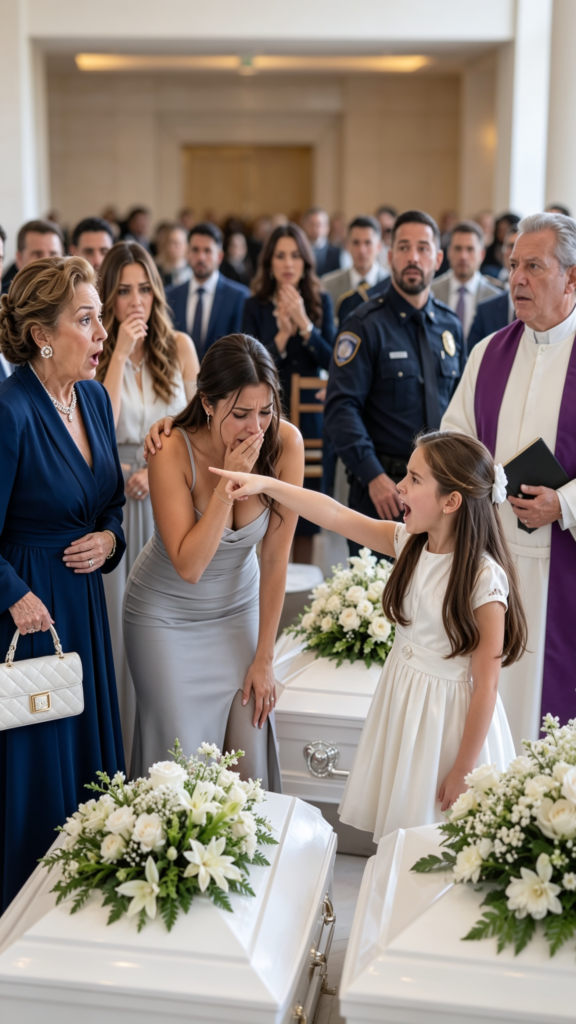
Doña Elvira's voice echoed in the funeral chapel as if she had thrown a stone against everyone's chest.
No one said a word.
In front of two white coffins, Valeria Ríos felt her knees buckle. Her twins, Nicolás and Gabriel, barely three months old, were surrounded by flowers, candles, blue bows, and photographs where they still seemed to be breathing.
They had come into the world after five years of treatments, bank debts, prayers to the Virgin of Zapopan, and early mornings when Valeria silently cried so as not to wake her husband.
The funeral home was in Tonalá, on a street where trucks, tamale vendors, and loud motorcycles continued to pass by, as if the pain of this family had not stopped anything.
Inside, it smelled of lilies, reheated coffee, and guilt.
Doña Elvira, Valeria's mother-in-law, stood by the coffins in a black dress, a pearl necklace, and a rosary wrapped around her fingers.
She wasn’t crying.
She wiped her eyes with a handkerchief, but her makeup remained flawless.
—I told you many times —she continued, looking at the neighbors—. A house with three children needs order. But Valeria was always proud. She never accepted that she couldn’t do it alone.
Valeria wanted to scream that she could.
That she fed the babies every three hours.
That she slept sitting up.
That she washed onesies until dawn.
That she also took care of Abril, her seven-year-old daughter, while her husband came home late from work and her mother-in-law entered the house as if she owned it.
But the words wouldn’t come out.
Beside her, Martín, her husband, had his gaze lost on the floor. He wore a dark suit, his tie crooked, and his eyes swollen.
He looked shattered.
But he didn’t defend her either.
Not when his mother called her careless.
Not when she insinuated that the babies had died because of her.
In the second row, Valeria’s parents had come from Tepic. Her mother cried, holding onto a handbag. Her father, Don Ernesto, clenched his jaw so tightly it looked like it would break.
But Martín’s family occupied almost the entire room.
Aunts, cousins, doña Elvira's friends, ladies from the prayer group. They all whispered softly, looking at Valeria as if she had already been condemned.
—She looked worn out —said one woman.
—Three children were too much for her —another replied.
Valeria lowered her gaze.
Then she felt a small hand slip between her fingers.
It was Abril.
The girl wore a simple black dress, her hair tied back with a blue scrunchie, and shoes that barely fit. Her eyes were red, but she wasn’t crying.
She squeezed Valeria’s hand three times.
It was their secret signal.
“I’m with you.”
—Mommy —she whispered.
Valeria wanted to hug her, but doña Elvira raised her voice again.
—A mother must not only love. She must know how to raise. There are women who make themselves victims, but the truth always comes out.
Father Joaquín, at the lectern, cleared his throat awkwardly. He didn’t interrupt. Doña Elvira helped at the parish, paid for flower arrangements, and everyone held her in regard.
—Mom, please —said Martín.
He said it so low it almost sounded like an apology.
Doña Elvira touched his shoulder.
—No, son. Someone has to say what everyone thinks. Your babies deserved a more capable mother.
Valeria felt something dark rise up her throat.
Then Abril let go of her hand.
She walked slowly toward the lectern. Her little shoes echoed on the cold floor.
Everyone turned.
Valeria tried to call her, but Abril was already beside Father Joaquín.
The girl took an old cellphone with a cracked screen out of her bag and said, in a voice that froze the chapel:
—Father… can I show them what my grandmother Elvira put in my little brothers’ bottles?
Doña Elvira turned pale.
Martín lifted his head for the first time.
And Valeria understood that the death of her children might conceal something more horrible than the funeral itself.
PART 2
Father Joaquín looked at Abril as if the girl had just opened a door that no adult had dared to touch.
He didn’t ask for silence.
He didn’t snatch the cellphone away.
He just leaned in front of her and spoke slowly.
—My dear, show us what you have.
Doña Elvira took two steps toward the lectern.
—That girl is traumatized. She doesn’t know what she’s saying. Valeria is using her to attack me.
Don Ernesto stood up immediately.
—You are not getting near my granddaughter.
The room tensed.
Martín looked at his mother, then at Abril, then at Valeria. His mouth was slightly open, as if he suddenly understood that the pain wasn’t over.
Abril unlocked the cellphone.
Her fingers trembled so much she made two mistakes.
—I didn’t want to upset anyone —she said—. But I also didn’t want everyone to say my mom was bad.
Valeria walked to her almost without feeling her legs.
When she hugged her shoulders, Abril let out a breath as if she had been carrying a huge stone inside her chest.
—I’m sorry, Mommy —she murmured—. I thought that if I gathered evidence, they would believe me this time.
Valeria felt her soul break again.
Her seven-year-old daughter had been living with a fear no child should know.
—You don’t have to apologize, my sweet girl —she said, her voice breaking—. You didn’t do anything wrong.
Abril opened the gallery.
The first image appeared on the screen.
It showed the kitchen of their house in Tonalá. The table was filled with diapers, bottles, and clean rags. Doña Elvira was seen from behind, bent over the bottles of Nicolás and Gabriel.
Next to her was Martín’s brown briefcase, the one he took to the dental office where he worked as a representative for medications.
In doña Elvira’s hand was a small bottle.
In the other, a spoonful of white powder.
A murmur rippled through the chapel.
—That doesn’t mean anything —Elvira said, although her voice no longer sounded certain—. I was just organizing. I always helped in that house.
Abril swiped the screen.
The next photo showed the bottle closer.
You could read part of the label: controlled medication for inducing sleep, with a warning not to be used in minors.
Martín stepped back.
—Mom… what is that?
Doña Elvira didn’t look at him.
Abril moved to the next photo.
Elvira was pouring the powder into a bottle.
Another.
She closed the cap.
Another.
She shook it.
Another.
She did the same with the second.
One of Martín’s cousins crossed herself.
Aunt Lourdes, Elvira’s sister, started crying with her hand over her mouth.
—Elvira, tell me that isn’t true…
Doña Elvira squeezed the rosary until her knuckles turned white.
—I just wanted them to sleep! —she suddenly shouted—. That was all! Those children cried all day long. That girl was going crazy, haggard, unbathed, with the house a mess. Someone had to bring order.
Valeria felt rage return her voice.
—Did you give my babies medicine to sleep?
—Don’t be dramatic —spat Elvira—. It was just a little bit. In my day, mothers knew how to do what was necessary. Not like now, who cry for everything.
—They were three months old —Valeria shouted—. Three months!
Martín put his hands on his head.
—Mom, please… tell me it wasn’t you.
Elvira looked at him with a mix of fury and victimhood.
—I was saving your marriage, Martín. You came home tired. She was useless. Everything smelled of milk, of diapers, of chaos. I did what a responsible grandmother had to do.
The chapel fell silent.
Then Abril pulled out a purple notebook from her backpack.
It had star stickers and a label with her name written in marker.
—I also wrote it down —she said.
Valeria looked at her, devastated.
—What did you write, my love?
Abril opened the notebook carefully.
Her childish handwriting filled the pages with dates, crooked drawings, and short phrases.
—Monday, August 3 —she read—. My grandmother put medicine in the bottles. She said it was vitamins so Nicolás and Gabriel would be good babies. Then they slept a lot, and my mommy cried because they wouldn’t wake up to eat.
Doña Elvira began to breathe rapidly.
—Wednesday, August 5 —Abril continued—. Grandma said my mommy doesn’t know how to raise. She said that one day my daddy would get tired, and she would teach us to obey.
Martín closed his eyes.
Father Joaquín lowered his gaze.
No one dared to interrupt the girl.
Abril turned the page.
—Sunday, August 9. Grandma got angry because Gabriel cried. She said, “Babies that cry control weak mothers.”
Valeria pressed her lips together.
She remembered that week.
She remembered how Gabriel slept too much.
How Nicolás left the milk half full.
How she told Martín that something wasn’t right, and he responded that she was exaggerating because of exhaustion.
Abril read the last note with a broken voice.
—Tuesday, August 11. Grandma said this time they would sleep all night. That nothing would wake them up.
The notebook fell to the floor.
The chapel exploded.
A woman screamed, “murderer.”
A cousin of Martín ran out.
Aunt Lourdes collapsed into a chair, repeating:
—I didn’t know, I didn’t know…
Doña Elvira tried to walk toward the side door.
But Don Ernesto and two other men blocked her way.
—You’re not leaving here —Valeria’s father said, in a calm that was terrifying.
Father Joaquín was already calling 911.
Valeria’s mother hugged Abril and covered her ears while the chapel filled with cries, shouting, and phones recording.
Martín approached his mother.
His eyes were red.
—You killed my children.
Doña Elvira slapped him.
—Don’t talk to me like that! I’m your mother!
Martín didn’t move.
—You killed Nicolás and Gabriel.
—Your wife killed them with her incompetence —she replied—. I just tried to correct what she couldn’t control.
When the patrols arrived, the scene looked like a Mexican nightmare that no one believes until they see it on the news.
Two white coffins in the center.
A girl with a purple notebook.
A mother holding her living daughter while saying goodbye to her two dead sons.
And a grandmother shouting that it had all been “for the love of family.”
The officer in charge, Mariana Salcedo, ordered that no one touch anything.
—That cellphone and that notebook are evidence —she commanded.
A police officer approached Elvira.
—Ma’am, you need to come with us.
—I didn’t do anything wrong! —she screamed as they put the handcuffs on her—. The kids cried too much! Someone had to do what their mother didn’t!
Before leaving, she looked at Valeria with hatred.
—This is your fault. If you had been a good mother, I wouldn’t have had to step in.
Valeria didn’t answer.
For the first time in eight years, she didn’t need to defend herself.
The truth was right there.
In an old cellphone.
In a purple notebook.
In the small voice that everyone had ignored.
The next 72 hours changed everything.
The prosecutor reopened the investigation. At first, Nicolás and Gabriel’s deaths had been treated as an inexplicable tragedy, perhaps a double sudden death, something rare but possible.
But with the photos, Abril's notes, and Valeria's testimony about the strange changes in the babies, the story crumbled.
The toxicology analyses confirmed what no one wanted to accept.
The twins had dangerous levels of a sedative that should never have entered a baby’s body.
The medication matched samples that Martín kept in his briefcase.
It hadn’t been a mistake.
It hadn’t been a confusion.
Doña Elvira had been drugging her grandchildren for weeks.
But the hardest blow came when they reviewed her cellphone.
There were searches about dosages for babies, deep sleep, slow breathing, and risks of sedatives.
They also found messages she had sent to a friend from the prayer group.
“Valeria is overwhelmed. If something ever happens, everyone will understand that woman wasn’t made to be a mother.”
The prosecutor understood then that Elvira not only wanted silence.
She wanted to manufacture guilt.
She wanted to prove that Valeria was incapable.
She wanted to regain control of her son, her house, and her grandchildren.
Martín collapsed.
One afternoon, sitting in the room where the two cribs used to be, he took a blue onesie and began to cry like a child.
—I gave her the key —he repeated—. I left the briefcase open. I told you not to make a fuss. I allowed everything.
Valeria watched him from the door.
She would have rushed to comfort him before.
She would have embraced his guilt as if it belonged to her too.
But something inside her could no longer go back.
—Your mother killed them —she said—. But you opened the door every time I asked you to set limits.
Martín lowered his head.
—I know.
—You heard how she humiliated me. You saw how she took the babies from my arms. She called me useless in my own kitchen, and you said, “That’s my mom.”
He cried louder.
—I know, Vale.
—And at the funeral, you stayed silent while she tried to bury me alive with your children.
That phrase left him breathless.
There were no screams.
There were no broken dishes.
Just a truth so heavy it could no longer fit in that house.
Months later, the trial began.
Doña Elvira arrived dressed in black, her hair styled, and a martyr’s face. Her lawyer tried to say she had been a tired grandmother, an older woman who wanted to help and miscalculated.
He said Valeria was emotionally unstable.
He said the house was chaotic.
He said Elvira never intended to cause harm.
But then Abril testified.
The room changed when the girl entered, accompanied by a forensic psychologist.
Valeria wanted to stop the world to protect her.
Abril turned to her and squeezed her hand three times.
“I’m with you.”
The prosecutor asked if she knew the difference between lying and telling the truth.
Abril replied:
—Yes. Lying was when my grandmother said she cried for my little brothers, but she never had tears.
No one breathed.
Abril spoke about the bottles.
About the little spoons.
About the white powder.
About how her brothers slept so much that her mom would touch their backs to see if they were still alive.
About how doña Elvira said weak mothers raise weak children.
Then they showed the photos.
One by one.
The judge didn’t need to hear screams.
The facts were stronger than any insult.
When the verdict was announced, Valeria held Abril’s hand tightly.
Doña Elvira was found guilty of the deaths of Nicolás and Gabriel. She was sentenced to life in prison.
Upon hearing the ruling, she didn’t cry for the babies.
She screamed that they had destroyed her life.
That no one appreciated her sacrifice.
That Valeria had broken the family.
The family.
In her mouth, that word sounded like a cruel mockery.
Martín signed the divorce weeks later.
He didn’t fight for the house.
He didn’t ask for furniture.
He didn’t demand money.
He only asked to see Abril under psychological supervision.
Valeria accepted, not for him, but for her daughter.
Abril still loved her dad, although she was also hurt by his silence.
—I don’t expect you to forgive me —Martín told her the day he left—. Honestly, I don’t even know if I’ll ever forgive myself.
Valeria looked at him without hatred.
Hatred is tiring too.
—Don’t live seeking forgiveness —she replied—. Live remembering what happens when someone stays silent to avoid making the wrong person uncomfortable.
Valeria moved with Abril to Tepic, near her parents.
They rented a small house with a lemon tree in the yard and a kitchen that smelled of freshly made tortillas.
It didn’t have the blue room for the twins.
It didn’t have cribs.
It didn’t have a foreign key turning in the lock without permission.
For the first time in years, Valeria could sleep without fearing someone would come in to correct her life.
They took very few things.
Two little blankets.
The photos of Nicolás and Gabriel.
A few teddy bears.
And Abril’s purple notebook, kept in a special box.
Abril started therapy.
At first, she dreamed of bottles.
Of white powder.
Of her grandmother smiling.
She dreamed she screamed, and everyone told her to be quiet because the adults knew better.
One night, while they had quesadillas for dinner at the little table, Abril asked:
—Mommy, do Nicolás and Gabriel know that I tried to help them?
Valeria set her plate down.
She approached and hugged her.
—They know you loved them very much. They know you were very brave.
—But I should have told you sooner.
—No, my love. You were a child. Protecting them was the adults’ job. And many adults failed. You did more than anyone had the right to ask of you.
Abril cried against her chest.
Valeria did too.
A year later, Valeria started speaking in workshops about domestic violence.
She didn’t tell her story to elicit pity.
She told it so that other women would see the signs.
A mother-in-law who enters without permission.
A husband who justifies everything.
A family that calls “strong character” abuse.
A grandmother who uses the rosary as a shield.
Adults who don’t listen to children because they think they don’t understand.
She always ended up talking about Abril.
About how a girl saw what everyone denied.
About how she wrote the truth when no one wanted to hear it.
About how her small voice broke a silence that had already cost two lives.
The last time they visited the graves of Nicolás and Gabriel, Abril left a folded letter next to the flowers.
“Dear Nicolás and Gabriel: I just passed third grade. I still remember your little hands. Grandma Elvira can’t hurt anyone anymore. I told the truth. I love you so much. Abril.”
Valeria read the letter and cried.
Because her children would not return.
There would be no first steps.
There would be no first words.
There would be no double laughter filling the room.
But their deaths tore off a mask.
It showed that evil doesn’t always come screaming. Sometimes it arrives with advice, with keys, with prayers, with “I just want to help,” and with a smile that everyone respects out of habit.
And it also showed something more powerful.
That the truth can hide in an old cellphone, in a purple notebook, and in the voice of a girl no one expected to hear.