PART 1
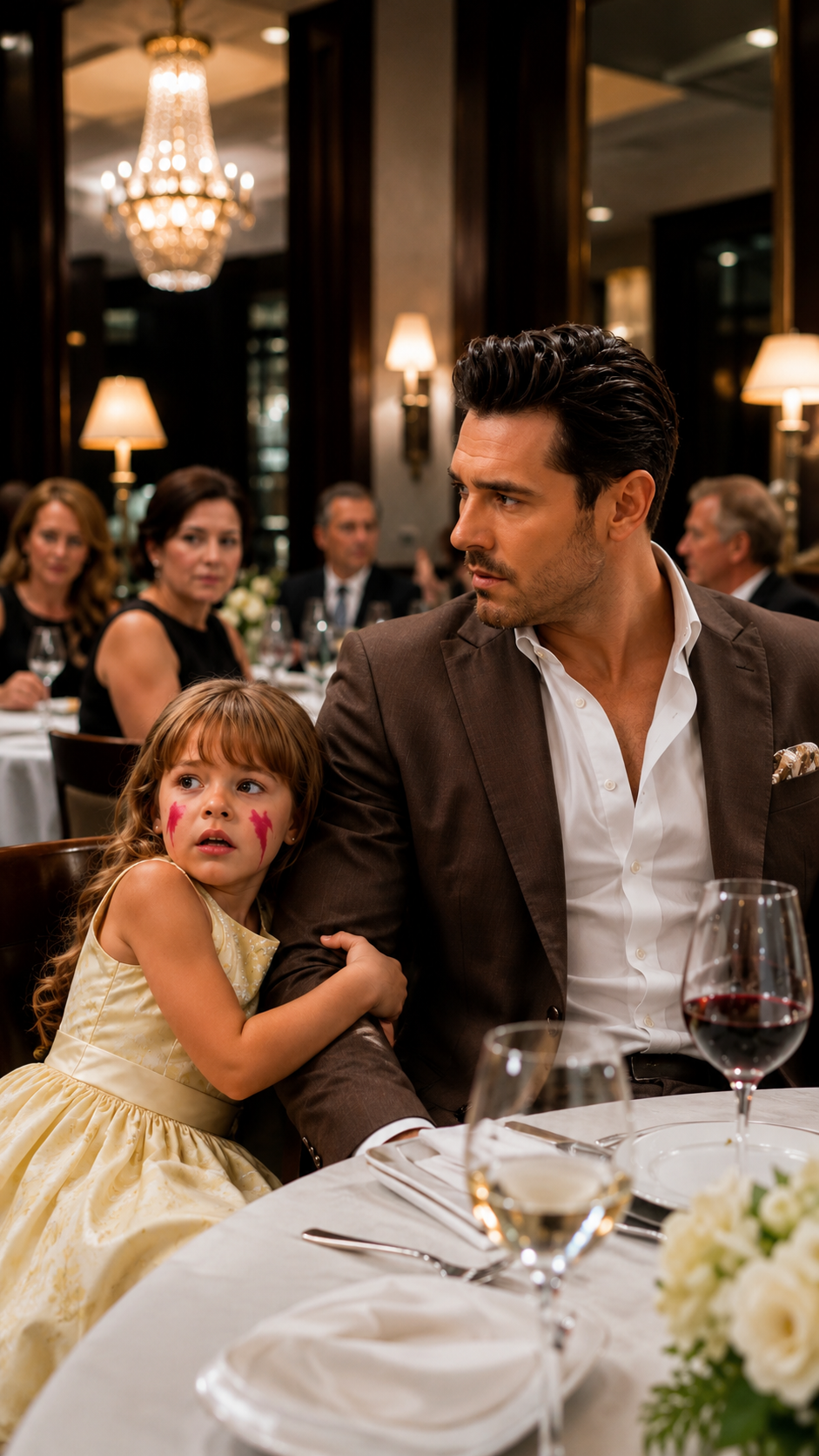
The girl appeared at the entrance of the restaurant with her feet caked in mud, her dress torn, and her face soaked in tears.
No one knew where she had come from.
The private room of La Palma Dorada, in San Pedro Garza García, fell silent. Even the mariachi playing softly in the corner stopped mid-chord.
At the back table sat Don Aurelio Mendoza, a 55-year-old man whom many called a businessman, others a benefactor, and some, in hushed tones, "the boss."
No one approached his table without permission.
No one looked at him for too long.
And certainly not a trembling, crying 7-year-old girl, breathing as if she had run across the entire city.
— Please! — she screamed — They’re killing my mom!
Aurelio's men stood up in unison. One reached for his jacket. Another blocked her path.
But the girl didn’t understand the fear of others.
She ran straight toward Don Aurelio and grabbed his black suit sleeve.
— My mom won’t wake up… they beat her… broke everything… please, sir.
Aurelio did not move.
For 25 years, he had built a reputation of stone. He did not plead. He did not explain. He did not forgive. His name alone was enough to shut mouths, open doors, and empty streets.
But that girl looked at him as if he could command death to leave.
— What’s your name? — he asked in a voice so low that his men barely recognized it.
— Lupita Morales.
The last name pierced his chest like an old bullet.
Morales.
Aurelio blinked once, but his hand tightened around the white napkin on the table.
— What’s your mom’s name?
— Rosa Morales. She has a flower shop in colonia Independencia. We live upstairs. Two men came. They wanted money. She said she didn’t have any. I hid behind some buckets with flowers.
An uncomfortable murmur spread through the room.
— One had a snake tattooed on his neck — Lupita said — The other had a scar here.
She touched her cheek.
El Güero, one of Aurelio’s men, went pale.
— Boss… those are from El Caimán’s group.
Aurelio lifted his gaze.
El Caimán had been extorting small businesses for months. Tortillerías, fondas, papelerías, florerías. Hardworking people. People who couldn’t defend themselves.
— Bring the truck — Aurelio ordered.
— Boss, it could be a trap.
Aurelio stared at his escort without blinking.
— Bring the truck.
Lupita didn’t let go of his sleeve.
— Are you going to save my mom?
Aurelio looked into those swollen, fearful eyes, and for the first time in years, he remembered a promise he couldn’t keep.
— She won’t be alone tonight, sweetheart.
And when he left the restaurant with the girl holding his hand, everyone understood that something very dangerous had just awakened.
PART 2
Rosa Morales’s flower shop looked as if it had been destroyed by an unnameable rage.
The glass from the display case was strewn across the sidewalk. The bouquets of roses lay trampled among puddles of water, dirt, and broken petals. A sign reading “Arrangements for weddings and baptisms” hung askew, as if it too had been struck.
Lupita wanted to run inside.
— Mom!
Aurelio held her by the shoulders, firm but gentle.
— Don’t go in, sweetheart. Look at me.
The girl shook so much that her teeth chattered.
Behind the counter was Rosa Morales, motionless, her hair plastered to her face, and one hand still clutching a notebook of accounts.
Aurelio felt the air grow heavy.
He had seen many things in his life. Too many. But a beaten mother in front of her daughter’s drawing was a kind of cruelty that even his own sins couldn’t justify.
— Doctor Ramírez — he ordered over the phone — I need an ambulance and full equipment at colonia Independencia. Now. Not tomorrow, not in 10 minutes. Now.
El Güero checked the back entrance.
— They left not long ago, boss. They left this.
On a fallen table lay a paper with large letters:
“Let them learn to pay.”
Aurelio picked it up, crumpled it slowly, and tucked it into his jacket.
He then found Rosa’s notebook.
Rent. Electricity. Lupita’s school. Medicine for the grandmother. Wholesale flowers. Gas.
At the end, circled, was a debt: 1,850 pesos.
That was the price of terror for a little girl.
That was what they valued the life of a mother.
— Seriously, what a lowlife — one of Aurelio’s men murmured.
No one laughed.
The ambulance arrived quickly, faster than usual in a neighborhood where one often had to wait, insist, and pray.
Rosa was still alive, but barely.
When they loaded her onto the stretcher, Lupita clung to Aurelio’s hand.
— My mom told me not to go out even if it sounded bad. But I saw she wasn’t moving anymore. I ran to where there were lights.
Aurelio looked toward the avenue.
The girl had crossed streets alone, at night, barefoot, to enter the most guarded restaurant in the city.
Not out of bravery.
Out of desperation.
In the hospital, Rosa went straight into surgery. Lupita was taken to a private room with a clean blanket and a kind nurse who brought her hot chocolate.
But the girl didn’t touch it.
— Do you know my mom? — she asked.
Aurelio stood by the window.
— I knew her many years ago.
Lupita lifted her face.
— Was she your friend?
Aurelio took too long to respond.
— She was someone I should have protected.
The girl didn’t understand, but she felt the sadness.
Aurelio didn’t say more.
Because eight years ago, Rosa Morales had worked in a fonda near the Juárez market. She was young, strong, cheerful, one of those women who said things straight to your face and didn’t shrink from anyone.
Aurelio loved her.
He loved her so much that he thought about leaving it all for her.
But Aurelio’s world didn’t let go easily. One night, when Rosa told him she was pregnant, he panicked like a coward. Not because of the responsibility, but because he knew his enemies would use that woman and that baby to break him.
Then he did the worst thing.
He pushed her away.
He sent her money anonymously. He had her watched without her knowing. Then, over the years, he let his men tell him that Rosa had left Monterrey.
And he believed it.
Or preferred to believe it.
At 3:18 in the morning, Aurelio’s cell phone vibrated.
— We’ve got them — said El Güero — The one with the snake is named Bruno. The one with the scar, Darío. They were at a bar in Buenos Aires bragging about what they did.
Aurelio looked at Lupita sleeping in a chair, clutching a bag with her mother’s dirty dress.
— Don’t touch them yet.
— Should we bring them?
— Yes. And I want El Caimán too.
Silence fell on the other end.
— Boss, El Caimán won’t go down easy.
Aurelio closed his eyes.
— Then let him learn.
Hours later, in an old warehouse near Santa Catarina, Bruno and Darío sat in front of Aurelio. They no longer looked so tough. The blood had drained from their faces.
— We didn’t know the girl was there — said Bruno.
Aurelio placed a photo he found in the flower shop on the table: Rosa and Lupita smiling next to a bouquet of sunflowers.
— And if you had known?
None answered.
— It was just a collection — Darío whispered — The lady owed.
Aurelio tilted his head.
— She owed 1,850 pesos. Is that why you left her nearly dead?
Bruno swallowed hard.
— The order came from above.
— From El Caimán?
Darío pressed his lips together.
Aurelio didn’t raise his voice.
— I’m going to ask you once. Don’t make me lose my patience.
Darío began to cry.
— Yes. But it wasn’t just him. Someone told him Rosa had to be scared. That if they pressured her, she would leave the neighborhood.
Aurelio remained still.
— Who?
Bruno lowered his head.
— Don Servando.
The name fell like a curse.
Don Servando was Aurelio’s old accountant. The man who managed properties, favors, payments, debts. The only one who knew where every peso and every secret was.
Aurelio felt a strange chill in his neck.
— Why did he want Rosa to leave?
Darío answered in a broken voice:
— Because the flower shop is on land they want to buy for a tower. And because he said the girl could cause problems if anyone saw her up close.
Aurelio didn’t speak.
But El Güero, who was behind him, understood before everyone else.
— Boss…
Aurelio pulled out the photo of Rosa and Lupita from his pocket. He looked at it again. The girl had his same eyes. The same eyebrow slightly raised. The same small mole near her ear.
He had always seen it.
He just hadn’t wanted to accept it.
— Take Don Servando to my office — Aurelio said — And find the papers for that purchase.
When he returned to the hospital, dawn painted the buildings gray. Lupita was still asleep. Rosa had not yet woken up.
Doctor Ramírez emerged from surgery with a tired face.
— She’s going to live. She’s delicate, but she’s going to live.
Aurelio leaned a hand against the wall. For the first time in years, his legs felt almost unresponsive.
— Thank you, doctor.
— There’s something else — the doctor said — In the preliminary tests, a match you requested to review showed up.
Aurelio looked at him.
The doctor lowered his voice.
— The rapid test indicates a very high compatibility. We still need to confirm with formal DNA, but everything points to the girl being your daughter.
Aurelio was not surprised.
That was what hurt him the most.
Because deep down, he had known since Lupita screamed in the restaurant.
Don Servando confessed before noon.
Not out of bravery, but because all his lies were written in contracts, transfers, and messages. He had used El Caimán to clear the block. He wanted to sell the entire lot to investors from San Pedro.
And Rosa was the last one refusing to leave.
But the real blow was something else.
Servando had hidden for seven years the letters Rosa sent Aurelio.
Letters where she said she didn’t want dirty money.
Letters where she asked that at least he get to know his daughter.
Letters where she pleaded for protection because someone was following her.
Aurelio read each page in silence.
In one, Rosa had written:
“Lupita asks about her dad. I tell her that one day she will know the truth, but I don’t want her to know him as a monster.”
Aurelio folded the letter with trembling hands.
That afternoon, when Rosa woke up, the first thing she did was look for her daughter.
— Lupita…
The girl leaped into her mother’s arms carefully, crying soundlessly.
— Mommy, Mr. Aurelio saved you.
Rosa looked toward the door.
Aurelio was there, hesitating to enter.
For the first time, the man whom all of Monterrey feared seemed unsure where to put his hands.
— Rosa — he said.
She looked at him with pain, rage, and exhaustion.
— Don’t come here pretending to be a hero now.
The phrase hit him harder than any threat.
— You’re right.
Lupita looked from one to the other.
— Do you two know each other?
Rosa closed her eyes.
Aurelio stepped forward.
— Yes, sweetheart.
The girl stood still.
— Why does he call me sweetheart?
Silence filled the room.
Rosa broke down in tears.
Aurelio knelt in front of Lupita, without touching her.
— Because I should have been with you since you were born. And I wasn’t.
Lupita didn’t understand everything at once. No child understands a seven-year absence in one minute.
But she did understand that her mother was crying differently.
Not out of fear.
But from an old wound reopening.
El Caimán was handed over to the authorities with enough evidence to sink him. Don Servando lost businesses, houses, and the protection he had bought with years of betrayals. The merchants in the neighborhood received back what had been taken from them. Some in envelopes. Others via deposits. No one signed anything.
The flower shop reopened two months later.
Rosa refused to live with Aurelio or forgive him right away. She told him in front of everyone that protecting someone wasn’t about sending bodyguards but staying when life got tough.
And he, for the first time, didn’t argue.
Every Tuesday, Aurelio went to the flower shop without guards at the door. He bought one bouquet of sunflowers and sat in a plastic chair while Lupita did her homework.
The people in the neighborhood murmured.
Some said a man like that never changes.
Others said that even the most twisted can feel shame when a girl looks at them without fear.
One day, Lupita handed him a drawing.
It was a flower shop, a smiling mom, a girl with braids, and a big man standing outside, not as the owner, but as someone waiting for permission to enter.
Aurelio looked at it for a long time.
— Is that me?
Lupita nodded.
— Yes. But you’re still on the sidewalk.
Rosa let out a sad laugh.
Aurelio smiled too, though it hurt.
Because he understood that justice wasn’t always about punishing the bad.
Sometimes it was about accepting that the greatest damage had been caused by oneself.
And in a neighborhood where everyone knew too much and forgave little, people started to wonder the same thing:
Does a man who arrives late to his daughter’s life deserve another chance, or are there absences that not all the money in the world can repair?