PART 1
The Family Court of Mexico City was more crowded than usual that morning.
There were reporters outside, lawyers in expensive suits, employees from Diego Valdés's company whispering in the benches, and family members who hadn't visited in years, now feigning concern.
Everyone claimed to be there for Sofía.
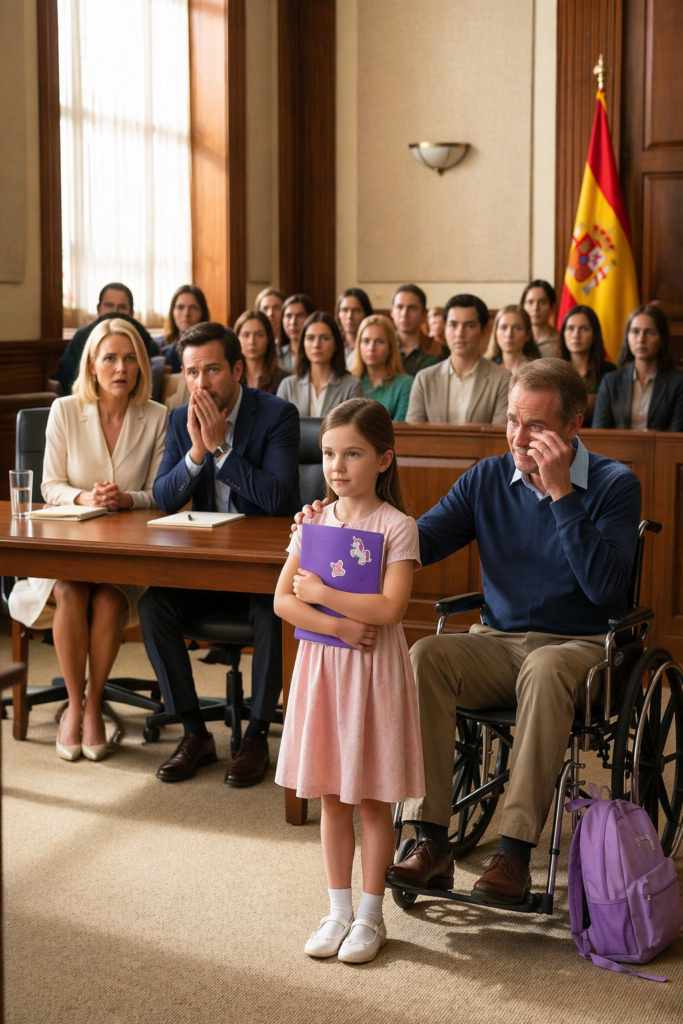
Sofía Valdés was 7 years old, with a crooked braid, black school shoes, and a purple folder covered in star stickers.
No one expected a little girl to understand what was happening.
But she understood more than the adults wanted to admit.
Her dad, Diego, sat in a wheelchair next to his lawyer. He had been battling amyotrophic lateral sclerosis for three years. His body had been gradually shutting down, but his mind remained sharp.
He remembered meetings, contracts, bedtime stories, allergies, vaccinations, favorite songs, and even the name of the stuffed animal Sofía needed to sleep when it rained.
Yet today, they wanted to use his illness to take his daughter from him.
Mariela, Sofía's mother, arrived dressed in a cream suit and a pearl necklace that shone too brightly under the cold court lights.
She had abandoned Diego and Sofía when the girl was two years old.
She said she left because she couldn't handle the pressure.
She said she needed to find herself.
She said many things.
But for five years, she sent no lunchboxes, missed festivals, wasn’t there for emergencies when Sofía had an allergic reaction, didn’t answer birthday calls, or learn what stories scared her daughter.
Now she stood there, with rehearsed tears, claiming she was back because she was worried about her daughter.
Next to her was Arturo Valdés, Diego's younger brother.
Arturo arrived with the face of a responsible uncle, yet his eyes did not look at Sofía.
They looked at the lawyers.
They looked at Diego.
They looked, above all, at the documents from Nube Clara, the tech company Diego had built from a rented apartment in Del Valle, now worth millions.
The plan was clear even if no one said it outright.
Mariela would ask for custody of Sofía.
Arturo would seek temporary control over Diego’s medical and business decisions.
And between the two, they would take the girl, the house, the shares, and the power.
Judge Catalina Martínez entered the courtroom, and everyone stood.
She had a tired gaze, but it was not weak.
From the first moment, she made it clear she would not allow theatrics.
"This court did not come to watch a family tear itself apart over money," she said. "Here, the well-being of Sofía Valdés will be decided. Anyone who forgets that will be removed."
Mariela lowered her gaze.
Arturo clenched his jaw.
Mariela’s lawyer spoke first. He said Diego was an admirable man but sick. He claimed Sofía lived in an environment of uncertainty. He said a child should not grow up watching her father lose mobility.
Then he showed photographs.
Sofía opening the apartment door.
Sofía reaching for a box of medicine on a shelf.
Sofía gently pushing Diego's wheelchair down the hallway.
Sofía standing next to a pill dispenser.
The images caused murmurs among the crowd.
They seemed like terrible evidence.
A child caring too much.
A father dependent on her.
A childhood stolen.
Diego closed his eyes in pain.
Not because the photos were false.
But because they were ripped from his truth.
Yes, Sofía helped sometimes.
But she also played, went to school, did homework, took piano lessons, ate quesadillas with Rosa, the nurse who lived with them, and fell asleep listening to her dad read even if he spoke more slowly.
Diego's lawyer was about to respond when a small voice cut through the courtroom.
"Excuse me, Your Honor."
Everyone turned.
Sofía stood up from the bench, her purple folder hugged to her chest.
Mariela made a gesture of shame.
Arturo let out a chuckle.
The judge looked at her carefully.
"What do you need, Sofía?"
The girl took a deep breath.
"I am my dad's lawyer."
Several people laughed.
Even a reporter stifled a quiet chuckle.
But Sofía didn’t sit down.
She walked to the front, placed the purple folder on the table, and opened the first tab.
Then everyone saw that inside there were no drawings.
There were receipts, printed emails, complete photographs, transcribed audio, and a letter with Mariela’s signature accepting money from Arturo.
The laughter in the room died like someone had flipped a switch.
PART 2
Judge Martínez raised a hand before Mariela’s lawyer could protest.
“Silence,” she ordered.
No one moved.
Sofía remained standing by the table, her fingers gripping the edge of the purple folder. She didn’t look like a child playing grown-up.
She looked like a girl tired of adults lying about her life.
Diego's lawyer, Licenciado Andrés Chen, approached slowly.
He didn’t take the folder.
He didn’t correct her.
He simply knelt to her height and asked if she wanted him to speak for her.
Sofía nodded.
“But they should read everything,” she said. “Not just the ugly photos.”
The judge authorized the material to be reviewed conditionally, as it involved a minor.
Arturo turned red.
Mariela clutched her chest as if she had just been insulted.
But what was in the folder was not a tantrum.
It was a complete life that no one expected to find organized by a 7-year-old.
The first section contained the complete photographs.
In the image of Sofía reaching for the box of medicine, Rosa could also be seen behind her, serving water and checking the dosage.
In the image of her pushing the wheelchair, the full video showed that they had only advanced two meters in the apartment because Diego had playfully said, "Let’s go, captain, take me to the living room."
Then he had stopped the electric wheelchair himself and had her sit on his lap to read to her.
In the image of the door, Trevor, the driver, could be seen entering with grocery bags.
Sofía was not caring for her dad.
She was opening the door because in her home, everyone did small things with love.
The second section included schedules.
Rosa Martínez, a licensed nurse, covered night and morning shifts.
Trevor took Sofía to school in Narvarte.
Nathan Ortega, the COO of Nube Clara, handled company emergencies.
The child therapist, Dr. Sara Beltrán, visited Sofía twice a month since Diego received his diagnosis.
There were invoices.
Contracts.
Medical reports.
Letters from teachers.
Everything indicated that Sofía was being cared for.
Not perfect.
But loved, protected, and accompanied.
Then came the third section.
That’s when the air changed.
There were printouts of emails between Arturo and Mariela.
In one, Arturo wrote: “If the girl stays with you, Diego will sink. I can request administration due to incapacity. You stay calm, and I will handle Nube Clara.”
In another, Mariela replied: “I need a guarantee. I’m not going to come back to make a fool of myself for nothing.”
Mariela’s lawyer stood up.
“Your Honor, we don’t know where that came from.”
The judge looked at him without blinking.
“Then you will have the opportunity to explain it. If it’s false, there will be consequences.”
Arturo tried to laugh it off.
“Please, she’s a child. Surely someone manipulated her.”
Diego opened his eyes.
For the first time during the hearing, he spoke.
His voice was low, raspy, yet clear.
“Don’t use that word with my daughter.”
The room froze.
Diego swallowed hard.
“Sofía was not manipulated. Sofía heard things she should never have heard because you talked about money in a hallway thinking a child wouldn’t understand.”
Mariela paled.
The judge called for a recess.
Outside, in the hallway, reporters crowded as if they had smelled blood.
Mariela approached Sofía with teary eyes.
“My love, you don’t understand. I just wanted to protect you.”
Sofía stepped back slightly behind Rosa.
“From what?” she asked. “From my dad or from being without money?”
The phrase was so simple that it hurt more than a scream.
Mariela didn’t respond.
Arturo did.
“That girl is insolent because of Diego.”
Rosa stepped forward.
“Don’t mess with the girl, sir.”
Arturo let out a bitter laugh.
“You’re an employee.”
Rosa lifted her chin.
“And still, I’ve been more present than your family.”
When they returned to the courtroom, the first witness was the neurologist Arturo had recommended, Dr. Fernando Ledesma.
He arrived with an impeccable resume.
Studies in the United States.
Presentations.
Publications.
A voice so calm it seemed to turn any possibility into a sentence.
He admitted that Diego had a progressive disease.
He admitted that his mobility had decreased.
He admitted that at some point he would need more support.
But when Licenciado Chen questioned him, the castle began to crumble.
“Doctor, does Mr. Valdés show cognitive deterioration currently?”
“No.”
“Can he make legal decisions today?”
“Yes, with physical assistance to sign or communicate when he tires.”
“Can you state with certainty that he will lose mental capacity in the next six months?”
“No, not with certainty.”
“Then what you describe is a future risk, not a present incapacity.”
The doctor took a deep breath.
“Correct.”
Arturo stopped looking at the judge.
Then Dr. Sara Beltrán, the child therapist, testified.
She said that Sofía was not acting like a child forced to care for an adult.
She said she had concerns, of course, because she loved her father and knew he was sick.
But she also said that she exhibited confidence, healthy affection, and a surprising understanding of who had really been in her life.
“The girl speaks of her mother cautiously,” she explained. “Not from manipulation, but from experience.”
Mariela covered her mouth.
For a moment, she appeared genuinely hurt.
But some wounds arrive late.
And arriving late doesn’t always suffice.
Mariela’s lawyer tried to insist with the photographs.
He said a child should not live among ramps, medicines, and nurses.
He said that was not a normal home.
Then Licenciado Chen requested permission to present a video recorded a month earlier.
It was Sofía’s 7th birthday.
Diego had organized a treasure hunt in his apartment in Roma.
Each clue was hidden in a place significant to her.
Under the piano bench.
Inside her astronomy book.
Behind the cookie jar.
Next to a bougainvillea pot on the balcony.
Diego followed her in his motorized chair, laughing when Sofía ran too fast and forgot to read the clues completely.
When she got stuck, he didn’t give her the answer.
He asked her questions.
“What place makes you think of stars?”
“Where do you keep what you’re afraid of losing?”
“What clue have you seen but not looked at closely?”
In the end, Sofía found a telescope wrapped in silver paper.
She screamed so loudly that Rosa came running with a cloth in her hand.
Diego, in the video, laughed until coughing forced him to stop.
Then Sofía carefully hugged his neck, as if she had learned that loving can also be delicate.
The room fell silent.
That video showed what the photos could not teach.
It showed play.
It showed patience.
It showed a childhood adapted, yes, but not destroyed.
It showed a sick father building joy with what he still had.
The judge requested to continue the next day.
That night, Mariela went to Diego's apartment.
Sofía did not welcome her. The girl was asleep.
Diego greeted her, with Rosa nearby for safety.
Mariela entered the room like someone stepping into a house that was once hers and discovering that life had moved on without permission.
She saw the drawings stuck to the refrigerator.
She saw the low shelves Diego had installed so Sofía could reach her books.
She saw the ramps.
She saw the small desk by the window.
She saw photographs from festivals, vaccinations, piñatas, homework, lost teeth, and crooked breakfasts.
In none did she appear.
Mariela broke down.
At first, she didn’t apologize.
First, she told the truth.
Arturo had sought her out four months earlier.
He told her that Diego was weakening.
He told her the company needed “healthy hands.”
He told her she could regain her daughter and secure her future.
He promised her a house in San Ángel, a high pension, and shares if she supported the request.
Mariela accepted.
Not because she had suddenly become a mother.
Not because her soul was shattered missing Sofía.
She accepted because she had debts, because her new partner had left her, and because she was terrified of aging with nothing.
“I told myself that kids adapt,” she confessed, her voice breaking. “I told myself she would be okay with me even though I hadn’t been there. What a terrible mother I was.”
Diego didn’t insult her.
That was the worst for her.
He simply looked at her with fatigue.
“Sofía is not a solution for your problems, Mariela.”
She cried then.
Not pretty.
Not like in the hearing.
She cried with her face contorted, like someone finally grasping the size of her ruin.
The next day, before the judge issued a ruling, Mariela stood up.
Her lawyer tried to stop her.
She wouldn’t let him.
“Your Honor, I submitted this petition saying I was worried about my daughter. The truth is I returned for economic reasons.”
The silence was brutal.
Mariela continued.
“Arturo Valdés offered me financial security if I requested custody of Sofía and supported his request to control Diego’s decisions. I accepted. I was not ready to be a mother when I left, and I did not become a good mother just because Diego got sick.”
Arturo stood up furious.
“This is nonsense! You’re sinking alone!”
The judge slammed the table.
“Mr. Valdés, one more word and I will order you removed.”
Mariela breathed shakily.
“Diego has been the father I did not know how to be. Taking Sofía away would be cruel to both of them.”
Then she withdrew her petition.
Arturo was exposed.
Without Mariela, his argument crumbled.
Licenciado Chen then presented transfers, messages, and a draft contract where Arturo had already prepared internal changes to take control of Nube Clara as soon as Diego was declared incapacitated.
The judge ordered copies sent to the Public Prosecutor's Office for possible procedural fraud and attempted undue administration.
Arturo didn’t leave in handcuffs that day, but he left defeated.
And sometimes public defeat weighs more than handcuffs.
The ruling was clear.
The court determined that Diego retained cognitive capacity, that his support network was sufficient, and that Sofía should remain in the home where she was known, loved, and protected.
The judge called Sofía to the front.
The girl walked slowly. Her shoes squeaked on the floor.
“Sofía,” said Judge Martínez, “being brave doesn’t mean carrying what isn’t yours. But today, you helped this court see your truth.”
Sofía looked at her dad.
“I just didn’t want them saying lies about him.”
The judge softened her voice.
“Family is not just measured by blood. It’s measured by who stays, who cares, and who puts a child before their ambition.”
Mariela exited through a side door.
Arturo left among cameras, unable to hide his face.
Diego and Sofía walked out together.
Rosa followed behind with the purple folder in her arms, as if carrying something sacred.
This could have been the end.
But it wasn’t.
Eight years later, Sofía Valdés appeared before a committee of the Congress of Mexico City.
She was 15, wearing a navy blue blazer, the same worn purple folder, and a silver bracelet with a small star that Diego had given her.
Behind her stood her dad, weaker now, with a nearly extinguished voice, but with his gaze intact.
Sofía spoke in favor of a reform to ensure that girls, boys, and adolescents were genuinely heard in custody and guardianship processes, with psychological support, clear language, and independent advocates.
Some deputies said that children were easy to manipulate.
That they didn’t understand legal matters.
That opening that door would complicate trials.
Sofía asked for the microphone.
“They confuse age with awareness,” she said. “A child may not understand the procedure, but they understand who hugs them when they tremble, who abandons them, and who only appears when there’s money.”
Her phrase went viral that same afternoon.
The reform was passed months later.
The press called it the “Sofía Law.”
She disliked the name.
Diego loved it.
Over time, the foundation they both created helped minors in family trials have therapists, lawyers, and, above all, the dignity of being heard before adults made decisions for them.
Mariela changed gradually.
Not in a movie way.
Not with perfect hugs.
Not with immediate forgiveness.
She started sending letters without asking for anything.
Later, she sent a silver pen that had belonged to Sofía’s great-grandmother, a journalist who covered social movements in the 70s.
She wrote a brief note: “Words are only valuable when used to defend the truth.”
Sofía didn’t forgive her right away.
Maybe never entirely.
But she learned that growing up doesn’t always require erasing the damage.
Sometimes it’s enough not to let the damage dictate.
Arturo, years later, did something unexpected.
He donated 5,000,000 pesos to the foundation unconditionally.
When Sofía asked why, he answered in a voice that no longer sounded arrogant:
“Because I saw my niece defend other children and thought maybe I would have been less miserable if someone had defended me.”
Sofía accepted the money.
She did not accept an apology that he never knew how to say properly.
Diego lived long enough to see her graduate from Law.
He lived long enough to be in the front row when Sofía won her first child defense case.
He lived long enough to tell her, with his voice almost a whisper, that Nube Clara was not his legacy.
“My legacy is you,” he told her. “And every child you don’t leave alone.”
He died two years later, at home, with Sofía holding his hand and Rosa praying softly by the window.
On the day of the funeral, Sofía placed the purple folder on Diego’s desk.
She no longer needed to carry it for people to believe her.
But she never threw it away.
Five years later, outside the Congress, now a newly sworn legislator, a reporter asked her what had started it all.
Sofía smiled.
She didn’t think of politics.
She didn’t think of money.
She thought of a sick father who still read her stories.
She thought of a little girl who knew who loved her.
She thought of a room full of adults laughing at a purple folder.
And she thought of the silence that came after, when the truth lay open on the table.
At 7 years old, Sofía Valdés said in a courtroom: “I am my dad’s lawyer.”
She wasn’t a lawyer yet.
But she was speaking the truth.
And in a family where everyone wanted to use a man’s illness to take away what he loved, the truth was enough to start justice.