PART 1
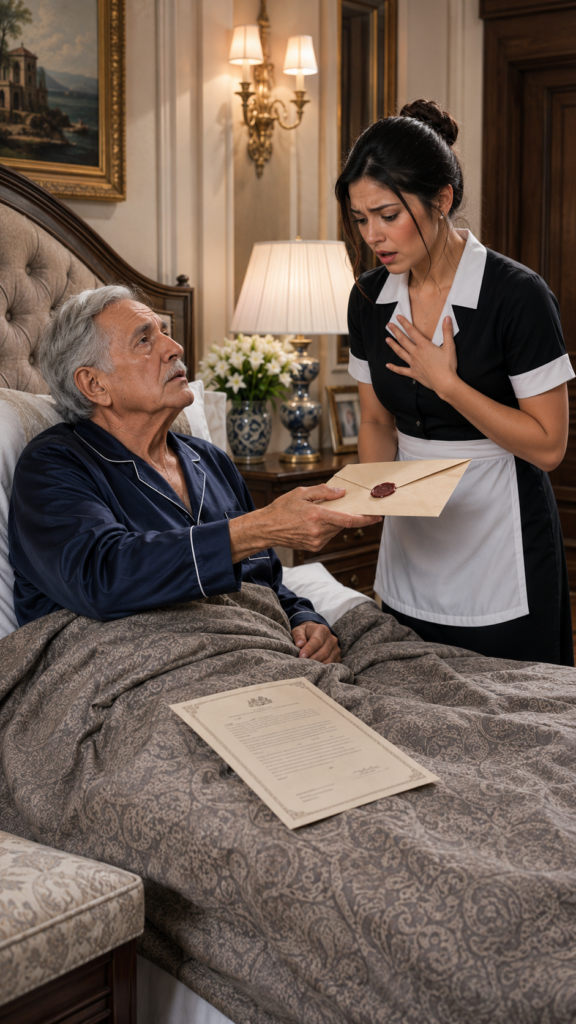
—Abril, I need you to sleep here with me tonight.
The young woman dropped a small spoon onto the tray. The metallic sound echoed in the vast bedroom as rain lashed against the windows of the Arriaga mansion in Puerto Vallarta.
Don Julián Arriaga, one of the wealthiest hotel magnates in Mexico, watched her from the bed. He looked frail, tethered to an oxygen tank, his skin almost translucent.
—Sir, I... I don’t understand —Abril replied, stepping toward the door.
—I'm not asking for anything indecent —he clarified—. Just stay awake. I need to talk to someone before I die.
For four years, Abril Mendoza had worked as a live-in maid at that estate. She knew every hallway, every key, and every whim of the family.
She also knew that Don Julián's three children had been arguing for hours downstairs.
Mauricio was demanding access to the company accounts. Renata wanted to sort through her deceased mother’s jewels. Tomás was arguing with a lawyer about several properties in Los Cabos.
None of them had come up to check on their father.
—Why me? —Abril asked.
Don Julián gestured to a chair beside the bed.
—Because you’re the only person in this house who comes in without asking me how much money I’m going to leave you.
Abril sat down, still skeptical.
On the bedside table lay an old photograph. In it, a young girl with dark hair stood in front of a bougainvillea, holding a small wooden box.
—That was my eldest daughter —Don Julián explained—. Her name was Elisa.
Abril frowned.
Everyone knew the three Arriaga heirs, but she had never heard of Elisa.
—She fell in love with a mechanic from Guadalajara —he continued—. I told her she was ruining her life. I forced her to choose between that man and her family.
—And she left?
—Yes. I was convinced she would come back on her knees.
Don Julián closed his eyes.
—But she never returned.
Years later, Elisa wrote to him. Her husband had died in an accident, and she had a baby. She wasn’t asking for a fortune. Just help to pay the rent and find a decent job.
Don Julián received that letter, but his pride was stronger.
He kept it without replying.
Abril felt a knot form in her stomach.
Her own mother was also named Elisa. She had been widowed when Abril was a baby and had worked for years selling food and cleaning houses in Guadalajara.
Without thinking, Abril touched the medallion she wore under her uniform.
It was a small silver hummingbird.
Don Julián opened his eyes and stared at the piece of jewelry.
—Where did you get that?
—It belonged to my mom.
The old man began to tremble.
—What was her full name?
Abril wanted to get up. Something inside her warned that this conversation was about to shatter the life she knew.
—Elisa Mendoza Robles.
Don Julián covered his face and let out a groan.
—My God... I had you here for four years, and I didn’t want to see it.
In that instant, the door swung open.
Mauricio entered, accompanied by Renata and Tomás. The three had been eavesdropping from the hallway.
—How convenient —Mauricio said—. The poor maid turns out to be the daughter of a woman who disappeared just when our father is dying.
—I didn’t come here to ask for anything —Abril replied.
Renata looked at her uniform with contempt.
—Of course not. You just sneaked into his bedroom at night to talk about inheritances.
Don Julián gathered his strength and struck the mattress with his hand.
—Shut up! I won’t allow you to humiliate her again.
Renata's eyes widened in surprise.
—Why do you defend her so much?
The old man looked at Abril and uttered the word no one was prepared to hear:
—Because she is my granddaughter.
Silence fell over the room.
Don Julián opened a hidden compartment in the nightstand and pulled out a yellowed envelope. On the front was Elisa’s handwriting and a date from 29 years ago.
Abril immediately recognized her mother’s script.
Mauricio tried to grab the letter, but the old man placed it in Abril's hands.
—I kept it for too long —he confessed—. And I changed my will eight months ago.
Mauricio lost all color.
Renata stopped breathing for a second.
Tomás switched off the recording on his phone.
Then Don Julián pointed to a small safe behind a painting.
—There’s the proof that you knew who Abril was long before I did.
PART 2
Mauricio let out a nervous laugh.
“Dad is delirious. We need to call the doctor.”
“Dr. Cárdenas no longer works for me,” Don Julián replied. “I discovered that you were paying him to keep me sedated.”
Tomás slowly put away his cellphone.
Renata looked at her brothers, hoping one of them would deny the accusation. None did.
Abril still held the letter in her hands. She wanted to open it, but fear paralyzed her.
All her childhood, she had believed her mother had no family. Elisa said that some doors should remain closed so that pain wouldn’t creep back in.
Now Abril understood that behind one of those doors lay a fortune, a surname, and three people who might have known the truth.
“Open the safe,” Don Julián demanded.
Mauricio stepped in.
“You have no right to involve an employee in family matters.”
Abril stared at him intently.
“A minute ago you said I had come for an inheritance. Now it turns out I don’t even have the right to listen. Make up your mind, dude.”
Tomás expressed disbelief.
Abril had never spoken to them like that. For years, she had endured orders, mockery, and abandoned glasses on freshly cleaned tables.
But that night, she no longer needed a job.
She needed to defend her mother’s name.
Don Julián gave her the combination. Inside the safe were legal documents, an electronic memory drive, and a second letter.
Abril connected the memory drive to the bedroom television.
The first recording showed Mauricio and Tomás inside Don Julián’s office, ten months earlier.
“The girl’s name is Abril Mendoza,” Tomás said. “Her mother was Elisa.”
Mauricio paced back and forth.
“Are you sure?”
“I found her file when I reviewed the staff. It has the correct birth date and still holds the hummingbird that grandpa had made for Elisa.”
“Then we need to fire her.”
“Not yet,” Renata intervened from an armchair. “Dad trusts her. If we throw her out without reason, she will investigate. Let her stay and keep an eye on her.”
The recording ended.
Abril felt as if she were suffocating.
“You knew…”
Renata looked down.
“It was just a possibility.”
“You watched me serve you meals for months knowing I could be your sister’s child.”
Mauricio tried to approach.
“Abril, think calmly. We can come to an agreement. A house, money, whatever you need. But this matter cannot leave this room.”
“My mom needed help for years, and now you want to buy my silence in five minutes.”
“Your mother made her own choices,” Mauricio retorted.
Don Julián raised his head.
“Elisa chose to love. I chose to punish her. Don’t confuse things to feel less miserable.”
Abril finally opened the letter from 29 years ago.
“Dad, I know you forbade me from coming back, so I’m not returning. I’m only writing because my daughter is not to blame for my decisions.”
Elisa recounted how her husband had died leaving debts. She worked making sandwiches in the mornings and cleaning an office at night.
Sometimes she took little Abril wrapped in a blanket because she had no one to leave her with.
She didn’t ask for money for herself.
She asked her father to help her granddaughter have a safe roof over her head.
Abril had to pause.
“You never replied?”
Don Julián shook his head.
“I wrote a horrible response. Then I tore it up. I thought she would call the next day, but pride turns every day into an excuse.”
“She checked the mailbox,” Abril murmured. “When I was a child, she still checked it even though hardly anyone wrote to us.”
Those words sank the old man.
At that moment, the door knocked.
Licenciada Jimena Ortega, Don Julián’s personal lawyer, entered, accompanied by a notary and two security guards.
Mauricio became furious.
“What are they doing here?”
“To ensure that Mr. Arriaga can speak without threats,” Jimena replied. “There are also copies of the recordings at three different notaries.”
Tomás let out a curse.
The lawyer placed several documents on the table.
A genetic test, conducted with a hairbrush kept among Elisa’s belongings, confirmed that Abril was Don Julián’s biological granddaughter.
The will had been signed eight months prior, when two independent doctors certified that the businessman was in full use of his faculties.
“The three children will receive only previously assigned personal properties,” Jimena explained. “They will not have control over the hotels or the main accounts.”
Mauricio punched the wall.
“That company also belongs to us!”
“No,” his father replied. “I built it. And you nearly destroyed it by borrowing for your absurd businesses.”
Jimena handed another document to Abril.
“Don Julián established two possibilities. You can receive the main shares to manage them or transfer them to a foundation named after your mother.”
Abril read the foundation's purpose.
It would help women with children who had been abandoned by their families, offering them shelter, childcare, legal advice, and job training.
“It’s exactly what Elisa asked for,” Abril said.
Don Julián nodded.
“I wanted to respond to her, even if it was 29 years late.”
Renata began to silently cry.
“Elisa also wrote to me.”
Everyone turned to her.
“I was 19,” she confessed. “Dad told us that Elisa left because she hated the family. In her letter, she explained that she had a little girl and asked me to go meet her.”
Abril clenched the paper.
“Did you go?”
“No.”
“Did you reply?”
Renata shook her head.
Abril’s pain transformed into rage.
Her mother hadn’t sought help at just one door. She had knocked on several, and behind all of them were people too cowardly to open.
“My mom died thinking none of you wanted to know about her.”
“I was young,” Renata whispered.
“My mom was young too. But she worked early in the morning with a baby in her arms while you decided that responding to a letter was too complicated.”
Mauricio took the documents and tried to tear them.
One of the guards held him back before he could do so.
Tomás ran to the television to yank out the memory drive, but Jimena raised her phone.
“Everything is backed up. If you continue to behave like this, I will also present the statement where Don Julián explains that he feared for Abril’s safety.”
The siblings froze.
For the first time, they lost control of the room.
Don Julián asked for the curtains to be opened. The storm had passed, and the sky began to clear over the bay.
“The decision is yours,” he told Abril. “You can keep the shares. No one would have the right to judge you.”
She contemplated the bedroom, the expensive sculptures, and the marble floors she had mopped so many times.
Then she remembered the small apartment where her mother turned off the heater to save gas. She recalled her dry hands, her worn shoes, and the habit of smiling when she didn’t have enough money.
“The mansion will bear the name Elisa Mendoza,” she decided. “And the companies will fund the foundation.”
Mauricio let out a bitter laugh.
“You don’t know how to manage hotels.”
“That’s true. But I know how to hire qualified people without forcing them to be complicit. That’s already more than what you did.”
Jimena hid a smile.
“You’re going to destroy our father’s legacy,” Tomás said.
Abril shook her head.
“I’m going to turn it into something that isn’t embarrassing.”
Don Julián extended his hand.
“I don’t deserve your forgiveness.”
Abril sat beside him.
“I can’t forgive you in one night for what my mother suffered for 29 years.”
The old man nodded.
“I prefer that truth to a pious lie.”
“But I can stay until dawn.”
Don Julián’s eyes filled with tears.
For the next few hours, he spoke to her about Elisa.
He told her how, as a teenager, he would sneak out to eat tacos on the street because he detested dinners with politicians. Once he sold an expensive watch to pay for a gardener’s daughter’s surgery.
Abril recognized her mother in every memory.
She too told him of the life Don Julián had missed. Elisa sang while cooking, burned the rice when she was worried, and kept a yellow dress that she never dared to wear.
“I gave it to her when she turned 18,” he said.
“She said it belonged to a life that was no longer hers.”
Don Julián closed his eyes.
“It should have belonged to both lives.”
At 6:20 in the morning, his breathing began to weaken.
Mauricio and Tomás remained in the hallway talking with lawyers. Renata was near the door, clutching the letter she had never replied to.
Don Julián looked at Abril.
“Do you think Elisa knew I loved her?”
Abril felt that question could break her.
“I think she waited her whole life for proof.”
A tear rolled down the old man’s face.
“She waited longer than I deserved.”
Minutes later, he whispered his daughter’s name and died holding the hand of the granddaughter he had known too late.
The news appeared in every media outlet.
Don Julián’s children contested the will but lost. The medical evidence, the recordings, and the legal documents proved that the businessman had acted freely.
Mauricio lost his position. Tomás was investigated for irregular movements. Renata disappeared for months.
Abril took Elisa’s ashes to the garden of the mansion and placed a simple stone:
ELISA MENDOZA ARRIAGA DAUGHTER, MOTHER, AND BRAVE WOMAN THIS HOUSE WILL NO LONGER DENY YOUR NAME
The fortune couldn’t return the lost years.
But the truth could prevent another woman from waiting in front of an empty mailbox.
Six months later, the mansion ceased to be a private residence.
The party hall became a daycare. The guest rooms received beds and cribs. The library transformed into a legal advice center.
On the first night, a young woman arrived with a sleeping baby and all her clothes in two supermarket bags.
Upon seeing the shiny floors, she stepped back.
“I don’t belong in a place like this.”
Abril recalled the first time she had entered through the service door.
She took one of the bags.
“Yes, you do. This house was created precisely for women who were made to believe otherwise.”
Two years later, the Elisa Mendoza Foundation had helped 94 women and 137 children.
Renata appeared one afternoon carrying several boxes.
Inside were the photographs, letters, and belongings of Elisa that the family had hidden.
“I should have given you this before,” she said.
“Yes.”
“I don’t know how to repair what I did.”
Abril observed her for a few seconds.
“Start by stopping the excuses.”
That wasn’t forgiveness.
But it was the first honest conversation they had.
In one of the boxes, Abril found another letter from her mother.
It was addressed to her.
“Daughter, you come from a family that knows how to build enormous buildings but doesn’t know how to open a door on time. Don’t let money teach you that same cowardice. When you find a closed door, open it for someone else.”
Abril framed the letter and placed it at the entrance of the foundation.
People said she was lucky.
They said she went from cleaning a mansion to being its owner. That she inherited millions for bringing a cup of tea to the right person.
But that wasn’t the true story.
The true story was of a mother who asked for help and received silence.
Of a daughter who refused to sell that mother’s dignity.
And of an old man who, on his last night, understood that leaving a fortune meant nothing if he also left the damage he had caused intact.
Don Julián asked Abril to stay because he wasn’t looking for a lover, a nurse, or another obedient employee.
He was looking for a witness.
Someone capable of hearing the truth before his children buried it under money.
PART 3 And thanks to her, the house that had kept its doors closed for 29 years ended up becoming a refuge for those who had nowhere else to turn.