PART 1
On the night Santiago Beltrán knocked on the door of his ex-wife's house on Christmas Eve, he didn’t expect forgiveness.
He expected Valeria to slam it in his face.
He expected her to spit all the hate she’d harbored for seven years.
What he never imagined was seeing a child running behind her, wearing red shoelaces, a crooked Santa hat, and holding a plastic cart in his hand.
—Mom, look! Santa left a tire lying around!
Santiago gasped, his breath caught in his throat.
The boy looked to be about seven years old.
But it wasn’t the age that hit him in the chest like a bullet.
It was the eyes.
Those dark, serious, distrustful eyes, just like his own.
The same way of tilting his head.
The same marked eyebrows.
The same look of someone who observes first before deciding to trust.
Valeria turned pale.
—Santiago… —she whispered.
He squeezed the wrapped box he held in his hands.
He had traveled from Monterrey to this quiet neighborhood in Querétaro only to return some Christmas decorations he found in a warehouse.
Or so he had repeated to himself all the way.
The truth was much sadder.
He wanted to ask for forgiveness.
Even if it was too late.
Even if it meant nothing.
Even if he was the man who had inherited a criminal organization and she was the woman who once begged him to leave that world before it swallowed them whole.
The boy stared at him.
—Who are you?
Valeria reacted quickly.
She placed a hand on the boy’s shoulder and gently pushed him down the hallway.
—Leo, go wash your hands. Dinner is almost ready.
—But mom…
—Now, honey.
Leo frowned, glanced back at Santiago, and shuffled away with the cart as if carrying a secret.
The silence became heavy.
Santiago looked at Valeria.
—How old is he?
She crossed her arms over her beige sweater.
—7.
Santiago felt the ground shift beneath him.
Seven years since the divorce.
Seven years since he’d pushed her out of his life, believing she had betrayed him.
Seven years since he signed papers without listening to her.
Seven years since she disappeared without asking for anything.
—Valeria…
—Not here —she said, her voice broken but firm.
—Is that boy…?
—I said not here.
Santiago looked at the house.
Small.
Warm.
Smelling of punch, cinnamon, and cookies.
There was a Christmas tree by the window, adorned with handmade decorations and a crooked golden star on top.
There were no bodyguards.
No armored trucks.
No marble, weapons, or men waiting for orders.
Just a real house.
A life that didn’t belong to him.
—Can I come in? —he asked.
Valeria hesitated.
Then Leo shouted from the hallway:
—Mom! The star fell again because gravity is so mean!
Santiago almost smiled, but he held it back.
He had no right to smile in this house.
Valeria took a deep breath and stepped aside.
—One minute.
He walked in.
The door closed softly behind him.
But for Santiago, it felt like a sentence.
Valeria took the gift from his hands without looking at it.
—I didn’t know —he said quietly.
—You weren’t supposed to know.
Santiago turned towards her.
—Wasn’t I supposed to know I had a son?
His eyes filled with ancient rage.
—You still can’t use that word.
Still.
She didn’t say never.
She didn’t say no.
She said still.
And that small word opened his chest wide.
Leo appeared again, holding a cardboard star.
—Mom says scary adults shouldn’t touch the tree.
Valeria closed her eyes.
—Leo…
The boy pointed at Santiago.
—You’re scary.
Santiago crouched slowly, not getting too close.
—That’s fair.
Leo studied him.
—Are you bad?
Valeria froze.
Santiago could lie.
He had lied in offices, courthouses, funerals, and meetings where a single word could kill someone.
But he couldn’t lie to that child.
—I’ve done bad things —he said—. But I’m trying to do something good.
Leo considered him like a judge.
—Can you fix stars?
Santiago blinked.
—I can try.
—Santiago —Valeria warned.
He looked at her.
There was no challenge.
Just a silent plea.
Let me do at least this.
She swallowed hard.
—Just the star.
Leo went for a chair.
Santiago approached the tree as if walking towards an altar.
The star was cheap, golden, taped on with clear tape.
His hands, those hands that had signed punishments and dirty deals, now trembled in front of a child’s star.
He straightened it carefully.
Leo watched him.
—You have villain hands.
Valeria let out a sound that was half-laugh, half-pain.
Santiago looked at his hands.
—Sometimes hands learn late.
Leo didn’t understand.
Valeria did.
Santiago placed the star.
It was still crooked.
Leo barely smiled.
—Better.
—Only better?
—It still looks like it fought.
Santiago looked at the star.
—Maybe it won.
For the first time, Leo smiled genuinely.
And it hurt Santiago more than any threat.
Valeria sent the boy to check the cookies, without touching the oven.
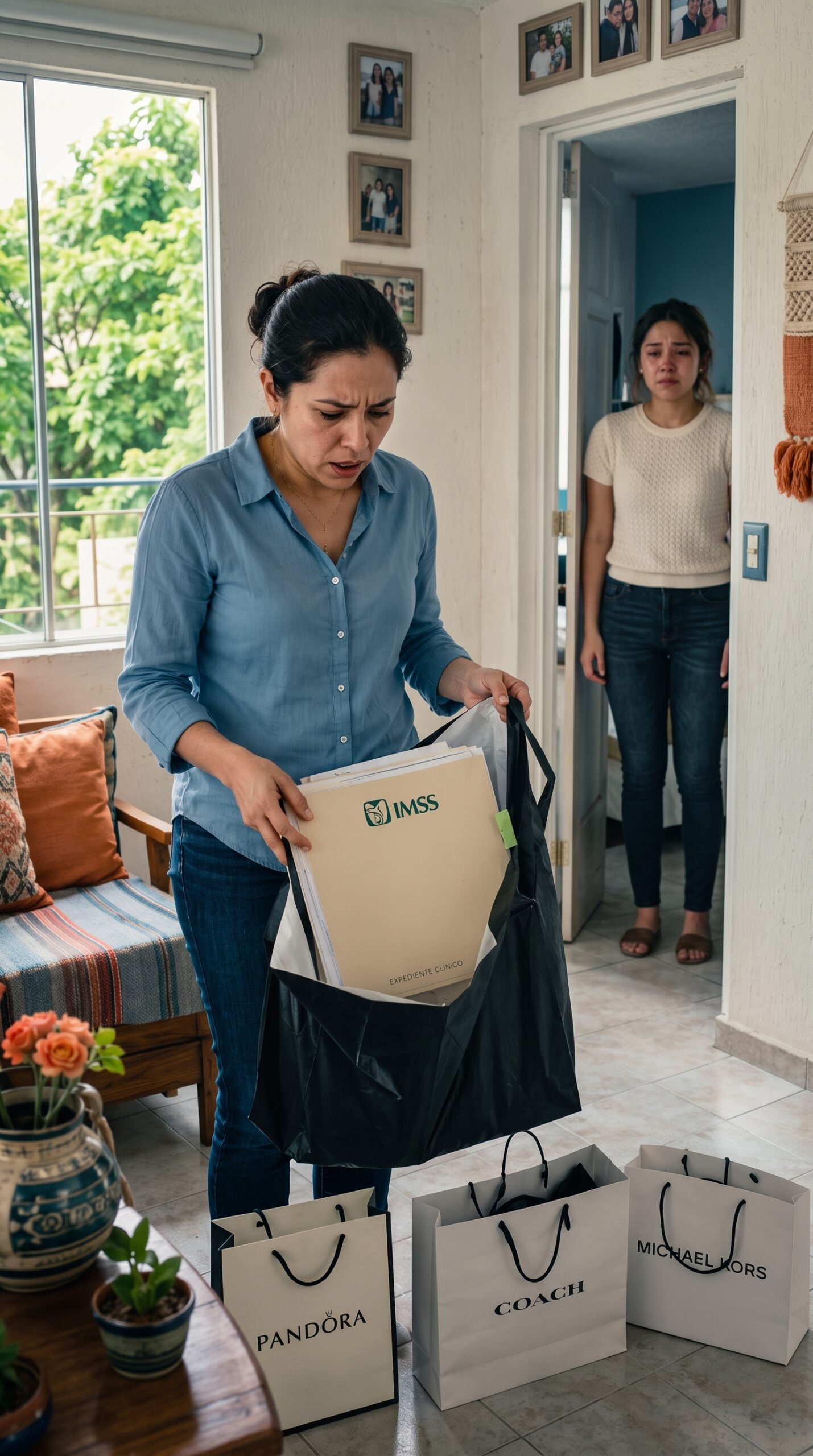
When they were alone, she opened a drawer and pulled out an old folder.
—Before you ask more, look at this.
Santiago saw worn documents.
A pregnancy test.
A medical report.
An unsent letter.
And a returned certified envelope.
His name was on the label.
Santiago Beltrán.
Receipt rejected.
His blood froze.
—I never received this.
Valeria pulled out another paper.
A delivery receipt.
Received by: Darío B.
Santiago stopped breathing.
Darío.
His cousin.
His right-hand man.
The man who showed him fake photos of Valeria leaving a hotel with a rival lawyer.
The man who told him she sold information.
The man who filled his head with poison while Valeria cried in silence.
—Darío received the second letter —she said—. It never got to you.
Santiago felt the old beast inside him awaken.
The part that resolved betrayals with blood.
But he was in a kitchen smelling of cookies.
With his son in the hallway.
With the woman he had destroyed without touching a hair on her head.
—Why didn’t you insist? —he asked, hating himself for the question.
Valeria looked at him with brutal sadness.
—Because when I went to find you at the courthouse, you walked right past me and said that if I came near your family again, I would regret it.
Santiago froze.
He remembered that day.
He remembered the rain.
He remembered Darío holding his arm.
He remembered Valeria at the end of the hallway, pale, one hand over her belly.
And he remembered the worst.
He didn’t stop.
He didn’t ask.
He didn’t look.
He just chose to believe everyone but her.
—I didn’t know you were pregnant —he murmured.
—No —Valeria said—. But you knew I was there.
At that moment, Leo entered with flour on his cheek.
—Mom, the cookies make weird bubbles.
Valeria rushed to the oven.
Leo looked at Santiago.
—Are you staying for dinner?
Valeria almost dropped the tray.
—Leo…
The boy shrugged.
—It’s Christmas. If he fixed the star, he can eat.
Santiago couldn’t speak.
Valeria slowly closed the oven.
—Mr. Beltrán has other plans.
Leo looked at him.
—Do you have family?
Santiago held his gaze.
—I did.
The answer slipped out on its own.
Valeria stood still.
Leo frowned.
—Did you lose them?
Santiago looked at Valeria.
—Yes.
Leo thought for a few seconds.
—Then you can have dinner here once. But don’t sit in my chair.
Valeria closed her eyes.
The pause was excruciatingly long.
Santiago braced for the no.
He deserved it.
But she took a breath and said:
—Set another plate, Leo.
And Santiago understood, with his heart shattered, that what was about to happen that night seemed impossible even in his worst nightmares.
PART 2
The dinner was the strangest thing Santiago Beltrán had experienced in years.
There were no expensive glasses.
There were no armed men outside.
There were no codes, threats, or whispered calls.
There was chicken with mole, baked potatoes, punch, overly sweet cookies, and a boy explaining that Santa needed better brakes because the roofs in Mexico weren’t made for professional landings.
Santiago spoke little.
He listened a lot.
He watched how Leo asked Valeria for permission with his eyes before serving himself more water.
He watched how she wiped the flour from his cheek with her thumb.
He watched the drawings stuck to the refrigerator.
A sun.
A rocket.
A family of two.
Valeria and Leo.
He wasn’t erased.
He had never been drawn.
That hurt more.
After dinner, Leo fell asleep on the couch, hugging his cart.
Valeria covered him with a blanket.
Santiago stood a few steps away, like a stranger in a church.
—Does he have my last name? —he asked.
—No.
The no was harsh.
Worse still.
—His name is Leonardo Rivas.
Rivas.
Her last name.
Santiago nodded.
—Does he know anything about me?
Valeria looked at the sleeping child.
—He knows his dad couldn’t be there.
—That was too generous.
—I didn’t do it for you. I did it for him.
Santiago swallowed hard.
—Thank you.
—Don’t thank me yet.
She crossed her arms.
—You’re not going to enter his life like a truck without brakes. You’re not going to bring men down my street. You’re not going to decide school, doctor, routine, or Christmas just because you discovered blood. You’re not going to tell him who you are until I say he’s ready.
The old Santiago wanted to respond.
He wanted to say it was his son.
He wanted to impose.
He wanted to command.
He wanted to turn the pain into authority.
But he looked at Leo sleeping.
And it crushed him.
—Alright.
Valeria watched him.
—That was too easy.
—No —he said—. It was the hardest thing I’ve said in years.
She didn’t cry.
But her eyes shone.
—We’ll do a DNA test. Not because I doubt. Because your world turns everything into a weapon.
—Yes.
—With a lawyer chosen by me.
—Yes.
—Visits with me present.
—Yes.
—And if Darío or any of your men approaches my son, I’ll disappear again.
Santiago held her gaze.
For the first time, he didn’t get angry at being threatened.
He respected her.
—Darío won’t come near.
—I don’t want to know how.
—Then I won’t tell you.
—I don’t want blood for my son.
Santiago paused.
—There will be no blood in his name.
Valeria understood the difference.
She didn’t like it.
But she understood.
That night, Santiago left before midnight.
He didn’t touch Leo.
He didn’t ask for a photo.
He didn’t try to hug Valeria.
From the sidewalk, he looked at the window.
Leo was awake again, pressed against the glass, waving with his cart in hand.
Santiago raised his.
Leo smiled.
Valeria appeared behind and lowered the curtain.
Not as punishment.
As a boundary.
And Santiago accepted that boundary as one accepts a just sentence.
On January 4, the result arrived at a lawyer’s office without luxury.
Probability of paternity: 99.99%.
Santiago read the figure once.
Then again.
The paper didn’t turn Leo into his son.
He already was.
The paper merely confirmed how much time he had lost.
Valeria was on the other side of the table.
She didn’t look triumphant.
She looked tired.
—I won’t deny you legal paternity if you respect the process.
—I will.
—Leo is not a debt owed to you.
—I know.
—He’s not a way to repair what you did to me.
—I know.
—Don’t say “I know” just to shut me up.
Santiago raised his gaze.
—I don’t know everything. But I’m listening.
That answer disarmed her a little.
Not enough.
But something.
The first visit was in a sheltered park.
Santiago arrived without a suit because Valeria asked him to.
Leo associated suits with “adults who come to scold or sell insurance.”
Santiago came in a gray sweater and sneakers.
He felt more naked than in front of any enemy.
Leo ran with a ball.
—Can you throw?
Santiago looked at Valeria.
She nodded once.
—A little.
For 40 minutes, the man who had commanded bets, warehouses, routes, and favors learned that a child shouldn’t be thrown too hard, but neither should he be allowed to win.
—Don’t treat me like a baby —Leo said.
—Alright.
—But not like a giant either.
Santiago almost smiled.
—That’s complicated.
—Yeah. My mom says growing up is a hassle.
Santiago looked at Valeria.
She was sitting on a bench, coffee in hand, watching every second.
He didn’t blame her.
The second visit was in a library.
The third, in a café.
The fourth, at Valeria’s house, only for one hour.
Santiago brought a book about planets because Leo was obsessed with space.
He didn’t come with expensive cars.
He didn’t send video games.
He didn’t fill the living room with gifts.
Valeria forbade it.
—Don’t buy his affection.
Santiago replied:
—I wouldn’t know how much it costs.
She looked at him seriously.
He quickly added:
—That was a bad joke.
—Terrible.
But she almost smiled.
And that almost lasted several days.
Meanwhile, Darío fell.
Not with bullets.
Not with disappearances.
Not with bloody headlines.
Santiago destroyed him with papers.
Hidden accounts.
Transfers.
Messages.
Proof that Darío had forged Valeria’s photos, intercepted the letters, and sold the lie to the rest of the family.
The motive was worse than Santiago imagined.
Darío didn’t just want power.
He wanted Santiago to be alone.
Without a wife.
Without a son.
Without a human reason to leave the business.
A broken man was easier to control.
When Santiago learned everything, the old part of him wanted to do something irreversible.
Then he remembered Leo asking if he was bad.
He remembered the crooked star.
He remembered Valeria saying she didn’t want blood for her son.
So he chose another destruction.
Darío ended up delivered to financial investigations, abandoned by the same partners who used to kiss his hand.
No one ever mentioned his name at the table again.
Valeria never asked for details.
Santiago never offered them.
It was one of the first times he genuinely respected her silence.
In spring, Leo began to ask.
—Why does Santiago come on Saturdays?
Valeria and Santiago exchanged glances.
They had discussed that moment with a child therapist.
They wouldn’t lie.
But they wouldn’t open a wound with huge words either.
Valeria sat on the floor next to Leo.
Santiago remained in a chair, still, hands on his knees.
—Because Santiago is someone very important in your story —she said.
Leo frowned.
—Like a superhero?
—No —Santiago quickly replied.
Valeria looked at him.
Almost grateful.
—Like your dad —she said.
The world stopped.
Leo looked at Santiago.
—Is he really my dad?
Valeria stroked his hair.
—Yes.
Leo thought.
—Then why didn’t he live here?
The question was clean.
Without hate.
That’s why it hurt more.
Santiago leaned slightly.
—Because I made very big mistakes. And because I didn’t know you were here when I should have known. But that wasn’t your fault. Never.
Leo looked at his mom.
—Was it her fault?
—No —Santiago said before Valeria could speak—. Your mom protected you. Always.
Valeria closed her eyes.
Leo lowered his gaze.
—Can I still call you Santiago?
Santiago felt something break and heal at the same time.
—Yes. Whenever you want. However you want. Or never. You decide.
Leo nodded seriously.
—Santiago is fine for now.
—Santiago is fine —he repeated.
That night, Valeria found Santiago on the porch.
—Thank you for not blaming me.
He looked at the quiet street.
—There was no blame to give you.
—You would have found it before.
—Yes.
The word didn’t ask for a prize.
It merely acknowledged an ugly truth.
Valeria hugged herself.
—We lost seven years.
—Yes.
—Don’t ask me to pretend we didn’t.
—I won’t.
—Don’t ask me to get back with you just because we have a child.
—I won’t.
—Don’t use Leo to jump into my life faster.
Santiago looked at her.
—I’m going to prove it slowly.
Summer brought children’s games, melted ice creams, and the first drawing Leo gave him.
There were three figures.
Mom.
Leo.
Santiago.
Valeria was in the center.
He was on the side.
He didn’t ask why.
He understood the map.
Valeria was home.
He was still a visitor.
He kept the drawing in a safe where he had previously hidden dirty contracts.
It seemed like the first decent use of that box.
In October, Leo accidentally called him dad.
It was in a bookstore.
—Dad, look at this rocket.
Santiago froze.
So did Leo.
Valeria looked up from another table.
The boy turned red.
—Sorry.
Santiago crouched in front of him.
—You don’t have to apologize.
—It slipped out.
—Sometimes important things come out that way.
Leo looked at him.
—Is that okay?
Santiago looked at Valeria.
She had tears in her eyes but nodded.
—Yes —he said—. It’s okay.
Leo smiled and showed him the rocket.
That night, Santiago cried alone in his car.
Not as a don.
Not as a dangerous man.
As a father who received a word late and knew that the delay was also his fault.
The next Christmas, Santiago returned to Valeria’s house.
This time he didn’t arrive unannounced.
He didn’t arrive with wrapped apologies.
He arrived with a box of decorations she allowed him to bring.
The tree was still crooked.
The star was still bent.
Leo, a bit taller, handed him the tape.
—You fix it better.
Valeria, from the kitchen, said:
—That’s up for debate.
Santiago looked at the star.
—Gravity is still cruel.
Leo sighed.
—I told you, dude.
Valeria scolded him from the kitchen.
—Leonardo!
—Sorry, mom.
Santiago climbed onto the chair.
He placed the star.
It was tilted.
Not perfect.
Alive.
After dinner, Leo fell asleep with chocolate on his mouth and a planet book on his chest.
Santiago helped wash the dishes.
Valeria let him.
And that, in that house, was enormous.
—Sometimes I still hate you —she said suddenly.
Santiago left the plate in the sink.
—I deserve it.
—Don’t say that to sound noble.
—I’m not saying it for that. I’m saying it because I can bear it. Your rage, your limits, your nos. I don’t need to turn your pain into war to defend myself anymore.
Valeria looked at him for a long time.
—That does sound different.
—I’m trying to be.
—For Leo.
—Yes.
He paused.
—And because I should have been for you.
Valeria lowered her gaze.
She didn’t say it was too late.
They both knew.
Santiago Beltrán knocked on his ex-wife’s door on Christmas, expecting to find hatred.
He found it.
But he also found a child with his eyes, a crooked star, and the brutal truth that some absences cannot be explained with a single lie.
They are explained with pride.
With fear.
With stolen letters.
With men who prefer to believe in betrayal rather than listen to the woman who loved them.
The seven years didn’t come back.
He didn’t reclaim Leo’s first steps, his fevers, his kindergarten drawings, or the Christmases where he didn’t fix a single star.
But he understood something he would never have accepted before.
A family is not claimed as property.
It is earned with patience.
With boundaries.
With documents.
With apologies that don’t demand forgiveness.
And with the humility to stay at the door until someone decides to open.
Because entering a broken life is not a right.
It is a trust.
And sometimes that trust is earned one Christmas at a time.