PART 1
The wedding was set to be the event of the year at a Morelos estate, with 300 guests, arrangements of white orchids, mariachis at the entrance, and armored trucks parked all the way to the road.
But no one was there for love.
Everyone knew that the marriage between Gael Montenegro and Abril Salvatierra was a deal dressed as a wedding. He was a feared businessman, owner of transport, private security, and too many secrets. She was the daughter of a retired politician who needed protection, influence, and open paths.
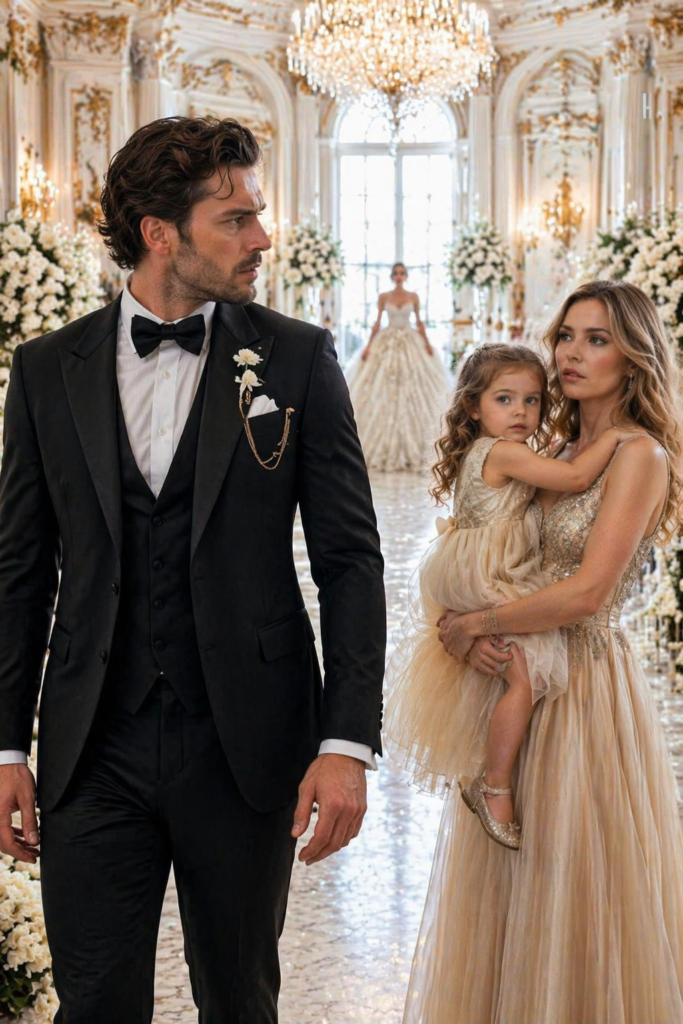
Gael stood at the altar in a tailored black suit. He didn’t smile. He never smiled in public.
Abril, on the other hand, looked happy to be buying a kingdom.
Beside her stood Don Ramiro Salvatierra, her father, greeting everyone as if he had already won an election. On the other side, Doña Leonor, Gael's mother, watched the ceremony with a chill that felt too cold.
Then the doors opened.
A woman appeared in the rain, soaked, her hair plastered to her face, wearing an old coat that barely covered a sleeping girl in her arms.
Gael froze.
It was Marisol Rivas.
The woman he had loved three years ago.
The woman who, according to him, had left without explanation, without a call, without a damn goodbye.
And the girl she carried had the same green eyes he had inherited from his father.
Whispers grew like wildfire. Several guests pulled out their phones. Abril's cousin let out a shocked “no way” before his wife elbowed him.
Abril’s smile vanished.
—Who is she? —she asked through clenched teeth.
Gael didn’t respond.
He stepped down from the altar and walked towards Marisol. Each step weighed heavier than a sentence of death.
When he was in front of her, Marisol recoiled. She didn’t look like a woman coming to claim anything. She looked like a woman who had already run too far.
—I didn’t come to ruin your wedding —she said, shivering—. I came because I have nowhere left to hide her.
Gael looked at the girl.
She must be three years old. She slept with one hand clinging to her mother's neck. She had dark eyebrows, a small nose, and that serious expression Gael saw in his own childhood photos.
—What’s her name? —he asked.
Marisol swallowed hard.
—Lucía.
Abril arrived, furious, lifting her dress to avoid stepping on it.
—Gael, tell me right now who this woman is.
Marisol lowered her gaze, exhausted. She didn’t answer.
Doña Leonor approached slowly, with her string of pearls and her respectable lady voice.
—Marisol, don’t make a scene. Not here.
Gael turned to his mother.
—Do you know her?
Doña Leonor said nothing.
And that silence slapped everyone in the face.
Marisol hugged the girl tighter.
—This morning a black car followed me from school. Yesterday a man asked about Lucía in the neighborhood. I couldn’t keep running.
—Who threatened you? —Gael asked.
Marisol looked straight at Doña Leonor.
—Your family.
The estate went cold.
Don Ramiro let out a dry laugh.
—Montenegro, control your problem. There’s a lot of money sitting at these tables.
Gael didn’t even look at him.
Abril squeezed his arm.
—You can’t embarrass me like this in front of everyone.
He calmly pulled his arm away.
—The wedding is canceled.
The noise exploded. Guests spoke at once. Phones recorded. Abril screamed his name, red with shame.
Doña Leonor stepped forward.
—Gael, don’t be an idiot. That woman came to destroy you.
At that moment, Lucía woke up.
She opened her green eyes, looked at Gael sleepily, and asked softly:
—Mom… is he my dad?
PART 2
Lucía's question fell on the estate as if someone had turned off the music, the air, and the lie all at once.
Gael, a man who had closed deals with dangerous people without batting an eye, didn’t know how to answer a three-year-old girl.
Marisol pressed her lips together. She didn’t want her daughter to learn that truth surrounded by rich gossips, hidden politicians, and families smiling while hating each other.
Gael knelt in front of the girl, without touching her.
—I don’t know if I have the right to have you call me that —he said, his voice breaking—. But I’ll find out why I wasn’t there with you.
Marisol let out a bitter laugh.
—It sounds easy when you show up three years late.
That hurt more than any threat.
Gael ordered them to be taken to a safe house near Tepoztlán. Not to the family mansion. Not to the Polanco apartment. To a place that even his mother couldn’t enter without permission.
Abril followed him to the exit, crying with rage.
—Are you going to throw away a multi-million dollar alliance for a woman who hid a daughter from you?
Gael looked at her coldly.
—Never speak of my daughter as if she’s a burden.
—You don’t even know if she’s yours.
He looked at Lucía, sleeping again on Marisol's shoulder.
—She came asking for protection. That’s enough.
That night, the scandal exploded on social media. “Tycoon cancels wedding for ex with secret child.” “Bride abandoned in front of 300 guests.” “The hidden heir of the Montenegros.”
On Facebook, everyone had an opinion. Some called Marisol greedy. Others said Gael was paying for his debts. Many noticed the same thing: Doña Leonor seemed to know too much.
And yes, she knew everything.
At the safe house, Marisol didn’t want to have dinner. Lucía fell asleep on a couch with a little blanket that a bodyguard bought at a pharmacy, because in that world there were guns, trucks, and money, but no one knew what a child needed.
Gael stayed in the kitchen.
—Tell me what happened.
Marisol looked at him with fatigue.
—Everything? Or just what won’t make you look like a jerk?
He didn’t defend himself.
—I was restoring paintings in your house in Las Lomas —she began—. You came late, brought me coffee, sat down to watch me clean broken saints, and made me believe that beneath the feared man there was someone good.
Gael looked down.
—I fell in love with you —Marisol said—. Then I found out I was pregnant. I was going to tell you, but your mother called me to a restaurant in Polanco.
Gael’s expression changed.
—What did she say?
—She showed me pictures. Burned cars, threatened women, children used for revenge. She told me that’s what happened to a weakness of men like you. That if I stayed, my baby would pay.
Marisol took a deep breath.
—Then she gave me a letter. Supposedly written by you. It said I was a mistake, that you chose your family, and that you’d send me money if I disappeared without making noise.
Gael stood up.
—I never wrote that.
Marisol froze.
For three years she had hated that letter. She had read it while pregnant, alone, in a rented room in Iztapalapa, with 900 pesos in her pocket and afraid to give birth without anyone.
—Don’t ask me to believe you —she whispered.
—I won’t ask you —he replied—. I’ll bring you proof.
The next day, Gael sought out Petra, the former housekeeper of the mansion. She had left two weeks after Marisol's disappearance.
He found her in Puebla, selling tamales outside a church, carrying a guilt that was evident on her face.
When she saw Gael, she started to cry.
—I knew this day would come.
—Tell me what my mother did.
Petra sat down, trembling.
—Doña Leonor said it was for your own good. But she called Esteban Luján.
Gael felt a blow to the chest.
Esteban was his trusted advisor for fifteen years. He knew his accounts, his routes, his enemies, and his secrets.
—He forged your handwriting —Petra confessed—. They practiced with your notes until the letter looked just like yours. Doña Leonor wanted Marisol to believe you had thrown her away. If not, she would never have left.
Gael then understood that the betrayal didn’t come from his enemies.
It came from his own home.
When he returned to Tepoztlán, Lucía was drawing on the floor. Marisol was making instant soup because the kitchen was filled with expensive things, but nothing useful for a child.
Lucía looked up.
—Can you draw cats?
Gael swallowed hard.
—Very badly.
—Let’s see.
He sat far away and drew a cat so ugly it looked like a possum.
Lucía looked at him seriously.
Then she burst into laughter.
That sound disarmed him.
He had missed her first steps, her birthdays, her fevers, her fears. He had lost three years because her mother called cruelty protection and because he had built a world where cruelty seemed normal.
That night, when Lucía was asleep, Gael told Marisol everything: Petra, the fake letter, Esteban, and Doña Leonor.
She listened without interrupting.
In the end, she sat as if she had no strength left.
—So you didn’t leave me.
—No.
—And you thought I left because I wanted to.
—Every day.
Marisol covered her mouth. The hatred that had held her for three years found no place left. It hurt to have loved him. It hurt to have hated him. It hurt to remember the public hospital where Lucía was born while Gael lived in a mansion, knowing nothing.
—I was alone —she said, breaking—. I cleaned houses, restored broken virgins, sold my bracelet. There were nights when Lucía had dinner, and I didn’t.
Gael wanted to hug her, but he stopped.
—I’m sorry.
Marisol let out a sad laugh.
—that word is too small for what happened.
—I know.
—And your mother was cruel, but she didn’t invent the danger. Your world was dangerous. If you want to be close to Lucía, you can’t keep being the man everyone fears.
Gael didn’t promise quickly. For the first time, he understood that a pretty promise could also be another lie.
—I can’t undo everything in one night —he said—. But I can start.
Marisol looked at him with tears.
—Don’t say it like a boss. Prove it as a father.
Meanwhile, Esteban was already moving.
The canceled wedding had broken the deal with Don Ramiro. Abril wanted revenge. Ramiro wanted the routes Gael had denied him for years. And Esteban wanted to take it all.
In an office near the port of Veracruz, Esteban spoke on the phone.
—Gael has softened. He has a woman and a girl. That makes him vulnerable.
Ramiro answered:
—Then take away his throne.
But Gael was not naïve.
He detected odd transfers, private meetings, and inquiries about the house in Tepoztlán. That same night, he moved Marisol and Lucía to another property near Valle de Bravo.
Marisol didn’t make a scene. She just carried her sleeping daughter and asked:
—Will we be safe here?
—As long as I breathe.
She looked at him hard.
—I don’t need movie lines. I need my daughter to wake up alive.
And she did.
The next day, Gael went to see his mother.
Doña Leonor was in the mansion's living room, with her gold rosary and her straight back.
—I know about the letter —he said—. I know Esteban forged my handwriting. I know you threw a pregnant woman out and stole my daughter from me.
Leonor didn’t look away.
—I saved her.
—You condemned her to poverty.
—Your father died for trusting. I wasn’t going to let you die for a restorer without a surname.
Gael stepped closer.
—My father died for this world that you defend. Not for love.
Leonor tightened the rosary.
—I am your mother.
—And that hurts more.
He took a deep breath.
—From today on, you don’t decide for me. You don’t speak in my name. You don’t get close to Marisol. You don’t get close to Lucía.
Leonor’s mask shattered.
But Gael left without looking back.
The final betrayal came three nights later, in an abandoned warehouse in Iztapalapa. Esteban thought he had summoned Gael to negotiate. He thought he had Ramiro’s men hidden. He thought that love had made him weak.
He was wrong.
Gael arrived with recordings, documents, and federal police surrounding the place. For the first time, he didn’t resolve with blood what could end in justice.
Esteban pulled out a gun.
—You lost yourself for an old woman and a girl.
Gael looked him straight in the eye.
—No. I found myself.
The shot rang out suddenly.
Tomás, the bodyguard who had been with Gael for years, dove in front of him. The bullet entered him from the side.
Esteban was subdued. Ramiro’s men surrendered. The evidence was enough to sink them.
Tomás died before dawn, with Gael holding his hand.
—Don’t be stone again, boss —he whispered—. The girl needs you human.
When Gael returned to Valle de Bravo with blood on his shirt, Marisol opened the door and understood.
She didn’t hug him like a lover.
But she placed a hand on his arm.
—Don’t waste what he gave you —she said.
And Gael didn’t waste it.
For months, he dismantled his dark businesses. He handed over accounts, names, and routes. Don Ramiro ended up imprisoned. Esteban received a long sentence. Abril disappeared from social magazines, though she continued to claim she had been the victim.
Doña Leonor was left alone in the mansion.
Powerless.
Without a granddaughter.
Without a son.
Gael sold properties and created a fund for families harmed by his last name. Many called him a traitor. Others said a girl had tamed him.
He let them talk.
At home, he learned tougher things. He learned that Lucía hated broccoli but could eat twelve strawberries. He learned to braid her hair crooked. He learned to check under the bed when she said there were monsters.
He learned that being a father wasn’t about giving a last name.
It was about showing up a thousand times until a girl stopped being afraid.
Marisol didn’t forgive him quickly.
There were days when she looked at him and saw the man who wasn’t there. There were nights when she cried for the young woman who gave birth alone, scared and without anyone to call.
Gael didn’t ask her to hurry.
He just stayed.
One Sunday, Lucía ran in the garden, tripped, and scraped her knee. Gael got there first, but he stopped and looked at Marisol, waiting for permission.
Marisol nodded.
Then he knelt down.
Lucía raised her arms.
—Dad, it hurts.
The word left him breathless.
He picked her up carefully, trembling. Marisol turned towards the window and covered her mouth, for that word also broke something inside her.
Months later, Doña Leonor fell ill.
Gael didn’t want to see her. Marisol had no reasons either. But Lucía found a photo and asked about “the sad lady.”
They went to the hospital.
Leonor was thin, without pearls or makeup. When she saw Marisol, she looked down. When she saw Lucía, she started to cry.
The girl handed her a drawing filled with crooked suns.
—It’s for you.
Leonor took it with trembling fingers.
—I don’t deserve this.
Marisol looked at her calmly.
—No. You don’t deserve it. But my daughter isn’t to blame for your cruelty, and I won’t teach her that hate is inherited too.
Leonor cried harder.
—I took three years from you.
—Yes —Marisol said—. And that can’t be erased.
One year after the canceled wedding, Gael lived in a simple house near Cholula. Without convoys. Without armed men. Without surnames weighing more than Lucía’s laughter.
Marisol opened a restoration workshop. She returned to touch ancient wood, broken canvases, and saints with broken fingers. She gave light back to damaged things.
One afternoon, Lucía played under a tree with leaves in her hair. Gael was making pancakes, though he always burned the first one.
Marisol sat beside him.
—Do you miss the power?
Gael looked at his daughter.
—I miss having understood late what true power was.
She didn’t respond.
—I thought power was everyone looking down when I walked in —he said—. But power is my daughter sleeping without fear. It’s listening to you when you talk about a pain I can’t erase. It’s choosing peace when violence would be easier.
Marisol looked at him with wet eyes.
—I don’t know if we can go back to what we were.
—I don’t want to go back —he said—. That was born among secrets. I want something new. Something clean. If you ever let me be close.
She fell silent.
Then she rested her head on his shoulder.
It wasn’t a perfect ending. It didn’t erase the fake letter, the poverty, or the three lost years.
But it was an honest beginning.
Because blood doesn’t justify cruelty.
And a father isn’t born the day he begets.
He’s born the day he decides to change so that his daughter doesn’t have to survive in the same world he helped create.