PART 1
Emiliano Aranda returned to Mexico City a day earlier than planned, with his tie loosened, a black suitcase in hand, and a bouquet of white tulips bought at Benito Juárez Airport.
He was coming from Monterrey, where he had closed a multimillion-dollar deal for his medical technology company. At 38, he had offices in Santa Fe, a chauffeur, bodyguards when he wanted, and a mother who had taught him from a young age to distrust everyone.
Especially women who weren't "at his level."
His wife, Mariana, was seven months pregnant.
She was an elementary school teacher, daughter of a mechanic from Iztapalapa, simple, cheerful, one of those women who say "it's nothing" even when they're breaking inside. Emiliano loved her, but ever since they married, his mother, Regina Aranda, never stopped telling him that Mariana wasn't right for him.
"Son, a poor woman quickly learns where the money is," she'd say with a cold smile. "Just watch out. You don't want to end up raising someone else's child."
Emiliano always said he didn't believe her.
But doubts, when they come from a mother, don't enter like screams. They seep in like drops of poison.
That night, he wanted to surprise Mariana. He imagined finding her asleep, with a pillow under her back and a hand resting on her belly. He imagined kissing her forehead and feeling their baby move.
But when he opened the door to their apartment in Polanco, there was no music, no television, no baby room humidifier.
Only darkness.
And a metallic smell that chilled his blood.
He walked slowly toward the bedroom. The hallway light barely touched the floor.
Then he saw her.
Mariana was lying by the bed, her silk nightgown on backwards, a strap broken, hair matted to her face, and a hand pressed against her abdomen.
The frame of their wedding photo lay shattered.
Glass scattered across the light carpet.
Dark stains next to her bare feet.
Emiliano stood frozen.
For a few horrific seconds, he didn't think of pain. He didn't think of help. He didn't think of their baby.
He thought of his mother's words.
"Women hide things, son."
He looked at the backwards nightgown. The broken photo. The disordered room.
And a vile idea crossed his mind.
Had another man been there?
"Mariana?" he asked, his voice cracking.
She barely whimpered.
That sound carried no guilt.
It was pure suffering.
Emiliano dropped the flowers and rushed to her. Touching her face, he felt her cold skin. There was a deep cut on her palm, as if she had fallen on the glass trying to get up.
"Love, look at me. What happened?"
Mariana opened her eyes with effort.
"Don't let her… near the baby."
"Who?"
She cried weakly.
"Your mom."
PART 2
Emiliano felt his world tilt.
For a moment, his mind rejected those words. Regina Aranda couldn't have been there. Not like that. Not in the bedroom. Not while Mariana was seven months pregnant.
But Mariana curled up in pain and let out a low, broken moan that shattered any pride Emiliano had left.
He fumbled for his phone and called 911.
"My wife is pregnant, she's bleeding, her stomach hurts, please, hurry… we're in Polanco… please…"
Then he called Dr. Salcedo, Mariana's gynecologist.
"Don't move her too much," the doctor ordered. "Keep her awake. If there are contractions, count them. I'm heading straight to the hospital."
Contractions.
That word split his chest.
Emiliano carefully embraced Mariana, trying to cover her with a blanket. She trembled. The twisted nightgown no longer seemed a sign of betrayal, but evidence of a struggle. She had tried to dress, to get up, to reach the phone, maybe to call for help.
"Forgive me," he whispered, tears streaming down his face. "Forgive me for doubting you."
Mariana barely shook her head.
"She… wanted you to see this."
"What did she want me to see?"
"To make you think… I was cheating on you."
Emiliano felt nauseated.
Then he glanced at the floor.
Amid the shards of the wedding frame, next to a dark stain, was something small and shiny.
A pearl earring.
Exactly like those Regina always wore, even for Sunday breakfast.
He picked it up without saying a word.
The ambulance arrived 12 minutes later.
Paramedics rushed in, checked Mariana's vitals, and placed her on a stretcher. One of them looked seriously at Emiliano.
"Her blood pressure is low. We need to transport her now."
"And the baby?"
The paramedic didn't answer immediately.
That was worse than any words.
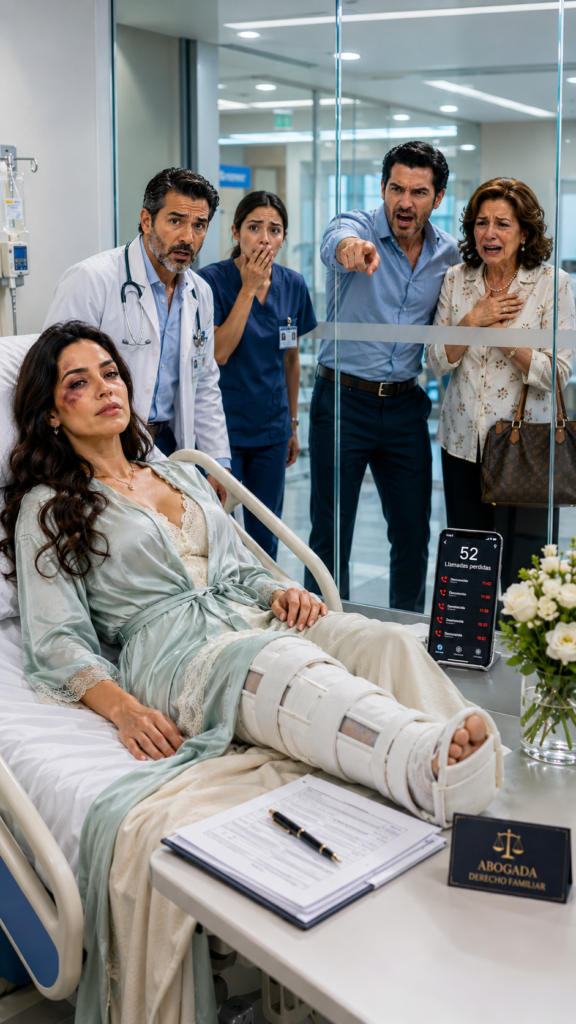
At Ángeles Hospital, everything became noise: white lights, doors opening, nurses running, doctors speaking in code, monitors beeping as if every sound decided a part of his life.
Dr. Salcedo arrived with his coat on crookedly and a stern face.
"What did you find at the house?"
Emiliano recounted everything: the nightgown, the blood, the glass, the earring, and Mariana's words.
The doctor clenched his jaw.
"There are signs of extreme stress, but there's also something else. We're going to do a blood test."
"Something else like what?"
"Like a substance that could have caused the contractions."
Emiliano froze.
"You're saying someone gave her something?"
"I'm saying I don't want to rule anything out."
At that moment his phone rang.
Mom.
The screen seemed like a mockery.
Emiliano answered without greeting.
"Son, are you home yet?" Regina's voice was elegant, calm, as if she were calling to inquire about dinner.
He looked through the emergency room glass. Mariana was surrounded by doctors.
"I'm at the hospital."
A small silence followed.
Too small for anyone.
Enough for him.
"Hospital? What happened?"
"Mariana is in serious condition."
Regina sighed.
"Oh, Emiliano… I warned you. That girl was going to destroy you."
He closed his eyes.
Before, that phrase might have sounded like concern.
Now it sounded like satisfaction.
"My wife is bleeding and you talk as if you've won."
"Don't say nonsense. I'm worried about you."
"No. You're worried because I didn't react as you wanted."
The silence grew longer.
"You're upset, son."
Emiliano took the pearl earring from his pocket.
"I found something of yours in my bedroom."
Regina didn't respond.
Not for 1 second.
Not for 2.
It was 3 full seconds of silence.
Then she let out a dry laugh.
"I've been to your apartment many times."
"Not today. Not in my bedroom. Not while Mariana was on the floor."
"Be careful with what you say."
"No, Mom. You be careful with what you did."
And for the first time in 38 years, Emiliano hung up on her.
He didn't feel guilt.
He felt fear.
Because if Mariana was telling the truth, Regina had not only tried to destroy his marriage; she had endangered the lives of his wife and his child.
A nurse came out minutes later.
"Mr. Aranda, we need your authorization. The baby has a heartbeat, but there's fetal distress. If she doesn't respond to treatment, we'll have to perform an emergency C-section."
Emiliano signed without reading.
Signed with a trembling hand.
Signed feeling like every letter was a plea.
When they moved Mariana, she barely opened her eyes and searched for him among the hallway lights.
"I'm here," he said, walking beside the stretcher. "I'm not leaving."
Mariana moved her lips.
"The camera…"
"What camera?"
"The baby's room…"
Before she could say more, the door closed.
Emiliano stood alone in the hallway.
The camera in the baby's room.
He had installed it two weeks earlier to check from the office if the crib, light, and musical mobile were working. Mariana teased him lovingly.
"You seem like a first-time dad, honestly."
And he'd reply:
"I am, aren't I?"
He took out his phone and opened the app.
His fingers failed twice from nerves.
He searched for the recordings from that afternoon.
At 6:14 p.m., the apartment door opened.
Regina entered with her own set of keys.
Mariana appeared from the kitchen with a hand on her belly. There was no audio, but her surprise was visible. Regina spoke with harsh movements. Mariana shook her head.
Then Regina took something from her purse.
A small bottle.
Mariana refused it.
Regina pointed at her belly. Mariana stepped back.
Then the unthinkable happened.
Regina grabbed the wedding frame from the dresser and smashed it on the floor.
Mariana was startled and tried to pass by her.
Regina grabbed her arm.
The struggle was quick, clumsy, brutal.
The nightgown twisted.
Mariana slipped on the glass and fell sideways, protecting her belly with both hands.
Regina stared at her.
Didn't help her.
Didn't call anyone.
She just crouched, placed something next to the broken frame, and left the apartment.
The recording ended with Mariana trying to drag herself to the door.
Emiliano watched the video once.
Then again.
By the third time, he wasn't crying anymore.
He was shaking with rage.
He called his lawyer, the police, and the building manager. He handed over the video, the earring, the bottle that later appeared under the dresser, and all of Regina's calls.
At 2:31 a.m., Dr. Salcedo emerged from the operating room.
Emiliano stood up so fast he nearly fell.
"Your wife is stable," the doctor said. "We had to perform a C-section. It was difficult, but she pulled through."
Emiliano couldn't breathe.
"And the baby?"
The doctor looked at him wearily but managed a small smile.
"It's a girl. She's in the incubator, delicate, but alive."
Emiliano covered his face with his hands.
He cried as he hadn't since he was a child.
Not out of shame.
Not out of weakness.
Out of relief.
They named her Lucía, because Mariana said that name sounded like light amid anything.
When Mariana woke up, Emiliano was sitting beside her, with a wrinkled gown, red eyes, and his hand resting on hers.
"Our daughter is alive," he told her.
Mariana cried silently.
"Did you believe me?"
That question hurt more than any blow.
Emiliano lowered his head.
"I believed you too late."
She closed her eyes.
"That hurts too."
He didn't try to defend himself. He didn't say "I was confused." He didn't say "my mom manipulated me." He didn't say "I didn't know."
Because he did know.
Maybe not everything.
But he did know that Regina humiliated Mariana at family dinners, that she scrutinized her clothes, that she questioned if the baby "really looked like an Aranda," that she made venomous comments when he didn't want to listen.
And he, out of convenience, had called that character.
Out of cowardice, he had called it maternal concern.
Regina was arrested three days later, when she tried to leave for San Diego "to rest." Her lawyer claimed it was all a misunderstanding. That she had gone to visit her daughter-in-law. That Mariana, unstable due to pregnancy, had fallen on her own.
But the camera spoke.
The tests spoke.
The bottle spoke.
And Claudia, Regina's maid, also spoke, confessing that her mistress had been saying for weeks that "that child shouldn't be born into the Aranda family."
The big surprise came when they checked Regina's phone messages.
She didn't just want to separate Emiliano from Mariana.
She already had a contact with a private lab to conduct a fake DNA test as soon as the baby was born. Her plan was to convince Emiliano that Mariana had cheated on him, force her to sign a divorce agreement, and gain control of the family shares before Lucía could inherit anything.
It wasn't just hatred.
It was money.
It was name.
It was power disguised as maternal love.
The news exploded on social media when someone leaked part of the complaint. "Wealthy Mother Accuses Pregnant Daughter-in-Law of Infidelity" was the headline everyone shared.
Some defended Regina.
"A mother always knows things."
Others defended Mariana.
"It's terrifying to marry a man who doubts first and asks later."
That phrase haunted Emiliano more than any insult.
Because it was true.
Months later, Mariana left the hospital with Lucía in her arms. She never returned to the Polanco apartment. She chose a smaller house in Coyoacán, away from cold marble, away from family portraits, and away from any key Regina might have touched.
Emiliano sold the apartment.
Resigned from the family board.
Changed the surname of his company.
And started therapy, not for Mariana to forgive him, but to understand why he'd confused obedience with love for so many years.
Regina faced legal proceedings for assault, domestic violence, attempted harm to the pregnancy, and tampering with evidence. Her friends stopped inviting her to lunches. Her partners closed doors. Her pearls no longer seemed elegant.
They seemed like evidence.
One afternoon, when Lucía was six months old, Emiliano found Mariana in the garden, softly singing to the baby. He stood watching them from the door, afraid to interrupt.
Mariana noticed him.
"You can come over," she said.
He approached slowly.
"I don't know if you can ever forgive me."
Mariana cradled Lucía against her chest.
"I don't know either."
The reply was harsh.
But honest.
And for the first time, Emiliano didn't seek an easy way out.
He just sat beside her.
Because he understood that love wasn't about bringing flowers back from a trip.
Love was believing when everything seemed confusing.
It was protecting before suspecting.
It was setting boundaries even with the woman who gave you life when that woman tries to destroy the life you promised to protect.
And that night, as Lucía slept between them, Emiliano realized something many sons learn too late:
Not every mother deserves blind obedience.
And not every silent wife is hiding a betrayal.
Sometimes she's just waiting for the man who swore to love her to have the courage to truly see her.