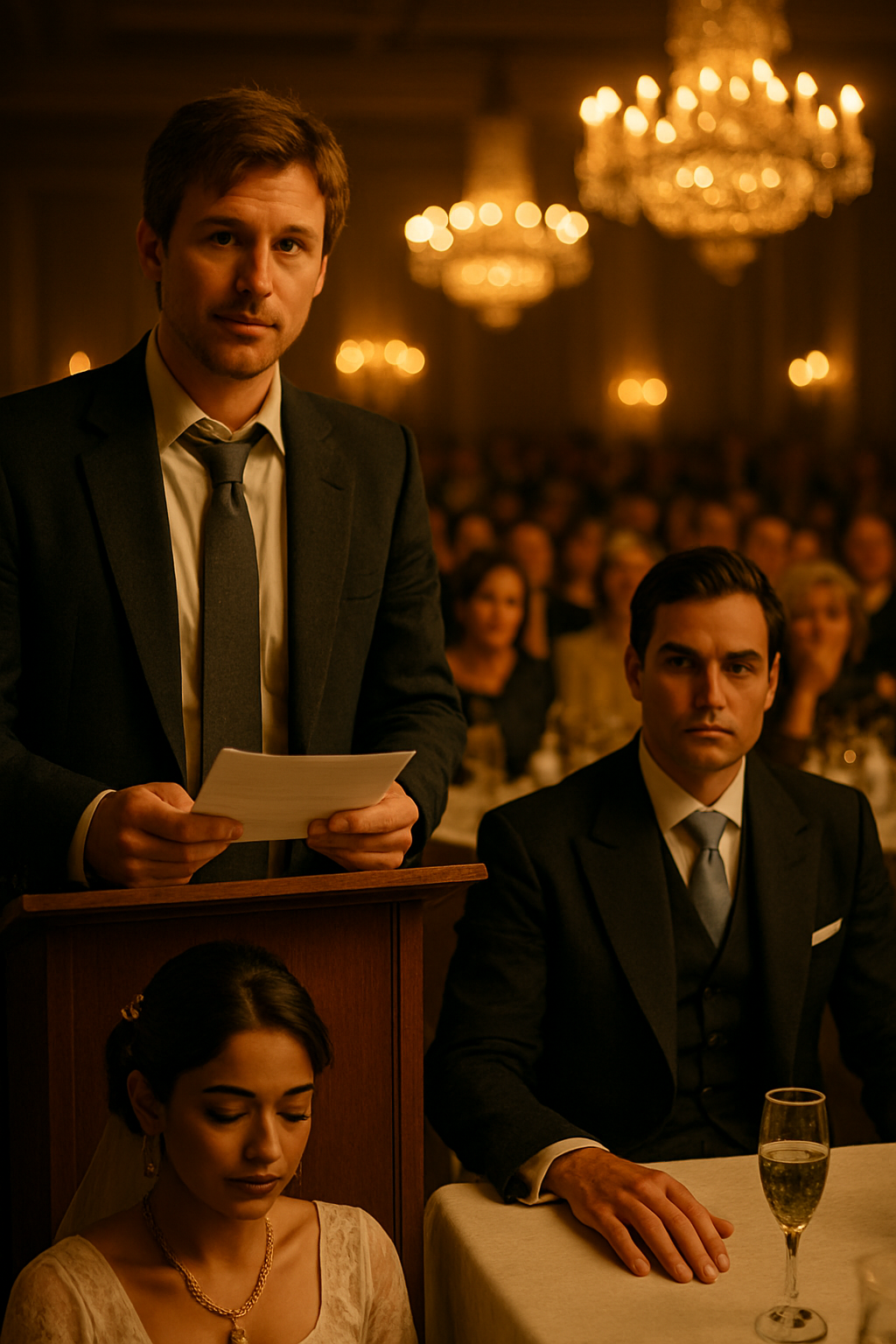
The microphone made a small sound when Tom tapped it, and three hundred people looked up from their salmon.
He smiled. It was the smile that had always worked — easy, self-deprecating, the smile of a man who knows he's funny and has the grace to be embarrassed about it. People relaxed. A few leaned in.
He had the cue cards in his left hand. He'd written them out three times.
"Good evening," he said. "For those of you I haven't met — I'm Tom. James's best man. And I want to begin by saying that everything I'm about to tell you is completely true."
Light laughter. A woman at table seven put her hand on her husband's arm.
James, at the head table, raised his champagne glass. He was smiling.
The reception hall at Hartley Park had ceilings high enough to make noise small. Chandeliers, ivory tablecloths, flowers that cost more than Tom's car. Three hundred guests arranged in perfect round tables stretching toward the back of the room.
Tom stood at the podium between the dance floor and the head table. He could see everything from here.
James on his left. Dark hair, strong jaw. The same face Tom had known since they were twenty-eight and sharing a terrible flat in Clapham. Still handsome in the way that didn't require effort. The groom's jacket fit the way expensive things do — like it had always been there.
Priya beside him. Ivory gown. Dark hair swept up and anchored with gold pins that caught the light when she turned her head. She was listening to Tom the way she listened to everything — with the particular quality of a person who doesn't miss things.
He'd liked Priya from the first time he met her. That hadn't made any of this easier.
"James and I met eight years ago," Tom said. "I was at a work function I didn't want to be at, standing by a bar I was already too familiar with, when this man —" he gestured at the groom, "— appeared next to me and said, and I quote: 'Tell me the most interesting thing that's ever happened to you, and I'll buy you a drink.'"
Genuine laughter this time. People who knew James recognized this.
"I thought it was a terrible opening line," Tom continued. "I still do. But I told him about the time I got lost in Portugal for six days, and he bought me four drinks, and by the end of the night we'd decided we were going to go to Portugal together the following summer."
He paused. "We never went to Portugal."
More laughter. James shook his head in affectionate exasperation.
"We did, however," Tom said, "spend the next eight years doing approximately seventeen other things we'd decided we were going to do. Which is actually quite a good percentage, for James."
He found his rhythm. He always found his rhythm — it was his gift and his habit and tonight it felt strange, because for once the rhythm was in service of something real.
"James is the most determined person I've ever met," Tom said. "I don't mean stubborn. I mean determined. When he decides something is going to happen, it happens. When he decides he wants something —" Tom glanced at his cue cards, though he knew the next line by heart, "— he gets it."
At the head table, James took a long sip of champagne.
The sip meant nothing. The room didn't notice.
Tom did.
"The first time I saw James pursue something he actually wanted," Tom continued, "we were at a conference in Edinburgh. 2019. He'd spotted a particular contract — I won't bore you with the details, but it was the kind of deal that could redefine a career. Everyone said it was untouchable. Three other firms had tried. James spent six weeks on it. He redefined the pitch. He rewrote the entire approach. He got the contract."
Tom looked at James. James was smiling, but his eyes had a quality Tom recognized.
"I remember what he said the night we celebrated," Tom said. "'The trick is you have to want it more than the thing itself wants to stay away.'"
Polite laughter. The kind people give a line they find charming but not quite funny.
"At the time I thought that was just James being James," Tom said. "But I've thought about it a lot since. Because it's true. The thing I've noticed about James — and I've had eight years to notice — is that when he makes a decision, he commits to it fully. No half measures. No going back."
He looked down at his cue cards.
He had written what came next. He had written it carefully, and then rewritten it, and then almost crossed it out, and then left it in.
"About five years ago," Tom said, his voice still easy, still warm, "James and I made a bet."
At the head table, James's champagne glass came down very slowly.
Not suddenly. Slowly. The way you put something down when you want to be sure it doesn't make a sound.
Priya, beside him, looked at the table.
Just for a moment. Just a glance. Then she looked back at Tom.
But Tom had seen it.
He continued.
"It was a stupid bet," Tom said. "The kind you make at two in the morning when you're both convinced you've figured something out. We'd had an argument — I say argument, James would call it a discussion, because James doesn't argue, he discusses things until you agree with him — about whether a person can change fundamentally, or whether they just change the version of themselves they show the world."
Three hundred people were listening.
"I said people can't really change. James said they can. He said — and I remember this exactly — 'I'm going to prove it. I'll show you. Give me five years.'"
Tom smiled. It was a real smile this time, complicated and private.
"I said fine. Five years."
He looked at his cue cards again. He didn't need them. He had never needed them.
"Here's the thing about James," Tom said. "He is an extraordinary man. I mean that without reservation. He is brilliant and generous and loyal to the people he chooses, and he is one of the handful of people in the world I would trust with my life. That is not a small thing. I don't give that easily."
He paused.
"But James has one quality — one particular quality — that I've been wrestling with for a long time. And standing here tonight, looking at you both —" he glanced at James and Priya, "— I think it's the most important thing I can say."
The room was quiet in a way wedding receptions rarely are.
"James," Tom said, "knows exactly what he wants. Always has. The problem —"
He stopped.
He looked at his cue cards one more time.
James sat perfectly still at the head table. His hand was flat on the white tablecloth. Not gripping it. Just resting there, as if he'd placed it there deliberately to keep himself anchored.
Priya had not moved.
"— the problem," Tom continued, "is that sometimes what James wants and what James says he wants are two different things. And James is smart enough — and honest enough with himself, I think, even if not always with others — to know the difference."
The room didn't react. Not yet. The words sounded fine. They sounded like wedding speech words. Warm. Slightly pointed. The kind of gentle ribbing best men always deliver.
But at the head table, James was no longer smiling.
Six hours before the ceremony, Tom had been sitting in the hotel room with the cue cards spread out on the bed.
He had done this twice already. Written the speech, scrapped it, written it again.
The first draft had been a normal best man speech. Funny stories. Fond exaggeration. A toast that made people cry a little, in the good way.
He'd scrapped it after Rachel called.
Rachel Kent had not been invited to the wedding. Not because she and James had ended badly — they hadn't, exactly. They had ended quietly, which was almost worse. She'd called Tom because she didn't know what else to do, and she'd said: "I just wanted to know if he's happy. Can you just tell me if he's happy?"
Tom had said yes. Because that was the easiest thing to say.
After the call, he'd sat with the phone in his hand for a long time.
Rachel was four tables back. He'd seen her when he arrived. She was wearing a dark green dress and her auburn hair was pulled back. She was there because she worked with James's sister, and James's sister didn't know, had never known.
Tom wondered if James had known Rachel would be there.
He thought probably yes. James knew most things.
The question was what Tom was going to do about it.
The thing about the bet was that Tom had understood it differently each year.
In 2021, two years after they'd made it, Tom understood it as bravado. James had been going through a period — you could call it that — where he was reassessing things. The consulting firm had taken off. The money was suddenly real. He was thirty-two and successful and, Tom suspected, slightly frightened by what success meant for the person he was going to have to be. The bet had been James's way of saying: I can grow into this. Give me time.
In 2023, Tom had started to understand it differently.
Because by 2023, James had changed. Not fundamentally — Tom had been right about that, he still believed it — but visibly. The edges had softened. He talked about things he hadn't talked about before: the future, stability, what he wanted in ten years. He met Priya, and Tom watched him be different with her than he'd been with anyone.
But Tom had also known James in 2018. Tom had known James when Rachel was in the picture.
And knowing those two Jameses — the one who'd made the bet and the one who was sitting at the head table in a morning coat — Tom had started to understand that the bet wasn't about whether James could change.
It was about whether James would tell the truth about who he was.
The speech was Tom's answer to that.
"Let me tell you about a weekend we spent in the Lake District," Tom said.
His voice was still even. Still warm. Still the voice of a best man who is doing the thing correctly.
"This was 2019. James had just turned thirty. There were six of us — I won't name everyone, don't worry — and we'd rented a cottage. James had organized the whole thing, because James always organizes the whole thing, and it was perfect. Better than any of us had thought to ask for."
He paused.
"There was a point on the second night — we'd been out walking all day and someone had found an extraordinary bottle of wine — where James gave a kind of speech. Not a formal speech. Just talking. He was talking about what he wanted his life to look like. Really talking. The kind of conversation where you forget there are other people listening."
Tom looked at his cards. Read them. Continued.
"He talked about wanting to matter to someone. Not to be successful — he was already successful, he knew that — but to actually matter. To have a person who knew everything and stayed anyway."
He let that sit for a moment.
"I remember thinking at the time that I'd never heard him say anything that honest. And I was right. Because in eight years of friendship, I've never heard him be quite that honest since."
Silence.
Three hundred guests in the warmth of Hartley Park, and all of them quiet.
"Except tonight," Tom said. He raised his glass slightly, not drinking yet. "I think James is about to be honest."
He wasn't looking at his cue cards now.
He was looking at James.
James met his eyes. His expression was composed. Careful. It was the expression of a man who is not surprised by what is happening and has decided that what he does next will define something.
"So in the spirit of that," Tom said, "I want to say something that I think everyone in this room deserves to hear."
He paused for exactly long enough.
"James Whitfield is the best man I know. I say that without irony. I also say it knowing everything — everything — about him. The things that are easy to admire. The things that aren't. The bet he made and the way he honored it and the way he didn't."
Priya was watching Tom with an expression that was not readable.
"I've spent eight years being his friend," Tom said. "The way you're his wife. Knowing the real thing. And I'll tell you what I've concluded."
He set the cue cards down on the podium.
He didn't pick them up again.
"The real thing," Tom said, "is worth knowing."
A long pause. Then, quietly: "I hope you believe me, Priya."
At four tables back, Rachel Kent sat very still.
She had heard the speech the way you hear music that used to mean something — at a remove, through glass, aware of what it once did to you without it doing it now.
She had not cried. She was not going to cry.
What she had done, sometime around the Lake District story, was understand.
Tom wasn't doing this for James.
He wasn't doing it for Priya.
He was doing it — she could see it, in the way he'd glanced past the head table once, precisely once, at the back of the room — for her.
Not as a gift. Not as an apology.
As a witness.
He was saying: I know. I knew. I was there. It was real.
She pressed her thumb against the edge of her wine glass until the pressure was something to focus on.
She would not look at James. She had decided that, very carefully, in the car on the way here.
She looked at Tom instead.
He looked back for just a moment.
James stood.
People applauded before they quite knew why — the standing itself was enough to trigger it. The applause built as he moved to take the microphone, and he accepted it with a nod that was gracious without being theatrical.
He held the microphone. He looked at the room. Then he looked at Tom.
The look lasted three seconds.
Five seconds.
Long enough that the applause had faded, and people who'd already picked up their glasses had set them back down.
"Tom," James said.
His voice was steady. The voice of a man who has walked into things with his eyes open before.
"I've been trying to figure out," James said slowly, "since approximately the fourth anecdote, whether you're doing this to help me or to hurt me."
The room was absolutely still.
"And I've concluded," James said, "that you're doing it because you think I need to. Which is the most James-and-Tom thing that's ever happened in our friendship."
He turned slightly toward Priya.
She had not moved. She was looking at the table. One hand was resting on the white linen. The other was in her lap.
"I owe you something," James said to her. Not loudly. But into the microphone, so the whole room heard.
Then he put the microphone down and said it quietly, privately, in a voice just for her:
"I owe you the same speech. And I should have given it before today."
Priya finally looked up.
Her expression was — not surprise. Not shock. It was the expression of someone who has been waiting for confirmation of something they already knew and is feeling, in this moment, the particular relief of finally being right.
She had known for four months. She had known the way you know things when you have a quality of listening very carefully — when you hear not just the words but the space between them, the silence around the things that aren't said.
She had not known the details. She had not known about Rachel. She had known there was a Rachel — some shape, some presence, some unlaid thing that her husband had decided to call the past but hadn't quite finished placing there.
She looked at James.
She said, very quietly: "I know."
James's jaw tightened just slightly.
"I know," she said again. Not angry. Almost gentle. "I've known something was missing. I didn't know what. I've been waiting."
She looked at Tom.
"Thank you," she said.
Tom did not know, exactly, what she was thanking him for. He suspected she wasn't entirely sure either. He nodded.
Then she looked back at James.
"I think," Priya said, "we should finish the party. I think we should have dinner and dancing and cake, and I think every person in this room should have a good night."
She paused.
"And then tomorrow, you're going to tell me everything. All of it. And we're going to figure out what comes next."
James looked at her for a long time.
"Okay," he said.
She nodded. She picked up her champagne glass.
She raised it toward Tom.
Tom raised his in return.
Three hundred guests, who had understood almost nothing of what had just happened but had felt all of it, began to applaud. Someone at table twelve stood up, and then several others. By the time Tom set his glass down the whole room was standing, which was wrong and right at the same time — they were applauding the speech, the couple, the moment, the thing they couldn't name but recognized.
Love is not only the easy version. They all knew that. They had all, in one form or another, lived it.
Tom stepped back from the podium.
He passed the microphone to the MC. He walked back to his table. He sat down. He picked up his wine.
Rachel Kent, four tables back, was looking at her hands.
He thought about going to her. He didn't.
Some things had been said tonight. Some things hadn't. The ratio was probably right.
He sat with his wine and thought: I don't know if I did the right thing.
He thought: I don't know if there was a right thing.
He thought: I know that what I said was true. I know that Priya deserved to know the shape of what she married. I know that James deserved to say it out loud, and I know he wasn't going to do it himself.
Across the room, the band began to play.
James and Priya were still at the head table, talking quietly, their heads close together. Around them, guests were laughing and eating and doing the generous thing that people do at weddings, which is to allow the couple their privacy even in the middle of a crowd.
After the first dance, James found Tom at the bar.
They stood side by side the way they always had — not facing each other, looking out at the room.
"Nice speech," James said.
Tom said nothing.
"I mean it," James said. "It was very well written."
"You're not angry."
"I'm a lot of things. Angry is in there somewhere."
Tom nodded.
"She knew," James said. "She didn't know what she knew, but she knew something. Four months ago she asked me directly if there was something I wasn't telling her. I said no."
"I know," Tom said.
"How did you know?"
"Because you told me you'd said no. And I knew you were lying to me when you said it wasn't a lie."
James was quiet for a moment.
"Is she going to leave me?" he asked.
The question surprised Tom. Not because it wasn't valid — it was entirely valid — but because James had always been a man who didn't ask questions he didn't know the answer to.
"I don't know," Tom said honestly.
"Neither do I," James said. He turned his glass in his hand. "First time for that."
"Is it the right answer?"
A long pause.
"She's extraordinary," James said quietly. "You know that. You've always known that."
"I do know that."
"And I love her. I genuinely love her. What I feel for her is real. What I had before —" He stopped.
"You don't have to explain it to me," Tom said.
"I'm not explaining it to you. I'm explaining it to myself."
Tom watched the dancers.
"What you had before was also real," Tom said. "That's the thing. If it hadn't been real, none of this would matter."
James made a sound that was almost a laugh.
"When did you get wise?" he said.
"I've always been wise," Tom said. "I just usually use it for things that don't matter."
At eleven-thirty, Rachel came to find him.
She found him near the windows that opened onto the garden. He had a whisky he hadn't drunk much of.
She stood next to him. For a while they didn't speak.
"You didn't have to do that," she said finally.
"I know."
"He's going to have to talk to her now."
"I know."
"About me."
"Yes."
She was quiet for a moment.
"I don't want to be talked about," she said. "I don't want to be the thing he has to explain. I don't want —" She stopped. "I just wanted to know he was okay. That was all. That's why I called you."
"I know," Tom said. "I'm sorry."
She looked at him. Her expression was complicated — not angry, not wounded. Tired. The tiredness of someone who has been carrying something at a distance for a long time and has just put it down somewhere uncertain.
"Did you do that for me?" she asked.
"Partly."
"What was the other part?"
He considered this honestly.
"I think I was tired," he said, "of being the only person in the room who knew everything."
She looked at the garden through the glass.
"That's very honest."
"I'm having an honest night."
She almost smiled. Not quite.
"Is it going to be okay?" she asked. "For them?"
Tom thought about Priya's face when she said I know. The quality of it. The relief and the grief mixed together in the particular proportion that belongs to people who are finally allowed to be right about something they wish they were wrong about.
"I think," he said carefully, "that she's the right person for him. I think she's the only person who might actually —" He stopped. Started again. "She's not going to leave him for having been human. But she's going to require him to be honest about it. And that's either the thing that makes this work or it isn't."
Rachel nodded slowly.
"And you?" she asked. "Are you okay?"
He thought about it.
"I'm standing at my best friend's wedding," he said, "having just given a speech that was either the kindest thing I've ever done or the worst. I have a whisky I don't want. And I'm talking to you, which is the first part of this evening that has felt straightforward."
"That's not an answer."
"No," he agreed. "But it's what I've got."
She nodded.
After a moment, she picked up her own glass.
"He should have told her," she said. "Before today. Months ago."
"Yes."
"He should have told her about everything."
"Yes."
"He should have —" She stopped herself. Her jaw was tight. "I'm not going to do this. I'm not going to stand at his wedding and do this."
"You don't have to."
"No," she said. "I really don't."
She turned back to the room.
"Goodnight, Tom," she said.
"Goodnight."
He watched her walk back toward her table. She didn't look at the head table. She had decided that, and she kept to it.
He had always liked that about her. The way she decided things and held them.
At midnight, Tom was the last one at the bar.
The band was playing something slower now. James and Priya were dancing — he'd seen them, ten minutes ago, moving in the way that people do when they are genuinely talking and dancing at the same time, when the movement is just something for the body to do while the real work happens.
He didn't know what James was saying to her.
He didn't need to.
He had done the only thing he could do: put the truth in the room. What people did with it after was theirs.
He thought about the bet. Whether James had won it. Whether you could win a bet like that.
He thought: maybe the bet was never about changing. Maybe it was always about saying out loud what you knew was true.
Maybe James had just needed someone to start the sentence.
Tom signaled the bartender for another drink.
He was still wearing the suit. His tie had been fully loosened since the third toast. He looked, he imagined, like a man who had survived something — which was fair, because that's what he was.
The barman set a glass down in front of him.
"Good speech," the barman said, the way bartenders do — meaning nothing and everything.
Tom raised the glass.
"It'll do," he said.
He drank.
Outside, through the tall windows, the garden was lit with small lights strung between the hedges. Somewhere past them was the car park, and beyond that the road, and beyond that the rest of everything — the year that would come next, the conversations James and Priya would have in the morning and the morning after, the slow careful work of telling the truth to someone who loves you and hoping the love holds.
It might.
Tom had done what he could.
He put his glass down.
He sat in the quiet of the emptying bar, his tie loose, his cue cards in his jacket pocket, and he thought: I said true things tonight. I did it carefully. I tried not to do more harm than good.
Whether he'd succeeded — he genuinely didn't know.
But he had stood at that podium with three hundred people watching, and instead of being charming in the way that cost nothing, he had been honest in the way that cost something.
That was new for him.
He thought he might try it again sometime.