PART 1
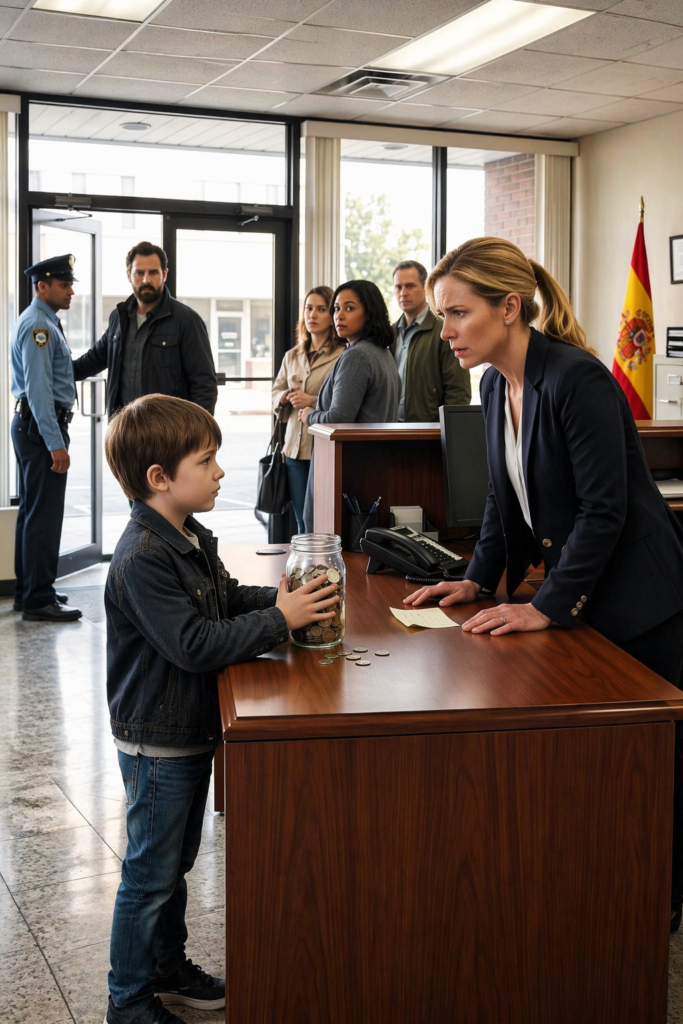
The entire bank fell silent when a 7-year-old boy walked in carrying a pickle jar full of coins.
It was Monday morning at Banco Sierra, a quiet branch in the heart of Querétaro, one of those places where people lined up to pay their bills, withdraw cash, or inquire about loans.
The boy wore dusty sneakers, an oversized jacket, and his eyes were swollen from lack of sleep.
He approached the counter without letting go of the jar and said:
—I want to open a savings account before the bad men come back.
The teller, Mariana, thought she hadn’t heard him right.
—Are you here with your mom or dad, sweetheart?
The boy shook his head.
—My mom's been asleep for four days.
The line stopped moving.
A man tucked his phone away. A woman with a grocery bag crossed herself. Even the entrance guard, who always pretended not to hear anything, turned sharply.
From her glass office, Laura Medina, the manager, saw the scene and rushed out immediately.
Laura was 42, dressed in a navy suit, with a calm voice and a way of looking at people that made them feel someone decent still remained behind a desk.
She knelt in front of the boy.
—What’s your name?
—Mateo.
—Mateo, where is your mom?
He clutched the jar against his chest.
—At home. She said if she didn’t wake up, I should come to the bank. Bring the coins. Ask for someone who knows how to do the right thing.
A strange chill crept down Laura's neck.
—Did your mom give you any paper?
Mateo pulled a trembling hand from his jacket pocket and took out a note folded four times.
The paper was wrinkled, stained as if someone had hurriedly written it.
Laura opened it carefully.
There was an address, an incomplete phone number, a phrase that read: “Don’t trust anyone who comes from him.”
And at the end, written in black ink, a name:
Ricardo Villaseñor.
Laura stopped breathing for a second.
In Querétaro, that name wasn’t spoken lightly.
Ricardo Villaseñor was a builder, an investor, owner of plazas, subdivisions, and even people's wills. He appeared in magazines smiling with politicians, donated toys at Christmas, and had a reputation for solving problems before they became news.
But Laura also knew another thing.
Years ago, her own husband had worked reviewing loans for a company linked to Villaseñor. After refusing to sign some shady papers, he was fired, threatened, and died six months later in an accident that never sounded like an accident.
Laura tucked the note away.
—Mateo, come with me to my office.
The boy looked toward the bank door, terrified.
—What if they come in?
—They won’t touch you here.
She wasn’t sure, but she said it as if she could promise.
In the office, Mateo set the jar on the desk.
—My mom said if I counted it right, this would be enough to start.
Laura swallowed hard.
There were $1, $2, $5 coins, and a few $10 ones. Money gathered from pockets, under couches, birthday gifts, and change from the store.
—How long did it take you to save it?
—Since my grandpa died.
—What was his name?
—Don Efraín Salgado.
Laura froze.
She knew that name too.
Efraín Salgado had been a foreman on several of Villaseñor’s developments. An honest man, famous for inspecting rebar, blueprints, and foundations as if every house were for his own family.
Then he closed his workshop.
Then he got sick.
And then he died.
Mateo lowered his voice.
—My mom said my grandpa hid something under the old stars.
Before Laura could ask more, a bearded man walked into the bank.
He didn’t stand in line.
He didn’t speak to anyone.
He just looked straight at Laura’s office.
And when he saw Mateo, he smiled as if he had finally found what he had been searching for.
PART 2
Laura closed the blinds of her office with a motion so natural that no one in the lobby could notice the fear creeping up her spine.
Mateo noticed everything.
—He’s one of them —he whispered.
The bearded man advanced toward the service area, wearing an overly pressed white shirt and expensive boots. He didn’t look like a street thug. He looked like one of those who get paid to scare without getting their hands dirty.
Mariana, the teller, asked how she could help him.
—I’m here for my nephew —he said, smiling—. His mom’s not right in the head. She caused a scene at home.
Mateo began to tremble.
Laura took her cell phone and dialed a number she hadn’t used in years.
Detective Armando Haro.
They had studied together in high school. He became a police officer. She became a bank manager. They had seen each other little, but Laura knew Armando was one of the few who didn’t bend easily.
When he answered, Laura spoke without greeting.
—Armando, I have a 7-year-old boy in my office. He says his mom’s been asleep for four days. He has a note with the name Ricardo Villaseñor.
There was silence on the other end.
Then a door closed.
—Where are you?
—Banco Sierra, Centro branch.
—Don’t let him leave. Don’t give him to anyone. Give me the mother’s address.
Laura glanced at the note.
—Colonia Las Campanas, privada Jacarandas, apartment 302.
Armando took a deep breath.
—I’m on my way with a unit. Keep the boy calm.
Laura hung up and sat next to Mateo.
—A trusted police officer is going to your house.
—Is my mom alive?
That question was too big for such a small child.
Laura didn’t lie.
—they’re going to do everything to help her.
Mateo pressed his lips together to keep from crying.
—She told me that if they caught me, not to tell them about the stars.
Laura felt every piece of that story reek of danger.
—What are the stars?
—I don’t know. My mom didn’t know either. My grandpa said that money and truth were hidden under the old stars.
Laura jotted down the phrase.
Outside, the bearded man was starting to raise his voice.
—That’s enough. I know the boy is in there. If you don’t bring him out, I’m going to sue the bank for kidnapping.
Mariana was doing her best to keep him entertained.
The guard approached, but Laura knew a guard with a radio wouldn’t stand a chance against someone sent by Villaseñor.
The phone rang again.
It was Armando.
—We’re at the building —he said—. The door is locked. We can hear movement inside.
Laura looked at Mateo.
The boy was looking at her as if her face could give him the answer.
—Movement from who?
—I don’t know. We’re going to enter.
The line stayed open.
Laura heard banging.
Commands.
A door being forced open.
A man’s scream.
Then another.
Twelve eternal seconds passed.
Armando spoke again, agitated.
—We found her.
Laura closed her eyes.
—Alive?
—Alive. Very weak. It looks like they kept her sedated. There were two men trying to move her. We have them detained.
Mateo stood up so fast he knocked over a chair.
—Is my mom?
Laura crouched in front of him.
—She’s alive.
The boy couldn’t hold it any longer.
He cried out with a broken sound, as if he had been holding the world up with his arms and finally someone had taken it off his shoulders.
Laura hugged him.
She didn’t think about protocols. She didn’t think about cameras. She just hugged a boy who smelled of sweat, fear, and old coins.
Armando continued to speak.
—Her name is Elena Salgado. She’s asking for Mateo. Says Villaseñor is going to send someone to the bank.
Laura looked toward the blinds.
—He already sent someone.
—Don’t go out the main door. Use the staff exit. I’m going to send a patrol to the hospital.
Before leaving, Laura did something that later cost her a meeting with compliance, two calls from corporate, and a formal warning.
She opened the savings account.
Not because an account would resolve a chase.
But because a frightened mother had built that last plan for her son, and Mateo had made it there carrying it in his own hands.
They counted the coins quickly.
It totaled $1,748.
Mateo stared at the screen as if it were treasure.
—Is it enough?
—Yes —Laura said—. It’s enough to start.
Then she transferred $80,000 from her personal savings into the same account, under temporary protection.
Mateo’s eyes widened.
—That’s not mine.
—Today it is. We’ll figure out how to arrange it later.
—My mom says not to accept money from strangers.
Laura smiled sadly.
—Your mom is right. But today I’m not a stranger. I’m the bank lady who listened.
They left through the back hallway.
Mariana stayed in the front, pale, facing the bearded man with a folder in hand.
—Sir, I need an official ID and a legal document proving your relationship.
—You don’t know who you’re messing with.
—I’m just doing my job here —Mariana replied—. But without papers, I won’t give you a single card, let alone a child.
Laura put Mateo in her car and drove to the General Hospital.
The boy looked out the back window every five seconds.
—My mom said Mr. Villaseñor buys police.
—Not all of them.
—And does he buy banks?
Laura tightened the steering wheel.
—not this one.
At the hospital, Armando welcomed them through a side entrance.
Elena Salgado was in a monitored room.
Her lips were cracked, her eyes sunken, and there were bruises on her wrist. She looked both younger and older at the same time, as if fear had drained her over days.
When she saw Mateo, her face broke.
—My love…
Mateo ran toward the bed but stopped before touching her.
—I brought the jar. I opened the account. I did what you said.
Elena hugged him with a weak but desperate strength.
—you did it, my boy. You did it.
Laura stood by the door, feeling like she was entering a pain that didn’t belong to her.
But Elena looked at her.
—Are you Laura?
—Yes.
—My dad said that in this bank, there were still good people. I didn’t believe him.
Armando closed the door.
—Elena, we need to know what Villaseñor is looking for.
She stroked Mateo’s hair.
—My dad found evidence. Fake contracts. Bribes. Altered construction documentation. Developments built on unstable land. People who signed permits without checking anything.
Armando leaned in.
—Where is that evidence?
—With the money. Under the old stars.
Laura and Mateo exchanged glances.
Elena breathed with difficulty.
—I searched the house for my dad’s things, in boxes, in furniture, in his workshop. I never understood that phrase.
Mateo wiped his nose with his sleeve.
—Grandpa said the stars were for kids.
Elena frowned.
—What?
—in the library. The story room. You said he made the ceiling when I was a baby.
Laura felt everything clicking into place.
The Municipal Public Library had a children's room famous for its blue ceiling with golden stars. Kids would lay on cushions to listen to stories while looking up.
Efraín Salgado had remodeled it eight years prior.
Armando was already calling for a warrant.
But before finishing, an agent opened the door.
—Detective, Ricardo Villaseñor is at the bank.
Elena paled.
—No…
—He arrived with lawyers and private security —the agent continued—. He says an employee has kidnapped the child. He demands the surveillance videos.
Laura pulled out her cell phone and called Mariana.
—Block all videos from today. Entrance, lobby, hallway, office, and staff exit. Send a legal notice to corporate. Nobody gives anything without a court order.
Mariana responded without hesitation.
—Done. And Laura… that guy looks like he wants to burn the place down with everyone inside.
—Don’t let him touch anything.
An hour later, while Elena remained under watch and Mateo stayed with her, Armando entered the library with an urgent order.
They locked the children’s room.
The ceiling was still there, dark blue, with golden stars already faded by time.
Under a built-in bench, behind a loose board, they found a metal box.
Inside was money.
A lot.
More than $19,000,000 in sealed bundles.
But the money wasn’t the worst part.
There were USB drives, copies of contracts, photographs of buildings with cracks, falsified civil protection reports, payment lists, and a handwritten letter from Efraín.
“If you’re reading this, Ricardo Villaseñor didn’t stop.”
In the letter, Efraín explained that Villaseñor had used public works and private developments to launder money and pay bribes. Efraín had saved part of that money not to get rich, but to have enough evidence to protect Elena and Mateo if something happened to him.
He also wrote something that made Elena cover her mouth when she read it days later.
“If I die suddenly, it wasn’t my heart. It was what I know.”
The hardest twist came with a recording.
In a call, Villaseñor spoke with a private doctor.
—The old man is getting in the way. Make it look natural.
Armando didn’t say anything when he heard that.
Neither did Laura.
Elena cried silently, not only for her father but because for months she had thought his death had been an inevitable tragedy.
It wasn’t.
It was a warning.
By nightfall, Ricardo Villaseñor was no longer the untouchable businessman shouting in a bank branch.
He was a suspect.
The next day, his photo appeared on all the local news.
In three days, federal agents raided two of his offices.
In a week, four officials began to testify to save themselves.
The bearded man from the bank confessed that he had been sent to pick up Mateo before he spoke.
One of the men detained in the apartment admitted that Elena had been sedated to force her to reveal where the box was.
The other said the phrase that shattered everything:
—The boy was the pressure. If she didn’t speak, we were going to use the child.
When Elena heard that, she hugged Mateo so tightly that a nurse had to carefully ask her not to pull out the IV.
Laura tried to withdraw the $80,000 from the account.
Elena wouldn’t let her.
—you believed him before having proof.
—He came with a jar of coins —Laura replied—. It was impossible not to believe him.
A month later, Mateo returned to Banco Sierra.
This time he didn’t come alone.
He was holding Elena’s hand, looking thinner, still tired, but standing.
The lobby recognized him.
Mariana cried as soon as she saw him.
The guard pretended to check the door so that no one would notice his eyes had also filled with tears.
Mateo carried the clean, empty jar, with a label stuck on the front.
“MY FIRST ACCOUNT.”
Laura came out of her office and knelt in front of him.
—What a beautiful jar.
—I don’t need it to run away anymore —Mateo said—. Can you keep it here?
Laura felt a lump in her throat.
That jar had carried $1,748.
It had also carried a scared mother’s last plan, a boy’s fear, and the truth that brought down a man everyone pretended not to see.
—we'll keep it in a safe place.
She placed it on a shelf behind her desk, next to diplomas, old photos of the bank, and a plant she almost always forgot to water.
Months passed.
The case grew.
More names came out, more works, more bought permits, more families who had lived in dangerous buildings without knowing it.
Villaseñor lost accounts, properties, allies, and that magazine smile that had served as a shield for years.
Elena and Mateo were relocated to another city while the process advanced.
The recovered money was in the hands of lawyers and authorities, but a legal portion was set aside for their protection and another to repair damages to families affected by Villaseñor’s irregular works.
Laura visited them once.
She brought school supplies, children’s books, and a new piggy bank.
Mateo laughed more now.
He still looked at the doors when someone entered, but not all of them.
Elena began to work part-time in a library.
She said she felt close to her father there without feeling afraid.
One Saturday, Laura received a letter.
Inside was a drawing.
It was a bank, a woman in a blue suit, a boy carrying a jar, and a huge sun over them all.
Below, in crooked handwriting, Mateo wrote:
“Thank you for helping me save my mom.”
Laura stared at the paper for a long time.
Years before, she had lost her son in an accident she never fully understood. Since then, she had learned to live with a silence lodged in her chest.
Mateo didn’t fill that void.
No child replaces another.
But his bravery opened a window where Laura thought no light would ever enter again.
The following Monday, she placed the drawing next to the jar.
Sometimes, a client would ask what it meant.
Laura never told the whole story.
She only said:
—It was from a very brave boy.
And since then, whenever a child entered the bank holding their mother’s hand, Laura would lift her gaze just a little quicker.
Because Mateo taught her something no banking manual could teach.
Sometimes bravery doesn’t come screaming.
Sometimes it’s 7 years old, wearing dusty sneakers, holding a jar of coins in their arms, and a small voice saying they need to open an account before the bad men come back.
And sometimes, when an adult decides to listen instead of turning away, that voice is enough to change everything.