PART 1
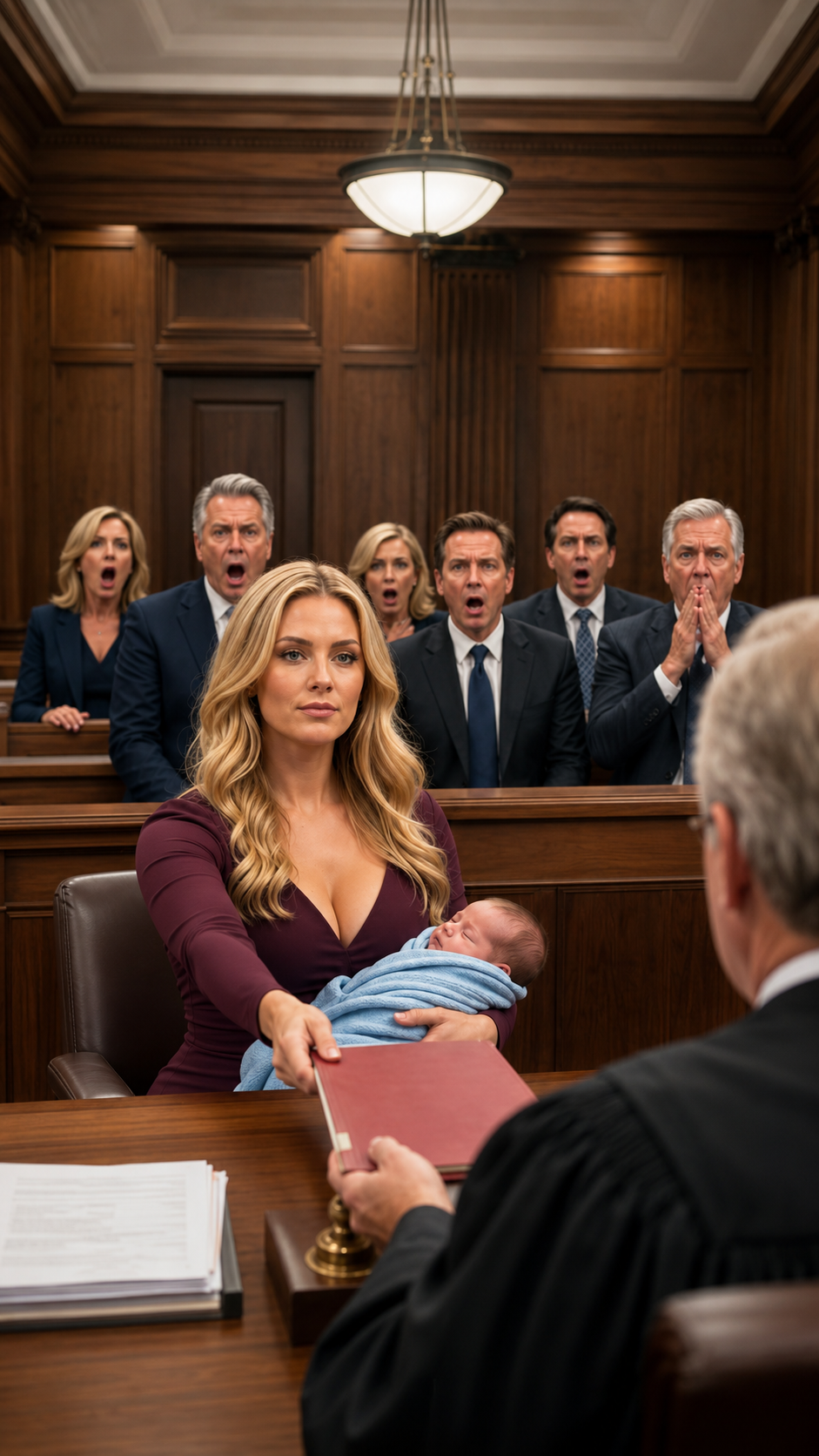
Mariana Ortiz walked into the Family Court of Mexico City with her newborn baby sleeping against her chest.
Her face was pale, her hair half-up, and she wore a beige jacket that covered her arms, even though it was warm. She moved slowly, still aching from the delivery just six days prior.
Across the room, Daniel Montejo smiled as if he had already won.
Beside him stood his lawyer, Eduardo Salas, one of those expensive attorneys who spoke softly but struck hard. Also present was Doña Teresa, Daniel's mother, impeccably dressed, sunglasses perched on her head, her disdain not even bothering to hide.
And next to her, Natalia.
The woman for whom Daniel had stopped sleeping at home months earlier.
Natalia wore a gold bracelet that Mariana recognized immediately. It was the same one Daniel had given her on their third anniversary, when he still pretended to be a loving husband.
Now it gleamed on another's wrist.
“Look at her,” Doña Teresa murmured. “She brought the kid to garner sympathy.”
Daniel let out a low laugh.
To them, Mariana was a worn-out woman, freshly delivered, without a powerful family and without enough money to stand up to the Montejos. They thought she had come alone because no one wanted to defend her.
What they didn’t know was that Mariana had spent months silent, observing, and gathering evidence.
The red folder pressed against her chest didn’t contain pleas. It held photographs, medical records, messages, audio files, bank statements, emails, and certified copies.
All perfectly organized.
Daniel had requested full custody of the baby.
He claimed that Mariana suffered from emotional crises, that she fabricated assaults, and that she lacked the stability to care for a newborn. He had even presented her psychological consultations after he pushed her against a table, then claimed she had fallen on her own as “concerning background.”
The judge reviewed the papers seriously.
“Mrs. Ortiz, do you have legal representation?”
Eduardo Salas smiled.
Daniel adjusted his jacket.
“No, Your Honor,” Mariana replied.
Doña Teresa almost burst out laughing.
But Mariana didn’t look away. She kissed the baby’s forehead, opened her bag, and pulled out the red folder.
The room fell silent.
She walked to the judge's desk and placed the folder in front of him.
For the first time, Daniel frowned.
“Your Honor,” Mariana said, her voice trembling yet firm, “I didn’t come to ask for compassion for my son.”
Natalia stopped fiddling with her bracelet.
“My son is not my excuse.”
Mariana stared directly at Daniel.
“My son is the evidence.”
Daniel went pale.
Because in that moment, he understood that everything he had buried was about to come to light.
PART 2
Eduardo Salas tried to stand immediately.
“Your Honor, I request a review of the relevance of any document before admitting it. The lady is clearly distressed from postpartum.”
Mariana didn’t move.
The baby barely moved his mouth, still asleep, as if he didn’t know that his very existence had just changed the atmosphere of the entire room.
The judge raised a hand.
“Counselor, sit down. Let’s review.”
Daniel clenched his jaw.
Until that moment, he still believed he could control the narrative. For years he had controlled what Mariana said, what she spent, whom she saw, when she could go out, and even which version of the beatings she should repeat.
“I tripped.”
“It was an accident.”
“I’m anxious, but Daniel is good.”
He had trained her to shrink away.
But that day, in that court in Mexico City, Mariana no longer seemed like the woman who asked for permission to breathe.
The judge opened the folder.
The first section contained medical reports from the General Hospital where Mariana had arrived twice with injuries. Both reports bore the same note: “patient reports fall at home.” But on the third page, there was a subsequent clarification signed by Dr. Elena Vargas.
The doctor explained that the injuries did not match a simple fall.
There were pressure marks on the arms.
A bruise on the ribs.
And a threat that Mariana, in tears, dared to mention in a whisper that night:
“My husband says that if I speak, he will take my son away.”
Daniel swallowed hard.
“That’s false,” he said. “That doctor misinterpreted everything.”
Mariana moved to the next section.
There were the screenshots of messages.
Daniel: “Don’t be dramatic. No one will believe a pregnant and unstable woman.”
Daniel: “If you sign over the baby, I’ll let you see him on weekends.”
Daniel: “My mom already talked to the lawyer. We’ll paint you as crazy.”
Doña Teresa leaned forward.
“Those messages could have been fabricated.”
Mariana looked at her for the first time.
“I thought you would say that, ma’am.”
She pulled out a USB drive.
“That’s why I brought the backups with digital forensic analysis.”
The judge ordered them to be added to the record.
Eduardo Salas stopped smiling.
Natalia crossed her legs, uncomfortable. She no longer looked like the confident girlfriend who had arrived with a designer bag and expensive perfume. She looked like someone starting to understand that perhaps Daniel hadn’t told her the whole truth.
But the hardest blow was yet to come.
Mariana requested permission to speak.
The judge nodded.
“Six days ago, when my son was born, Daniel didn’t go to the hospital. He didn’t call. He didn’t ask if the baby was okay. The first thing he sent were documents for me to temporarily relinquish control of the child.”
“Because you weren’t in condition,” Daniel interrupted.
“No,” Mariana replied. “Because you needed the baby.”
The room froze.
Doña Teresa went rigid.
Natalia turned to look at Daniel.
Mariana opened the last part of the red folder.
“Daniel’s grandfather left a family trust. According to clause 12, the first male born of a Montejo after 2025 would receive rights to shares of the family construction company. But only if the father had legal custody before the baby’s first month of life.”
The judge reviewed the document.
Daniel stood up.
“That’s a private family matter.”
“Not when you used that money as leverage to take my son away,” Mariana said.
Her voice came out broken, but not weak.
She pulled out another document.
It was a copy of an email sent by Eduardo Salas to Daniel and Doña Teresa.
Subject: “Immediate Custody Strategy.”
In the body of the message, it read that they should present Mariana as “emotionally unstable,” use her therapy as background, and pressure for a provisional handover of the child before the trust deadline.
Eduardo froze.
“That email is confidential,” he murmured.
The judge looked at him harshly.
“What’s concerning isn’t that it’s confidential, Counselor. What’s concerning is what it says.”
Natalia stood up suddenly.
“Daniel, what is this?”
Daniel didn’t answer.
His silence was worse than a confession.
Mariana then pulled out the final evidence.
A recording.
Doña Teresa’s voice sounded clear in the room:
“Mariana doesn’t matter. The child does. If we manage to get her to sign or declare her unstable, Natalia can raise him as her own. Soon no one will remember the mother.”
Natalia covered her mouth.
Not for Mariana.
For herself.
Because she had just discovered that she wasn’t loved either. She was only being used as a pretty image to replace a living mother.
But the recording continued.
Daniel’s voice came through:
“If the baby is born early, even better. That way Mariana will be weak. We’ll pressure her at the hospital, and she’ll sign anything.”
Mariana closed her eyes.
For months, she thought that remembering that phrase would destroy her. But hearing it there, in front of everyone, she understood that the fear no longer belonged to her. It now belonged to them.
The judge ordered a brief recess to review the admission of evidence.
Daniel approached Mariana quickly.
“Delete all this,” he whispered, in the same voice he used at home when no one was watching. “I can still fix this. I’ll give you money. I’ll let you keep the house. But don’t make a scene.”
Mariana held the baby tighter.
“A scene?” she asked. “Is that what you call wanting to steal my son?”
Daniel looked around, desperate.
“You don’t know who you’re messing with.”
Before Mariana could respond, Natalia stepped in.
“No, Daniel. You don’t know who you messed with.”
Everyone turned.
Natalia was trembling, but she pulled out her cell phone.
“I have something, too.”
Doña Teresa’s eyes widened.
“Shut up, girl.”
But Natalia didn’t obey.
She played an audio recorded a week prior. In it, Daniel promised her that when he had custody, Mariana would “legally disappear” from the child’s life. Then he told Natalia that she could sign school applications, health insurance, and even present herself as the mother at family events.
Natalia took a deep breath.
“I thought Mariana was unstable because that’s what you told me. I thought you were protecting the baby. But you used me, Daniel. You used me to make everyone believe you already had a family ready to replace her.”
Daniel lost control.
“You don’t understand anything!”
The baby woke up with the shout and began to cry.
That cry shattered something in the room.
It wasn’t a loud cry. It was small, fragile, helpless. But it sounded like an accusation greater than any file.
Mariana calmed him patiently, whispering in his ear. The judge watched her as the baby settled back in her arms.
The scene spoke more than a hundred arguments.
When the hearing continued, Eduardo Salas requested to withdraw as legal representative. He cited a professional conflict.
Doña Teresa began to cry, but her weeping was not regretful. It was filled with rage.
“You’re destroying us because you’re spoiled,” she said to Mariana. “That child is a Montejo.”
Mariana looked up.
“That child is a person. Not an inheritance. Not a key to money. Not a trophy to cover your filth.”
Daniel tried to speak, but the judge stopped him.
The provisional resolution was decisive.
Immediate custody to Mariana.
Protection measures for her and the baby.
Prohibition of approach for Daniel and Doña Teresa.
Investigation for domestic violence, threats, manipulation of evidence, and possible fraud related to the trust.
Furthermore, the judge ordered copies to be sent to the Public Prosecutor’s Office and the Bar Association regarding Eduardo Salas’s conduct.
Daniel sank into his chair.
For the first time, he didn’t look like the untouchable businessman from Polanco. He looked like a small man, cornered by his own lies.
Mariana left the courthouse with the baby in her arms and the red folder under her arm.
Outside, the afternoon was cloudy. There was noise from cars, coffee vendors, and people walking as if the world continued the same.
But for her, nothing was the same.
Natalia caught up to her on the sidewalk.
“Forgive me,” she said, her eyes filled with tears. “I really believed what he said.”
Mariana looked at her for a few seconds.
She didn’t hug her.
She didn’t insult her.
She simply replied:
“Trust men less who need to destroy a woman to seem like good fathers.”
Natalia lowered her head.
Mariana walked away without looking back.
Weeks later, Daniel tried to present himself as a victim on social media. He posted an elegant photo with a phrase about “fathers silenced by unjust systems.”
But someone leaked part of the audios.
The internet did its thing.
People commented, shared, and opined. Some defended Daniel because “he was also the child’s father.” Others said that no father who threatens the mother deserves to use the word family.
Doña Teresa stopped appearing at social gatherings.
Eduardo Salas was investigated.
Natalia disappeared from the Montejo’s life.
And Mariana, little by little, began to sleep without nightmares.
She never said she won.
Because a woman who arrives at court six days after giving birth, with a broken body and a trembling soul, shouldn’t have to “win” the right to raise her child.
She should simply be protected.
Months later, when her baby began to smile upon hearing her voice, Mariana understood something that no one in that room could take from her:
Daniel believed a child was a test of power.
Doña Teresa believed it was an inheritance.
Natalia believed it was a second chance.
But for Mariana, that child was the truth wrapped in a blanket.
And sometimes, the truth comes small, sleeping in a mother’s arms, but with enough strength to bring down an entire family.