The seat was too close to the aisle. Rachel had noticed this when she first sat down, because she had a habit of noticing small logistical failures in any room she entered — exits, angles, who was sitting where and why. Occupational. The kind of attention you develop when you've spent fifteen years in environments where every resource, every square foot of lab space, every line on a grant application, was contested. She had chosen the aisle seat deliberately. She told herself it was because her back hurt. She had been telling herself things for a long time.
The ballroom of the Harrington Hotel was not the sort of room Rachel was usually inside. The chandeliers were the kind that made you feel slightly underdressed regardless of what you were wearing, and Rachel was wearing a navy blazer that she had pressed that morning while Marcus ate cereal in front of the television, the cereal she'd bought at the corner store because she hadn't had time to go to the real grocery this week, the week she'd spent preparing Dr. Gerald Whitmore's acceptance remarks for an award he hadn't known he was going to receive until she told him about it. She had found out about the nomination before he did. That was how it usually went.
The Carlisle Prize for Excellence in Epidemiological Research was not the most prestigious award in the field — that would be the Landis Medal, which Whitmore would almost certainly receive within three years if current trajectories held — but it was the one that came with the ceremony, the hotel ballroom, the rubber chicken in cream sauce that Rachel had not touched, the four-hundred-dollar plate that the university had paid for, her attendance considered a professional courtesy, her presence here as invisible as it had always been.
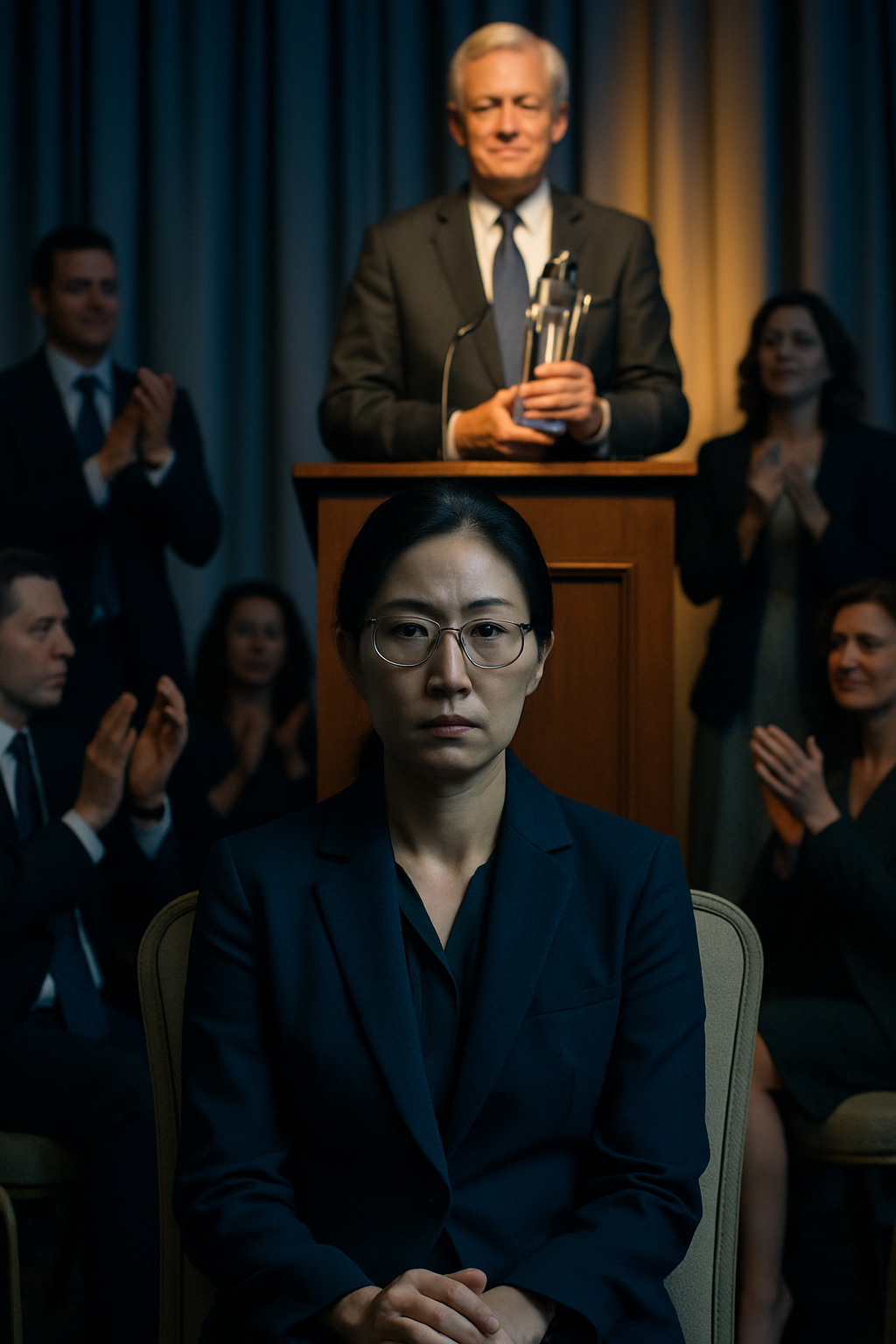
She watched him walk to the podium.
He had the kind of presence that photographs well. Sixty-three years old, silver-haired, straight-backed in a way that suggested he had been told his whole life that he looked distinguished and had eventually started to believe it. He wore the charcoal suit she had suggested when he'd asked, two weeks ago, whether he should go with the charcoal or the navy, and she had said charcoal, definitely charcoal, and he had written back, Perfect, thanks R, the way he always abbreviated her name as though the full version cost him something.
The applause was generous. She watched the room give it to him — the other department heads, the university president, the three people from the NIH who had funded the MRSA cohort study, the longitudinal work on antibiotic resistance patterns in hospital settings that had, according to the prize committee's citation, represented a landmark contribution to understanding transmission dynamics in clinical environments.
She had written that study. She had designed the data collection protocol. She had spent eight months recruiting participants across four hospital systems. She had run the statistical analyses, written the discussion section four times because the first three versions weren't quite right, and drafted the response letters when the reviewers pushed back. She had spent a Tuesday evening explaining to Marcus, then eight years old, why she couldn't come to his school's science fair because she had to finish the revision for the paper, and he had said okay, Mom, in the tone of voice that children develop when they have been disappointed enough times to stop expecting anything different.
Gerald Whitmore cleared his throat and smiled at the room.
"I'm deeply honored," he said.
She knew the speech. She had written it.
She had come to the lab in 2014 with a PhD from Johns Hopkins and a postdoc from Duke and a publication record that any department head would have been pleased to have among his junior faculty. She had also come with a son who was three years old, a custody arrangement that required her to stay within commuting distance of Baltimore, and a student loan balance that made the gap between academic salary and actual cost of living in that city a problem she thought about most mornings before she was fully awake.
She had not planned to stay at Harrington University. She had been clear about this in her interview, which she later understood had been a mistake, because clarity of that kind reads differently to different people. She thought she was being honest. Gerald Whitmore thought she was negotiating.
"We'd love to keep you," he had said, leaning back in his office chair with the comfortable confidence of a man who has never had to perform competence for anyone. "You're exactly the kind of researcher this department needs. Fresh eyes. Real statistical training. Someone who can actually run the quantitative side of things."
She should have heard it then. The quantitative side of things. As though the quantitative side were a service function rather than the intellectual core of the work.
But she was thirty-three and tired and she needed the job.
"I'd want my own research agenda," she said.
"Of course," he said. "Of course."
The first paper was not dishonest in the way the later ones were. She was listed as second author, which was still wrong — she had run the study, designed the survey instrument, cleaned the data, done every analysis — but second author at least acknowledged her presence. She told herself it was the way things worked. She had heard this from other women, other junior researchers, older colleagues who had been through it and come out the other side with tenure and a kind of pragmatic resignation that they called realism. You pay your dues, they said. You build the relationship. He has the connections, the reputation, the name that gets the grants funded. You get credit over time.
She believed this because she needed to believe it. There is a particular kind of self-deception available to intelligent people that ordinary people cannot access — the ability to construct a logically coherent framework around something that is simply wrong, to give it the architecture of a reasoned position so that you can look at yourself in the mirror each morning and see a person making strategic choices rather than a person being used.
The second paper removed her from the authorship line entirely. "Acknowledgments," Whitmore had said, when she asked. "I think acknowledgments makes more sense here, given the scope of the contribution." The scope of the contribution had been: designing the study, running it, writing all 8,400 words of the manuscript, and revising it through three rounds of peer review. She had said, "I don't think that's accurate." He had said, "Rachel, I need you to trust me on this." She had needed the job. She had trusted him.
After that, it simply became the arrangement. Not discussed, not formalized, not admitted to by either of them in any direct way. She wrote the work. He submitted it. His name was first and usually only. In the acknowledgments, if she was lucky, there was a line: The authors thank the research team for their invaluable support. Sometimes her name appeared in that sentence. Often it did not.
She told herself the arrangement had a logic. She got salary, benefits, stability, the infrastructure of a funded lab. He got the papers. She was not a named author, but she was employed, which was not nothing, which was actually quite a lot when you were a single mother in a city where a two-bedroom apartment cost $2,400 a month and your son needed new shoes and the pediatric dentist didn't take your insurance.
This is what she told herself. She was very good at it.
The texture of a decade is not dramatic. It is accumulated in small moments, most of which seem unremarkable at the time, which is perhaps how a decade can pass without a person quite registering what has been lost.
There was the night in October 2016 when she stayed until eleven finishing the discussion section of the longitudinal MRSA paper — the one that would, eventually, be cited four hundred and twelve times — while Marcus was with his father for the week, which meant she had the apartment to herself, which meant she had no reason to go home, which meant she worked. She remembered the particular quality of the silence in the lab after the building's HVAC system cut off at nine, the way the refrigerator hum became audible, the smell of the centrifuge that had been running since three in the afternoon. She remembered drinking cold coffee from a mug that had Gerald Whitmore's name on it, a conference giveaway, the logo of a symposium she had not been invited to attend.
There was the international infectious disease conference in Vienna in 2017, for which Whitmore's travel was approved in March, and for which she submitted her own travel request in April, citing three papers currently in submission as justification. The request was denied — budget constraints, the department administrator said, apologetically — and she had accepted this without comment. Three weeks later she had seen the photo on the department website: Whitmore at the conference dinner, standing with two program officers from the CDC, smiling in front of a Viennese window. She had been presenting the abstract he was standing there discussing. The abstract she had written. She had gone back to her desk and run a regression analysis and said nothing.
There was the afternoon in 2018 when Marcus, then seven, found the printed draft of a paper on the kitchen table — she had been reading it over breakfast, red pen in hand, the habit ingrained enough that she did it at home now — and asked whose name was on it. She looked at the cover page. Gerald Whitmore. "Someone I work with," she said. "Did you help?" he asked. She looked at him. "Yes," she said. "Did it say so?" he asked. She was quiet for a moment. "No," she said. He went back to his cereal. He was seven. He did not push it. But she thought about it for three days.
There was the peer review response she drafted in February 2019 for a journal submission — Reviewer 2 had raised a methodological objection about the stratified sampling approach, and it was a real objection, the kind that required either a substantive rebuttal or a genuine concession, not the diplomatic hedging that Whitmore had initially suggested. She had written four pages of technical response, careful and precise, and had sent it to Whitmore to submit. The submission letter to the editor bore only his name. When the paper was accepted, she received an email from him that said: Great outcome on Reviewer 2 — I thought your instinct there was right. She had read that email three times. Your instinct. As though instinct were the word for it. As though instinct were what you called four pages of documented methodological reasoning.
There was the grant renewal in 2019 when she spent four weeks writing the application — seventy-two pages including appendices — and Whitmore submitted it with his name as principal investigator and hers as co-investigator, which she had thought was progress, which she had allowed herself to feel briefly hopeful about, until she received the program officer's feedback letter addressed solely to Dr. Whitmore, and she understood that co-investigator on a grant with someone else's name first meant something specific in terms of whose work this was considered to be, and that something was not what she had told herself it was.
There was the morning Marcus was twelve and asked, not unkindly, why she always seemed tired. She told him she was working on something important. He asked what. She told him it was a study about how infections spread in hospitals. He thought about this. "Is it yours?" he asked. She looked at him. He was twelve. He had been watching for five years without knowing quite what he was watching. "Yes," she said. "It's mine." She meant it. She also knew that the paper, when it ran, would say Gerald R. Whitmore at the top.
The decade had a texture of competence without credit. Of presence without acknowledgment. Of doing the thing so well and so consistently that it became invisible, which is what happens to all maintenance work, all work that keeps a system running — it disappears into the background until it stops, and then everyone notices its absence.
She found out about the nomination the way she found out about most things pertaining to Gerald Whitmore's career: because she managed his professional correspondence.
This had evolved gradually, the way all the other things had. It began with her monitoring the shared departmental email for grant-related correspondence and expanded, over time, into managing his responses to peer review requests, his conference invitations, his speaking engagements. He was not a disorganized man — he was, actually, quite methodical — but he was a busy one, and she was efficient, and over time the efficient person fills the spaces left by the busy one, and eventually the efficient person is doing the busy one's job.
The email from the Carlisle Prize committee arrived on a Thursday afternoon in January. It was addressed to Dr. Whitmore. Rachel read it because she read all his correspondence. She sat with it for approximately forty-five seconds.
Then she wrote him a brief congratulatory note and forwarded the email with her reply.
She did not tell anyone else. She went home and made pasta. She helped Marcus with his history homework — he was writing an essay about the Pullman Strike, the labor dispute of 1894, workers and ownership and who decides what the work is worth. She did not think about the irony. She thought about it later, lying awake at eleven-thirty, and felt a grim kind of amusement that did not quite reach her eyes even in the dark.
What she felt, in the weeks after, was not entirely what she would have expected of herself. She had expected bitterness, and there was bitterness, but it was familiar, a well-worn garment she had been living in for years. What she felt instead — intermittently, in spaces she tried not to examine too closely — was something like grief. Not for the award, not for the recognition, but for something more elemental and harder to name: for the version of herself who had arrived at that first interview believing, genuinely believing, that the way she was treated would correspond to the quality of her work. For the ten years she had spent in the negative space of someone else's reputation.
She had made the FOIA request three years earlier. This was not, as she would later be asked to explain, an act of retaliation or escalation. It was an act of documentation. There is a distinction.
In 2023, she had been passed over for promotion. This was not surprising — she had been passed over twice before — but this time the explanation offered by the department review committee included language about independent research contributions and established publication record, and she had read those phrases and understood that the system had, in its bureaucratic indifference, provided her with a precise articulation of her own erasure. She had no independent research contributions because her contributions had not been independent. She had no established publication record because her publications had been attributed to someone else.
The FOIA request was not to the university. It was to three federal funding agencies — NIH, CDC, and a smaller HHS grants office — requesting all documentation pertaining to five specific grant awards, including original research proposals, progress reports, and any correspondence related to personnel contributions. She did not tell Whitmore. She did not tell anyone.
The returns took several months, arrived in installments, came in the form of PDFs and scanned documents, some of them barely legible, some of them startlingly clear. She had spread them across the kitchen table over three evenings, sorting by grant number first, then by date, building a chronology that no one had ever assembled in one place before.
Among the materials were original grant proposals in draft form, containing tracked changes, version history, author metadata. The metadata carried her name. The tracked changes were in two colors — her annotations in red, his minimal edits in blue, and the ratio was approximately nine to one. She had sat with one document for nearly an hour, scrolling through it slowly, watching the pattern repeat across forty pages: dense red commentary in her hand, correcting structure, tightening argument, supplying citations that had been left as placeholders; occasional blue insertions from him, mostly tonal adjustments, a word changed here, a phrase softened there. The intellectual architecture of the grant — the thing that had been funded, the thing that had produced the papers, the thing that was now being honored in a hotel ballroom — was overwhelmingly red.
There were complete draft manuscripts with her name in the header: Rachel Kim, draft 1. Draft 2. Draft 3. There were version notes that read: RC's revision, final before submission. There was one document in which a peer reviewer's comment had been printed out and her handwritten response was pinned to it, the response that had been incorporated verbatim into the published reply, signed only by Whitmore. She read that handwritten note twice. She recognized her own handwriting as though it belonged to a stranger — someone who had been very careful, very precise, very thorough, in a room where no one was watching.
There was one email exchange from 2017 in which she had written, Gerald, I've finished the methods section and the preliminary results — can you review before I finalize? and he had written back, Looks great Rachel, I'll take it from here.
She had read all of it. She had sat with it for three evenings, going through the documents in the order she had received them, and she had felt something cold and clarifying move through her — not surprise, exactly, because she had known, she had always known, but verification is different from knowledge in the way that a locked room is different from a locked room whose door you have finally opened. The documents did not tell her anything she had not understood in some register for years. What they did was make it external. Undeniable. Evidence-grade. They moved the fact from the interior, where it could be doubted and minimized and explained away, to the exterior, where it simply was.
She had saved everything. She had not done anything with it yet.
"Yet" was doing a significant amount of work in that sentence, and she was aware of it.
Gerald Whitmore was at the podium now, and he was saying thank you in the way that people say thank you when they have been rehearsed in gratitude without being required to feel it — the warm, general, professionally calibrated thank you of a man who is used to receiving credit and has mistaken this familiarity for deserving it.
He thanked the Carlisle Prize committee. He thanked the university president, who nodded from the head table. He thanked the NIH program officers who had funded the work. He thanked his colleagues in the Department of Epidemiology and Public Health. He thanked, specifically by name, Dr. James Okafor, his associate department head, and Dr. Susan Verlaine, his long-standing collaborator at Johns Hopkins.
Then he said: "And of course, I want to thank the broader research team, including our lab coordinator Thomas Briggs, our administrative support staff — Jennifer Walsh, Priya Menon, Rachel Kim — and the many graduate students who have passed through the lab over the years."
Rachel Kim.
Administrative support staff.
She heard it the way you hear something you have been half-expecting and fully dreading: as a confirmation rather than a shock, which is actually worse than shock would have been, because shock is metabolized quickly whereas confirmation sits in the chest like something dense and permanent.
The man sitting to her left — she did not know him; she had not introduced herself — shifted in his seat and cleared his throat. The applause began. Gerald Whitmore smiled at the audience in his silver-haired, charcoal-suited way, and the glass trophy caught the light, and Rachel's hands were folded in her lap, and she did not clap.
She was very still. She had always been good at stillness.
She thought: administrative support staff. She thought: I wrote the paper that citation came from. The 2017 MRSA paper. The one that opened his remarks. I wrote that paper in four months of nights and weekends while Marcus had an ear infection that kept him home from school for a week and I paid the babysitter overtime so I could finish the revision. I wrote it. He submitted it. He is holding the award for it. He just said my name in a list that also includes Jennifer Walsh, who processes expense reports.
None of this showed on her face.
The applause continued. Whitmore descended from the podium to handshakes and shoulder-clasps, the physical grammar of male professional success, the language of a club she had never been invited to join. The dinner resumed. Waitstaff circulated with coffee and a small chocolate dessert. The table around her filled with the noise of congratulation and institutional pride.
Rachel Kim reached into her bag. She took out her phone. She sent a single text message to a number she had saved three weeks ago, when the journalist had first reached out through her university email address to ask if she would be willing to speak about the attribution practices in the department.
The text said: I'm ready. He just said my name in the acknowledgments list. Administrative support staff. I have everything. Let's talk tomorrow.
She put her phone back in her bag. She picked up the small chocolate dessert and ate it. It was very good. She had not eaten since lunch.
The journalist's name was Daniel Park. He had reached out because someone had sent him a tip — she never found out who, though she had her suspicions, a former grad student who had watched the dynamic for two years before leaving the program — and because he wrote for a science journalism outlet that had been covering attribution disputes in academic research with increasing frequency, as more FOIA requests by more researchers had begun to surface the same structural pattern in lab after lab, field after field.
He was in the lobby when she came out of the ballroom. She recognized him from the photo on his author page — early thirties, a little underdressed for the hotel, carrying the particular energy of a journalist who has been waiting and is now not waiting, which is a specific kind of contained alertness. He looked at her and she looked at him and neither of them pretended to be surprised.
"Dr. Kim," he said.
"Give me five minutes," she said. "There's something I need to do first."
She knew where the backstage corridor was because she had arranged the ceremony logistics. She walked past the registration table, through the door marked STAFF ONLY, down the corridor that smelled of hotel carpet and institutional air conditioning. She could hear, behind her, the slow dissolution of the formal event into the informal one — glasses, voices, the sound of people becoming less careful.
Gerald Whitmore was standing near a folding table with two members of the prize committee, the glass trophy resting beside a half-empty bottle of mineral water. When he saw her, his face did something small and complex that she had seen before and now understood differently. Not surprise. Something else. The very brief calculation of a man who has, somewhere in himself, always known this moment was possible.
"Rachel," he said, warmly, the way he always said her name when there were witnesses. "Quite an evening."
The committee members drifted, with the sensitivity of people who recognize an impending private conversation.
"Administrative support staff," she said.
He smiled carefully. "I wasn't able to name everyone individually. You know how these speeches are — the committee expects brevity, and I was already over time. I tried to include—"
"Gerald."
The smile held, but something behind it went very still.
"I have the FOIA materials," she said. "I have the original drafts. The version histories. The metadata. I have the email from 2017 where you told me the methods section looked great and you'd take it from here, and four weeks later it was published under your name. I have draft manuscripts with Rachel Kim in the header. I have tracked changes — yours and mine, side by side, nine to one. I have all of it."
He looked at her for a moment without speaking. The charcoal suit. The silver hair. The glass trophy beside the mineral water, the light catching it at an angle that suggested it was more important than it was. When he spoke, his tone had shifted — not to guilt, she noticed, not to guilt — but to a kind of tired patience, the tone of a man who has decided to manage a situation rather than acknowledge it.
"Rachel, I think you need to be careful about how you characterize things. The work in that lab was collaborative — that's always been the case. You know better than anyone how these research environments function. Multiple people contribute in multiple ways, and the question of attribution—"
"I wrote the papers."
"You contributed substantially. Yes. That's never been in question. But I brought the infrastructure, the funding relationships, the institutional connections that made the work possible. Without those—"
"Without those, I would have taken my methods somewhere else and built the same infrastructure in three years," she said. "With those, I built it for you in one, and you put your name on it."
He was quiet again. She watched him recalibrate — the first approach not working, moving to the next. "I'm trying to understand what outcome you're hoping for here," he said carefully. "Because if there are things I can do — a correction to the award record, a formal acknowledgment, a co-authorship on the next submission — I'm genuinely open to discussing—"
"I'm talking to Daniel Park tonight. He's in the lobby."
Silence. A specific kind of silence. She watched him process this — not the thing itself, she noticed, not the substance of what she was saying, not the ten years, not the papers, not her name in the acknowledgments next to the woman who processed expense reports. He was processing the exposure. The sequence of consequences. The reputation management problem. She watched him solve for that and not for the other thing, and she thought: yes, that is exactly who you are, and I have spent ten years not seeing it because I needed not to see it.
"You'd be throwing away your career," he said. The tone was quiet. Almost kind.
"I'm forty-three," she said. "I have a son who asks me why my name isn't on my work. I have a FOIA file that makes the case without me saying a word. What career am I throwing away, exactly?"
He started to say something and stopped. She had never seen him stop before saying something. It was brief, the stopping. Then: "What do you want, Rachel?"
And here it was — the bargaining, arriving right on schedule. What do you want. As though the question were new. As though it had not been answerable at any point in the last ten years by simply looking at what she had been doing every day and treating it accordingly.
"Nothing from you," she said.
She turned and walked back down the corridor toward the lobby. She could hear him behind her, not following, just standing there in the space she had left, holding the glass trophy in the light of an evening that had not gone the way it was supposed to go.
Daniel Park was still in the lobby. He had a coffee now. He offered her one and she shook her head.
"How much time do you have?" he said.
"As much as you need," she said.
The piece ran six weeks later. Daniel Park was, as it turned out, a careful journalist — the kind who verifies rather than merely believes, who sat with the FOIA documentation for two weeks before publication, who called Gerald Whitmore for comment and received a statement from the university's communications office that described the allegations as a mischaracterization of standard collaborative research practices, a statement that was word-for-word identical to language used in two similar cases at other institutions that year, which Park noted in the article.
The article was three thousand words. It contained four of the FOIA documents, reproduced with redactions. It quoted, by name, Rachel Kim.
Rachel had known it was coming. She had read the draft. She had corrected two factual errors and let everything else stand. She had not slept much in the weeks between the backstage corridor and publication, but it was a different kind of not-sleeping than before — less weight, more exposure, the insomnia of a person standing in the open rather than a person pinned under something.
Marcus was fourteen now. She told him the night before it ran. She sat at the kitchen table — the same kitchen table where he had, at seven, asked whose name was on the paper she was reading — and she told him most of it. Not all of it, not the parts that were too complex or too heavy for fourteen, but enough. Enough that he would understand, the next morning, what it meant when the article appeared.
He was quiet for a moment. Then he said: "So they'll say your name now."
She looked at him. "Some people will," she said. "Not everyone."
"But it'll be true," he said. "Even if they don't say it."
She thought about this for a long time after he went to bed.
The university convened a review committee. This was expected. The committee process was slow, institutional, and designed — as such processes usually are — to produce a result that the institution could defend rather than a result that was correct. She participated when required. She did not expect justice from it and was not surprised by its measured conclusions.
Gerald Whitmore did not lose the award. Awards, once given, are almost never rescinded; the infrastructure of recognition is not built for revision. He kept the Carlisle Prize. The spring following the article's publication, he announced his retirement — a decision the department framed, in its official communication, as a natural transition at the conclusion of a distinguished thirty-year career. The announcement went out on a Tuesday, and by Wednesday the departmental website had been updated to read Professor Emeritus in the space where his title had been. There was a small reception, reportedly attended by about twenty colleagues. Rachel was not invited. She did not expect to be. She heard about it from a graduate student who had been present, who told her the mood had been subdued and the speeches short. No one, apparently, had mentioned the article.
She was cited in four papers in the twelve months following the article. Real citations, not acknowledgments. Daniel Park's piece was picked up and referenced in three other investigations of attribution practices at research universities. Two grad students at other institutions emailed her. She replied to both.
Her promotion application was approved the following November. The committee's language, this time, mentioned her substantial independent research contributions. She read that sentence and let herself feel what there was to feel about the irony of the word independent, which had nothing to do with her having suddenly become more independent and everything to do with the fact that what had always been independent was now visible.
She did not know if this was victory. She was suspicious of the word. Victory implied a clear result and a definable endpoint, and what she had was something more complicated and less resolved: a decade on the record. Her name in the right place on the right documents. A conversation with her son that she did not regret having. A career that was now hers in name as well as in fact, which was not the same as having back the decade, which was not the same as those hours in the silent lab not counting, which they always would, the HVAC and the cold coffee and the centrifuge and the draft with her name at the top going into the world under someone else's.
What it cost: the comfort of invisibility, which she had not known she had grown to depend on until it was gone. The predictability of a structure she had resented but inhabited. The psychic ease, if ease is the right word — perhaps the word is numbness — of having resolved the contradiction years ago and not having to re-live it daily.
What it meant: harder to say. She thought about this sometimes in the evenings, after Marcus had gone to his room and the apartment was quiet and she was herself in the silence of it. What does it mean, to have documented something that was always true? Does the documentation change what happened? Does it change what the years were? Does it give back a decade?
No. Obviously not.
But Marcus was fourteen, and she had told him. And somewhere in the bureaucratic machinery of three federal funding agencies, in digital storage, in PDFs of documents that predated anyone's decision to look at them, there were files with her name on them, in her handwriting, timestamped, metadata-intact, saying: this was mine. I was here. I did this work.
It was not nothing.
She had needed, for a very long time, to do something that was not nothing.
She finished her coffee. The apartment was quiet. Outside the window, Baltimore was doing what Baltimore does at eleven o'clock on a Thursday in November: the particular yellow of the streetlights in the fog, the sound of someone's car door, somewhere, a dog, somewhere else, the general insistence of a city on existing regardless of what any individual person inside it is working out. She watched it for a while. Then she turned off the kitchen light and went to bed.
She slept.