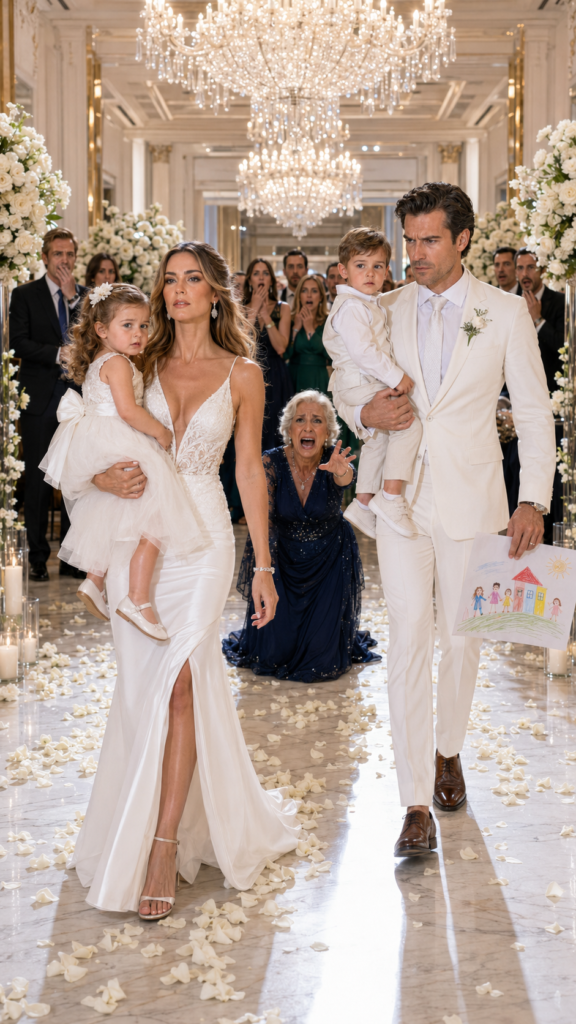
The night Brendan Cross launched his debut novel, Lily Stone sat in the third row and held very still.
She had dressed carefully. Not for him — she'd stopped doing things for him, exactly, somewhere around the fourth month when she was writing the chapter where the protagonist loses his father and she cried at her own keyboard, alone, at 2 AM, while Brendan was in group therapy four hundred miles away. She dressed carefully because she knew what was coming and she wanted to be composed when it arrived. Dark green dress. Hair down. Reading glasses pushed up into it. The folder in her bag — she'd left that at home. She didn't need it tonight.
The venue was a converted warehouse in Brooklyn, the kind that had exposed brick and Edison bulbs and a bar that served craft cocktails with names from the novel. His novel. She had a glass of something called "The Meridian" in her hand — she'd named that chapter. She'd named everything.
Brendan took the stage at eight-fifteen. He was wearing the corduroy jacket she'd bought him for a different occasion, a better one, two years ago. He looked good. He always looked good. That had been part of the problem and part of the reason and, she supposed, part of what had kept her at her laptop writing his voice when she could have been writing her own.
"This book," he said, into the microphone, his voice doing the thing it always did — dropping just slightly, gathering people in — "almost didn't exist."
That was true. She had watched it not exist for three years. She had watched him start it and abandon it, start it differently and abandon it again, talk about it at dinner parties with the authority of a man who was writing it. She had given him notes. She had given him structure. She had given him, in the end, herself.
The rehabilitation was for alcohol. Thirty days in Vermont, then another thirty because the first thirty hadn't been enough. She'd driven him there. She'd watched him check in. She'd driven home alone and opened her laptop because she didn't know what else to do with the silence, and she'd opened his files, and she'd started.
Sixty days became ninety became a hundred and twenty. He came home different — genuinely different, she thought; she had believed that. She'd printed the completed manuscript and left it on the kitchen table like a meal she'd cooked. He'd read it in two days. He'd called it extraordinary. He'd looked at her with something she'd mistaken for gratitude.
"I want to read you something," Brendan said from the stage.
He opened to a page. She knew which page before he began. She'd written it at 3:47 AM on a Tuesday in February, when the sleet was hitting the windows and she was so deep in the novel that she'd forgotten it wasn't hers. The paragraph about the lighthouse. About arriving at a place you've been trying to leave your whole life and realizing that leaving was never going to be the thing that saved you.
He read it the way she'd heard it in her head. Of course he did. He had her voice in his ear — she'd read sections aloud to him, coached the rhythms, explained the choices. He'd absorbed all of it. He read beautifully.
The audience was quiet in that particular way that means something landed.
Lily took a sip of her drink.
"I have to thank some people," Brendan said, setting the book down. "My agent, Philip — who believed in this when it was, frankly, unbelievable." Laughter. "My editor at Harlow & Sons, who somehow made it better." Pause for effect. She'd taught him that. "And there's someone — there's someone who was with me through the darkest part of this. Who showed up at exactly the right moment. Who inspired every word that matters in this book."
Lily set her glass down on the small cocktail table in front of her chair.
"Vanessa," Brendan said. He turned — not toward the third row. He turned toward the left, toward the front, toward where Philip Harte's assistant was sitting, composed and surprised-looking and twenty-nine years old. "You know what you did. I don't think I can say it properly from up here. Thank you."
Vanessa Hart put her hand to her chest. Her expression was the exact expression of a woman receiving something she'd been waiting for.
Lily sat in the third row.
She sat very still.
The applause started. She joined it, mechanically, her hands moving together and apart. Around her, people were smiling. To her left, a woman she'd never met leaned over and said, "That was beautiful, wasn't it?" and Lily said, "Yes," because it was the shortest true thing she could say.
She stayed for the wine. She said congratulations to Philip. She said nothing to Brendan — he was surrounded, the particular gravitational field of a newly launched author with good reviews and a beautiful room. She said nothing to Vanessa Hart, who she had met twice before at industry events and found perfectly pleasant.
She left at nine-thirty. She walked to the subway. She sat on the F train going home and looked at her hands.
Ink stain on her right index finger, old, from a pen she'd been using when she was deep in the middle section of the book. She'd been grinding out the climax for three days straight and she'd leaked ink on herself and kept writing because stopping felt like dying.
She looked at that ink stain all the way home.
The folder was on the kitchen table when she got home. She'd put it there that morning because some part of her had known — had been certain enough to want evidence nearby.
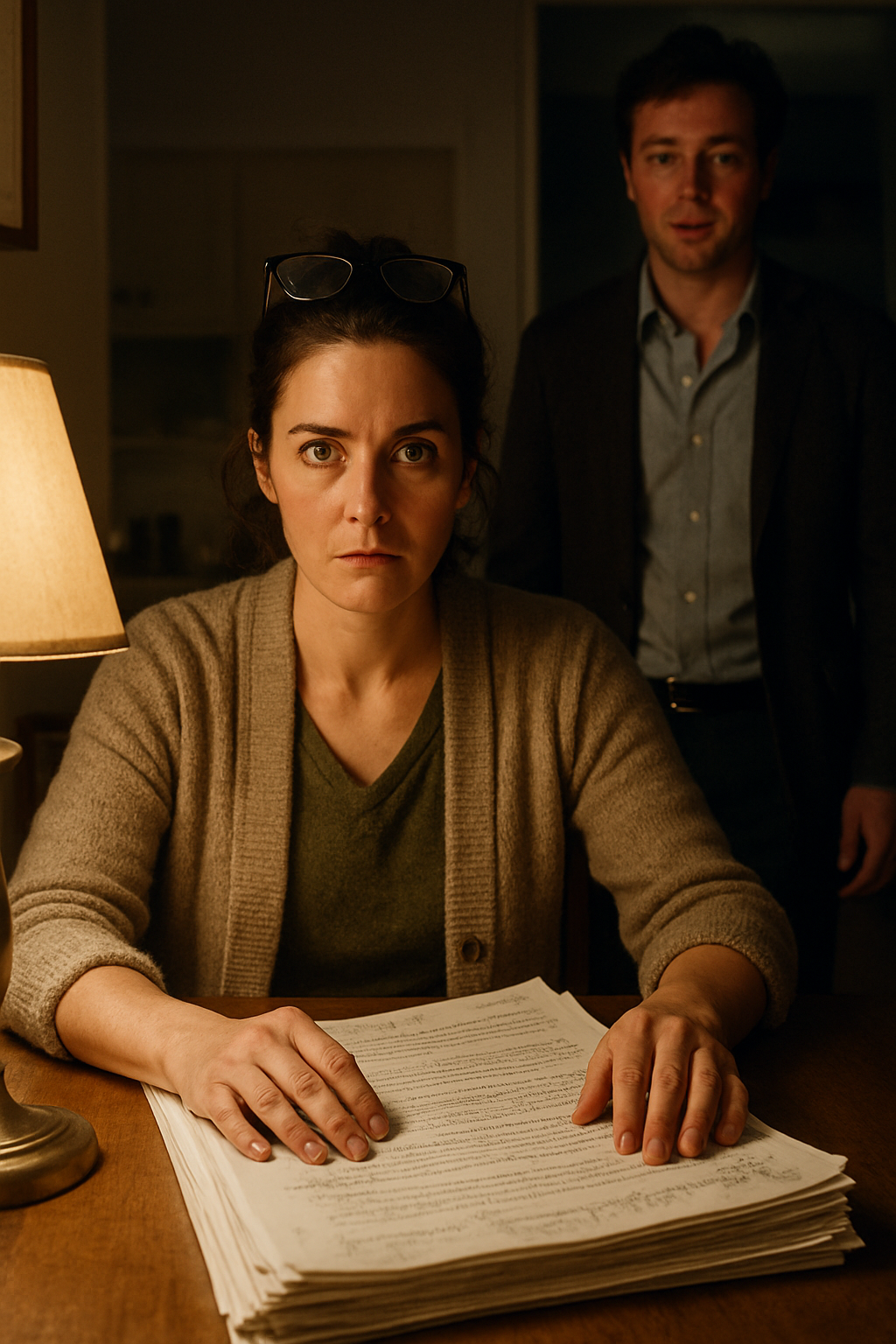
She sat down. She didn't turn on the overhead light, just the lamp at the end of the table. She opened the folder.
The drafts went back eighteen months. The earliest ones were in her handwriting — longhand notes she'd made when she was trying to crack the structure, before she'd even started typing. The dates were in the upper right corner of every page, the way she always dated her notes. February 14th. February 17th. February 21st — she remembered that day, she'd solved the problem of the second act by taking a walk to the bodega in the sleet and coming back with coffee and seeing it all at once. She'd written twelve pages that day.
Her laptop, when she opened it, had the revision history. Every version of every chapter, auto-saved by the word processor, timestamped to the minute. She'd been using her own account, her own software license. She'd sent him drafts by email — those were in her sent folder, date, time, subject line: "Ch. 7 — revised," "Climax draft 2," "Final pass — full MS attached."
She'd kept everything. She hadn't kept it as evidence. She'd kept it the way she kept everything — compulsively, archivally, the way a writer keeps work because the work is real and throwing it away would feel like a small death.
She opened a new email.
To: submissions@harlowandsons.com, rights@harlowandsons.com CC: editorial@harlowandsons.com Subject: Authorship Documentation — "The Meridian" by Brendan Cross (Pub. Date June 2026)
She wrote the email the way she wrote everything — clearly, specifically, without drama. She was not asking for anything in this first email. She was providing information. She explained who she was. She explained what she had done. She listed the documents she was attaching. She explained what those documents demonstrated.
She attached forty-seven files. The complete draft history. The email correspondence. Her handwritten notes, photographed with timestamps from her phone, which automatically geotagged them to the apartment. A voice memo she'd sent Brendan in March of the previous year where she read the lighthouse paragraph aloud and said, "I think this is the one. I think this is the center of the whole thing." His response: "You're a genius. This is it."
She read the email twice.
She pressed send at 11:47 PM.
She closed the laptop and made tea and sat at the table and waited for whatever was coming next.
Brendan came home at 12:30. She heard him on the stairs — the particular sound of someone who was drunk enough to be careful, which was the version of drunk she'd learned to read better than any other. He came through the door with his jacket over his arm and his face still carrying the evening: flushed, satisfied, a bottle of something in his hand that someone had given him.
He stopped when he saw her.
She was still at the table. The lamp was still on. The folder was still open. Her laptop was closed now, but the folder was open and he could see — she could see him seeing — the top page. Her handwriting. Her date. February 14th.
"Lily," he said. Not a question. A recognition.
"Sit down," she said.
He looked at the folder for another moment, then pulled out the chair across from her and sat. He put the bottle on the table, which she noted. He was putting the bottle between them.
"You did great tonight," she said. "You really did. The reading was — you read it beautifully."
"Lily—"
"I'd like you to explain the arrangement," she said. "You used that word earlier, you told Philip there was an arrangement. Explain it to me."
He was quiet for a moment. Then: "We talked about this."
"We talked about you getting help and me supporting you. We talked about me helping with the book. We talked about a lot of things."
"You offered," he said. "You said—"
"I offered to help." Her voice was completely level. She'd found this voice around the third month of writing, when she'd realized she needed it. "I offered to give you notes. I offered to help you break the structure. I wrote eighty thousand words, Brendan. I wrote the book."
He looked at the folder. "Your name was never going to be—"
"Say that again," she said. "Say that more clearly. I want to make sure I understand."
He stopped.
"Your name was never going to be on it," he said, finally. The words landed differently when he said them plainly. She could see him hear them, landing.
"No," she said. "It wasn't. And you thanked your muse."
He said nothing.
"Her name is Vanessa Hart," Lily said. "She works for Philip. How long?"
He looked at the table. "It wasn't — during the book. It wasn't while you were—"
"How long."
"A year," he said. "About a year."
She nodded. She'd suspected something. Not specifically, not with a name, but she'd felt the shape of it in the way he'd talked about Philip's office, the meetings he'd started attending in the city even after the book was done.
"Okay," she said.
"Lily—"
"I sent the email at 11:47," she said. "To Harlow and Sons. With the documentation. You should know that."
His face changed. The flush drained out of it. She watched him understand what she'd sent and to whom.
"You didn't," he said.
"I did." She stood up. "You should probably call Philip tonight. Before they open the email in the morning."
She picked up the folder — all forty-seven documents, her drafts, her voice, her eighteen months — and she carried it to the bedroom and she closed the door.
The morning came the way mornings do when you haven't slept: abruptly, insistently, with the particular cruelty of full light.
What Harlow & Sons did when they opened Lily Stone's email was not immediate. The editor who opened it at 9:14 AM on a Thursday forwarded it to the publisher at 9:31. The publisher forwarded it to legal at 9:47. Legal opened the attachments and spent approximately forty minutes reviewing the documentation before calling Philip Harte at 11:03.
Philip had already spoken to Brendan. Philip already knew, which is to say Philip had been woken at 1 AM by Brendan's panicked call and had spent most of the night trying to figure out what could be done, which turned out to be: not very much.
The documentation was complete. This was the problem. Most ghostwriting arrangements existed in a legal gray area precisely because they were undocumented — the ghost was paid, the agreement was understood, nothing was written down. Lily had not been paid. Lily had no agreement. What Lily had were dates, drafts, email correspondence, voice memos, and — this was the detail that made legal visibly uncomfortable — the manuscript file metadata, which showed the document had been created on her laptop, under her software license, from her user account, and had been edited from that same account for the entirety of its composition.
The book had been published for eleven days.
By 2 PM, there were conversations happening between Harlow & Sons and their legal team about the nature of copyright, the definition of work-for-hire, and the absence of any signed agreement. By 4 PM, a junior editor had been dispatched to review every version of every draft in the manuscript tracking system and discovered, with increasing discomfort, that Brendan Cross's editorial contributions consisted primarily of: two emails asking to make the protagonist taller, and one phone call in which he'd said "I trust you" and "it's perfect" and "I can't wait to hold it."
They called Lily at 4:47.
She answered on the second ring.
She had a lawyer by the following Tuesday. The lawyer's name was Margaret Osei, and she had handled three similar cases, none of which had made it to trial because the evidence had been sufficient enough in each instance to motivate a settlement.
Margaret reviewed the documents over a weekend and called Lily on Monday morning. "I've seen cleaner cases," she said, "but not many. The voice memo alone is going to be very persuasive."
Brendan did not call. He sent one text, at 3 AM the night of the launch: I'm sorry. I thought it was different. I thought we both understood. She read it. She did not respond. She was not interested in what he had thought.
What she was interested in was the second file on her laptop.
She'd started it six weeks after she finished writing his book. She'd started it almost accidentally — she'd been in the apartment alone on a Sunday in the autumn and she'd opened a new document to work through something she was thinking about and four hours later she had eight thousand words that were unmistakably, irreducibly hers. Her voice. Not his rhythm, not his concerns, not the careful maintenance of a sensibility she'd been tending for someone else's benefit. Something sharper and stranger and altogether more honest.
She'd kept writing it. She'd written it in the mornings before work, in the evenings, on weekends. She'd written it the way she hadn't written anything in three years — with the specific recklessness of someone who has nothing left to protect.
The manuscript was now a hundred and four thousand words.
She'd had a title for it since November.
She opened the document. She read the title she'd typed on the page:
The Muse — A Novel
She read the first line: The thing about writing someone else's book is that you have to believe in them completely, and the thing about believing in someone completely is that it teaches you, eventually, exactly where they stop.
She sent it to three agents on a Thursday afternoon in July, three weeks after Brendan Cross's novel was quietly pulled from sale pending a legal review of authorship and contractual obligations.
The first offer came on a Monday.
She accepted it on Wednesday.
In the acknowledgments, she thanked no one by name. She thanked the month of February, the sleet against the windows, the lamp at the end of the table, and the particular quality of 3 AM — which, she wrote, "turns out to be the most honest hour there is."
She kept the ink stain. She thought it was probably a permanent fixture by now. She thought that was fine.