# She Worked For the Man Who Killed Her Husband. She Did Not Know Until the Night He Confessed to His Wife.
## Part One: The Routine
Ruth Okonkwo arrived at the Calder house every Monday, Wednesday, and Friday at seven-fifteen in the morning.
She let herself in with the side-door key they had given her after the second month. She hung her coat on the hook beneath the second stair. She changed into her dark blue work uniform in the downstairs cloakroom, the one with the gold-leaf mirror she was not supposed to clean because Mrs. Calder said the patina was the point.
She always cleaned it anyway. Gently.
The Calder house was a four-storey Georgian terrace in Islington that had been in Patrick Calder's family for two generations. It smelled of old wood and good candles and, on the mornings after dinner parties, of wine that had gone slightly past itself. Ruth knew every room. She knew which floorboard in the upstairs hallway creaked and had to be stepped over. She knew that Mr. Calder kept a bottle of Scotch in the bottom drawer of his study desk and that the level dropped more quickly on certain weeks than others.
She knew that Mrs. Calder — Helen — cried sometimes in the bath. Not sobbing. Just a quiet, controlled release, like a pressure valve. Ruth had heard it three times in three years and had never said anything, and neither had Helen, and that was a kind of understanding between them.
Ruth was good at her work. She had always been good at work.
Her mother had told her: You have to be twice as thorough to be considered half as good. So be four times as thorough and leave them no room. Ruth had taken this in at eleven and never let it go.
She polished. She arranged. She left towels folded in the way she had learned from a YouTube tutorial on Japanese hotel standards, and Helen Calder had once looked at the bathroom and said, without turning around, "You're remarkable, Ruth."
Ruth had said: "Thank you, Mrs. Calder."
She had meant it to land simply. She was not sure it had.
## Part Two: What She Carried
Her husband had died on a Tuesday.
The fourteenth of March, six years ago. Daniel had left the house at six-forty in the morning, the way he always did, because he drove a delivery lorry for a logistics firm and his route started early. He had kissed her on the temple. She had been half-asleep. She had not opened her eyes.
She had thought about that every day since. The not opening her eyes.
The police had come to the door at eleven that morning. A constable and a liaison officer. Daniel had been struck by a vehicle while crossing a zebra crossing on Highbury Corner. The driver had not stopped. There were no reliable witnesses. The vehicle was believed to be a dark-coloured estate car. The case had been assigned to the traffic investigation unit.
Ruth had sat down on the bottom stair — the same stair, she would later think, not that stair, a different stair, a different life — and she had said, Is he dead?
The constable had said, Yes. I'm very sorry.
She had nodded. She had asked them to sit down. She had made them tea.
People had marvelled at her composure at the funeral. She had stood straight and accepted condolences with her chin level. Her mother-in-law had wept against her shoulder, and Ruth had held her and rubbed her back in slow circles, and someone had whispered to someone else, she's extraordinary, isn't she.
Ruth had not been composed. She had simply run out of room. When there is nothing left inside you, there is nothing left to break.
She had thrown herself into the police investigation. She had attended every meeting. She had compiled her own file — a manila folder, then an expanding wallet, then a cardboard box — full of CCTV printouts and witness statements and correspondence with the investigating officer, a woman named DS Claire Marsh who had tried, genuinely, and who had still come to her two years later and said, Ruth, I have to tell you, we've exhausted the leads.
The box lived under her bed in her flat in Stoke Newington. She dusted it every month.
She did not know why. It was not hope, exactly. It was more like keeping a place set at a table for someone who might never come.
## Part Three: The Night
It was a Friday in November, and Ruth should have left at four.
She had been there since seven-fifteen. Ten hours was not unusual for her Fridays — the Calders often hosted on Saturday evenings and Ruth liked to do the deep clean the day before so the house was settled and still and correct by the time the guests arrived.
But this Friday Patrick Calder had come home early. He had come in through the front door at two in the afternoon when he was not expected until seven, and he had not called out and he had not looked for her and he had gone straight to the study and closed the door.
Ruth had been on the second floor with a duster. She had heard the door close. She had kept dusting.
Helen had arrived at half-past five. Ruth had heard the cab outside, the key in the lock, and then a long pause in the hallway that meant Helen was looking at Patrick's coat on the hook and registering that something was different about this Friday.
Ruth had gone downstairs to say she was nearly finished. Helen was standing in the hallway with her bag still on her shoulder and her eyes on the study door.
"Is he in there?" Helen had asked.
"Since two o'clock."
Helen had looked at Ruth then — a specific look, complicated, the look of a woman deciding how much to let show — and then she had nodded once and said, "Go ahead and finish up, Ruth. There's no rush."
Ruth had thought: something is happening tonight.
But it was not her business. She had gone to the utility room to collect the mop for the kitchen floor.
She was in the hallway between the utility room and the kitchen at seven-forty-three when she heard Patrick Calder's voice through the study door.
She had not been listening. She wanted to be clear about that, later, in her own accounting of it. She was walking. The hallway was narrow. The study door, she would realise later, had not latched properly — it sat an inch open — and Patrick Calder was not whispering. He was using the voice of a man who believed he was alone with his wife in a closed room.
"I need to tell you something," he said. "I need to tell you now because I can't — Helen, I can't carry it anymore."
Ruth had stopped.
She did not think. Her feet simply stopped.
"Patrick." Helen's voice, flat and very careful.
"Six years ago. The accident at Highbury Corner." A pause. The sound of a glass being set down too hard. "The man on the crossing. The papers said it was a hit-and-run, they never found the vehicle —"
"Patrick. Stop."
"It was my car, Helen."
The hallway was very cold.
"It was late, I had had — I had been at the Meredith dinner, I had drunk more than I should have, and I panicked. I didn't stop. I drove to the firm's parking garage and I sat there for two hours and then I drove home and you were asleep and I — I told myself it was an accident, I told myself the drink was a factor, I told myself—"
"Stop talking."
"Helen—"
"Stop. Talking."
Silence.
Ruth was standing in the hallway with a mop in her hands and her heart was not beating correctly. She could feel her own pulse in her ears. The mop handle was wet from where she had gripped it too hard.
"The man died," Patrick said. His voice had changed. It was the voice of a very old boy. "I looked it up. His name was Daniel Okonkwo. He was thirty-six. He had a wife."
The hallway tilted.
Ruth put her hand on the wall.
He had a wife.
She was not breathing. She was aware that she was not breathing and she was not able to fix it.
"His wife," Helen said slowly, from inside the study. And then a longer silence. "Patrick. Ruth's husband."
Another silence.
"My God," Patrick Calder said.
And then: nothing. The study was silent. The house was silent. Ruth was standing in the hallway with her hand flat against the wall and the mop in her other hand and she was understanding, in a way that was physical before it was anything else, that the man in the next room had killed her husband and she had been cleaning his floors for three years.
She put the mop down. Very carefully. Against the wall.
She walked to the cloakroom. She changed out of her uniform. She put on her coat.
She let herself out of the side door.
She walked to the bus stop and she stood in the rain and when the bus came she got on it and she sat in the back row and she looked at her hands in her lap and she did not cry.
She was forty-two years old and she had buried her husband and raised two children on a housekeeper's wages and she was very good at not crying when she could not afford to.
She rode the bus all the way to Stoke Newington.
She went inside.
She pulled the box out from under the bed.
## Part Four: The Box
She had not opened it in four months.
She did not need to read the documents to remember what was in them. She knew the case number. She knew DS Claire Marsh's direct line. She knew the estimated time of the collision — between six-fifty and seven-ten on the morning of the fourteenth of March — and she knew that the vehicle had been described as a dark-coloured estate car by a woman walking a dog on the far side of the road who had seen it accelerate away.
Patrick Calder drove a dark grey Land Rover Discovery.
He had driven it since 2018.
She knew this because she had occasionally moved it from the driveway when the council street-cleaning vehicle needed to get past, and she had sat in the driver's seat and noted that it smelled of him — of that particular cedar-and-alcohol combination — and she had thought nothing of it. Nothing.
She took out the manila folder. The original statements. The CCTV printout from a corner shop two streets away that showed the edge of a dark vehicle at 6:58 AM, partial plate, the last three characters — KDR — visible.
She had given this to DS Marsh. DS Marsh had run it. The combination of partial plate and vehicle description had generated multiple candidates; without a full plate or a witness to the driver, there had been insufficient grounds for pursuit.
Ruth pulled out her phone. She opened the DVLA vehicle check app she had downloaded two years ago in a brief, frantic week before putting it away again.
She typed in the number plate of the Land Rover Discovery she had moved three times from the Calder driveway because she had memorised it, the way she memorised everything about the houses she worked in. It was part of the discipline. It was part of being thorough.
The plate came back: Dark Grey Land Rover Discovery. Registered 2018.
She sat on the floor with her back against the bed.
Outside, the rain was heavier now. She could hear it on the window.
She sat there for a long time.
## Part Five: What She Did Not Do
She did not call the police that night.
She thought about it. She sat on the floor and she turned it over, all the angles. She had heard a confession, but she had heard it through a door she had not been invited to stand at, and Patrick Calder was a man with a solicitor on speed dial and a family history in this city going back sixty years and a school board position and a charity he had founded — the Patrick Calder Foundation, which funded after-school programmes in deprived boroughs, which had been written up in the Evening Standard, which she had read about in the staff cloakroom at the Islington house three months after she started working there.
She had thought, when she read it: a good man.
She sat on the floor and she pressed her lips together and she looked at the box.
A phone call to the police at eight-fifteen on a Friday night, from a housekeeper who had been eavesdropping through an unlatched door, saying she believed her employer had confessed to the six-year-old hit-and-run death of her husband — this would not go the way she needed it to go.
She needed it to go the right way.
Her mother's voice again: You have to be twice as thorough. Leave them no room.
She got up off the floor.
She made tea.
She sat at her kitchen table and she thought very carefully about what she had, and what she needed, and what she was going to do.
## Part Six: Three Days
She went back to work on Monday.
She had thought she would not be able to. She had thought her body would refuse, the way bodies sometimes refuse to do what the mind has decided. But she woke at five-thirty on Monday morning — earlier than usual — and she made herself coffee and she looked out the window at the dark and the street lamps and she thought: I have been in that house for three years. I know every room. I know every file they keep. I know where the study keys are. I know that the filing cabinet in the corner is never locked because Patrick Calder is a man who trusts his own home.
She put on her uniform and she went.
Helen Calder was in the kitchen when Ruth arrived. She was standing at the counter with both hands wrapped around a mug and she had not slept, that much was clear. Her eyes were flat and she was very still in that way she had when she was afraid.
Helen looked at Ruth when Ruth came in.
A long look.
"Good morning, Mrs. Calder," Ruth said.
"Good morning, Ruth."
Ruth took off her coat. She changed into her uniform. She began with the downstairs rooms.
She did not rush. She did not slow down. She cleaned with exactly her usual thoroughness, which was considerable.
In the study, while Patrick was out — he had a morning meeting, Helen had mentioned it to someone on the phone in the kitchen — Ruth dusted the bookshelves and the desk and the filing cabinet. The filing cabinet drawer slid open when she tested it. She was not surprised.
She did not take anything.
She noted what was there.
On Wednesday she came back. She brought her personal phone, the old one she kept in her bag, and she photographed two documents. Insurance records from 2019. A repair invoice from a body shop in Essex dated March 2020 — fourteen months after the accident — for damage to the front offside corner of a dark grey Land Rover Discovery, reference number consistent with the plate.
She understood that this was not direct evidence. She understood that the invoice said nothing about a crossing in Highbury. But it was a thread.
She was good at threads.
On Thursday — not her usual day — she called DS Claire Marsh's number. It had been reassigned. She was put through to a cold case unit. She spoke to a detective constable named Hargreaves who sounded young and slightly distracted and who took her name and said he would call her back.
She waited.
She cleaned her flat. She organised the box. She looked at the photograph of Daniel that she kept on the mantelpiece — the one from the holiday in Lagos in 2014, where he was laughing at something she had said that she could no longer remember, his head tipped back, all his teeth showing. A man who laughed too much.
She pressed her fingers to the frame and she did not cry.
I'm getting there, she told him. I'm being thorough.
## Part Seven: The Photograph
DC Hargreaves called back on Friday morning.
He was less distracted this time. He had clearly pulled the file.
"You said you have new information regarding case reference GH/2019/4481," he said.
"I do."
"Can you describe the nature of this information?"
"I've heard a verbal confession from the individual I believe to be responsible. I have supporting documentary evidence that I believe is consistent with the vehicle described in the original investigation."
A pause.
"Mrs. Okonkwo, this is a serious claim."
"Yes," Ruth said. "It is."
She told him, carefully and precisely, exactly what she had heard and when she had heard it and where she had been standing. She told him about the filing cabinet and the insurance records and the repair invoice. She gave him the plate number. She gave him the body shop reference.
Hargreaves said he would need to escalate this. He said it would take a few days. He said she should not take any further action and should not alert the individual.
"Of course," Ruth said.
She hung up.
She sat at her kitchen table for a moment.
Then she opened her phone and looked at the photograph she had taken of Daniel two weeks before he died. She had taken it in the kitchen, early morning, before he left for work. He was standing by the kettle in his uniform, both hands around his mug, steam rising. He was looking at the camera with a slightly embarrassed expression because he did not like having his photograph taken and she always took them anyway.
She printed it at the corner pharmacy on Church Street.
She put it in her bag.
## Part Eight: Saturday Morning
She was not scheduled for Saturday. She went anyway.
She let herself in with the side-door key. Seven-fifteen, the way she always did. She hung her coat and changed in the cloakroom and she could hear movement in the kitchen — the kettle, footsteps — and she knew from the heaviness of the footfall that it was Patrick, not Helen.
She went to the kitchen.
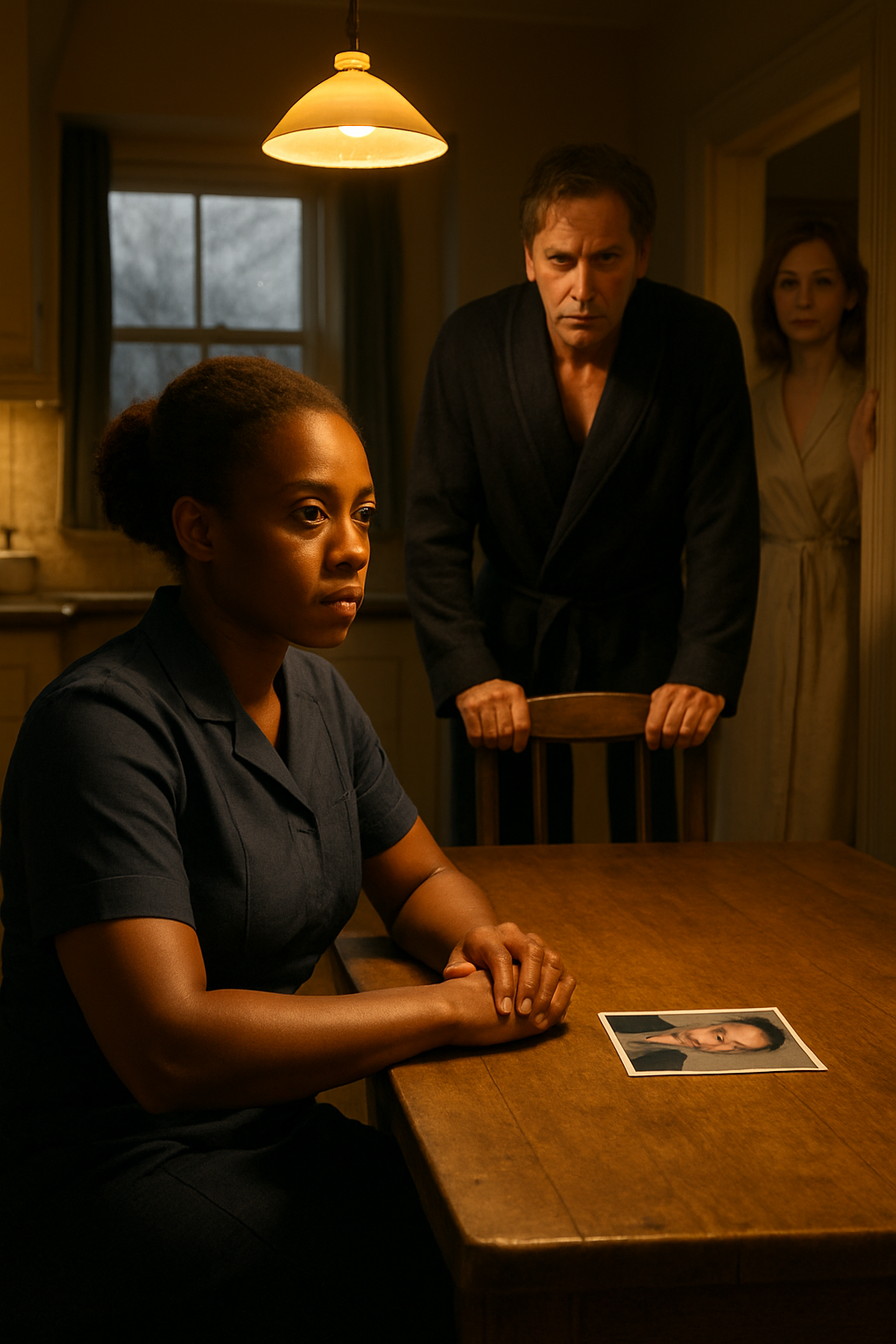
He was at the counter with his back to her, pouring water from the kettle. He was wearing a dark navy dressing gown, silver-streaked hair still unsettled from sleep. His hands, she noticed, were not entirely steady. The kettle trembled slightly as he set it down.
"Ruth." He turned. His face changed when he saw her — something moving behind his eyes, very quickly. "I didn't know you were coming in today."
"I wanted to finish the floors," Ruth said. "I didn't get to them properly on Friday."
A pause.
"Right," he said.
Ruth pulled a chair out from the kitchen table and sat down.
This was not something she had ever done in three years. She had never sat at the kitchen table. It was the family's table, not hers. Patrick Calder registered this, she could see him register it, but he did not say anything. He was a man who understood, in that deep instinctive way that people who have done terrible things always understand, that a reckoning eventually sits down in front of you and does not stand up again until it is finished.
He turned slowly from the counter.
Ruth reached into the pocket of her uniform and took out the photograph. She set it on the table, face up, in the centre. Patrick's morning light — the warm yellow of the kitchen overheads combined with the grey November coming through the window — fell across Daniel's face.
Patrick Calder looked at the photograph.
The colour left his face in a single slow pass, like water draining from a bath.
Ruth waited.
She had very good patience. She had been building it for six years.
When Patrick Calder finally looked up at her, she was looking back at him steadily. Her natural hair was pulled back in a loose bun, tight dark coils above the nape of her neck. Her posture was correct. Her hands were folded on the table in front of her.
She had not cried. She was not going to cry. There would be time for that later, in private, where it belonged.
She asked him one question.
"What did my husband see, in the last second?"
Patrick Calder stared at her.
"Was it your face?" Ruth said. "Did you look at him?"
The kitchen was absolutely silent.
Patrick Calder's hands found the back of his chair. He gripped it the way a man grips something when his legs are not entirely reliable. The knuckles went white.
"Ruth," he said. His voice was barely there.
"I've already spoken to the police," she said. "They are coming. I am not here to make a scene, Mr. Calder. I am here so that you understand — before they arrive — that he had a name and a face and a wife who has spent six years under the delusion that no one would ever answer for it."
She stood up.
She left the photograph on the table.
She walked to the hallway, took her coat from the hook below the second stair, and let herself out of the side door.
The morning was cold and very bright.
She walked to the end of the street and she stood at the corner and she looked up at the sky, which was the pale clear blue of a November morning that has decided to be beautiful despite everything, and for the first time in six years she felt the exact specific weight of what she had been carrying — felt it clearly, the way you only feel the weight of something when you begin to set it down — and her eyes filled.
She pressed her lips together.
Not yet.
She straightened her shoulders.
She walked to the bus stop and she sat down on the bench and she put her hands in her lap and she waited.
She was very good at waiting.
## Epilogue
Patrick Calder was arrested six days later. The investigation was reopened. The repair invoice from the Essex body shop, combined with the partial plate and updated forensic analysis of the original CCTV footage, was assessed as sufficient grounds to proceed. His solicitor issued a statement. The Patrick Calder Foundation paused its activities pending the outcome.
Helen Calder did not leave the house for two weeks.
On the twenty-third day, she sent Ruth a letter. Handwritten, three lines:
I knew something had happened that night. I told myself I didn't. I am sorry for what that cost you.
Ruth read the letter once.
She put it in the box.
She kept working. There were other houses that needed cleaning, and she was very good at her work, and she had two children who needed feeding and a mother's voice in her head that said, you have to be four times as thorough and leave them no room.
She left the box under the bed, but lighter now.
She started opening her eyes again in the mornings.
That was the most important thing.
She had stopped, after Daniel died, because there was nothing she wanted to wake up to.
Now, most mornings, when the alarm went at five-thirty and the pale light came in through the curtains, she lay there for a moment before moving and she thought of his face — the one in the photograph, the laughing one, head tipped back — and she thought: I did not let them forget you.
And she got up, and she put on the kettle, and she started again.