PART 1
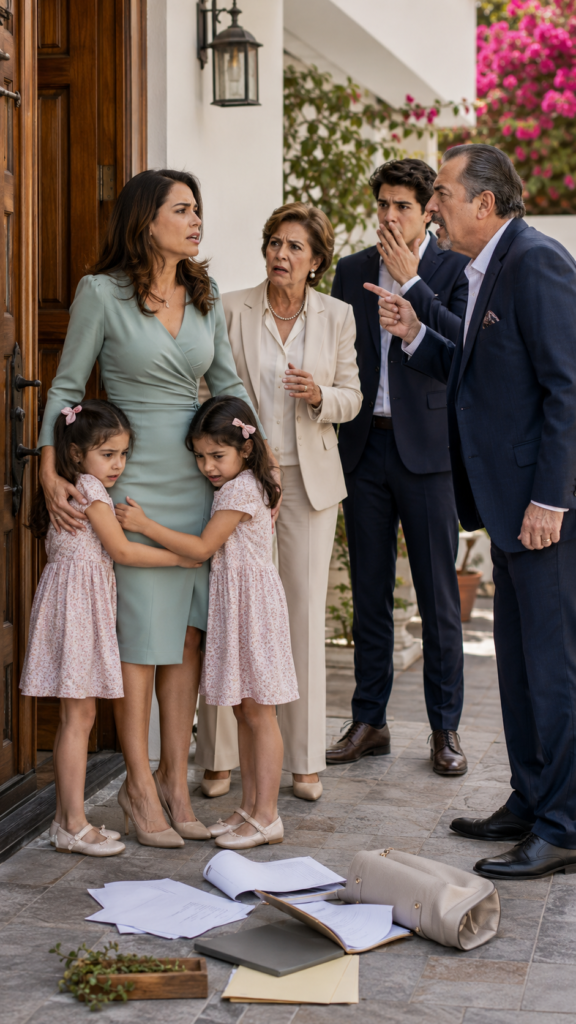
—This house was never yours, Mariana. Grab your kids and get out before I throw your things into the street myself.
The rain poured furiously over an elegant private street in Querétaro. It was almost 5 PM, and Mariana Ríos was still wearing the black dress with which she had bid farewell to her husband, Andrés Villarreal, just that morning.
Next to her stood Santiago, 16 years old, drenched, his eyes red from holding back tears. Behind him, Camila, 9, clutched an old jacket of her dad's as if it were the only thing left in the world.
But before them, standing on the porch of the house where Mariana had lived for 12 years, were her in-laws.
Don Ernesto Villarreal held a bunch of keys like they were a weapon. Doña Beatriz, his wife, wore an expensive black coat and a cold look that cut deeper than any knife.
—Andrés is gone —Beatriz said, looking Mariana up and down—. Your good life is over.
Mariana swallowed hard.
—This is my children's house. They grew up here. Their room is here, their pictures, their things.
Ernesto let out a dry laugh.
—Your children eat because my son worked. You were just the kept widow who hung on to his last name.
Santiago stepped forward.
—Don’t talk to my mom like that.
Mariana tried to stop him, but the boy's pain was faster than her caution.
Ernesto looked at him with contempt.
—And you? You think that just because you have Villarreal blood you can disrespect me?
—My dad wouldn't have allowed this —Santiago said, his voice cracking.
Ernesto's expression changed.
It wasn’t sadness.
It was fury.
He slapped Santiago so hard that the sound mixed with the thunder. Santiago fell against a flower pot on the porch, and Camila screamed as if her soul had been ripped away.
—Don’t touch him! —Mariana screamed, kneeling beside her son.
But Beatriz seized that moment.
She grabbed Mariana's left hand and, with one swift motion, ripped off the wedding ring. The metal scraped against her skin, leaving a red line between her fingers.
—This belonged to my family —Beatriz said, closing her fist—. Andrés made many mistakes, but giving you this ring was the worst.
Mariana looked up.
For 12 years, she had endured disguised comments as advice, disdain during Christmas dinners, and veiled jabs about her humble origins in Celaya, as well as uncomfortable silences when Andrés defended her as part of the family.
But to throw her out on the day of the funeral, to hit her son, and to tear off the ring in front of her daughter was no longer disdain.
It was pure cruelty.
—Let’s go, Mom —Santiago whispered, his cheek red and swollen.
Mariana helped her children to the car. The rain hit their faces, but none of them turned back. Behind them, Ernesto shouted:
—That’s right, know your place. You were never a Villarreal.
Mariana put Camila in the back seat, checked Santiago's face, and opened the glove compartment searching for tissues.
Then she saw it.
A brown envelope, sealed with clear tape.
Her name was scrawled in Andrés’s shaky handwriting.
“For Mariana. Open only if my parents cross the line.”
She felt her heart stop.
Andrés had left it for her three weeks before he died, when cancer had already stolen his voice, but not his lucidity.
—Love, promise me you won’t open it out of curiosity —he had said that night—. Only when you really need it.
Mariana broke the seal with trembling hands.
The first page read:
“If you’re reading this, it means my parents did exactly what I feared. Don’t argue. Don’t beg. Call attorney Aurora Méndez. The house is in your name through a trust. The cabin in Valle de Bravo is too. My shares in Grupo Villarreal are for you, Santiago, and Camila. They don’t know everything. And if they touch my children, deliver the second envelope.”
Mariana felt the air rush back into her.
She dialed the number written at the bottom.
A woman answered on the second ring.
—Attorney Aurora Méndez.
—I’m Mariana Ríos, wife of Andrés Villarreal.
There was a brief silence.
Then Aurora's voice became firm.
—Stay inside the car with your children. Don’t come near the door. I’m coming over with certified documents and a patrol.
Ernesto saw her talking on the phone and laughed from the porch.
—What’s going on? Are you calling your mom to borrow a room?
Mariana rolled down the window just a little.
—No. I’m calling Andrés’s lawyer.
Ernesto’s smile disappeared.
Beatriz clenched the ring in her fist.
And 20 minutes later, when a patrol parked in front of the house and a gray truck followed, they both understood that something very serious was about to explode.
A woman in a navy blue suit, carrying a black briefcase and an expression that didn’t come to negotiate, got out of the truck.
Aurora Méndez didn’t even greet.
First, she approached the car, looked at Santiago's swollen cheek, saw Camila crying silently, and then turned towards the in-laws.
—Don Ernesto, doña Beatriz —she said, opening her briefcase—. Andrés asked me that if I arrived today, to show no mercy.
Then she pulled out a sealed folder.
And what she placed on the car hood left Beatriz as pale as paper.
PART 2
Aurora placed the sheets inside a sleeve to keep the rain from staining them.
—This property legally belongs to Mariana Ríos de Villarreal as the primary beneficiary of a marital trust signed eight months ago before a notary public. Andrés Villarreal left precise instructions: neither his parents nor any family member could evict his wife or children.
Ernesto let out a nervous laugh.
—That’s nonsense. My son bought this house with Villarreal money before he got married.
—He bought it with shared credit, paid it off during the marriage, and legally transferred it to the trust when he received his diagnosis —Aurora replied—. You were invited to the signing. You didn’t attend because you said you weren’t going to legitimize whims of a sick poor person.
The police officer looked at Ernesto.
—Did you hit the minor?
Santiago remained inside the car, holding Camila’s hand tightly.
Mariana opened the door.
—Yes. He hit him in front of everyone.
—I was disrespected —Ernesto said.
The officer hardened his gaze.
—He’s 16 years old and just buried his father. You’re not in a position to justify anything.
Beatriz tried to hide the ring in her bag.
Aurora stopped her with a terse phrase:
—That ring is also mentioned in Andrés’s personal instructions. It belongs to Mariana.
—It was my mother’s! —Beatriz shouted—. That woman doesn’t deserve to wear it.
Mariana stepped out of the car, soaked, with a pale but firm face.
—You didn’t give it to me. Andrés did.
The officer extended his hand.
Beatriz hesitated. For a moment, it looked like she was going to run inside, but the neighbors were already watching from windows and garages.
Furious, she handed over the ring.
Mariana received it, but didn’t put it on. She cradled it in her palm, closing her fist as if protecting a wound.
Aurora continued.
—There is also an immediate eviction instruction for anyone who attempts to occupy the property without authorization from Mariana. Don Ernesto, doña Beatriz, you can remove personal belongings under police supervision. Nothing more.
—This is my son’s house! —Ernesto roared.
—No —Mariana said, for the first time without trembling—. It was our family’s home.
Beatriz glared at her with hatred.
—You stole Andrés from us.
Mariana felt that sentence pierce through her chest.
—I took care of him when you only asked about the company papers.
Silence fell like another thunder.
Ernesto wanted to respond, but Aurora raised a second folder.
—And since we’re mentioning papers, Andrés left something else. But he instructed me to use it only if you assaulted Mariana or the children.
Ernesto’s face changed.
It was no longer anger.
It was fear.
—You don’t know what you’re talking about —he murmured.
Aurora looked at him directly.
—I do know. And so did Andrés.
That night, the in-laws left the house with two small suitcases, watched by the patrol. Beatriz cried in anger. Ernesto remained silent, clenching his jaw. The entire neighborhood watched, but no one dared to defend them.
When they changed the locks, Mariana finally entered with her children.
The living room still smelled of old coffee, funeral flowers, and Andrés’s cologne. Camila ran to the couch where her dad used to watch movies and hugged a cushion. Santiago stood still, staring at the family photos on the wall.
—Did Dad know this was going to happen? —he asked.
Mariana didn’t know what to answer.
Aurora took her to Andrés’s study.
Behind a shelf of accounting books was a small safe. Mariana knew the safe but never the combination. Aurora handed her a piece of paper.
—He left it for you.
Mariana dialed her children’s birth date: 1609.
The safe opened.
Inside were policies, deeds, account statements, passwords, and three envelopes.
One said: “For Mariana.”
Another: “For Santiago and Camila when they’re ready.”
The last said: “For the judge, if my parents try to take anything else from them.”
Mariana felt a chill down her spine.
—Take anything else from them?
Aurora sighed.
—Andrés suspected they wouldn’t be satisfied with the house.
And he was right.
Three weeks later, Ernesto and Beatriz filed a lawsuit. They wanted to annul the trust, claiming that Andrés was weak, confused, and manipulated by Mariana. But the lowest blow came on the last page.
They sought provisional custody of Santiago and Camila.
According to them, Mariana was “emotionally unstable,” “without economic capacity,” and “a risk to the minors’ assets.”
When Mariana read that, her knees buckled.
—They can’t do this —she whispered.
Santiago took the papers from her hands.
—Do they want to take us from you?
Camila started to cry.
Mariana hugged both of them.
—No, my love. No one is going to separate us.
But that night she didn’t sleep.
On the day of the hearing, the family court was filled with murmurs. Ernesto arrived in a gray suit, Beatriz in dark glasses, and their lawyer carrying a red folder. They behaved like victims.
The lawyer spoke first.
He said that Andrés had died manipulated. That Mariana had taken advantage of his illness. That the children needed “Villarreal stability.” That a widow without resources couldn’t manage shares, houses, or a business.
Mariana gritted her teeth.
Aurora waited her turn.
When she stood up, her voice was calm.
—Your Honor, we present two medical opinions signed five days before the creation of the trust. Andrés Villarreal was declared fully lucid by independent specialists. We also present video of the notarial signing, emails sent by Andrés himself, and testimonies from three bank employees.
The judge reviewed the documents.
Ernesto began to sweat.
Aurora continued.
—Regarding custody, we present police reports, photographs, and the statement of minor Santiago, who was physically assaulted by Don Ernesto on the same day of his father’s funeral.
—That kid provoked me! —Ernesto shouted.
The judge looked at him sternly.
—You’re talking about your grandson.
Beatriz lowered her head.
Then Aurora pulled out the last envelope.
Mariana recognized it immediately.
“For the judge.”
—Andrés Villarreal left this information to be presented only if his parents legally attacked his wife or attempted to separate his children from her.
Ernesto's lawyer stood up.
—I protest.
—If it’s relevant, I will hear it —the judge said.
Aurora connected the USB drive.
Andrés’s voice filled the room. Weak, tired, but crystal clear.
—Mom, Dad, if you’re hearing this, it means you did what I asked you not to do. It means you hurt Mariana or my children for money.
Mariana covered her mouth.
Camila sobbed.
The recording continued.
—I know about the fake invoices. I know about the accounts in Monterrey. I know you used ghost suppliers to siphon money from Grupo Villarreal for years. I didn’t report you because you were my parents. But Mariana doesn’t have to pay for my silence.
Ernesto turned white.
Beatriz began to cry, but no one knew if it was from guilt or fear.
Andrés continued:
—Mariana didn’t take anything from me. She bathed me when I could no longer lift myself. She took me to 47 chemotherapy sessions. She slept in hospital chairs while you asked how much my shares were worth. She is my family. Santiago and Camila are my blood, my pride, and my reason. If you try to separate them from their mother, I’ll expose everything I know.
The judge demanded silence, but no one spoke.
It wasn’t necessary.
Aurora presented account statements, duplicate invoices, transfers to ghost companies, and emails where Ernesto referred to Mariana as “the girl who can be taken out with pressure.”
The hearing changed in minutes.
The lawsuit was rejected. The trust was upheld. Mariana's custody was ratified without restrictions. The judge ordered the financial evidence to be sent to the Public Prosecutor’s Office.
Ernesto left escorted by his lawyer, not lifting his gaze.
Beatriz stood in front of Mariana.
—I lost my son —she said, her voice broken.
Mariana looked at her without hatred, but also without easy compassion.
—My children lost their father. I lost the man I loved. And you chose to turn that pain into war.
Beatriz looked at the ring in Mariana’s hand.
—It was my mother’s.
Mariana took a deep breath.
—And Andrés decided it should be mine.
Beatriz didn’t ask for forgiveness.
She just left.
The following months were heavy. The house remained full of absences. Andrés’s favorite mug stayed in the cupboard. Santiago stopped playing soccer for a while. Camila slept with her dad's jacket and asked if it rained in heaven too.
Mariana learned that winning a lawsuit doesn’t heal grief.
It only prevents others from turning it into ruin.
In spring, she took her children to the cabin in Valle de Bravo. Andrés had repaired it little by little, dreaming of spending weekends there when the illness ended.
They opened windows, shook off furniture, and planted bougainvillea by the entrance.
At sunset, Mariana took out the ring.
She hadn’t worn it since the day Beatriz ripped it off in the rain.
Santiago looked at her.
—Are you going to put it on again?
Mariana smiled through tears.
—Yes. But not because it makes me a Villarreal.
Camila hugged her waist.
—Then why?
Mariana slid the ring onto her finger.
—Because your dad chose me. Because he protected us. Because even after leaving, he didn’t allow anyone to treat us like leftovers.
That night they had burnt quesadillas in honor of Andrés, because he always left them black and said they were “gourmet style.” The three laughed for the first time without feeling guilty.
Mariana then understood that a family isn’t measured by last names, houses, or inheritances.
It’s measured by who stays when the storm arrives.
And even though Ernesto and Beatriz wanted to throw them out into the rain, even though they called them burdens, poverty, and nuisances, they could never erase the truth Andrés left written more strongly than any will:
Blood doesn’t always make family.
Sometimes, true family is who covers you from the cold when everyone else closes the door.