PART 1
Clara Méndez received the invitation on a Tuesday afternoon, while she was closing her small tutoring center in the Portales neighborhood of Mexico City.
The envelope was thick, ivory-colored, with golden lettering and a seal that smelled of old money.
Wedding of Julián Altamirano and Renata Prado.
Clara stood frozen.
For four years, she had managed not to utter that name without feeling her hands tremble. Julián Altamirano, heir to a chain of hotels in Los Cabos, Mérida, and San Miguel de Allende, had been the man who promised her a simple life: a house with plants, Sunday breakfasts, and children running down the hallway.
He had also been the man who said nothing when his mother destroyed her.
Doña Viviana Altamirano always looked at her as if Clara had entered her mansion in Las Lomas with muddy shoes.
Clara didn’t come from an elegant surname. Her father had been a minibus driver in Neza, her mother sold tamales on weekends, and she studied pedagogy while tutoring to pay the rent.
To Julián, that was admirable.
To Viviana, it was a disgrace.
The first time Clara dined with them, Viviana raised her glass of wine and said, with an icy smile:
—Kindness is nice, Clara, but a family like ours needs something more than good intentions.
Julián listened.
And didn’t defend Clara.
Then came the worst part.
Viviana demanded medical tests before any commitment. She called it “family responsibility.” Clara accepted because Julián swore nothing would separate them.
The doctor explained that Julián had fertility issues and that Clara could also face complications in getting pregnant.
Not impossible.
Just difficult.
But Viviana turned that word into a sentence.
—A woman who can’t even guarantee children is not a good option for my son.
Clara looked at Julián, hoping for a single phrase.
Just one.
But he looked down.
That night, Clara left the house with a small suitcase and a shattered heart.
Julián never went after her.
Two months later, Clara found out she was pregnant.
At seven weeks, the ultrasound showed three heartbeats.
Triplets.
Clara cried alone in the bathroom of a public clinic, filled with fear, rage, and a question lodged in her chest: how to tell a man who allowed her to be treated like trash?
She wrote letters. Sent messages. Went once to the Altamirano building.
They never let her in.
A guard told her:
—Miss, by orders of Mrs. Viviana, you cannot enter.
Clara understood.
And disappeared.
Now, four years later, that invitation was not courtesy. It was mockery.
Inside was a handwritten note:
“To show you what you lost.”
Clara didn’t cry.
She just looked toward the living room, where her three children were building a tower of blocks: Mateo, serious and protective; Sofía, curious as lightning; and Emiliano, the most cheerful of the three.
All three had Julián’s eyes.
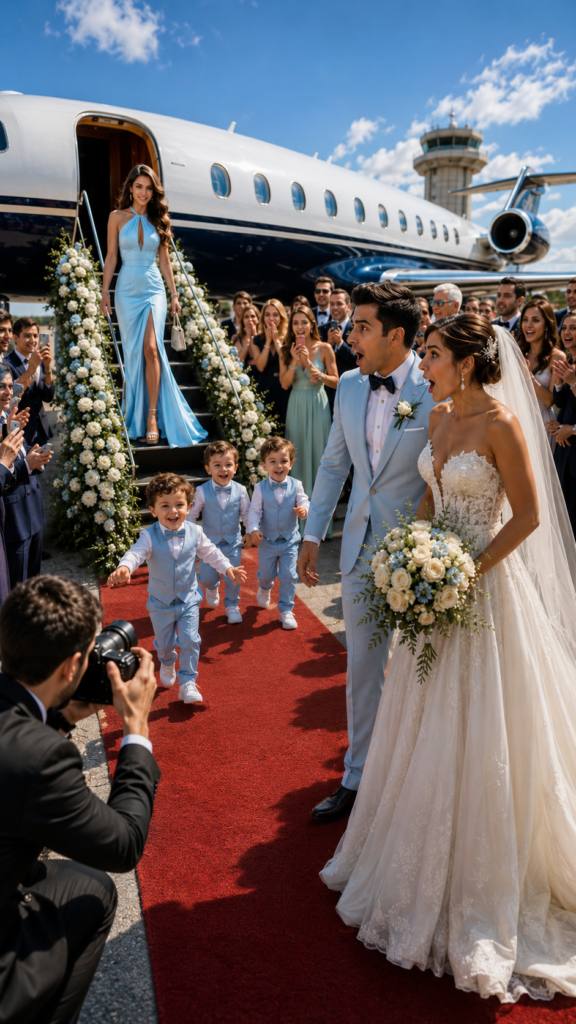
On the day of the wedding, Clara arrived at the estate in Morelos wearing a simple blue dress, holding the children’s hands.
The entrance looked like a magazine cover: white flowers, soft mariachi music, waiters with silver trays, guests wearing jewelry that sparkled as if the sun owed them something.
Viviana saw her enter.
She smiled like someone who just won a bet.
—I’m glad you came, Clara —she said loudly—. It’s always important to learn to accept one’s place.
Some guests turned.
Others pretended not to hear but smiled.
Clara tightened Sofía’s hand.
Julián was at the front, dressed in a black suit, next to Renata Prado, a beautiful, impeccable woman, one of those who seemed untouched even by a hurricane.
When Julián saw Clara, he lost color.
Then he saw the three children.
His face shattered.
Sofía, with her four years and an innocence that knew nothing of surnames or vengeance, let go of her mother’s hand and walked toward him.
The music continued for a few more seconds.
Until the little girl lifted her face and asked:
—Mom… is that man the dad we were never allowed to meet?
PART 2
The mariachi stopped playing.
It didn’t fade slowly. It stopped abruptly, as if someone had cut the world’s electricity.
The guests froze. A glass fell to the floor and shattered near the front row. Renata Prado turned slowly to Julián, expecting him to laugh, to say it was a misunderstanding, that the little girl had made a mistake.
But Julián said nothing.
His eyes were fixed on Sofía.
Then he looked at Mateo.
Then at Emiliano.
And in those three faces, he found something that no surname could deny.
Their eyes.
Their chin.
The same way of furrowing their brows when they were scared.
—What’s happening, Julián? —Renata asked, already without a smile.
Viviana stepped in before he could.
—Nothing. A cheap scene. This woman has always been very clever at calling attention.
Clara felt the blow of those words, but this time she didn’t lower her head.
This time she wasn’t alone.
—I didn’t come to make a scene —Clara said with a firm voice—. You invited me.
The murmur grew like fire in dry grass.
Viviana feigned surprise.
—Me? Oh, please. Don’t be ridiculous.
Clara pulled the envelope from her purse and held it up.
—with your handwriting. With your note. “To show you what you lost.”
Renata took the envelope before Viviana could react. She read the phrase, and her face changed.
—Did you invite her to humiliate her? —she asked, looking at her future mother-in-law.
Viviana pressed her lips together.
—Renata, don’t get involved in matters you don’t understand.
Julián took a step toward Clara.
—Are they... mine?
The question hurt.
Not because Clara hadn’t expected it, but because for years she had imagined that moment with rage, tears, and screams. But seeing him there, pale, confused, almost destroyed, she only felt exhaustion.
—Yes, Julián. They are your children.
Viviana let out a dry laugh.
—Impossible. We all know what the doctor said.
—The doctor said difficult —Clara replied—. Not impossible.
Mateo hid behind his mother. Emiliano looked at the floral arrangements, not understanding why everyone seemed angry. Sofía stood before Julián, her brow furrowed.
—Did you know about us? —the little girl asked.
Julián swallowed hard.
—No, my love… I didn’t know.
Viviana stiffened at hearing that “my love.”
—Don’t talk to her like that —she ordered—. You don’t even know if it’s true.
Then Clara pulled out a folder from her bag.
It wasn’t an elegant folder. It was a transparent plastic one, worn at the edges, holding years of papers kept like wounds.
—Here are the birth certificates. The ultrasounds. The medical tests. The letters I sent to your office. The printed messages. And this.
She pulled out a folded sheet.
Julián took it with trembling hands.
It was a copy of the receipt for a letter delivered to Corporativo Altamirano, four years ago.
Signed by Patricia Rivas, Viviana’s personal assistant.
Julián looked up.
—Did my mother receive this?
Viviana tried to snatch the sheet away.
—Don’t be naïve. A desperate woman can forge anything.
—Then let Patricia speak —Renata said.
Everyone turned.
Among the guests, a woman in a gray suit, sitting near the aisle, froze.
Patricia Rivas had worked for the Altamirano family for 15 years. Always discreet. Always obedient. But that afternoon, for the first time, she looked like someone about to vomit the truth.
Viviana glared at her.
—Patricia, don’t you dare.
Renata approached her.
—Ma’am, my wedding was supposed to be celebrated here. If there’s a lie in the middle, it’s better it comes out now.
Patricia stood up slowly.
Her hands trembled.
—Yes, the letter did arrive —she said quietly.
The entire garden was suspended.
Julián seemed to lose his breath.
—What letter?
Patricia looked at Clara with shame.
—Several. Miss Clara went to the corporate office three times. She left letters, copies of tests, a phone number. Mrs. Viviana ordered that nothing reach Mr. Julián.
—Shut up —Viviana spat.
But Patricia had already crossed a line she couldn’t uncross.
—She also had your number blocked on Mr. Julián’s phone. And when Clara went to Las Lomas pregnant, she asked me to call security to remove her.
Clara closed her eyes.
For years, she had wondered if she should have insisted more. If she should have screamed louder. If she should have swallowed her pride and knocked on a hundred doors.
The truth confirmed something worse: she hadn’t failed. She had been erased.
Julián turned to his mother.
—Did you know?
Viviana lifted her chin, still proud, still convinced that money could clean any monstrosity.
—I did what I had to do for the family.
Julián took a step back as if she had hit him.
—For the family? You hid my children for the family?
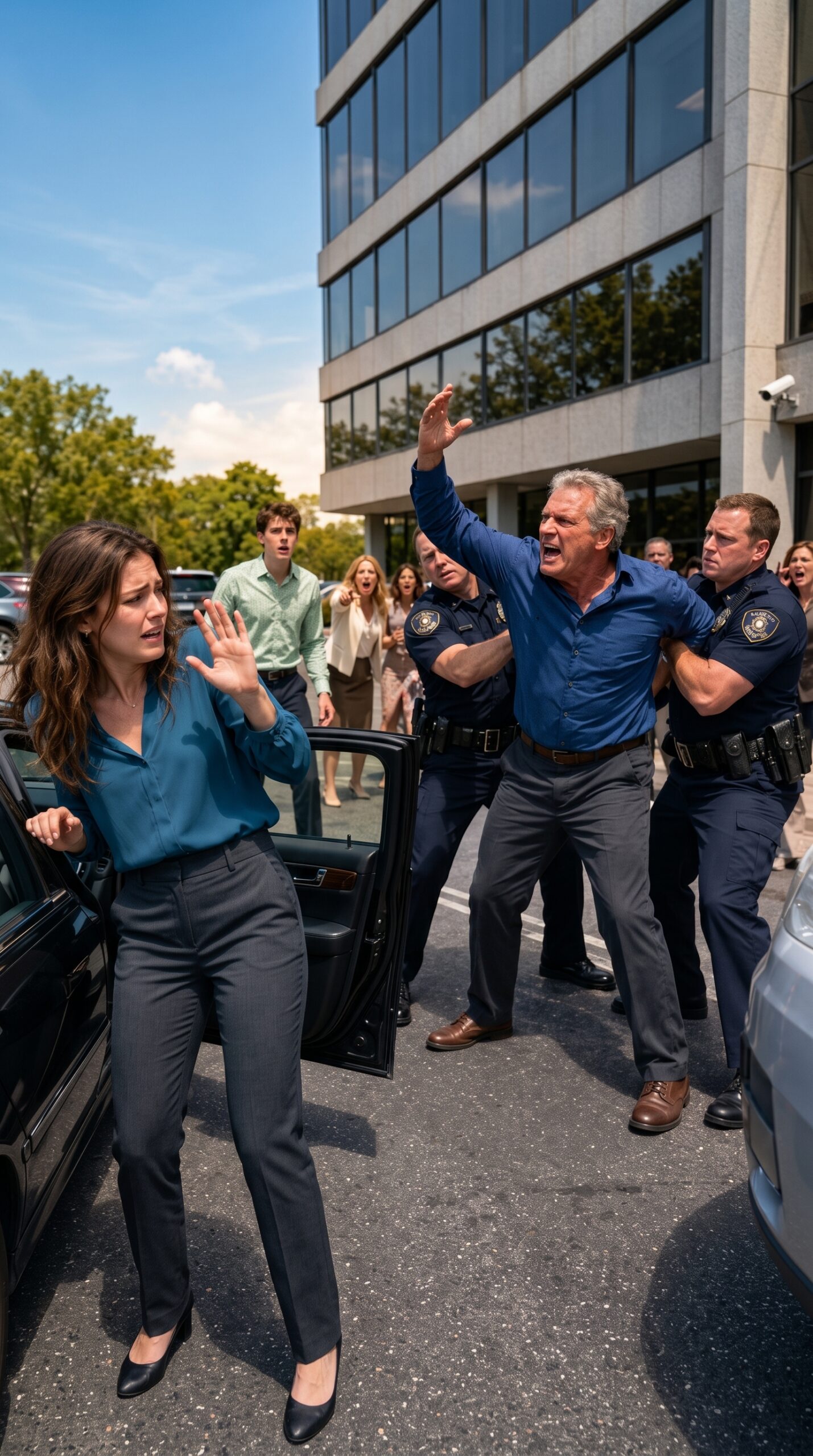
—Those kids could have been anyone’s! —Viviana shouted—. She wasn’t worthy of you. I wouldn’t allow a girl without class to enter our surname with a convenient pregnancy.
The murmur turned into a scandal.
An aunt covered her mouth.
A cousin pulled out his phone.
A man murmured, “What a rotten mother.”
Renata slowly removed the engagement ring.
The gesture was so clear that everyone understood it before she spoke.
—Julián, I’m not marrying into a family where a woman can destroy four lives and everyone applauds her for being classy.
Viviana turned to her, desperate.
—Renata, think carefully about what you’re doing. Your family and ours...
—My family taught me not to marry a man who still can’t stand up to his mother —Renata said.
That hurt more because it was true.
Julián didn’t protest.
He just looked down.
The same look Clara remembered from that dinner when she needed him to defend her, and he chose silence.
But this time, something changed.
Julián lifted his head.
—Mom, it’s over.
Viviana blinked, incredulous.
—Excuse me?
—It’s over —he repeated—. The company, the house, the decisions, everything you control using my name. It’s over.
—Don’t be ridiculous. Everything you have exists because of me.
—No. Everything I have you turned into a cage.
Clara felt her chest tighten. Part of her wanted to see him suffer. Another part wanted to take her children and run before that circus marked them forever.
Then Sofía spoke again.
—If he’s my dad… why didn’t his mom want him to love us?
No one answered.
Because there was no answer that didn’t sound cruel.
Julián knelt in front of the little girl. He didn’t try to touch her. He didn’t dare.
—Because adults sometimes do horrible things out of fear, pride, or cowardice. And I was also cowardly.
Clara looked at him.
It wasn’t a complete apology. It didn’t erase four years. It didn’t change diapers he hadn’t changed, fevers he hadn’t watched over, birthdays he hadn’t sung.
But it was the first truth she had heard from him in a long time.
Mateo emerged from behind Clara.
—My mom cried many nights —he said seriously—. I heard her even though she thought I didn’t.
Julián closed his eyes.
That blow didn’t come from Clara.
It came from a four-year-old who didn’t know how to lie.
Viviana tried to regain control.
—Julián, get up. You’re making a fool of yourself in front of everyone.
He didn’t move.
—The fool was you when you invited the mother of my children to humiliate her.
Renata, with the ring in her palm, approached Clara.
—I’m sorry —she said—. I didn’t know anything.
Clara nodded.
She didn’t hate her. Renata had also been used as a piece on Viviana’s board.
At that moment, an older man stood up from the second row. It was Don Esteban Prado, Renata’s father, a businessman known for not getting involved in gossip.
But this time, he spoke loudly.
—The wedding is canceled. And whoever uploads edited videos to mock this woman, will have to deal with me.
No one laughed.
Viviana stood alone among expensive flowers, crystal glasses, and a shame that not even all her money could buy back.
Julián looked at Clara.
—I’m not going to ask you to forgive me today. I have no right. But I want to take a DNA test, not to doubt you, but so that no one questions them again. And then I want to respond legally, financially, and as a father, if you allow me.
Clara held his gaze.
The Clara from before would have wanted to hear that.
The Clara now didn’t need promises to survive.
—The test will be done —she said—. But not to give you peace of mind. To protect them.
Julián nodded.
—Yes.
—And one more thing —Clara added—. My children are not a second chance to repair your guilt. They are kids. If you enter their lives, enter well. Without disappearing. Without obeying your mother. Without making them feel they have to earn your surname.
Julián cried in silence.
—I understand.
Clara didn’t know if it was true.
But her children deserved the truth, not a pretty lie.
Three weeks later, the results arrived.
99.99%.
Julián Altamirano was the biological father of Mateo, Sofía, and Emiliano.
The news exploded on social media because someone from the wedding had uploaded the full video. Not the edited one. Not the one Viviana would have wanted. The full one, where Sofía’s question and Patricia’s confession could be heard.
All of Mexico weighed in.
Some said Clara should have spoken earlier.
Others that Julián didn’t deserve to know them.
Many tore Viviana apart.
But Clara didn’t live for the comments.
She lived for three children who now asked why they had a different surname on paper, why their dad cried when he saw them play, why a grandmother could be so mean and still wear expensive perfume.
Julián started with supervised visits at the family visitation center.
He arrived on time.
He brought stories, not expensive gifts.
He learned that Mateo hated having his hair ruffled. That Sofía asked everything three times. That Emiliano couldn’t sleep without his green dinosaur.
And each small detail hurt like a past-due bill for the soul.
Viviana tried to approach once.
She arrived with imported toys and a photo-ready smile.
Clara received her at the door of the center, without shouting.
—You don’t come near my children until a judge authorizes it and a therapist says you won’t harm them.
Viviana was indignant.
—They are my grandchildren.
Clara looked at her fearlessly.
—No. They are the children you tried to erase.
That phrase was the true end of the wedding.
Not the silent mariachi.
Not the returned ring.
Not the scandal on social media.
The true end occurred when Clara understood she was no longer that woman waiting for someone to defend her.
Now she defended herself.
Months later, Julián attended the school festival of the triplets. He sat in the back row, just as Clara had asked. He didn’t show up with bodyguards or extravagant flowers. He arrived with three juice boxes, a simple camera, and eyes filled with nerves.
Sofía saw him from the stage and smiled.
She didn’t run to him.
She didn’t call him dad yet.
She just waved her hand and greeted him.
For Julián, that gesture was worth more than any hotel with his surname.
Clara watched him from one side of the school yard.
She didn’t feel love.
Not yet.
Maybe never.
But she felt peace.
Because that day she understood that justice doesn’t always come with screams or revenge.
Sometimes it comes with a little girl asking an innocent question in front of everyone.
And with a mother who, after being humiliated, walks upright because she knows that the truth can take four years… but when it walks through the door, it can stop even a lavish wedding.