PART 1
Renata didn’t arrive at that dinner thinking she would lose everything.
She walked in wearing a simple blue dress, her hair pulled back, and carrying a bag of corn bread she'd bought at a bakery in the Americana neighborhood of Guadalajara, still believing that education could save her from an awkward evening.
The Sandoval house was in Puerta de Hierro.
Enormous, cold, filled with marble, family photos, and silver saints on furniture that no one could touch.
That night, there were 18 people seated around an incredibly long table.
Wine glasses, fine china, pressed napkins, and that hypocritical Mexican custom of smiling while someone stabs you with sweet words.
Renata was 34 years old.
She was a civil engineer, working on vertical housing projects, and owned an apartment in Providencia.
No one had given it to her.
She bought it with loans, extra shifts, weekends without rest, and five years saying “no” to vacations, expensive clothes, and nights out with friends.
But for her husband’s family, that apartment already had another destiny.
—Sweetheart, we’ve talked about it —said Doña Amparo, her mother-in-law, adjusting her shawl as if she were a tired queen—. I can’t keep living in a house with so many stairs.
Renata put her fork down.
Andrés, her husband, didn’t look at her.
Her father-in-law, Don Leobardo, cleared his throat.
—The most practical thing is for your apartment to be transferred to Amparo’s name. This way, there won’t be legal problems later. And you, as a good wife, can support her with 24,000 pesos a month for her expenses.
The table continued eating as if they had just talked about the weather.
Renata blinked slowly.
—Excuse me?
An aunt let out a nervous giggle.
—Oh, don’t act like that, Renatita. It’s family.
For 25 minutes, they discussed her house as if she weren’t there.
That the master bedroom would be perfect for Doña Amparo.
That the balcony would be great for her plants.
That Renata and Andrés could rent something smaller “while they got settled.”
That 24,000 pesos wasn’t much for a professional woman.
Andrés drank tequila in silence.
Renata looked at him, hoping that for once he would take her side.
But he just clenched his jaw.
Then Renata said:
—No.
The word fell on the table like a slap.
Doña Amparo’s eyes widened in offense.
—What do you mean, no?
—My apartment isn’t for lending, it isn’t for giving away, and it’s not to be put in anyone’s name. And I’m not going to give 24,000 pesos a month for a decision made without asking me.
Andrés stood up so abruptly that the chair hit the floor.
—Are you really going to humiliate me like this in front of my family?
—You’re humiliating me.
That was enough.
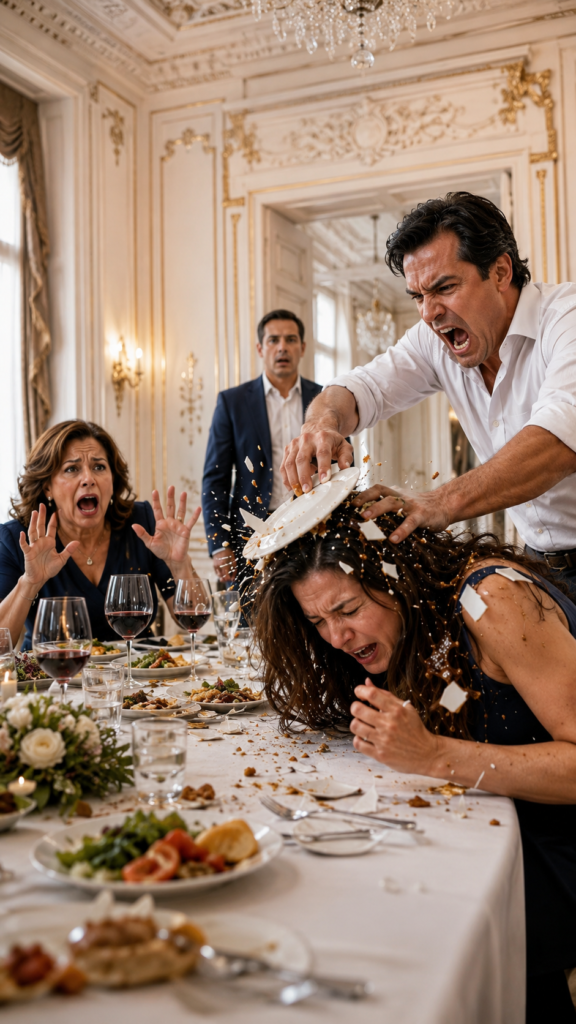
Andrés grabbed a plate of mole and smashed it against Renata’s head.
The blow was a sharp crack.
The porcelain shattered.
The hot mole ran down her hair, along her temple, down her neck.
A line of blood stained her blue dress.
No one moved.
Not the aunt.
Not the brother-in-law.
Not Don Leobardo.
Doña Amparo merely murmured:
—That’s what you get for being sassy.
Renata gripped the table to keep from falling.
The buzzing in her ears was terrible.
But what was worse was seeing everyone look at her as if the problem wasn’t the hit but that she was still standing.
Andrés was breathing heavily, red with rage, believing he had finally broken her.
Renata straightened up.
She pulled a shard of plate from her hair.
Taking a napkin, she wiped the blood from her brow.
Then she looked at him without fear.
—You have no idea what I’m capable of.
She pulled out her cell phone.
The screen was smeared, but it worked.
Dialed 911.
When the operator answered, Renata spoke with a calm that froze everyone:
—I need a patrol car and an ambulance. My husband just assaulted me in front of his entire family. They are all witnesses.
That got them up.
That made them scream.
Doña Amparo rushed toward her with a false smile.
—Sweetheart, don’t exaggerate. It was an accident.
Renata didn’t blink.
—It wasn’t an accident. It was violence.
Andrés stepped forward.
—Hang up, Renata.
She brought the phone closer to her mouth.
—Take another step, and I’ll tell the operator you’re threatening me again.
The doorbell rang 7 minutes later.
And when the police entered the house, the Sandovals still had no idea that this dinner would destroy the secret they had been cooking for months.
PART 2
Two municipal police officers and a paramedic crossed the living room.
The atmosphere in the house shifted.
It no longer smelled of expensive tequila, mole, and rich lady perfume.
It smelled of fear.
The paramedic sat Renata down near the entrance and began to clean her wound. Her temple was open, her scalp filled with sauce, and small cuts dotted her neck.
She trembled, but she didn’t stay silent.
One officer separated Andrés.
The other asked for identifications.
—Who saw what happened? —he asked.
The entire table fell silent.
That cowardly silence masquerading as prudence.
Doña Amparo was the first to speak.
—Officer, it was a marital argument. My son is impulsive, yes, but she provoked him too. You know how these couple things are.
The officer looked at her seriously.
—Ma’am, there’s a woman injured here. Don’t minimize.
Andrés tried to get closer.
—Renata, love, don’t do this. We’re married.
She looked at him, the bandage already stuck to her head.
—We were also married when you hit me in front of 18 people.
The officer asked her to recount everything from the beginning.
Renata spoke of the apartment.
Of the 24,000 pesos.
Of Doña Amparo’s pressures.
Of the times Andrés asked to use her cards “just for an emergency.”
Of how the family called her cold, ungrateful, and “very independent” every time she refused to pay for something.
Then she unlocked her phone and showed messages.
One said:
“If you make my mom look bad, I can’t promise what will happen at dinner.”
Another:
“That apartment should already be the family’s; don’t be selfish.”
And one more, sent by Andrés 2 days earlier:
“It’s in your best interest to cooperate, Renata. Don’t want to see me angry.”
The officer looked up.
—Do you want to file a report?
Andrés turned pale.
—Renata, think about it. You’re going to ruin me.
Doña Amparo put a hand on her chest.
—You’re going to destroy my son over a fit.
Renata swallowed hard.
Her head hurt.
Her soul hurt more.
But she answered:
—Yes. I want to file a report.
They took her to the hospital.
The only one who went with her was Jimena, the wife of Andrés's younger brother.
Jimena said little on the way.
She just held her bag, wiped her hands with wet wipes, and before getting out of the car, murmured:
—I’m sorry for taking so long to do the right thing.
Renata didn’t understand.
She did the next day.
After six stitches, tests, and a night without sleep, Renata sat in her lawyer’s office, Carla Méndez, a university friend.
On the desk, she laid out screenshots, bank statements, photos of old bruises, audios where Andrés demanded money, and the deeds to her apartment.
Carla reviewed everything with a stern face.
—Renata, this didn’t start with the plate. That plate was when the mask fell off.
They requested protection measures.
Then they went to Renata’s apartment to change the locks, review documents, and ensure Andrés hadn’t entered.
The place was calm.
Her plants were still by the window.
Her blueprints lay on the table.
Her engineering books were still arranged by color, as always.
It was her refuge.
Hers.
But Carla wanted to check the storage room.
Renata was exhausted, nauseous, and carrying a heavy sadness in her chest, but she agreed.
They went down to the building’s basement.
Among boxes, old suitcases, and tools, they found a black folder that wasn’t hers.
Andrés’s name was written on it in marker.
Inside were copies of her bank statements.
Appraisals of her apartment.
Photographs taken from the street.
A draft of a donation contract.
And a sheet with Doña Amparo’s handwriting:
“Renata is stubborn. If she refuses, pressure her in front of everyone. She cares deeply about appearances. She has to give in out of shame.”
Carla was stunned.
—This isn’t just domestic violence anymore. It looks like a plan to take your property.
Renata felt the floor drop out beneath her.
They didn’t want to care for a sick lady.
They didn’t want “family unity.”
They wanted her apartment.
They wanted her salary.
They wanted her obedience.
That same day, they delivered the folder to the authorities.
And when Renata thought nothing could hurt more, Jimena arrived at Carla’s office with red eyes and a USB drive in hand.
—I have something —she said—. But if I hand it over, my husband will never forgive me.
Carla closed the door.
Renata looked at her, breathless.
Jimena placed the USB on the desk.
—Dinner was recorded.
The silence weighed like a stone.
—Recorded by whom? —Carla asked.
Jimena pressed her lips together.
—By Don Leobardo.
Renata’s father-in-law.
The same man who pretended not to see the blood.
Jimena explained that Don Leobardo recorded certain family meetings when money was involved.
Not for safety.
For control.
He liked to keep evidence of agreements, promises, inheritances, and loans. He said that way no one could “make up stories later.”
That night he had placed a small camera on a bookshelf in the dining room, pointing directly at the table.
—They wanted to record Renata agreeing to hand over the apartment —Jimena said—. I don’t think they planned the hit, but they definitely planned to corner her.
Carla connected the USB.
On the screen, the dinner appeared.
Doña Amparo spoke sweetly:
—A good daughter-in-law knows how to sacrifice. In the end, everything stays in the family.
Then Don Leobardo:
—It’s not right for a married woman to have separate property. That divides the home.
And then Andrés, with hard eyes:
—Don’t make me look like an idiot in front of them.
Renata appeared silent, breathing slowly.
Her “no” was heard clearly.
So was Andrés's insult.
So was the hit.
So was Doña Amparo’s voice saying:
—That’s what you get for being sassy.
Renata covered her mouth.
She didn’t cry from shame.
She cried because she finally had proof that she wasn’t crazy.
For months, Andrés had told her she was exaggerating.
That she was intense.
That she took everything personally.
That in Mexico, families support each other and she was a selfish person with a college degree.
But the video didn’t lie.
The video showed the trap.
Showed the abuse.
Showed 18 people watching a woman bleed without doing anything.
The complaint advanced.
Andrés was charged with assault and domestic violence. An investigation was also opened for threats, coercion, and possible attempted fraud related to the apartment.
The protection order prohibited him from approaching Renata, her home, and her work.
He couldn’t handle it.
First, he sent emails from new accounts.
“You ruined my mom.”
“All this over a damn apartment.”
“You’re going to regret it.”
Carla attached each message.
Then the family campaign began.
The Sandovals said Renata was ambitious.
That she never wanted to integrate.
That she had used Andrés.
That she had staged a theater to keep everything.
That now women “can’t stand anything.”
For weeks, Renata felt like responding on Facebook, posting the video, burning them with names and surnames.
But Carla told her something she would never forget:
—Don’t fight in the mud they prepared. Just walk with the evidence.
And that’s what she did.
While they screamed, she documented.
While they lied, she delivered proof.
While they cried over reputation, she defended her life.
The hearing was tough.
Andrés arrived in a white shirt, looking like a victim with swollen eyes.
He said he was stressed.
That his business was failing.
That his mom was sick.
That Renata provoked him by humiliating him.
That he “lost control for 1 second.”
The judge listened without changing her expression.
Then she requested the video to be played.
The room went cold when Andrés's voice sounded:
—How dare you say no to my mom, you idiot?
Then the hit.
Then the silence.
Then Doña Amparo’s voice:
—That’s what you get for being sassy.
Doña Amparo looked down.
Not from regret.
From public shame.
That was the only shame this family understood.
When Renata spoke, her voice trembled.
But it didn’t break.
—For years I believed that keeping the peace meant staying quiet. I thought being a good wife meant not bothering, not claiming, not saying it hurt. That night I understood that a family that demands your house, your money, and your silence is not family. It’s a cage with a last name.
Andrés didn’t look at her.
The sentence didn’t erase the wounds, but it set a boundary.
He was convicted for assault and domestic violence.
The restraining order remained in place.
He had to pay medical expenses, therapy, and damages.
It was also legally established that neither he nor his family had any rights over Renata’s apartment.
The divorce came months later.
Total separation of assets.
No alimony for Andrés.
No claims over her property.
No unexpected visits.
No late-night calls.
No more shadow breathing down her neck.
But the fall didn’t end there.
The investigation revealed that Andrés had asked for money from several acquaintances, saying Renata would soon put her apartment up as collateral.
Don Leobardo denied knowing anything.
Until messages appeared where he told his son:
“Press her before she seeks advice. If she signs, we’re set.”
Doña Amparo tried to present herself as a sick, worried mother.
But her handwriting on that sheet marked her.
The Sandoval family, which believed itself untouchable, began to crumble from within.
Jimena separated from Andrés’s brother 4 months later.
One afternoon she called Renata and said:
—I don’t want my daughter to grow up thinking that a decent woman is one who lets herself be trampled.
Renata cried when she hung up.
Not from sadness.
From relief.
As if her pain had finally opened a door for someone else.
A year after that dinner, Renata invited people back to her apartment.
There was no fine china.
No expensive tablecloths.
No one calculating how much each piece of furniture was worth.
There were fish tacos, hibiscus water, sweet bread, and genuine laughter.
Present were Carla, Jimena, and 3 friends from work.
The window was open.
The noise of the city came in, the cars, a tamale vendor in the distance, and that simple life Renata hadn’t realized she missed.
Jimena raised her glass. —To Renata. Because that night she said Andrés didn’t know what she was capable of… and she was right.
Renata smiled with tears in her eyes. —The truth —she said— is that I didn’t know either.
I didn’t know I could stand up with blood on my face.
I didn’t know I could call the police in front of an entire family.
I didn’t know that a “no” could mean more than the screams, the last names, the threats, and the guilt.
For a long time, I confused resisting with enduring.
Enduring was extinguishing me.
Resisting was reporting.
Resisting was protecting my home.
Resisting was stopping the apologies for refusing to let them steal.
Sometimes I still dreamed of the sound of the plate breaking.
But I no longer woke up in fear.
I woke up in my bed, in my apartment, with my keys on the table and my blueprints open by the window.
And when someone asked her if she didn’t feel sad about having “destroyed a family” by refusing, Renata responded the same way: —She didn’t destroy a family. She saved herself from a cage they called home.
Because there are blows that don’t just break the skin.
They also break the spell.
And when a woman truly awakens, there’s no husband, mother-in-law, or entire family capable of putting her back to sleep.