PART 1
Amelia Rivas returned from the cemetery with her black dress clinging to her skin, her eyes dry from too much crying, and a plastic bag filled with funeral papers that still smelled of incense.
That morning, she had buried Rodrigo Cárdenas, her husband of 7 years, in a cemetery south of Guadalajara. He was 39. A silent cancer had taken him, the kind that first steals away appetite, then voice, and finally leaves everyone wondering why life can be so cruel.
All Amelia wanted was to enter the apartment, take off her shoes, sit next to the urn with a cup of coffee, and cry without anyone watching her.
But when she opened the door, she didn’t find silence.
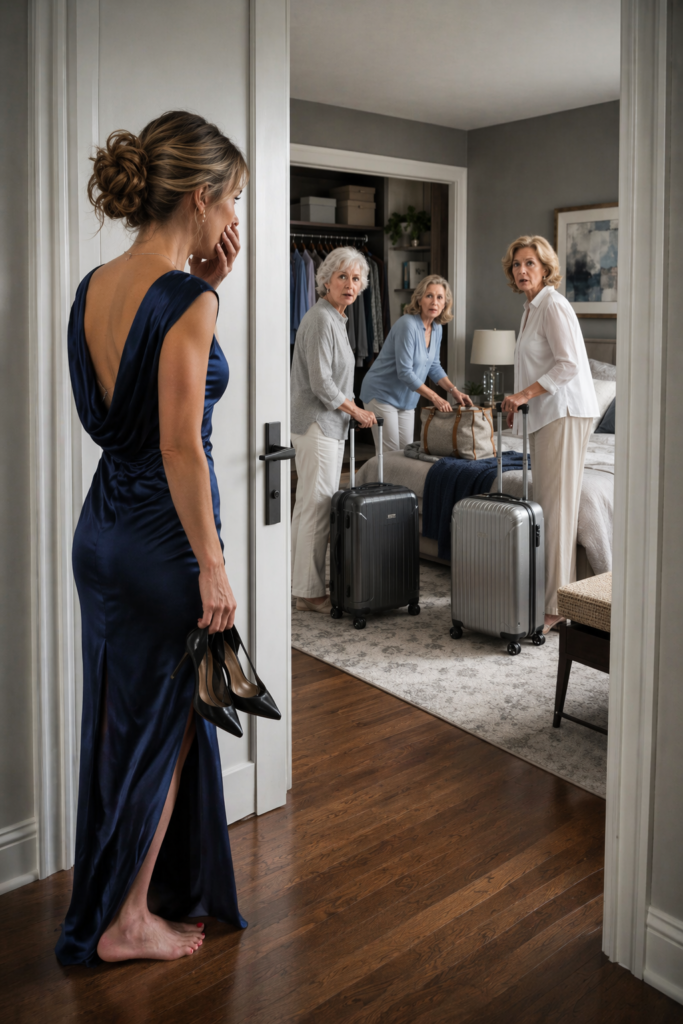
She found suitcases.
Her mother-in-law, Doña Lidia, stood in the middle of the living room wearing a pearl necklace, dark glasses, and the same martyr’s face with which she had received condolences all day.
Around her, 8 of Rodrigo’s relatives were opening drawers, emptying bookshelves, folding clothes, and stuffing items into black bags as if they were cleaning out an abandoned storage unit.
A sister-in-law was packing Rodrigo's shirts into a red suitcase. A cousin was checking the computer. An aunt was wrapping the coffee maker Amelia had given Rodrigo for their anniversary in a towel.
On the table lay a handwritten list:
“Watches. Laptop. Deeds. Cards. Keys. Documents. Fine clothes. Safe.”
Amelia stood frozen.
—What are you doing?
Doña Lidia calmly removed her glasses.
—Oh, dear, don’t make a scene. Rodrigo is gone. This house returns to his family.
Amelia felt her chest close up.
—This was my home too.
The sister-in-law, Patricia, let out a dry laugh.
—It was my brother’s house. You only lived here because he left you.
Cousin Sergio lifted the laptop.
—Besides, we searched. There’s no will. So, don’t get your hopes up.
Amelia glanced at the temporary urn on the shelf. No one had moved it, but no one respected it either. The white flowers from the funeral lay discarded aside, crushed by a bag of clothes.
—Who let you in? —she asked.
Doña Lidia pulled a key from her bag.
—I’m his mother. I’ve always had the right.
Amelia recalled a night when Rodrigo, already very thin, had told her to change the lock.
—My mom doesn’t understand boundaries —he had said—. But don’t fight alone. Promise me that.
She thought he spoke from pain. Now she understood he spoke from memory.
Patricia opened the nightstand in the bedroom.
—The important stuff should be here.
Amelia took 2 steps forward.
—Don’t touch that.
Patricia looked her up and down.
—And who are you to give orders?
—His wife.
—His widow —Sergio corrected—. And widows leave when the family claims what’s theirs.
The phrase fell like a stone.
Then Amelia did something no one expected.
She laughed.
It wasn’t a joyful laugh. It was a clean, hard laugh, so out of place that everyone stopped moving.
Doña Lidia pursed her lips.
—What are you laughing at? Has the madness hit you?
Amelia set the bag of funeral papers on a chair, slowly took off her high heels, and looked at everyone.
—I laugh because Rodrigo was right.
—Right about what?
—That you would come before the flowers wilted.
Doña Lidia slammed her hand on the table.
—I’ll give you 10 minutes to gather your things. If not, I’ll call the police.
Amelia pulled out her phone. She had 1 new message.
“We're downstairs. Don’t open any more drawers.”
Amelia looked up.
—Perfect, Doña Lidia. Call the police.
At that moment, there was a knock at the door.
And when Amelia opened it, everyone understood too late that Rodrigo had not left without leaving them one last surprise.
PART 2
The woman who entered didn’t look familiar or like a neighbor. She wore a gray suit, a black folder under her arm, and a cold gaze, the kind that doesn’t ask for permission because it arrives with everything signed.
Behind her came the building manager, Don Efraín, with a clipboard of documents. Beside him walked a municipal police officer, serious, hand on his radio.
—Good evening —the woman said—. I am Licenciada Renata Villaseñor. I represent the property interests of Rodrigo Cárdenas and the trust established in favor of Amelia Rivas.
The living room froze.
Doña Lidia let out a laugh.
—Trust? Don’t be ridiculous. My son was an independent accountant, not the owner of Televisa.
Renata didn’t blink.
—Your son was discreet, not poor. Those are different things.
Sergio slowly lowered the laptop. Patricia stopped rummaging through the nightstand. The aunt holding the coffee maker seemed to realize how ridiculous she looked.
Amelia remained by the door, her black dress wrinkled and her jaw clenched.
Renata walked over to the table and examined the list.
—How convenient. Watches, laptop, deeds, cards, keys. Not a single photo. Not a rosary. Not a letter.
Doña Lidia crossed her arms.
—You don’t need to judge us. We came for what belongs to blood.
—Blood doesn’t give permission to steal —Renata replied.
The police officer stepped toward the suitcases.
—No one leaves with anything until this is clarified.
Patricia exploded.
—This is an abuse! We just buried my brother.
Amelia looked at her.
—And yet you had the strength to empty his closet.
No one answered.
Renata opened the folder.
—First, the apartment does not belong to Rodrigo Cárdenas as a physical person. For the past 14 months, it has been legally transferred to a property company. That company is part of a private trust.
Doña Lidia paled but kept her chin up.
—That can’t be.
—It can. It’s registered, validated, and active. The primary beneficiary, with absolute right of occupation and administration, is Amelia Rivas.
Sergio slammed his hand on the table.
—Rodrigo never told us that!
Renata looked at him calmly.
—Precisely because he didn’t want you to know.
The sentence hurt more than an insult.
Doña Lidia advanced toward Amelia.
—you manipulated him. Since he married you, my son stopped being himself.
Amelia swallowed hard.
She remembered Rodrigo in Civil Hospital, 5 days before he died. His lips were cracked, his fingers cold, and his eyes sunken, but he still smiled when she tucked in the blanket.
—They will come home, Ame —he said in a whisper—. My mom won’t cry for me. She will collect from me.
Amelia was angry that time.
—Don’t say that.
Rodrigo barely shook his head.
—I’ve known her longer than you. Don’t argue. Don’t plead. Just call Renata.
She didn’t understand why he insisted on that.
Now she did.
Renata pulled out several copies.
—Second. Rodrigo documented unauthorized entries to this residence while he was hospitalized.
Patricia’s eyes widened.
—What?
Renata laid 4 photographs on the table.
In the first, Doña Lidia was entering the apartment at 11:43 PM, using her old key.
In the second, Sergio was rummaging through Rodrigo’s desk.
In the third, Patricia was photographing documents with her cellphone.
In the fourth, another cousin was carrying a box toward the elevator.
Don Efraín cleared his throat.
—Mr. Rodrigo requested recordings to be kept since January. Here is the log.
Doña Lidia pressed her lips together.
—My son wouldn’t record us. He wasn’t like that.
Amelia spoke up for the first time, her voice firm.
—No. Rodrigo wasn’t like that. You made him that way.
The silence was brutal.
Sergio attempted to regain ground.
—He owed me 200,000 pesos. I have the right to collect.
Renata raised an eyebrow.
—Contract?
—It was between family.
—Then it wasn’t a debt. It was pressure.
—I invested in a business with him!
—No. You asked him for money to cover a gambling debt in Zapopan. Rodrigo paid it so your mother wouldn’t find out. There are transfers and messages.
Sergio turned pale.
Patricia looked at her mother.
—Gambling?
Doña Lidia clicked her tongue.
—Don’t listen to them. They’re making things up to divide us.
Renata pulled out another document.
—Third. Mrs. Lidia Cárdenas attempted to withdraw money from a joint account 2 days before Rodrigo’s death, using an expired power of attorney.
Amelia felt nauseous.
—What?
Doña Lidia turned to her in fury.
—He was my son. I had the right to help him.
—Help him? —Amelia said—. He was on oxygen.
Renata added:
—The operation was rejected by the bank. Rodrigo had canceled those authorizations 6 months prior.
Doña Lidia lost control.
—I gave birth to him! I took care of him before you! I know what he would have wanted!
Amelia felt all the pain rise in her throat.
—No, Doña Lidia. You know what you wanted. That’s different.
The police officer ordered everyone to step away from the drawers. Then he commanded them to open the suitcases one by one.
Shirts, books, documents, cables, watches, photographs, and even a small wooden box where Rodrigo kept movie tickets, old letters, and napkins from restaurants where he and Amelia had written couple nonsense returned.
Patricia snatched the box with disdain.
—Just junk.
Amelia seized it from her.
—For you.
The aunt tried to leave the coffee maker on a chair without being seen.
—That too —the police officer said.
The woman complied, her face red with embarrassment.
Renata closed the folder and pulled out a white envelope.
—Rodrigo left specific instructions for this scenario.
Doña Lidia let out a bitter laugh.
—Did he also leave a recorded play?
Renata looked at her.
—Yes.
No one spoke again.
Amelia felt the floor shift beneath her.
—A video?
Renata nodded.
—He recorded it in front of a notary, with 2 medical witnesses. He was conscious and oriented. He requested it be shown only if his family attempted to enter, take goods, or pressure you after the funeral.
Doña Lidia placed a hand on her chest.
—I don’t authorize anything.
—You don’t need to authorize it —Renata replied—. Rodrigo already did.
Don Efraín placed the laptop on the table. Renata connected a memory stick. The screen took a few seconds to light up.
And then Rodrigo appeared.
He was sitting on the hospital bed, a blue blanket over his legs and his skin too pale. He had a cannula in his nose and a weak voice, but his eyes were still the same: calm, noble, stubborn.
Amelia covered her mouth.
—Ame —Rodrigo said in the video—, if you’re watching this, it means I couldn’t return home with you. Forgive me for leaving this mess on top of your pain.
Amelia began to cry silently.
Rodrigo breathed slowly.
—I asked you to laugh because they always hated that you weren’t afraid of them. And because I took too long to learn that.
Doña Lidia looked away.
In the video, Rodrigo continued:
—Mom, if you’re there, don’t pretend to be surprised. For years, you used my guilt like a credit card. You asked me for money for my uncles, for Sergio, for Patricia, for debts that weren’t mine. When I refused, you said a good son doesn’t abandon his family.
Sergio lowered his gaze.
Patricia wiped her nose angrily.
Rodrigo coughed, then continued:
—But when I got sick, the only one who learned medication schedules, paperwork, insurance, studies, and sleepless nights was Amelia. She was my wife when my body stopped being easy to love. She didn’t ask how much the apartment was worth. She asked if it hurt to breathe.
Amelia bent over herself.
Renata placed a gentle hand on her shoulder.
Rodrigo’s voice grew firmer.
—That’s why everything I could protect goes to her. Not as a reward. As justice. This house is hers because she made this place a home when you treated it like a future inheritance.
Doña Lidia murmured:
—No, son…
But Rodrigo continued, as if he had heard her from the other side.
—To my mother, to Patricia, to Sergio, and to the relatives who confused love with convenience for years, I leave 1 peso each.
The room seemed to run out of air.
—That 1 peso is not a joke —Rodrigo said—. It’s an exact measure. That’s what loyalty is worth when you thought I could no longer defend myself.
Sergio cursed.
The police officer looked at him immediately.
Rodrigo continued:
—If you try to contest, my lawyer is authorized to present the complete file: transfers, documents used without permission, attempts to withdraw, entries to the apartment, threatening messages, and the sale of my dad’s tools after his death.
Doña Lidia was petrified.
Patricia turned to her.
—What sale?
That was the twist no one expected.
Renata paused the video for a second and pulled out another folder.
—Rodrigo discovered that, after his father’s death, Mrs. Lidia sold machinery and tools from the family workshop for 480,000 pesos. That money should have been divided among the children. It was never reported.
Patricia’s mouth fell open.
—Mom… you said the workshop didn’t leave anything.
Doña Lidia lost all strength.
—It was to save the house.
—The house was already paid for —Renata said.
Sergio looked at his aunt with disgust.
—So you brought us here over Rodrigo, but you had already kept the money from my uncle?
The family began to break into murmurs.
The video resumed.
Rodrigo looked at the camera with sadness.
—I didn’t do this for revenge. I did it because I got tired of Amelia paying emotional bills she didn’t sign. She will have enough to learn how to live without me. She doesn’t deserve to defend herself from vultures dressed in mourning.
Amelia cried louder.
Rodrigo smiled faintly.
—Ame, change the lock. Open the windows. Buy flowers that don’t smell like a funeral. And don’t let anyone convince you that staying with what’s ours is ambition. Ambition is coming for suitcases before asking if a widow has eaten.
The screen went black.
No one moved.
Doña Lidia was now sitting, without pearls of dignity, without the voice of a wounded mother. Just an exposed woman.
Patricia cried, but she no longer looked at Amelia. She looked at her own mother.
—You lied to us for years.
Doña Lidia tried to stand.
—I did what I could.
Amelia watched her with a calm that hurt.
—No. You did what you wanted.
The police ordered the relatives to leave the apartment only with their personal belongings. Don Efraín took the old key from Doña Lidia and wrote a report. The lock would be changed that very night.
Sergio was the first to leave, red with embarrassment. Then Patricia, with a broken face. Then the uncles, cousins, and nephews, who no longer looked like a grieving family but like people surprised robbing a stranger’s home.
Doña Lidia was last.
She stopped at the door and looked at the urn.
—He was my son.
Amelia held her gaze.
—Yes. And still, he had to protect himself from you before he died.
The phrase left her defenseless.
Doña Lidia lowered her gaze and left.
When the door closed, the apartment fell silent for the first time since the funeral.
It wasn’t peace. Not yet.
It was the kind of silence that remains after an explosion, when everything is still broken, but at least no one is breaking anything anymore.
Amelia sat on the floor next to Rodrigo’s urn. She hugged the wooden box with tickets, letters, and napkins as if she were embracing a piece of her former life.
Renata approached.
—Legally, you’re protected. They won’t be able to take anything from you.
Amelia looked at the chair where Rodrigo always left his glasses.
—I’ve already lost the only thing I wanted.
Renata didn’t respond. There are truths that no lawyer can win against.
The following weeks were a mix of paperwork, exhaustion, and blocked calls. Doña Lidia did not contest. Sergio disappeared from the family group. Patricia confronted her mother over the workshop money. Some relatives tried to say it had all been “a misunderstanding due to grief,” but no one could explain the suitcases, the photos, or the list.
The trust was executed. The apartment remained Amelia’s. The anonymous donations Rodrigo made to accounting students in Jalisco continued. His books were organized. His accounts closed. His files sealed.
But Amelia learned something bitter.
Justice can close a door.
It can’t fill an empty bed.
It can’t brew coffee for two.
It can’t return someone’s laughter in the kitchen or the sound of keys arriving home.
A month later, Amelia went to the Santa Tere market. She bought white calla lilies, sweet bread, and coffee from the pot. She didn’t choose funeral flowers. She chose living flowers.
She returned to the apartment, opened all the windows, and let the noise of Guadalajara in: trucks, vendors, children shouting on the street, a light rain hitting the balconies.
She placed the calla lilies next to the urn.
She turned on Rodrigo’s favorite lamp.
Then she sat on the sofa where he used to read and looked at the home he had protected until his last breath.
—They never knew who you were —she whispered—. But I do.
Outside, it began to rain harder.
And Amelia understood that sometimes the last act of love isn’t saying goodbye.
Sometimes it’s leaving a door closed so that no one comes back to pillage what love built.