PART 1
—If my children know I’m alive, they won’t rest until I’m truly dead.
Julián Morales stood frozen among the damp graves of the Panteón de Belén in Guadalajara, a bag of sweet bread in one hand and a candle in the other. He had come late, almost in secret, as he did every June 23rd, to visit his mother’s grave.
He worked as a motorcycle courier, lived day by day, and carried the exhaustion of someone who could not afford to fall ill. He just wanted to pray for five minutes and return to his room in the Oblatos neighborhood.
But then he heard a moan.
At first, he thought it was a cat trapped among the old crypts. Then the voice came again, broken, buried in darkness.
—Help me… for the love of everything…
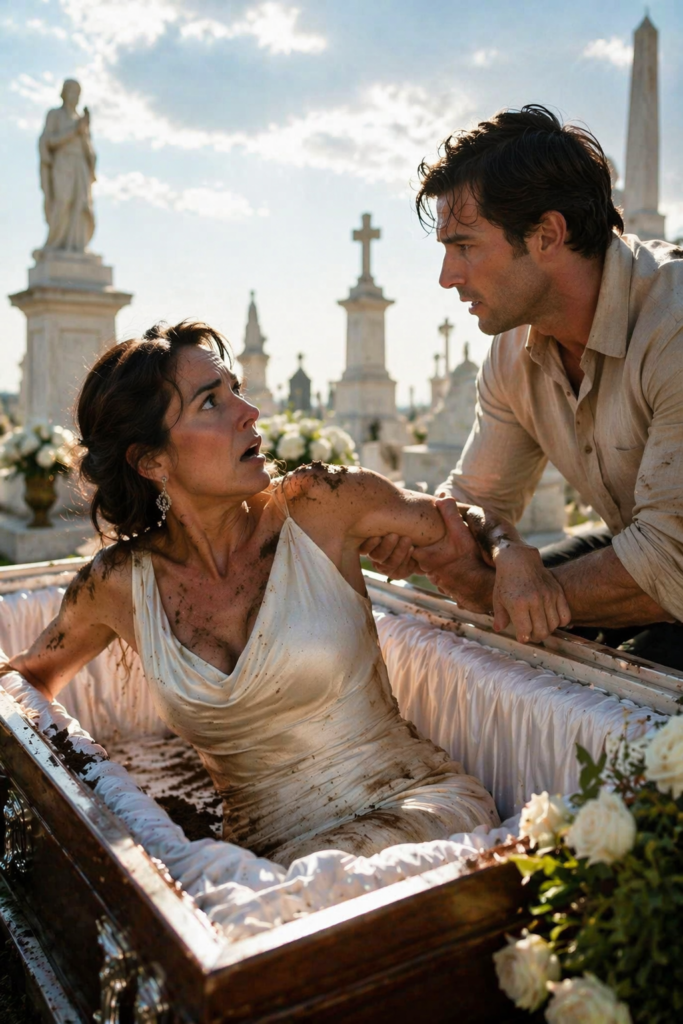
Julián shone his phone’s light and walked among the toppled tombstones. When the light fell on that woman, his hands went cold. She lay behind an open grave, her clothes caked with dirt, white hair plastered to her face, and her arms marked as if someone had gripped her tightly.
Even so, it was clear she was no ordinary old lady. She wore an expensive dress, pearls around her neck, and a presence that fear could not erase.
—I’m calling an ambulance —Julián said, crouching down.
The woman gripped his wrist desperately.
—No. They have doctors, police, lawyers… they have half the world in their pocket.
—Who, ma’am?
She looked towards the entrance of the cemetery, trembling.
—Rodrigo and Camila. My children.
Julián thought she was delirious. No one in their right mind would accuse their own blood like that. But a black car passed slowly down the side street, with tinted windows and lights off. The woman recoiled as if she recognized death.
—Get me out of here, boy. I beg you.
Julián didn’t ask more questions. He draped his jacket over her, helped her up, and somehow hoisted her onto his motorcycle. He drove through dark streets, avoiding major avenues, until he reached the home of a retired nurse who had cared for his mother years ago.
Doña Meche opened the door, and upon seeing her, asked no questions. She simply said:
—Get her in quickly.
It took them over an hour to stabilize her. When Doña Meche came out of the small room, her face was pale.
—Julián, this woman was drugged. And left there hoping the earth would do the rest.
When the woman woke up, she looked at Julián with tired eyes.
—My name is Regina Montemayor.
Julián lost his breath. Regina Montemayor, owner of Montemayor Hotels and half a dozen tourist developments in Jalisco, Nayarit, and Los Cabos. Her face appeared in business magazines, always alongside her two perfect, smiling, elegant children, Rodrigo and Camila.
That morning, the news had announced that Doña Regina had traveled to Monterrey for neurological treatment and that her children would temporarily take over the group’s direction.
Regina saw the news on Julián’s phone. She didn’t cry.
She just gritted her teeth.
—They’ve started.
That night, in front of Doña Meche’s house, the same black car parked for twelve minutes. No one got out. No one knocked.
But when a window cracked open just a bit, Regina whispered something that made Julián understand he was no longer rescuing a stranger.
—They came to confirm if the grave is empty.
PART 2
Julián took Regina to his rooftop room in Oblatos before dawn. It was a tiny place, with a single bed, a screeching fan, an electric stove, and an old curtain separating the bathroom. On the wall, there was a photo of his mother taped up.
—I’m sorry for the place —he murmured, embarrassed.
Regina looked around, leaning against the doorframe.
—Don’t apologize. It’s the first roof in years where no one wants to take anything from me.
For three days, Julián left only for medicine, food, and simple clothes bought at a market. Regina swapped her fine suits for a gray sweater, dark glasses, and a shawl. She looked like a different woman, but her gaze still belonged to someone used to commanding.
On an old laptop that Julián used to watch movies, Regina accessed a secret account only she knew. There, she kept copies of audits, private documents, and emails she had started reviewing months before.
What appeared confirmed her worst suspicions.
Rodrigo and Camila had sold land in Punta Mita for less than half its value to shell companies. They had moved money to accounts in Panama. They had forged permits, bribed notaries, and prepared a medical declaration where Regina appeared as incapable of deciding.
But a piece was missing.
In a folder named “Backup Letter,” a scanned document and an old photograph appeared. Regina stared at the screen as if she had seen a ghost.
In the image, she was twenty years younger, hugging a dark-haired boy, thin, wearing a school shirt and a shy smile.
Julián leaned closer.
—Who is he?
Regina swallowed hard.
—Samuel.
—Your son?
She closed her eyes.
—The only one who acted like one… and whom I destroyed with my own hands.
Samuel Ortega was not her blood. Regina had met him when he was fourteen, selling flowers at traffic lights near Expo Guadalajara. She took him home, paid for his schooling, and over the years, made him her husband’s trusted assistant, Don Arturo Montemayor.
Rodrigo and Camila had hated him from day one.
They couldn’t stand that a boy without a last name ate at their table, voiced opinions in meetings, and received praise from Arturo. They couldn’t stand that Regina looked at him with pride.
—They accused him of stealing 8 million pesos —Regina said, her voice breaking—. They showed me receipts, signatures, transfers. I believed them. I kicked him out one rainy night, without letting him explain.
Julián fell silent.
Regina opened the file.
It was a letter signed by Arturo before he died. In it, he stated that if one day Rodrigo and Camila acted out of ambition, Samuel should be heard before the board. He named him the moral heir of the group and a possible successor if Regina so decided.
At the bottom, there was a handwritten note:
“Regina, our children were born with the last name, but Samuel learned to love this family without owing us anything.”
She covered her mouth.
—That’s why they were afraid I would change my will.
That same afternoon, the used phone Julián bought received a nameless message.
“Stop playing ghost. The lady doesn’t command whether alive or dead.”
Regina didn’t need to ask who it was.
—Camila always wrote like that. As if the world were hers.
The danger was no longer far. A man in a cap appeared twice at the corner of the tenement. Then a white van drove three laps around the block. Julián understood they had been located.
They left through the rooftop, crossed to the neighboring house, and descended by a metal ladder. Don Beto, a mechanic friend of Julián’s, lent them an old truck and hid them in a closed workshop near Tonalá.
Regina knew that hiding would only buy them a few days.
In four days, there would be an extraordinary meeting with twelve advisors from Grupo Montemayor. Rodrigo and Camila wanted to formalize their control, declare Regina incapable, and modify the will. If they succeeded, they could sell the company in parts and erase the evidence.
—I need to get into the building —Regina said.
Julián looked at her like she was crazy.
—Ma’am, they are waiting for you there.
—I’m not going in. You are.
Thanks to an acquaintance of Don Beto, Julián got a temporary job as a driver for corporate events. He was given a black uniform, a temporary badge, and a list of transfers in the Montemayor tower in Puerta de Hierro.
To Rodrigo and Camila, Julián was invisible. Just another driver. A guy who opened doors, carried luggage, and looked down.
And that was precisely why he overheard too much.
He heard Rodrigo say that the fake will needed to be ready before Friday. He heard Camila laugh at the old advisors, saying that with an expensive dinner and a medical signature, their conscience could be bent. He heard lawyer Zambrano mention a USB stored in the legal file on the 12th floor.
That USB contained the original audios.
Julián waited for a meal with investors and climbed the service stairs. He memorized an access code by watching a technician use it and entered the file with his heart pounding in his chest.
He found boxes with forged contracts, payments to private clinics, prescriptions for sedatives, and copies of documents where Regina appeared to be signing on days when she wasn’t even in Guadalajara.
He also found a yellow envelope with Samuel Ortega’s name on it.
Inside were surveillance photos, old addresses, and a recent report: “Samuel Ortega lives in Querétaro under the name Samuel Ríos. Owner of Transportes La Noria.”
Julián took photos, stored the USB, and tucked the envelope under his shirt.
Then he heard footsteps.
—Check the file —a guard ordered—. The sensor activated.
Julián turned off the light and hid behind a shelf. The guards entered with flashlights. One passed so close that he could see the dust rising with his shoes.
Julián’s phone vibrated.
It was Regina.
He couldn’t answer.
The guard turned the flashlight towards the shelf. The light grazed his face. Julián held his breath.
In that instant, a cleaning lady dropped a bucket in the hallway and swore.
—Damn it!
The guards ran out to confront her. Julián seized those ten seconds. He crawled toward the back door, went down the emergency stairs, and walked out to the parking lot, pretending to check a tire on a truck.
He didn’t run until he lost sight of the tower.
When he returned to the workshop, Regina was sitting with a cup of cold coffee. Upon seeing the USB and the envelope, she understood that the truth had returned from the same hole where they had tried to bury her.
—Samuel is alive —Julián said.
Regina closed her eyes. It wasn’t relief. It was guilt.
That night, they traveled to Querétaro in Don Beto’s truck. Regina could barely keep her eyes open, but she refused to wait.
They found Samuel Ríos in a loading yard, checking boxes with his workers. He had gray stubble, rolled-up sleeves, and a hard serenity, like a man who had learned to survive without expecting apologies.
When he saw Regina, he froze.
—Samuel —she said.
He smiled without joy.
—That name was left lying outside your house twenty years ago, Mrs. Montemayor.
The phrase hit her where it hurt the most.
—I failed you.
—No. You condemned me.
Regina lowered her gaze.
—My children forged everything. Arturo left a letter. He always knew who you were.
Samuel listened without moving. Julián handed him the envelope, the photograph, and the letter. Samuel read slowly. His hands didn’t shake, but his eyes changed.
Then he opened a drawer in his office and pulled out a blue folder.
—I saved things too.
They were copies of old emails, computer accesses, and receipts proving that the transfers used to accuse him had come from Rodrigo and Camila’s accounts. Samuel could have reported them years ago, but he hadn’t.
—I didn’t want to see you destroyed —he said—. Even though you could destroy me.
Regina didn’t ask for forgiveness right away. She understood that there were pains where the word “forgiveness” sounds cheap.
She only said:
—I’m not here to ask you to love me. I’m here to ask you to let the truth in with me.
Samuel looked at her for a long time.
—I’m not after your money. Or your last name.
—I know.
—I’m going because no one deserves to have their children bury them alive.
The meeting was held two days later in the main hall of the Montemayor tower. There were twelve advisors seated around a long table, lawyers with folders, notaries, advisors, and two private doctors ready to assert that Regina could not decide.
Rodrigo wore a gray suit and rehearsed calm. Camila wore a cream dress and a gold cross on her chest, as if faith could serve as a disguise.
—Our mother continues under specialized treatment —Rodrigo stated—. For the good of the group, we propose to activate the incapacity protocol and transfer the executive presidency.
Camila distributed documents.
—This isn’t ambition. It’s family responsibility.
Some advisors nodded. Others looked down. No one wanted to confront the heirs of an empire.
The notary was about to initiate the vote when the doors swung open.
Regina Montemayor entered, leaning on Julián. She walked slowly, pale, with a cane in her hand, but with her head held high. Behind her came Samuel, carrying a black folder.
The room fell silent.
Rodrigo shot up.
Camila dropped a pen.
—Mom… —she said, pretending to cry—. Thank God you’re alive.
Regina looked at her with a coldness she had never bestowed upon her.
—Don’t bring God into the grave where you left me.
A murmur spread across the table.
Rodrigo tried to regain control.
—My mother is confused. She clearly needs attention. This confirms what we’ve been saying.
Regina took a deep breath.
—Now listen to the recording.
Samuel connected the USB to the room’s system. The screen lit up. First, transfers, compared signatures, payments to a clinic, prescriptions for sedatives, and photos of the truck used to take Regina to the cemetery appeared.
Then Rodrigo’s voice was heard.
“Make it look like treatment. If she wakes up, sedate her again. If the body doesn’t show up, better. No one fights over an inheritance from a grave.”
Camila clutched her neck.
Then her own voice was heard.
“When Mom can no longer decide, the twelve advisors will sign. And if Samuel shows up, we’ll make him disappear again.”
The advisors stood up. One of them, Don Esteban, slammed the table.
—This is madness!
Camila began to cry, but not out of regret. It was pure fear.
—It’s edited —she said—. That doesn’t prove anything.
Samuel opened the black folder.
—Then explain these emails from twenty years ago. The false transfers. The forged signatures. The orders to blame me for a theft that came from your own computers.
Rodrigo glared at Camila with hatred.
—You kept copies.
—YOU had her buried! —she screamed, losing control—. I just wanted her to sign the incapacity, not leave her in a cemetery like she was trash.
The confession fell like a gunshot.
Regina closed her eyes. That was the true end of her children. Not when the agents entered. Not when the notary suspended the meeting. Not when the advisors pulled away from Rodrigo and Camila as if they were poison.
It was when Regina heard that none of them cried for having lost her. They only cried because they had been discovered.
Rodrigo tried to leave, but two police officers stopped him at the door. Camila knelt in front of Regina.
—Mom, please. We are your children.
Regina looked down at her, with a face broken inside.
—My children died the day they decided my life was worth less than my bank accounts.
Camila wanted to hug her, but Regina stepped back.
—Don’t touch me.
In the following days, Grupo Montemayor shook as if an earthquake had hit. Rodrigo and Camila were investigated for attempted homicide, fraud, forgery, money laundering, and organized crime. Lawyer Zambrano lost his firm. The private doctors were summoned. Several executives who had signed in silence were exposed.
Regina returned to the presidency, but she was no longer the same.
She ordered the creation of an independent council, froze suspicious sales, and handed complete evidence to the Prosecutor’s Office. Each signature she reviewed hurt, for behind every fraud, she found a family dinner, a birthday photo, a Christmas where her children hugged her while planning to take everything from her.
To Julián, she offered an amount that would have changed his life in one fell swoop.
He shook his head.
—I didn’t get her out of there for money, ma’am.
Regina insisted another way. She bought him a modest house in his name and paid for Doña Meche’s knee surgery. She also opened a foundation for children of working mothers, with a simple plaque:
“For those who help without asking how much they will earn.”
Julián cried when he saw her. Not for the house. For his mother, who had taught him all his life that being poor was not a license to be cowardly.
Samuel did not immediately accept to run the company. He also didn’t accept to call her mom again. The wound was too old.
But he did agree to have coffee with Regina every Sunday.
Sometimes they talked about audits. Sometimes about Arturo. Sometimes they sat in silence for twenty minutes, and that silence spoke more than any forced hug.
One afternoon, Regina asked him:
—Do you think one day you can forgive me?
Samuel looked at his cup.
—I don’t know.
She nodded, with still tears.
—This time I’m not going to demand anything from you.
Julián continued to go to the Panteón de Belén every June 23rd. Only now he didn’t always go alone. Sometimes Regina accompanied him, laid flowers on Julián’s mother’s grave, and stood in front of the tombstone as if she understood an impossible debt.
There, among candles and damp earth, Regina understood what no business advice had ever taught her: blood can inherit a last name, but it doesn’t guarantee love. And sometimes true family arrives on an old motorcycle, with a borrowed jacket and the courage to do what’s right when no one is watching.
Because there are children capable of burying their mother alive for millions… and strangers who rescue her simply because they still know how to distinguish between ambition and the soul.