PART 1
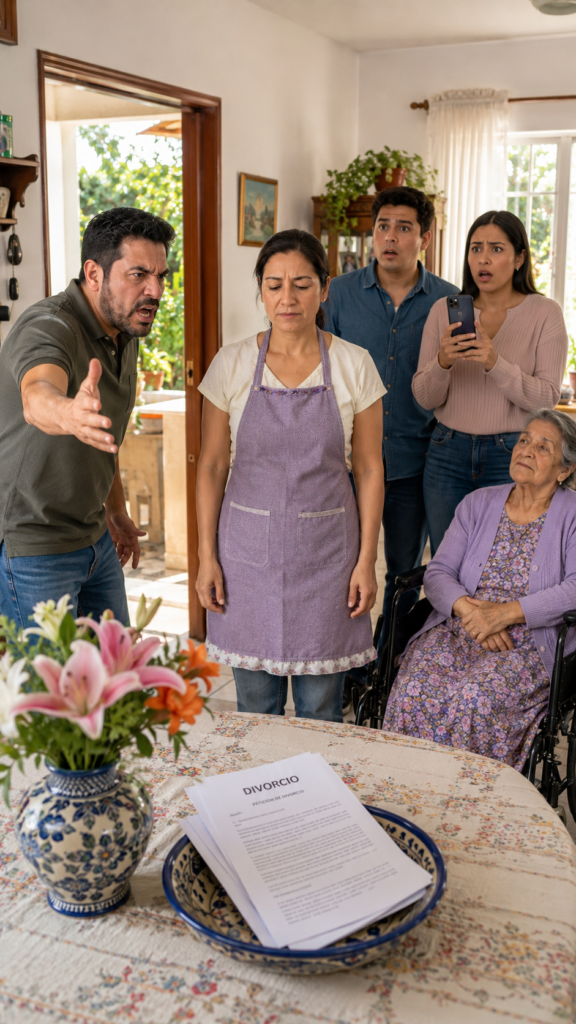
For 5 years, Mariana bathed, fed, and changed Doña Elvira, her paralyzed mother-in-law. So when her husband slammed the divorce papers onto the plate of chilaquiles and ordered her to sign, everyone expected to see her cry.
Mariana smiled.
Héctor frowned. His brother Ramiro burst into laughter, and Patricia, Ramiro's wife, raised her phone to record. Doña Elvira, seated in her wheelchair, spat with contempt:
—Get out, you gold-digging bitch.
Mariana didn’t reply. She looked at Diego, her 9-year-old son, clutching his backpack by the door, and breathed slowly.
She had met Héctor when they both worked at an auto parts factory in Puebla. They married young, rented a tiny room, and for years dreamed of buying a house.
Everything changed when Doña Elvira was hit by a car outside the La Acocota market. The spinal injury left her immobile from the waist down. That night, Ramiro knelt before Mariana in the kitchen.
—Sister-in-law, quit your job and take care of her. A nurse costs a fortune. We’re family, seriously, don’t abandon us.
Mariana agreed.
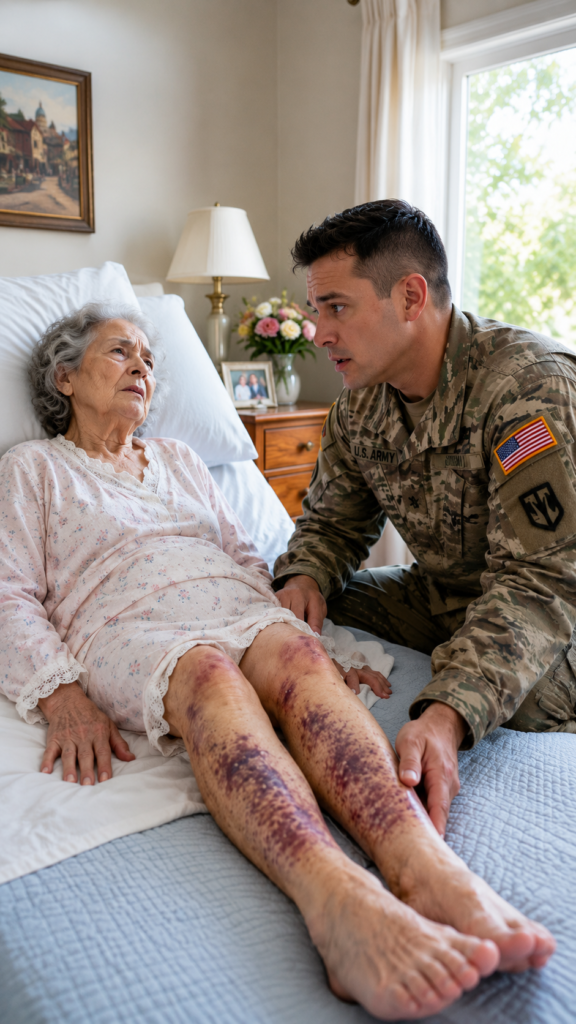
Since then, she never had another Sunday to herself. She changed diapers, cleaned catheters, prepared purees, adjusted pillows, and turned the elderly woman every two hours to prevent bedsores.
Héctor gave her 3,000 pesos a month for medications, special milk, and medical supplies. It barely lasted 15 days. Mariana ended up spending the 120,000 pesos her mother had given her when she got married.
In the meantime, Ramiro posted photos embracing their mother with captions like “my queen, my reason to live.” Patricia claimed at the market that Mariana was a lazy woman living off charity.
And Héctor never defended her.
The worst part was Doña Elvira. She called her a bitch, a freeloader, and a starving dog in front of the entire family. Always louder when there were visitors.
After 3 years, Mariana began to save receipts, messages, and recordings. She didn’t do it for Héctor’s mistress, though she was already aware of her.
She did it because one night she overheard the brothers talking in the yard.
—You’ll lower her heart medication —Héctor whispered—. If she doesn’t wake up one day, no one will investigate. We sell the house and split the pension while everything gets sorted.
Mariana felt her legs turn to ice.
From that night on, she locked Doña Elvira’s room from the inside and didn’t let anyone administer her medications. The elderly woman watched her in silence and murmured:
—You’re not as dumb as you pretend.
Now, two years later, Héctor was banging the table demanding the divorce.
—The boy stays with me. You have no job. And my mom stays too because this is her house.
Mariana took off her apron.
—I’m taking Diego —she said—. And I’m taking your mother too.
Ramiro jumped up, furious.
—Why would you want the old woman? Her pension belongs to the family.
Doña Elvira lowered her gaze.
Héctor stepped closer to Mariana and spoke so quietly that she thought no one else would hear.
—Sign today. Tomorrow Mom might wake up worse. You know I can make her condition worse.
Mariana pulled out her phone and played the recording from the yard at full volume.
But before it finished, Doña Elvira grabbed her wrist with her one usable hand and whispered something that forever changed the meaning of every insult.
—Don’t turn it off, daughter. Today they’re going to find out who the real bitch in this house was.
PART 2
Héctor’s voice filled the kitchen.
In the recording, it was clear how he planned to reduce his own mother’s medication, wait for her death, and sell the house before anyone checked her accounts.
Ramiro went pale. Patricia stopped recording. Héctor, however, regained his composure and smirked with disdain.
—That audio is edited. Anyone can fabricate something like that. No judge is going to take a woman without money or a lawyer seriously.
Mariana knew he wasn’t lying.
A recording made from a window, without witnesses and with background noise, could be challenged. For years, she had gathered evidence, but none guaranteed that Héctor would end up in prison.
Then Doña Elvira raised her voice.
—Tell him about the notary.
Héctor stopped smiling.
A month before, the elderly woman had asked to leave the house. Mariana said she would take her to the IMSS, but Doña Elvira handed her a note written in shaky handwriting.
It was a small notary office above a pharmacy, near downtown Puebla.
Mariana carried her to the taxi, took Diego with her, and waited outside for nearly 2 hours. Doña Elvira wanted to speak alone with the lawyer.
There she left a signed and recorded statement. She gave full names, dates, medication doses, bank movements, and details of the threats she had overheard for years.
She also left instructions for the statement to be delivered to the prosecutor’s office if she appeared dead under strange circumstances.
—She’s lying —Ramiro shouted—. My mom doesn’t even understand what she’s signing.
—I understand perfectly —Doña Elvira replied—. What I didn’t understand was how I raised two vultures.
Patricia stepped back. Héctor grabbed Mariana’s phone and tried to smash it, but she had already sent copies of everything to a neighbor, her sister, and the notary.
Additionally, two municipal police officers appeared at the door. Mariana had called them before breakfast and left the line open when Héctor threatened her.
Héctor was taken in to testify for threats and domestic violence. Ramiro followed behind him, shouting that it was all a trap.
Mariana packed two suitcases, took Diego by the hand, and pushed Doña Elvira’s wheelchair down the street.
The elderly woman never insulted her again.
They settled in a small apartment in San Manuel. There were only two bedrooms, so Mariana slept on a mattress next to her mother-in-law’s bed.
For 22 days, the silence between them was more painful than the insults.
Mariana began to remember details she hadn’t connected before. Doña Elvira never called her a bitch when they were alone. She only did it in front of Héctor, Ramiro, or Patricia.
When alone, she’d say: “Adjust my pillow,” “eat something,” “take a nap.” She was never affectionate, but neither was she cruel.
Mariana realized the insults had been an act.
Yet, she still didn’t understand why.
On the 22nd night, Doña Elvira began to breathe with difficulty. Mariana called an ambulance, but the elderly woman knew it wouldn’t arrive in time.
She squeezed Mariana’s hand and looked at her with eyes that, for the first time, hid nothing.
—I called you a bitch so they would leave you alive —she murmured.
Mariana felt a blow to her chest.
Doña Elvira tried to continue speaking, but only managed to move her lips. Minutes later, she stopped breathing.
There was no beautiful farewell or miracle. Just an exhausted woman sitting on the floor, holding a hand that was growing cold.
After the funeral, Héctor demanded to return to the house. He claimed that as the eldest son, it was his right to manage it. He also sought custody of Diego and accused Mariana of manipulating an ill elderly woman.
For 8 months, everything turned into a war.
Héctor hired a lawyer and claimed that Mariana had kidnapped his mother to take her pension. Ramiro testified the same. Patricia posted videos on Facebook saying Mariana was a scam artist.
The comments were brutal. People who had never changed a diaper or cleaned a catheter called her selfish.
Mariana found a job at a pharmacy and sold food on weekends. She couldn’t afford an expensive lawyer, but the notary connected her with a family defender.
Doña Elvira’s statement served as protection, although it didn’t guarantee a criminal conviction. Without medical analyses proving the rationing of medications, Héctor could deny everything.
Using the video in an uncertain trial would also expose Diego. The boy would have to testify against his father and relive the threats.
Mariana chose another strategy.
She sent Héctor a message:
“The day you come near Diego, the full statement will reach the prosecutor’s office, the court, and all the media. Ask the notary what your mom signed.”
Héctor didn’t respond.
Shortly after, the bank initiated proceedings against him for debts he had guaranteed using old documents from the house. Héctor believed for months that he would lose a property he would inherit upon his mother’s death.
But Doña Elvira had prepared one last surprise.
When Mariana lifted the mattress where the elderly woman had spent her last days, she found a folded envelope stained with medication.
Inside were certified copies of a donation.
The house hadn’t belonged to Doña Elvira since before the divorce. It had been legally transferred to Diego, with a clause preventing Héctor from managing or selling it before the boy turned adult.
Héctor had threatened, lied, and abandoned his mother for a house he would never be able to touch.
However, beneath the documents was another sheet.
It was a letter to Mariana.
“Daughter:
Forgive me for every time I called you a bitch.
My sons were watching everything. They wanted to know who I loved, whom I trusted, and to whom I could leave something. I knew that if they found out you were the one protecting me, you would become an obstacle.
That’s why I made them despise you.
I humiliated you in front of them so they would think you meant nothing to me. I wanted that when I died, they would let you leave with your son without imagining that the house already belonged to him.
I couldn’t thank you. I couldn’t hug you. I couldn’t call you daughter, because it would have shown on your face, and they would have understood.
I taught you to hate me to hide that you were the only person in that house I wanted to save.
Take care of Diego. And forgive me for using your wounds as a shield.”
Mariana read the letter three times.
Then she understood that every insult had been a calculated lie. Doña Elvira hadn’t been a cruel old woman, but a woman trapped, watched, and terrified by her own children.
She had used the only thing she still controlled: her voice.
For 5 years, she made Héctor and Ramiro see Mariana as an insignificant servant. Because of that, they never suspected she was gathering evidence, controlling medications, or knew the notary’s plans.
She protected her in a horrible yet effective way.
Mariana cried herself to sleep on the empty mattress.
Months later, the judge granted Mariana custody of Diego. Héctor agreed to stay away in exchange for the notarial statement not being presented publicly, although he was warned that any threats would break the agreement.
Ramiro and Patricia disappeared when they understood there was no pension or inheritance for them.
Mariana did not forgive them. She also didn’t idealize Doña Elvira. She knew love shouldn’t hurt like that and that no sacrifice erased 5 years of humiliation.
But she kept the letter.
She also preserved an accidental recording. One afternoon, the phone had been left on the table while Mariana prepared soup. In the audio, Doña Elvira could be heard breathing, moving a spoon, and waiting for Mariana to come out of the room.
Then, believing she was alone, she softly said:
—Alright, daughter. You rest too.
It was the only time she called her daughter without fear.
Every night, when Diego slept, Mariana played that audio in the apartment that would someday be replaced by the house Doña Elvira left to the boy.
She didn’t hear a perfect apology.
She heard the twisted love of a woman who had learned too late that in certain families, showing affection could become a sentence.
And while some insisted that Mariana should forgive her completely, others said no good intention justified such cruelty.
She never chose an easy answer.
She just knew that the woman who had hurt her the most was also the one who stood in front of danger to save her.
And that sometimes, the truth doesn’t turn pain into something good.
In the neighborhood, the story divided everyone. Some called Doña Elvira a heroine; others said a mother should have reported her children from the beginning.
Mariana understood both sides because protecting someone through fear also leaves scars that no inheritance can buy.
The truth only explained why someone had decided to carry the pain in silence.