PART 1
—Don’t even change, Renata. Grab your bag and get out of here. This house belongs to Mauricio’s family now.
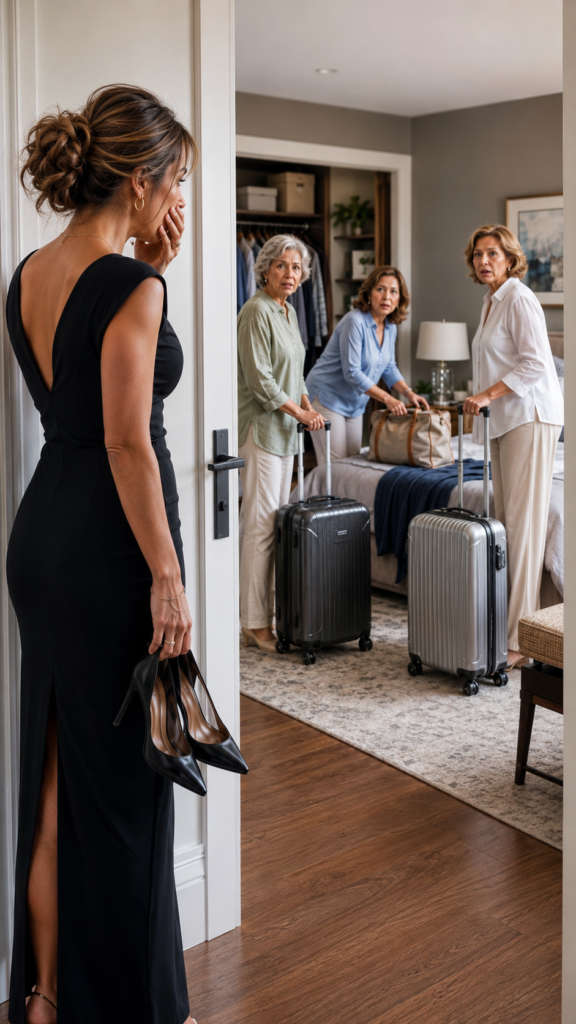
Renata Cárdenas stood frozen at the entrance, still dressed in black, with smeared makeup and the scent of funeral wreaths clinging to her hair.
Just hours before, she had buried Mauricio Alcázar, her husband of 11 years, in a cemetery in Guadalajara.
All she wanted was to get home, close the curtains, and cry without anyone watching.
But the residence in the Providencia neighborhood was filled with voices, open drawers, and luggage.
Her mother-in-law, Doña Elvira, was orchestrating the looting from the dining room.
Around her, eight of Mauricio’s relatives were stuffing shirts, watches, documents, dishware, and electronics into bags as if they were dividing an inheritance at a flea market.
Arturo, the older brother, was unplugging the computer from the study, while Brenda, a cousin who had never visited Mauricio during his illness, was rummaging through bank papers.
On the table lay a list: “House. Car. Accounts. Jewelry. Deeds. Passwords.”
Next to it rested Mauricio’s urn among wilting flowers. No one seemed to notice it.
—What are you doing in my house? —Renata asked.
Doña Elvira lifted her chin.
—This is not your house. It belonged to my son. Since he died without leaving children, everything goes back to his blood family.
—Mauricio and I bought this property together.
—You only signed where he told you to —Elvira shot back—. Don’t pretend to be a businesswoman. You lived off him and now you want to keep everything.
Brenda smiled as she opened another drawer.
—We already checked. There’s no will. So don’t start drama, cousin.
Renata felt her chest burn.
For four months, she had slept in a chair at the hospital. Those relatives had only shown up to take selfies and ask for money.
—Put everything back where it belongs —Renata ordered.
Arturo, the older brother, lifted the laptop.
—Or what? Are you going to call the police to accuse the mother of the deceased?
—Yes, if necessary.
Elvira pulled a key from her purse.
—I always had access. I’m his mother.
Renata recognized the old key.
Mauricio had wanted to change the lock after discovering that someone had searched his study. He hadn’t done it, but perhaps he had chosen another way to defend himself.
Then her cellphone vibrated.
It was a message from Licenciada Paula Esquivel, Mauricio’s lawyer:
“We’re outside. Don’t let them leave with anything.”
Renata looked at the stuffed bags, the torn photographs, and the abandoned urn.
And she started to laugh.
It wasn’t a joyful laugh.
It was dry, incredulous, almost cruel.
Everyone fell silent.
—Have you lost your mind? —Elvira asked.
Renata took off her heels by the door and walked barefoot into the dining room.
—No. I laugh because you made exactly the mistake Mauricio knew you would.
Arturo frowned.
—Mauricio had nothing to hide.
—You never knew what he had —she replied—. You also never knew who he truly was.
Elvira slammed her hand on the table.
—You have 10 minutes to leave before we call the police.
Renata looked toward the door when the doorbell rang.
—Good that you mentioned the police.
She opened it.
On the other side were Mauricio’s lawyer, the neighborhood administrator, and two officers.
Paula entered, saw the bags, and placed a black folder on the table.
Then she looked directly at Doña Elvira.
—Before anyone takes a single item, you need to know that Mauricio left instructions for this exact moment.
PART 2
Doña Elvira let out a laugh, though her voice trembled.
—My son was medicated. Anything he signed in the hospital isn’t valid.
Paula remained unfazed.
—Mauricio signed every document three months before his last hospitalization, in front of a notary and two witnesses. He also left medical evaluations certifying that he was fully aware.
Don Ernesto closed the door, and the officers ordered that no one touch the bags.
Paula opened the folder.
—The house wasn’t registered in Mauricio’s personal name. It belongs to a patrimonial society integrated into a private trust.
Elvira smiled disdainfully.
—Mauricio was a consultant. Not a millionaire.
—Mauricio founded a technology risk analysis company 14 years ago —Paula explained—. He sold part of his shares to a Canadian group and retained stakes through the trust. He never flaunted his money because he knew what happened every time this family caught scent of a peso.
Elvira’s smile faded.
Paula showed a certified copy.
—Renata is the only primary beneficiary, administrator, and legal occupant of this property.
—She manipulated him —Elvira shouted—. Ever since she appeared, my son stopped helping us.
Renata took a deep breath.
That accusation wasn’t new.
For years, Mauricio had paid Arturo’s debts, covered Brenda’s rent, and rescued his mother’s failed business twice.
When he started saying no, everyone blamed Renata.
—Mauricio didn’t stop helping you because of me —she said—. He stopped when he understood that you never intended to stop.
Arturo slammed the back of a chair.
—I was owed 900,000 pesos for an investment.
—Show me the contract —Paula requested.
—It was an agreement between brothers.
—So it wasn’t an investment —the lawyer replied—. It was another story made up to charge him.
One of the officers asked to check the contents of the bags.
Inside they found three watches, a folder with deeds, bank cards, a camera, and several USB drives.
Brenda turned pale.
—We were just protecting the things.
—Protecting them from whom? —Renata asked.
No one answered.
Paula pulled out four printed photographs.
The first showed Elvira entering the house while Mauricio was hospitalized.
The second showed Arturo photographing files from the study.
In the third, Brenda held a bank card up to her phone.
The fourth showed the three of them going through an open safe.
—These images are from five weeks ago —Paula said—. Mauricio installed cameras after documents and 120,000 pesos in cash went missing.
Elvira lost color.
—He would never have recorded his own mother.
—He did it because his own mother entered without permission.
Renata felt a stab.
Mauricio had told her about the money, but assured her he might have moved it and forgotten.
Even while sick, he continued to protect those who hurt him.
Paula handed Renata an envelope with her name on it.
Mauricio’s slanted handwriting made her hands tremble.
Inside was a note:
“Rena, I’m sorry for forcing you to face this on the day you’re going to feel the most broken. If they’re there, don’t negotiate. They didn’t come to say goodbye to me. They came to collect what they think my guilt still owes them. Trust Paula. And when my mother asks what I left her, tell her exactly what she earned.”
Elvira swallowed hard.
—What does that mean?
Paula pulled out a sheet.
—Mauricio left an individual provision for you, Arturo, Brenda, and other relatives.
The three leaned in closer.
—Each of you was assigned 1 peso.
Brenda opened her mouth.
Arturo cursed.
Elvira stood rigid, humiliated.
—That’s a joke.
—No —Renata said, tears in her eyes—. It’s an exact accounting.
Elvira took a step towards her.
—I’m going to contest everything. I’m going to prove that you isolated him when he was sick.
Paula closed one section of the folder and opened another.
—You can do that. But the contestation clause will trigger the automatic delivery of a file to the Jalisco Prosecutor’s Office.
Arturo tensed.
—What file?
—Misuse of signatures, fictitious loans, unauthorized transfers, and alteration of documents after Mauricio’s father’s death.
The room fell silent.
Renata knew fragments. After Mauricio’s father died, there appeared sold lands, questionable loans with dubious signatures, and a tax debt he paid to protect Elvira. Now everything had names, dates, and evidence.
—My son would never dare to report me —Elvira murmured.
—Your son spent years cleaning up what you all dirtied —Paula replied—. Before he died, he decided to stop doing it.
Then she pulled out a USB drive.
—I recorded a video.
—I don’t authorize this to be played —Elvira said.
—It doesn’t need your authorization.
Paula plugged the USB into the laptop.
The screen showed Mauricio in the hospital, pale and thin, but with steady eyes. Renata covered her mouth.
—Rena —said Mauricio in the video—, if you’re watching this, it means I didn’t make it back home. I’m sorry. I know you’ll want to be alone, but my family probably won’t even grant you that right.
Renata began to cry.
Mauricio smiled faintly.
—If they came in with bags, I hope you did what I asked. I hope you laughed.
A broken laugh escaped from Renata through her tears.
Elvira turned away.
—For too long, I confused being a good son with allowing abuse —Mauricio continued—. I paid debts that weren’t mine, accepted blame that was not mine, and kept secrets so my mother wouldn’t face the consequences of her actions.
Arturo lowered his head, and Brenda began to cry.
—You used my signature, my name, and my guilt. When I set boundaries, they accused Renata. It was easier to hate her than to accept my “no.”
—That woman filled your head —Elvira murmured.
Mauricio seemed to respond to her from the screen.
—Mom, Renata never separated me from you. You pushed me away every time you turned love into a bill.
Elvira put a hand to her chest. She no longer looked furious, but exposed.
—Everything I built is protected for Renata —he continued—, not because she asked me to, but because she was the only person who loved me without first checking how much she could take from me.
Renata closed her eyes.
—I leave my family 1 peso each. Not out of revenge. Out of precision. That represents the loyalty they showed when they thought I could no longer defend my home.
One of the officers looked at the open bags.
Mauricio breathed heavily.
—If you contest, Paula will deliver all the evidence. I will no longer carry secrets that made me sick long before cancer did.
Then he paused.
His expression changed.
—There’s something else Renata doesn’t know either.
She opened her eyes.
Paula remained still.
—For six years, I anonymously financed scholarships for young people from rural communities in Jalisco and Michoacán. The trust will continue to do so. Renata will oversee the program if she chooses to accept.
Arturo looked up. Mauricio had refused to pay him for a car but helped unknown students. He didn’t refuse to help; he refused to feed abuse.
—Rena —said Mauricio—, open the windows. Change the lock. Fill the house with coffee, music, and fresh flowers. Blood may give you a last name, but true family gives you peace.
The video ended.
No one spoke for several seconds.
Elvira was the first to break the silence.
—I am his mother.
Renata clutched the note to her chest.
—Yes. And he had 41 years to learn to love him without charging him for it.
Elvira raised her hand as if to hit her.
One of the officers stepped in.
—Ma’am, put that down now.
Arturo grabbed his mother’s arm.
The authority Elvira once held over everyone had been reduced to nothing.
The officers ordered the bags to be emptied. Shirts, books, watches, and documents returned to their place.
Brenda tried to keep a hidden USB drive in her sleeve.
The officer discovered her.
—Were you protecting that too?
Brenda began to sob.
Paula took note of the attempt.
—Renata will decide tomorrow if she presses charges for breaking and entering and attempted theft.
—You can’t do this to us —Arturo said—. We are Mauricio’s family.
—Exactly because of that, you were able to get so far —Renata replied—. Because he took too long to accept that you were the danger.
One by one, they left. They no longer looked like heirs but intruders trapped in someone else’s life.
Before leaving, Elvira looked at the urn for the first time. Her face cracked, but she chose pride.
—He will regret it wherever he is.
Renata held her gaze.
—No. For the first time, he left without owing you anything.
The door closed.
That night, they changed the lock, Paula secured the documents, and the officers filed the report. Afterward, the house fell silent.
Renata sat on the floor next to the urn.
Justice had preserved the walls, the accounts, and the memories.
But it couldn’t return Mauricio’s hands, his voice in the kitchen, or the habit of seeking her out with his foot in the early morning.
Elvira didn’t contest. Arturo stopped calling, and Brenda hired a lawyer. None wanted the file to reach the Prosecutor’s Office.
Renata handed the evidence to Paula but needed to cry before deciding whether to report.
A month later, she agreed to direct the scholarship program.
She discovered that 27 young people had already completed a degree thanks to Mauricio.
He had helped dozens without asking for photographs, applause, or obedience.
One afternoon, Renata bought white calla lilies in San Juan de Dios. She opened the windows, placed the flowers next to the urn, and turned on Mauricio’s lamp.
The house no longer looked ransacked but protected.
Renata looked at the empty sofa and smiled through tears.
—They never knew who you were —she whispered—. I did.
Outside, it began to rain.
And inside that house, Renata understood that Mauricio’s last act of love hadn’t been to leave her a fortune.
It had been to teach her, even after death, that setting boundaries doesn’t destroy a family.
It only reveals who never was.