PART 1
—Your girl isn’t on a trip, Carolina. Your girl is hiding in that house.
The words slipped from Doña Lucha's mouth, burning her tongue. She didn’t open the gate fully; she only peeked her half-face out, glancing at the Zapopan street with fear, as if someone might still punish her for speaking.
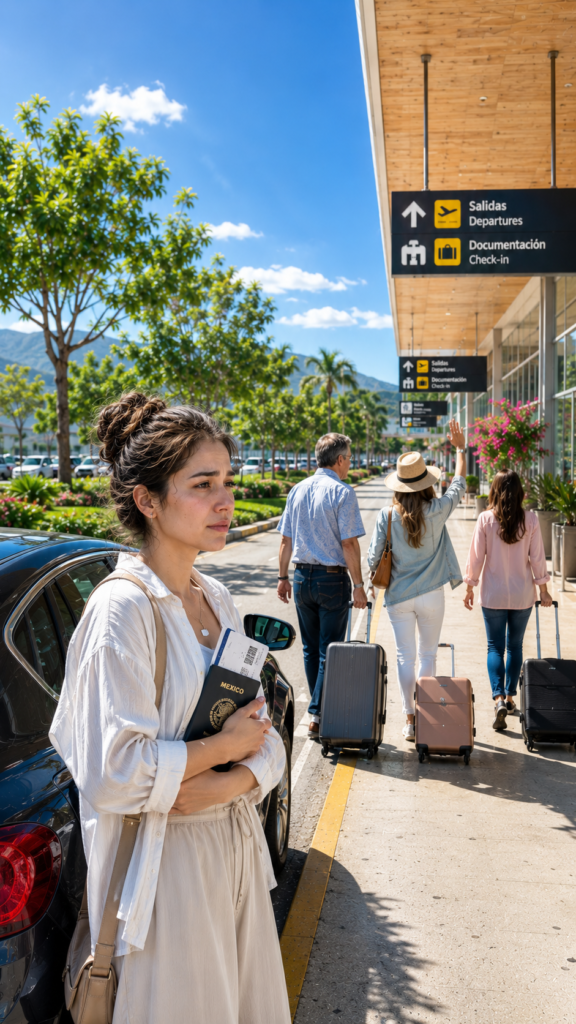
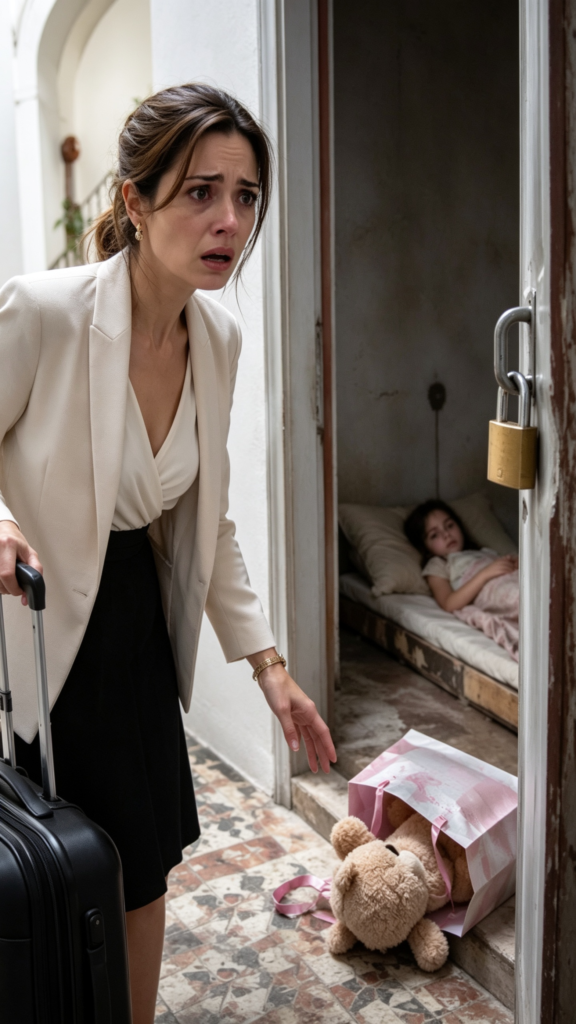
Carolina Rivas had just returned to Mexico after five years in Madrid. She traveled with two suitcases filled with clothes, stories, dolls, and new shoes for her daughter, Sofía, the little girl she had left behind at two when she accepted a scholarship for geriatric nursing.
She hadn’t left because she didn’t love her.
She left because her ex-husband, Iván Salcedo, had been out of stable work for months, because debts were knocking at the door, and because her ex-mother-in-law, Marta, had sworn to her in tears that she would care for Sofía like gold.
—She’s my granddaughter, honey. Here, she’ll have food, school, love, and family. You go in peace. An opportunity like this doesn’t come twice.
Carolina believed her.
For five years, she sent 28,000 pesos a month. Without fail. Sometimes she worked double shifts, cleaned houses on weekends, and stopped buying clothes so that Sofía would want for nothing. She kept every receipt, every message, every photo Marta sent her.
At first, Sofía appeared smiling on video calls, with crooked pigtails and floral dresses. Eventually, the calls grew shorter. Marta claimed the little girl was asleep, sick, busy with homework, at mass, in dance class.
Iván, as always, responded lazily.
—Don’t start nagging, Caro. My mom knows how to take care of kids.
But Carolina began to notice strange things. In the photos, Sofía almost never looked at the camera. She wore oversized sweaters even in April. Sometimes she looked smaller, as if time had passed for everyone but her.
Her sister Gabriela insisted many times:
—Something doesn’t add up, sis. Let me go see her.
But each time Gabriela said that, Marta would send a new photo or a weak audio message where Sofía said:
—Hi, Mommy.
And Carolina, torn by guilt, forced herself to believe.
When she finally saved enough money to return, she decided not to warn anyone. She wanted to embrace her daughter without cameras, without excuses, without a screen between them.
Marta and Ernesto’s house was locked. The grass overgrown, the curtains drawn, a burst trash bag next to the gate. Carolina knocked for ten minutes. No one came out.
She called Iván.
—Where’s Sofía?
—I don’t know—he replied, annoyed—. She’s probably with someone.
—with who, Iván? She’s seven.
—Oh, don’t start with your dramas since you got back.
Carolina hung up.
Then Doña Lucha crossed the street.
—They went on a cruise, dear. I saw them load suitcases two days ago. But I didn’t see the girl come out.
Carolina felt her blood rush to her feet.
She circled the house, pushed the back door, and entered. The smell was unbearable: dampness, spoiled food, confinement. In the kitchen, she found moldy plates and a note stuck to the fridge: “Caribbean Cruise, 12 days. Don’t forget passports.”
Then she heard something.
A small knock.
It came from below.
In the hallway, there was a locked door. A door that hadn’t existed before. Carolina pulled at the lock in desperation until it gave way because it was poorly installed.
She descended the concrete stairs, trembling.
And there, on a dirty mattress, next to a bucket and an empty bottle, was Sofía.
She weighed like a feather. Her hair stuck to her face, her lips cracked, and her ankle was tied to a pipe with a bicycle chain.
Carolina knelt.
—Sofi… my life… it’s Mommy.
The girl opened her eyes.
But she didn’t recognize her.
And when Carolina saw the chain embedded in her skin, she understood she was just beginning to enter the hell everyone had pretended not to see.
PART 2
Sofía didn’t cry when the ambulance arrived.
That was what broke Carolina completely. A seven-year-old girl, found in a basement, tied up like an animal, didn’t scream or ask for help. She merely stared at the ambulance ceiling with wide-open eyes, too large for such a thin face.
Carolina held her hand.
—I’m here, my love. I won’t leave you again.
But Sofía didn’t squeeze her fingers. She didn’t know if she couldn’t or if she no longer remembered how to trust.
At the civil hospital, Dr. Ávila examined her for nearly three hours. When she emerged, her face was tense, the kind that reveals the truth before a word is spoken.
—Sofía weighs 16 kilos.
Gabriela, who had just arrived running, covered her mouth.
—She’s seven—Carolina murmured.
—We know. She presents severe malnutrition, dehydration, anemia, infections in her ankle, old marks on her wrists, and a poorly healed fracture in her right arm. There are also signs of prolonged isolation.
Carolina felt the hallway sway.
—Can she speak?
The doctor lowered her voice.
—Physically yes. But her mind stopped trying. Sometimes silence is the only thing left for a child to survive.
That night, Carolina handed everything over to the prosecutor’s office: transfers, screenshots, audio files, emails, photos, receipts for the 28,000 pesos a month. More than 1,600,000 pesos sent to care for Sofía.
Money that never reached her food, nor her clothes, nor her check-ups.
When forensic experts searched the house, they found the first setup. Sofía’s room was immaculate. Pink bed, dolls on shelves, tagged dresses, new notebooks, and an unused backpack. It looked like a catalog room.
But there were no recent traces of a girl living there.
The photos that Marta sent had been taken in that room. Some were years old. Others were edited to hide dates. The same skirt appeared in images supposedly separated by 18 months. The same red bow. The same wall.
It was all a facade.
A lie decorated with Carolina’s money.
Then something worse emerged.
In Marta’s cell phone, the prosecutor’s office found messages sent to neighbors and relatives. To a cousin, she said Sofía lived in Madrid with Carolina. To a lady from the parish, she assured that the girl was hospitalized for "behavioral issues." To another, she wrote:
“As long as Carolina sends on time, don’t ask questions. The kid eats little, she’s cheap.”
Carolina read that phrase on a printed sheet and felt rage rise in her throat.
Iván arrived at the hospital on the third day. He wore dark glasses, a wrinkled shirt, and a face of annoyance, as if all this were a mess that had fallen upon him undeservedly.
—Caro, we need to calm down—he said—. This has spiraled out of control.
Gabriela almost lunged at him.
—Spiraled out of control? Your daughter was chained in a basement, dude.
Iván raised his hands.
—I didn’t know anything.
Carolina stared at him, unblinking.
—You never went to see your daughter?
—My mom told me she was fine.
—For five years.
—You left too.
The phrase landed like a slap.
Carolina didn’t respond. Because that guilt had been weighing on her since Madrid, since every night shift, since every birthday seen through a video call. But one thing was to have trusted the wrong family, and another was chaining a child.
That very night came the twist that sunk Iván.
A store across from the house had security cameras. The recordings showed Iván entering his parents’ house multiple times in the last two years. Not a lost visit. Not a “just stopping by.” Multiple times.
In one image, he was seen getting out of his car with a bag of hamburgers. He entered, stayed for 21 minutes, and left without Sofía.
In another, he arrived with Ernesto and took out black bags from the backyard.
When the prosecutor showed it to him, Iván stopped talking.
But the cruelest part was yet to come.
Doña Lucha, the neighbor who had alerted Carolina, handed over an audio she had recorded months earlier from her patio. Marta’s voice was clear and annoyed:
—Iván already knows the girl is down there. He says he won’t get involved because he doesn’t want fights with Carolina. Moreover, that woman pays on her own. There’s no way to lose that money.
Carolina listened to the audio sitting in a plastic chair in the hospital. She didn’t scream. She didn’t cry. She just felt something inside her shut down.
Iván hadn’t been a distracted father.
He had been a convenient accomplice.
Marta and Ernesto were arrested at Cancún airport, tanned, wearing beach hats, and carrying suitcases full of shopping. Marta had a new purse that cost almost as much as two months of food for a child.
When the police told her why she was being arrested, she didn’t ask about Sofía.
She said:
—This is a misunderstanding.
That word became poison for Carolina.
A misunderstanding was losing a set of keys. A misunderstanding was arriving late. Leaving a girl locked up while you went on a cruise wasn’t a misunderstanding. It was a repeated choice over years.
Sofía spent 22 days hospitalized. At first, she ate as if every spoonful could vanish. She hid bread under her pillow. She flinched when she heard keys. If someone closed the bedroom door, her body froze, mute, tearless.
Carolina learned quickly.
—The doors stay open—she told nurses, doctors, and visitors.
No one argued.
Gabriela became her shadow. She brought coffee, papers, clean clothes, and lawyers. She also held Carolina when comments on social media began to tear her apart.
“Where was the mom?”
“She’s also guilty for leaving.”
“A real mother doesn’t leave her daughter.”
Carolina read those phrases at dawn and sank down in the hospital bathroom, biting her hand to keep quiet. One night Gabriela found her on the floor.
—Don’t defend me—Carolina whispered—. I should have known.
Gabriela knelt in front of her.
—Yes, you should have checked more. Yes, you trusted too much. But you didn’t chain her. You didn’t leave her without food. You didn’t steal her money. Don’t confuse guilt with crime, Caro. Your responsibility starts now: never let her go again.
Carolina clung to that phrase as if it were air.
In the hearing, Marta walked in styled, rosary in hand, and the face of a suffering grandmother. Her lawyer attempted to say she was an elderly woman overwhelmed by a “difficult” child, abandoned by her mother and with behavioral problems.
Then the prosecutor showed the evidence.
The transfers.
The messages where Carolina asked to speak with Sofía.
Marta’s replies: “She’s sleeping,” “she’s at catechism,” “I’ll send you a photo tomorrow,” “don’t be intense, honey.”
She displayed the chain. She showed the mattress. She showed the cruise note. She showed the account statements where Carolina’s money was converted into jewelry, car payments, kitchen renovations, wine, trips, and designer clothes.
Ernesto cried when he heard he could go to prison.
He didn’t cry when they spoke of Sofía's weight.
Carolina understood then that some people don’t repent for the harm, only for the punishment.
Iván tried to save himself by saying he never went down to the basement. But the audio and the cameras left him with no escape. Moreover, a cousin of Marta handed over another message where Iván wrote:
“Don’t let Carolina come this year. Invent something. If she sees the girl, it’s all over.”
That was the moment when Carolina stopped searching for a shred of humanity in him.
The trial lasted five weeks.
Marta received 18 years in prison for aggravated child abuse, illegal deprivation of liberty, fraud, and failure to provide care. Ernesto received 11 years. Iván accepted an abbreviated procedure for concealment and failure to provide care; he received 7 years and lost all rights over Sofía.
When the judge granted full and definitive custody to Carolina, Gabriela cried.
Carolina couldn’t.
Justice sounded loud, but it didn’t return birthdays. It didn’t erase nights of fear. It didn’t fill the years when Sofía looked at a closed door, waiting for someone to remember her.
Months later, already in a small apartment in Tlaquepaque, Sofía still spoke almost nothing. She slept with the light on, chose to sit near the exit, and flinched if someone raised their voice. The therapist explained to Carolina that she shouldn’t push her.
—She lost all control. Now she needs to decide small things.
So Carolina learned to ask permission to enter, to walk slowly, to announce before touching her, to leave food visible on the table without forcing her to eat. Many nights, Sofía preferred to sleep on the floor. Carolina then laid a blanket a meter away and lay down close, without invading her space.
On a Thursday afternoon, while Carolina folded clothes, Sofía lifted her gaze from her crayons.
—Mom.
The T-shirt fell from Carolina’s hands.
She didn’t run. She didn’t scream. She just took a deep breath.
—I’m here, my love.
Sofía looked toward the open window.
—Is the door going to stay like that?
Carolina felt her chest shatter.
—Yes. For as long as you want.
The girl hesitated for a few seconds.
—And you?
Carolina knelt down to her level.
—I’ll stay too.
Weeks later, they adopted a mixed-breed cinnamon puppy from a shelter. Sofía named her Luna. The puppy didn’t bark loudly or jump on her. She just lay nearby, waiting. One night, Luna slowly climbed to the foot of the bed, and Sofía, after looking at her for a long time, lay down for the first time on the mattress.
Carolina cried from the doorway, making no noise.
Today Sofía continues to heal. Sometimes she hides bread. Sometimes she asks if the keys are far away. Sometimes she freezes when she hears footsteps. But she also draws huge suns, yellow houses, and a puppy with a long tail.
Recently, she drew three people: her, Carolina, and Gabriela. Below, she wrote in crooked letters:
“My family.”
Carolina doesn’t claim everything is fine because that would be a lie. There are wounds that don’t disappear; they only learn to hurt differently. But every day Sofía walks a little farther from the basement.
And if this story left anything, it was an uncomfortable truth: family isn’t measured by blood or pretty promises in a kitchen. It’s measured by who cares, who looks, who asks, and who doesn’t turn a blind eye when a child is fading away.
Carolina trusted the wrong people, and Sofía paid an unfair price.
But she returned.
She found her.
She brought her back from below.
And the first time Sofía took her hand again, as she had when she was two, she simply said:
—Don’t go.
Carolina hugged her gently, as you do with something still trembling.
—Never again.
And this time, Sofía truly believed her.