PART 1
—Marisol, your daughter didn’t go to any camp. Your daughter is locked in there.
Don Chuy's voice, the neighbor from the blue house, came out soft, trembling, as if even the walls could betray him.
Marisol Ortega stood frozen in front of the rusty gate of the Santa Margarita neighborhood in Zapopan, with two suitcases at her feet and a bag full of dresses, books, and new sneakers for Renata, her seven-year-old daughter.
She had returned from Barcelona after five long years.
She hadn’t come for a visit.
She had come to stay.
When she left, Renata was just two years old, with curly hair, round cheeks, and a laugh that filled any room. Marisol had accepted a contract caring for elderly people because in Mexico, money no longer stretched far enough.
Her ex-husband, Óscar Maldonado, couldn’t keep a job for more than three months. Her mother-in-law, Alicia, had convinced her, crying in the kitchen.
—Go peacefully, dear. Renata is my blood. She’ll be better here than with you struggling. Just send money for her expenses and we’ll raise her with love.
Marisol believed.
And she sent.
Every month, without fail, she sent 30,000 pesos. Sometimes she skipped dinner to complete the deposit. Sometimes she worked double shifts until her feet were swollen. She kept receipts, screenshots, audios, and photos.
At first, Renata appeared in video calls with little bows, a clean uniform, and a sweet voice.
—Hi, Mommy.
Then the calls became rare.
Alicia would say the girl was sleeping, bathing, in catechism, with a fever, doing homework, at a cousin’s house. Óscar always answered the same way.
—Don’t exaggerate, Marisol. My mom takes better care of her than you do from there.
But Marisol began to notice details that tightened her chest. Renata wore the same sweatshirt in photos from different months. Her eyes seemed dim. There were no glimpses of school, friends, parties, or the street.
Her sister Pilar told her:
—Sis, something isn’t right. Let me go see her.
But every time Pilar insisted, Alicia would send a new photo.
Marisol swallowed her anguish because guilt pursued her like a shadow. She told herself that a mother who left had no right to distrust those who stayed.
Until she saved enough money and bought a ticket without informing anyone.
She wanted to surprise Renata with a simple party, a three-milk cake, and purple balloons. She wanted to kneel and beg for forgiveness if necessary.
But the house was locked.
The curtains were dusty. The mailbox overflowed with bills. In the yard, a skinny dog sniffed through open trash bags.
Marisol knocked.
Nothing.
She called Óscar.
—Where’s my daughter?
—With my mom, I suppose—he replied, irritated.
—The house is empty.
—They must have gone out.
—Where to?
—Oh, don’t start with your European dramas.
Marisol hung up.
Then Don Chuy crossed the street, looking around.
—Alicia and Don Ramiro left for a tour of the Riviera Maya two days ago. I saw them get into a truck with new luggage. But I didn’t see Renata leave.
A chill ran down Marisol's spine.
She pushed the side gate. It was poorly locked. She entered through the service hall, stepping on dry leaves and empty bottles.
The kitchen smelled of rotting food. There were moldy plates, sticky glasses, and a note on the table:
“Cancún 10 days. Don’t forget the catamaran reservation.”
Then she heard a noise.
A light thump.
Like nails against concrete.
It came from the laundry room.
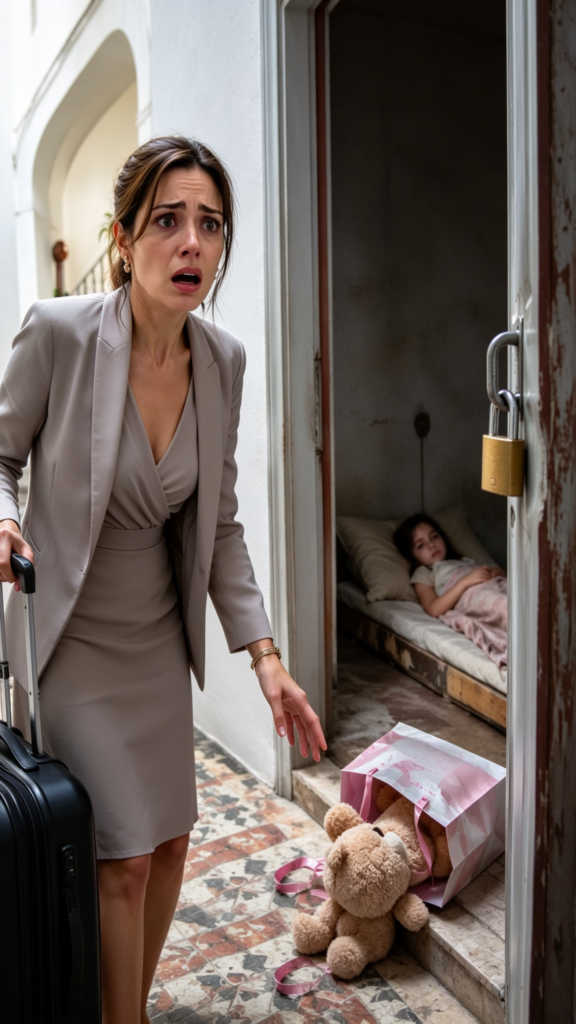
At the back was a wooden door with a new lock. Marisol pulled it with all her strength until the screw broke.
She opened it.
Descended eight dark steps.
And there, on a dirty mat, next to a bucket and a dry plate, was Renata.
Thin, pale, with tangled hair, and a bicycle chain tied to her ankle.
Marisol fell to her knees.
—Reni… my love… it’s Mommy.
The girl opened her eyes slowly.
She looked at her like she was a stranger.
And when Marisol saw the dark bruise around her ankle, she understood that the true horror was just beginning.
PART 2
Renata didn’t scream when Marisol broke the chain with some old pliers she found hanging on the wall.
Nor did she cry when Don Chuy called 911.
That was what destroyed Marisol the most: her daughter no longer reacted like a child. She stayed still, arms glued to her body, waiting for the next punishment even though there was no one left to punish her.
When the paramedics lifted her into the ambulance, Renata didn’t ask for water, food, or her grandmother.
She just stared at the open door of the house.
As if she couldn’t believe there was finally an exit.
Marisol climbed in with her. She carefully took her hand, but the girl didn’t squeeze back.
—I’m here now, Reni. No one’s going to put you back down there again.
Renata blinked, but didn’t respond.
At the Civil Hospital of Guadalajara, Doctor Méndez requested that no one enter the examination room for nearly four hours. When she finally came out, her face was hard, the kind of face that doctors wear when they’ve seen too much.
—Renata weighs 15 kilos.
Pilar rushed in and leaned against the wall.
—She’s 7 years old—Marisol said, as if the doctor could have made a mistake.
—We know. She has severe malnutrition, anemia, dehydration, an infection in her ankle, old marks on her wrists, healed bruises, and a poorly treated fracture in her collarbone.
Marisol felt the floor drop beneath her.
—And her voice?
The doctor took a deep breath.
—She can speak. But she doesn’t want to, or she can’t yet. Sometimes a child goes silent because it was the only way they could survive.
That night, Marisol delivered everything to the Prosecutor’s Office: transfer receipts, messages, audios, emails, photos, video call screenshots. For five years, she had sent 30,000 pesos each month.
More than 1,800,000 pesos.
Money that was supposedly for private school, food, clothing, doctors, dance classes, and a psychologist.
None of that existed.
The experts entered Alicia and Ramiro’s house the next day. On the upper floor, they found Renata’s room.
It was perfect.
White bed, pink blanket, arranged dolls, ironed dresses, tagged shoes, new notebooks, a unicorn backpack, and even a framed photo of the girl smiling.
But there were no recent traces.
No worn clothes.
No toothbrush.
No smell of childhood.
It was a set.
A room staged to take photos and deceive Marisol from the other side of the world.
Then they found a box under Alicia’s bed. Inside were receipts from jewelry stores, payments for a truck, plane tickets, cosmetic treatments, brand bags, and deposits to Óscar’s account.
Pilar saw the documents and swore.
—No wonder that loser never worked.
Marisol said nothing.
She was still waiting for Óscar to appear with an explanation, with shame, with fear, with something that resembled humanity.
He arrived at the hospital on the third day.
Wearing ripped jeans, white sneakers, and an open shirt as if he had just come from a meal. He didn’t first ask about Renata. He asked about the complaint.
—Marisol, we need to think carefully about what you’re doing.
Pilar stood in front of him.
—Are you really going to say that? Your daughter was chained up, dude.
Óscar took off his sunglasses.
—I didn’t know.
Marisol looked at him for the first time without love, nostalgia, or visible rage. Just with a cold exhaustion.
—Did you never see your daughter in five years?
—My mom said she was fine.
—And you believed her?
—You believed her too.
The statement hit like a stone.
Marisol felt the blow where it hurt the most. Yes, she had trusted. Yes, she had left. Yes, she had left Renata in the hands of the wrong family.
But she didn’t buy a chain.
She didn’t close a door.
She didn’t use money meant for food to pay for a catamaran.
Óscar tried to draw closer.
—We can fix this as a family.
Marisol took a step back.
—My family is in that bed. I still don’t understand what you are.
The twist came two days later.
A grocery store across from the house had cameras pointing to the street. The owner, a woman named Bety, came forward to testify because her conscience weighed heavy.
The recordings showed Óscar entering the house several times over the past two years.
Not once.
Not by accident.
Several.
In one video, he entered with a bag of rotisserie chicken and two sodas. He came out 18 minutes later without looking back.
In another, he arrived at night with Ramiro and they carried black bags to a truck.
In yet another, Alicia handed him cash at the gate.
When the prosecutor showed him the footage, Óscar stopped pretending.
But the worst was yet to come.
Don Chuy handed over an audio recorded from his patio months earlier. He had saved it because one night he heard a girl crying and wanted to have proof, but fear overtook him.
In the audio, Alicia’s voice could be heard:
—Óscar already knows Renata is down there. He says that as long as Marisol keeps sending, it’s better not to touch anything. That woman is far away and pays on time. The girl doesn’t spend that much.
Marisol listened to the phrase sitting in a chair at the hospital.
She didn’t scream.
She didn’t cry.
She just stared at her hands.
Those same hands that had washed elderly bodies in Spain, that had changed the diapers of strangers, that had cleaned other people’s homes to send money to her daughter.
Meanwhile, her daughter was eating leftovers in a basement.
Alicia and Ramiro were arrested at Cancun Airport upon returning from their trip. They came back bronzed, with beach hats, all-inclusive hotel bracelets, and four suitcases full of purchases.
When they were told they were arrested for child abuse, illegal deprivation of liberty, and fraud, Alicia didn’t ask if Renata was alive.
She asked:
—Who opened my house?
That question haunted Marisol for weeks.
It wasn’t “How is my granddaughter?”
It wasn’t “I want to see her.”
It was fear that their secret had been discovered.
Renata spent 26 days in the hospital. At first, she hid bread under the sheet. If a nurse closed the door, her body became rigid. If she heard keys, she covered her ears. If someone raised their voice in the hallway, she would wet herself without being able to help it.
Marisol learned a new rule to live by.
—Open doors—she always said—. No one closes anything without telling her.
Pilar became her shadow. She brought clean clothes, coffee, papers, lawyers, and silence when silence was needed.
She also defended her when social media began to tear her apart.
Because the story went viral.
“Where was the mother?”
“She’s to blame too.”
“A real mother doesn’t leave her daughter for 5 years.”
Marisol read those comments at dawn, locked in the hospital bathroom, biting her knuckles to avoid making noise.
One night Pilar found her sitting on the floor.
—They’re right—Marisol whispered—. I should have come sooner.
Pilar crouched in front of her.
—Yes, you should have checked more. Yes, you trusted too much. But don’t confuse error with monstrosity. You didn’t lock her up. You didn’t sell her for money. You didn’t leave her without water to go to Cancun.
Marisol closed her eyes.
—But she paid for my mistake.
—Then now pay her back with your whole life taking good care of her.
In the first hearing, Alicia appeared in a black dress, a rosary in hand, and a martyr grandmother’s face. Her lawyer tried to argue that she was a sick woman, tired, overwhelmed by a girl with “difficult behaviors.”
The prosecutor didn’t debate.
She just projected the evidence.
She showed the transfers from Marisol.
She showed the messages where she asked to talk to Renata.
She showed Alicia’s responses: “She’s sleeping,” “She’s in school,” “She’ll send you an audio tomorrow,” “Don’t be intense, dear.”
She showed the chain.
She showed the mat.
She showed the bucket.
She showed the note about the trip to Cancun.
Then she showed the bank statements: Marisol’s money turned into nails, jewelry, restaurants, truck payments, kitchen renovations, and vacations.
Ramiro cried when he heard the years of prison he could face.
He didn’t cry when they mentioned Renata’s 15 kilos.
Marisol understood something horrible: some people don’t regret the harm done; they regret being discovered.
Óscar tried to save himself by saying he never went down to the basement. That he only visited his parents. That his mom was controlling. That he was a victim too.
Then the last message appeared.
A cousin of Alicia’s delivered it, tired of the family wanting to cover everything up.
Óscar had written to his mother eight months before:
“Tell Marisol that Renata has chickenpox or something. If she comes and sees her like this, the money ends.”
That day, Marisol stopped searching in him for the father Renata deserved.
He didn’t exist.
The trial lasted six weeks.
Alicia received 19 years in prison for aggravated child abuse, illegal deprivation of liberty, fraud, and neglect.
Ramiro received 12 years.
Óscar accepted a plea deal for concealment, fraud, and neglect. He received 8 years and permanently lost parental rights.
When the judge granted full custody to Marisol, Pilar cried, embracing her.
Marisol couldn’t cry.
Justice sounded like a hammer, papers, and signatures.
But it didn’t return birthdays.
It didn’t erase nights in a basement.
It didn’t make Renata remember what it was like to trust.
Months later, Marisol rented a small apartment in Tlaquepaque. It had large windows, light walls, and no door with a lock on the inside.
Renata still spoke little. She slept with the light on. She always sat near the exit. She kept cookies in the drawers. She asked three times a day where the keys were.
The therapist explained to Marisol:
—Don’t force her to heal quickly. They took control over everything from her. Now she needs to decide small things.
So Marisol learned to ask for permission.
—Can I sit here?
—Do you want soup or rice?
—Do you prefer the window open or closed?
—Can I comb your hair?
Sometimes Renata said no.
And Marisol accepted.
Because loving was also about not invading.
Many nights, the girl didn’t want to sleep in the bed. She lay down on the floor, wrapped in a blanket. Marisol put another blanket a meter away and stayed close, without touching her, without demanding anything.
One Thursday afternoon, while Pilar made quesadillas in the kitchen, Renata was coloring a yellow house.
Suddenly she looked up.
—Mom.
Marisol froze.
She didn’t run.
She didn’t scream.
She didn’t hug her suddenly.
She just breathed as if the world had just gifted her a little piece of life.
—I’m here, my love.
Renata pointed to the door of the apartment.
—Will it stay open?
Marisol nodded.
—As long as you want.
The girl tightened her crayon.
—And you?
Marisol slowly crouched until she was in front of her.
—I’ll stay too.
Renata didn’t smile, but her shoulders dropped slightly. For anyone else, it would have been nothing. For Marisol, it was a miracle.
Weeks later, Pilar took both of them to an animal shelter in Tonalá. Renata walked among cages without getting too close. She stopped in front of a honey-colored mixed-breed puppy, thin, silent, with scared eyes.
—That one—she said softly.
They named her Canela.
Canela didn’t bark loudly. She didn’t jump. She didn’t demand affection. She just lay down close to Renata, as if she understood that some wounds need quiet company.
One night, Canela slowly climbed onto the bed. Renata looked at her for a long time. Then she lay down next to her, on the mattress, for the first time since leaving the hospital.
Marisol cried at the door, covering her mouth.
Today Renata is still healing.
Sometimes she saves bread.
Sometimes she asks if someone can go down the stairs.
Sometimes she freezes when she hears a bicycle chain on the street.
But she also draws enormous suns, apartments with open windows, and a honey-colored puppy lying next to a girl.
Recently, she drew three women holding hands: her, Marisol, and Pilar. Below, she wrote in crooked letters:
“My home.”
Marisol doesn’t say that everything is fine, because that would be a lie. There are pains that don’t disappear; they only learn to hurt differently.
But each day Renata moves a little further away from that room underground.
And if this story left anything, it was an uncomfortable truth: family is not proven by last names, rosaries, or pretty phrases in the kitchen. It’s proven by served food, open doors, uncomfortable questions, and adults who don’t play dumb when a child is fading away.
Marisol trusted the wrong people.
Renata paid a price no child should pay.
But Marisol came back.
She searched for her.
She pulled her out from below.
And the first time Renata took her hand again, she did so with fear, but also with a tiny hope.
—Don’t leave—she whispered.
Marisol hugged her carefully, like one hugs something that still trembles.
—Never again.
And this time, Renata believed her.