The party was perfect.
That was the first thing everyone said when they walked in. Perfect. Diane had heard it so many times in the past hour that the word had started to feel hollow, like a coin worn smooth from too many hands.
But she smiled each time. Touched their arms. Said "I'm so glad you could make it" the way she'd been saying it for twenty years at every dinner party, every holiday gathering, every one of Richard's work functions that she'd transformed from an obligation into an occasion. That was what she did. What she was good at.
The ballroom — she kept calling it the great room to the caterer, because ballroom felt excessive, even for this — was strung with warm Edison lights that she'd spent forty minutes adjusting with the venue's lighting technician until they landed exactly one degree warmer than ordinary. The centerpieces were ranunculus and eucalyptus, Richard's mother's favorites, because Diane had thought it would be a nice touch even though Richard's mother had been dead for six years and probably no one else would notice. The champagne was the French label his college roommate had once mentioned offhandedly at a dinner in 2019. She'd written it in her phone notes that same night.
Three months of planning. Every detail.
Eighty guests.
Richard stood near the bar in his charcoal suit, silver at his temples catching the Edison light, laughing at something his business partner was saying. He had a way of laughing that made everyone nearby feel like they were part of the joke — open-faced, head tilting back slightly, the kind of laugh that said I am exactly where I want to be. Diane had loved that laugh for twenty-two years. She still did. She watched him from across the room and felt the particular pride of a woman who has built something with a person and can see it clearly.
We built this, she thought. All of this.
At nine o'clock, Richard gave a toast.
He talked about turning fifty without self-pity, which some men couldn't manage. He thanked his business partners, his oldest friends, his children — Marcus, who was away at university and had sent a video that played on the screen behind the bar, and Lily, who was sixteen and standing near the dessert table looking simultaneously mortified and proud, the way teenagers do when their parents are being human in public. He talked about the years, about what they'd taught him, about how he didn't regret the choices that had brought him here.
Then he looked at Diane.
"I want to say something about my wife," he said.
The room got quiet. People always got quiet when Richard spoke directly. He had that quality — the room reorganized itself around his attention.
"Twenty-two years ago," he said, "I was a man with good intentions and not much else. No plan. No patience. No idea what I actually wanted." He paused. Smiled at her. "She gave me a blueprint. And then she built it with me, better than I would have done alone. Every single thing I have that I'm proud of —" he gestured around the room, at all of it, at the Edison lights and the ranunculus and the eighty people who'd shown up because he was worth showing up for "— has her fingerprints on it."
Someone near the back started crying. Diane saw it out of the corner of her eye — a woman from their old neighborhood, hand pressed to her mouth.
Diane raised her glass.
She was going to cry too, in a moment. She could feel it building behind her sternum, the good kind, the kind that comes from being seen.
"Happy birthday," she said across the room.
"Happy birthday," the room echoed.
He held her gaze for one more second, the way he did — that private look he reserved for her, the one that said you and I, we know something the rest of them don't.
Then someone refilled his glass and the room started talking again and Diane turned to the caterer who was hovering near her elbow to ask about the second dessert course timing.
It was 9:14 PM.
At 9:31 PM, the front door opened.
Diane was crossing the entrance hall toward the kitchen when she heard it — not the door itself, but the sound of a conversation pausing the way conversations pause when something unexpected appears in a doorway.
She turned.
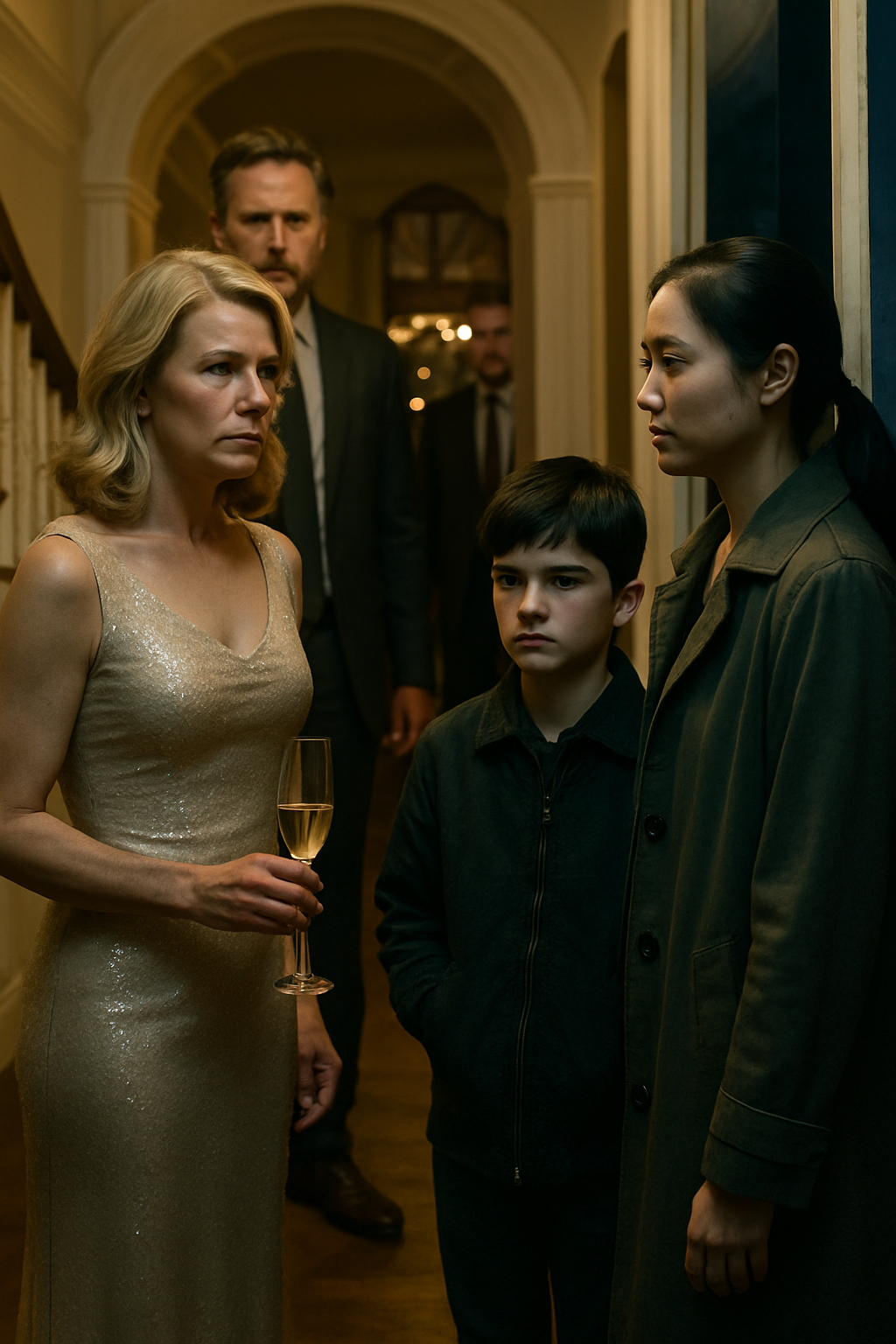
A woman was standing at the entrance.
Dark hair in a simple ponytail. A practical coat over a dress — the kind of dress you wear when you're trying to look presentable but you don't want to look like you're trying. Not a party dress. Not someone who'd been told this was a party.
She was thirty-something. Not unattractive. Not familiar.
And beside her — very close, the way children stand when they're uncertain of a room — was a boy.
Dark hair. About ten years old.
Diane's first thought was that they had the wrong address.
Her second thought — slower, arriving from a direction she hadn't expected — was about the boy's face.
She put down that thought immediately, the way you move a fragile thing out of the way before you've fully understood why.
"I'm so sorry," Diane said, moving toward them with her professional hostess warmth, the smile already arranged. "Are you looking for the Foster party?"
The woman looked at her directly. Her expression was careful — not unkind, but braced. The expression of someone who has rehearsed a conversation many times and is now standing at the start of it.
"Yes," she said. "I'm Paula. This is Noah." A pause. "I need to speak to Richard."
The noise of the party came from behind Diane like a wave she was standing in front of.
She kept her smile. Twenty-two years of practice.
"Of course," she said. "And you are — are you a colleague of his?"
Paula looked at her for a moment — one beat too long, one beat in which something was communicated that Diane received without yet being willing to process.
"No," Paula said. "I'm not a colleague."
"A friend?"
"I —" Paula stopped. Looked down at the boy briefly, then back at Diane. "I think it would be better if I spoke to Richard."
Diane looked at the boy then. Really looked.
He was standing with his hands in his jacket pockets and his chin slightly down, the posture of a child who has been told to be quiet and still and is trying very hard to comply. He was looking at the floor.
Then he looked up.
He had dark eyes. And Richard's jaw — the particular strong line of it, the slight squareness — and something in the arrangement of his features that was the specific way Richard's features arranged themselves when Richard was uncertain about something.
Diane had seen that expression on Richard's face ten thousand times.
She had never seen it on a child who was not her own.
"One moment," she said.
She kept her voice even. She had trained herself over decades to keep her voice even.
She walked back into the party.
She found Richard near the far end of the room, laughing again, champagne in hand. She touched his arm — the light touch she always used when she needed to interrupt without creating a scene — and leaned up to say quietly, near his ear:
"There's a woman at the door. Her name is Paula. She says she needs to speak to you."
She watched his face.
She had known this man for twenty-two years. She knew every register of his face — the way his eyes moved when he was about to disagree with someone, the way his jaw set when he was tired but didn't want to show it, the specific micro-expression he made when he heard something he hadn't prepared himself to hear.
She had never seen his face do what it did in the next three seconds.
It was not guilt, exactly. Not shock, exactly.
It was the expression of a person who has been waiting, for a very long time, for a specific thing to arrive — and has almost convinced themselves it won't — and is now watching it walk through the door.
Recognition. And beneath it, something that looked horribly like relief.
It lasted three seconds. Then his face closed.
"I'll go handle it," he said, already turning.
"She has a child with her," Diane said.
He stopped.
"A boy," she said. "About ten."
Richard did not turn around. She was looking at the back of his charcoal jacket.
"I'll go handle it," he said again. Quieter this time.
He walked toward the front hall.
Diane stood in the middle of her perfect party and watched the back of his head until it disappeared around the corner.
Then she picked up a glass of champagne from a passing tray. Drank half of it.
Then she went upstairs.
Their bedroom was at the end of the hall. She hadn't been up here since she'd changed her earrings at seven o'clock, before the guests arrived.
She sat on the edge of the bed.
She took out her phone.
She opened their joint banking app — the one she managed, because Richard had never been interested in the day-to-day, and she'd always been the one who understood where things were and what they were for. This had been, for two decades, something she'd thought of as her competence. Her contribution.
She typed in the password.
She went to the transaction history.
She searched the outgoing payments. Filtered by recurring. Sorted by date.
The first one she found was from eleven days ago.
$1,400. The 18th of the month. Labeled: Foster Insurance — Auto Draft.
She had never questioned it. She paid their insurance. Of course she did — she managed everything. She remembered setting this one up years ago, adding it to the list.
She scrolled back.
The 18th of the month. Every month.
She scrolled back one year. Two years. Five years.
Her hands were steady. She noticed this distantly — her hands were completely steady.
She kept scrolling.
Seven years. Eight.
$1,400. The 18th of every month. For ten years.
One hundred and forty-four payments.
She did the math in her head without meaning to. She'd always been good at mental arithmetic.
$201,600.
She put the phone down on the bed beside her.
She looked at the ceiling. The same ceiling she'd looked at ten thousand mornings. The same water stain near the window she'd been meaning to have someone look at for three years.
Somewhere below her, eighty people were at a party she had spent three months building.
Somewhere below her, her husband was talking to a woman named Paula and a boy who had his jaw.
She picked the phone back up. Looked at the screen again. One hundred and forty-four payments. Ten years. The boy was ten.
She sat there for a long time. Long enough for the sound of the party to rise and fall below her — a burst of laughter, a shift in the music, the particular register of a crowd that doesn't know anything is wrong.
Then she stood up.
She smoothed her champagne-colored dress — she had bought it specifically for this party, had tried on four others before settling on this one, had thought when she put it on tonight that she looked, if not young, then at least like the best version of herself.
She looked in the mirror.
She looked like a woman who had just found out something she couldn't un-find out.
She went back downstairs.
The party was still going. Of course it was. Parties don't stop for private revelations.
She could see, from the bottom of the stairs, that the front hall was empty. Paula and the boy were gone. Or in another room. She didn't look for them.
She found Richard near the bar. He was standing slightly apart from the group he'd been with, holding a fresh glass he hadn't drunk from, looking at nothing with the careful blankness of a man who is managing his face.
She walked to him.
She picked up a glass of champagne from the bar.
She held it out to him.
He looked at it. Looked at her.
She kept her expression even. Her voice even. Decades of practice.
"Tell them," she said.
He blinked. "What?"
She looked at the room. At the eighty people — their friends, his colleagues, the woman from the old neighborhood who had cried at his toast, his business partner, his daughter standing by the dessert table. All of them laughing, talking, in the middle of a celebration she had built for him.
"Tell them," she said again.
"Diane —"
"You gave a toast tonight," she said, still quietly, still evenly, still with the champagne flute extended toward him. "About everything you've built. About your blueprint." She paused. "Tell them where $201,600 went."
He looked at her. His face — the face she knew so well — was doing something she had never catalogued before. A kind of undoing.
"This isn't —" he said. "This isn't the place —"
"No," she agreed. "It isn't."
She set the champagne glass down on the bar without drinking from it.
She straightened.
"But it is my party," she said. "I built it. My fingerprints are on every inch of it." She held his gaze for one moment — the private look, the one they shared, the one that said you and I, we know something. "Now I know something too."
She turned and walked back into the party.
She did not leave. That was the first decision she made, there at the bottom of the stairs with the sound of the party around her like water.
She did not leave, and she did not cry, and she did not pull Richard aside and have the conversation that needed to happen — not tonight, not here, not in front of the caterer and the eighty guests and Lily by the dessert table who was sixteen and should not have to know any of this.
She moved through the party the way she always moved through the rooms she built — with purpose, with attention, with the small acts of maintenance that kept everything running. She refreshed drinks. She redirected a conversation that was becoming too political. She found the caterer and confirmed the timing of the third course. She stood with the woman from the old neighborhood who had cried at Richard's toast and talked for ten minutes about that neighborhood, about the old houses, about how quickly things change.
She was present for all of it. She was somewhere else for all of it.
Richard moved through the party too. She could feel where he was in the room without looking directly at him — had always been able to, the way you know where a storm is by the pressure change. He was performing normally. Laughing at the right moments, refilling glasses, doing the things that husbands do at parties. He did not look at her too much. He did not avoid looking at her too pointedly.
He had been doing this, she understood now, for ten years. Moving through rooms, performing normally, containing the second life inside the first one. He was practiced at it in a way she hadn't known to recognize.
At 10:45 PM, the first guests began to say their goodbyes. By 11:15, it was down to the last handful. By 11:30, the caterers were stacking plates and the venue staff was beginning the quiet disassembly of everything she'd spent three months creating.
Lily kissed her on the cheek at 11:20 and went upstairs. Richard shook the last guest's hand at the door.
And then there were just the two of them, and the caterers working efficiently around them, and the Edison lights still glowing warm over the empty tables.
She sat in the kitchen.
Not the great room, not the formal sitting room — the kitchen, at the ordinary table where they ate breakfast, where Lily did homework, where the mail piled up for days at a time because neither of them got around to sorting it.
She sat there with a glass of water and waited.
Richard came in after a few minutes. He sat down across from her. He'd loosened his tie. He looked, for the first time tonight, his age.
"I don't know how to start," he said.
"You start with her name," Diane said.
He nodded. "Paula Chen. We worked together. Briefly. 2015."
"And the boy."
"Noah." A pause. "He's mine."
She had known this, had known it since the bedroom, since the banking app, since she'd looked at the boy's face in the doorway. Knowing it and hearing it were still different things.
"Ten years," she said.
"Yes."
"You've known since —"
"Since she was pregnant. She contacted me. I —" He stopped. Pressed his hands flat on the table. "I wasn't part of their life. That was the arrangement. Monthly support, and I stayed out of it, and she didn't —" He stopped again.
"She didn't tell me," Diane said.
"No."
"And the insurance label."
He looked at her.
"On the payments," she said. "From our joint account. For ten years. You labeled it insurance."
Silence.
"I didn't want you to —"
"To know," she said. "That you had a child. That you'd had an affair. That you'd been taking money from our joint account for a decade to pay child support for a son I didn't know existed."
Richard said nothing. There was nothing to say that would help.
"She came tonight because Noah asked," he said after a long moment. "He's almost eleven. He wanted to —" His voice shifted slightly. "He wanted to meet his father before he turned eleven. That was the reason she gave. She didn't mean to cause —"
"Don't," Diane said.
He stopped.
"Don't tell me about what she meant," she said. "Not tonight."
He nodded.
They sat there for a while. The caterers finished in the other room — she heard the last of them leave, heard the door close. The house settled into the silence that houses settle into when they've held a crowd and the crowd has gone.
"What do you want to do?" Richard said finally.
She looked at him across the kitchen table. The table where they'd eaten ten thousand breakfasts. The man she'd built twenty-two years with — and she had built it, he'd said so himself tonight in his toast, in front of everyone, and he had not been lying when he said it. It had been true. And still.
"I want you to sleep in the guest room," she said. "Tonight."
"Diane —"
"That's what I want tonight," she said. "We can talk tomorrow. Next week. We can figure out what happens next. But tonight, I want you to go upstairs and sleep in the guest room."
He looked at her for a long moment. Then he stood, slowly, like a man carrying the weight of something he'd been setting down and picking up for years.
"I'm sorry," he said.
"I know," she said.
He left the kitchen.
She sat there alone with her glass of water, in her champagne-colored dress, in the kitchen of the house they'd built together, listening to the sound of his footsteps on the stairs.
She did not cry until after she heard the guest room door close. And then she cried for a while — quietly, the way she'd learned to do things quietly over twenty-two years of keeping the household running without drama, without fuss, without drawing attention to the parts that were hard.
When she was done, she washed her face at the kitchen sink. Dried it with the dish towel that had been hanging on the oven handle since Tuesday. Put the towel back.
She sat down again.
She thought about Noah. The way he'd stood in the doorway, close to his mother, hands in his jacket pockets, looking at the floor of a house he didn't belong to yet. He was ten years old. Almost eleven. He hadn't chosen any of this — not the parents, not the arrangement, not the party he'd walked into, not the woman in the champagne-colored dress who'd greeted them at the door with a practiced smile and not yet known why her hands would be shaking two hours later.
He had asked to meet his father before he turned eleven.
She turned that over in her mind for a long time.
She thought about what it meant to be a woman who organized everything. Who kept track of the insurance payments, the dinner reservations, the lighting angles, the champagne labels, the emotional weather of every room she walked into. Who noticed every detail except, for ten years, the one that mattered.
Or maybe that was wrong. Maybe she had noticed, in the abstract way you notice something you don't want to know — the slight distance that had never fully closed in 2015, the month he'd been strange about money, the quality of certain silences. She had noticed and not followed the noticing anywhere, because some part of her had understood that following it led somewhere she wasn't ready to go.
She couldn't be angry at herself for that. Not tonight. Maybe not ever. You survive the way you survive.
She opened her phone again. Not the banking app this time.
She opened her contacts and found the number of her lawyer — Sandra, who she'd known for fifteen years, who was direct and thorough and good. She typed a message: Need to talk. Nothing urgent tonight, but soon. This week if possible.
She sent it.
Then she opened her calendar. Looked at the weeks ahead — the dinners, the appointments, Lily's school events, the trip they'd planned for August. All the structure she'd built and maintained.
She started, methodically, to make notes.
Not decisions yet. Not the final shapes of things. But the first marks of a woman beginning to draw her own blueprint — separate from the one she'd handed someone else to build with, and this time in her own name, in her own handwriting, for a house that was going to be whatever she decided to make it.
The Edison lights in the great room had been turned off by the caterers. The ranunculus centerpieces were in neat rows on the kitchen counter, waiting for her to decide if she wanted to keep them.
She reached out and touched one of the flowers. Pulled a petal, turned it between her fingers.
Richard's mother's favorites. For a woman who had been dead six years and whom no one else had thought to include.
She had noticed. She had always noticed.
It was not nothing, to be the person who noticed. She had built things with that quality — real things, lasting things, a life with fingerprints on every inch of it.
She was going to build something else now.
She didn't know yet what it was. But she put down the petal, straightened in her chair, and picked up her phone, and she began.