PART 1
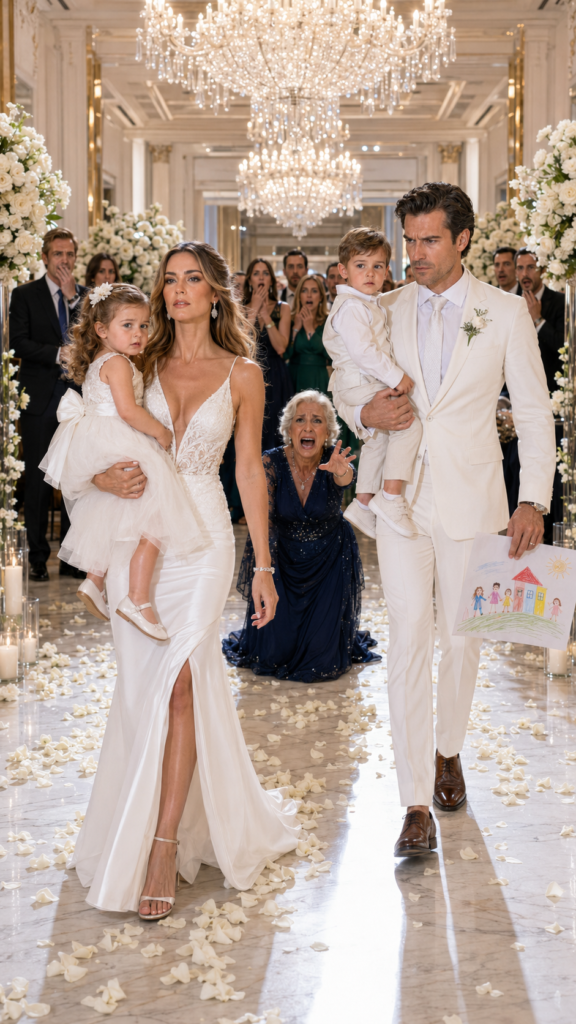
Valeria Montes and Rodrigo Cárdenas’s wedding was held in an old mansion in Coyoacán, with bougainvillea hanging from the balconies, white candles, discreet mariachi music, and black SUVs parked along the cobblestone street.
There were businessmen, congressmen, judges, nightclub owners, notaries, women with huge necklaces, and men who smiled too little to be at a party.
Everyone toasted.
Everyone pretended that the Cárdenas name only meant clean money, successful construction firms, and luxury restaurants.
Rodrigo was no ordinary man.
His family had public works contracts, bars in Polanco, warehouses in Tultitlán, and dangerous friends that no one dared mention out loud.
Valeria entered that world at 29, wearing a champagne-colored dress and holding the silly yet beautiful idea that love could warm a man used to being in charge.
The only person who treated her like family from the start was Don Eusebio, Rodrigo’s grandfather.
That night, while everyone was distracted with the cake, the old man took Valeria’s hand and whispered, “Don’t let them turn you into a decoration, girl.”
Valeria smiled, not fully understanding.
She thought it was just a sentimental old man’s phrase.
Eight months later, Don Eusebio died.
And the house in Bosques de las Lomas began to close in on her like a heavy door.
In that mansion, everything had an owner—except for her voice.
Breakfast was at 7. The flowers had to be white. Guests had to be approved 24 hours in advance. Loud music was prohibited. Valeria’s family photos couldn’t be displayed in the main room because, according to her mother-in-law, “they broke the harmony.”
The staff called her Mrs. Cárdenas, but before they obeyed, they looked to Esteban, the head of security.
Rodrigo never shouted.
That was the worst part.
His indifference was fine, polite, immaculate.
Valeria learned to read him like someone learns to walk in a dark house.
She knew when not to speak to him. She knew when to leave mezcal in the study. She knew which tie he would wear for each meeting. She knew which partner hated spicy food, which congressman was allergic to shellfish, and which wife needed a friendly call to maintain an alliance.
Rodrigo never asked how she knew all that.
He just assumed the world worked because he commanded it.
One night, after a private dinner in Santa Fe, Valeria returned home early. She had forgotten a folder with notes about an investor from Monterrey.
As she passed by the study, she heard the voice of Tomás, Rodrigo’s friend.
“I’m telling you straight, man. Valeria’s got a different look now. What are you going to do if she gets tired and leaves one day?”
Valeria froze, hand resting against the wall.
Rodrigo let out a low laugh.
“Leave? Tomás, come on. No one’s indispensable.”
Silence ensued.
Then he added, with a calmness that shattered something inside her:
“If she leaves, life goes on. With her or without her.”
Valeria didn’t step in.
She didn’t confront him.
She didn’t make a scene.
She went upstairs, opened a small suitcase, and packed simple clothes, a photo of her mother, a blue notebook, and some worn-out sneakers.
She left the jewelry.
She left the dresses.
She left the expensive perfumes.
At 2:14 AM, she placed her wedding ring on the table where Rodrigo left his cufflinks.
Then she slipped out through the service door.
No guards.
No driver.
No goodbyes.
At 6:09, Rodrigo found the ring glimmering under the cold light of dawn.
And for the first time in three years, the perfect house made a horrible noise: the silence of a woman who no longer intended to return.
PART 2
Rodrigo Cárdenas didn’t know how to lose.
He knew how to buy, pressure, negotiate, intimidate, and wait for everything to return to its place with just a flick of his finger.
So when he called Valeria’s cellphone and heard that the number no longer existed, he didn’t feel fear at first.
He felt anger.
He called again.
Nothing.
He summoned Esteban.
“Where’s my wife?”
The head of security lowered his gaze.
“We don’t know, sir.”
“How can you not know? That’s what I pay you for.”
“She left through the service door. Without security. Caught a cab on the corner.”
Rodrigo clenched his jaw.
“What did she take?”
From the bedroom entrance, Chayo, the cook, answered with swollen eyes.
“What was truly hers.”
Rodrigo looked at her as if he didn’t understand.
“This was all hers.”
Chayo raised her face.
“No, sir. If it had been hers, it wouldn’t have fit in one suitcase.”
The phrase hung in the air like a slap.
Rodrigo didn’t reply.
He ordered the review of cameras, booths, routes, and taxi payments. By mid-morning, Esteban found the info: Valeria had gotten off in the Santa María la Ribera neighborhood, in front of an old bakery.
“Bring her back,” Rodrigo said.
Chayo slammed a pot on the stove.
“If you bring her back by force, I’ll personally talk to the reporters. And I’ll tell them how to destroy a woman without touching a hair.”
No one moved.
Not Esteban.
Not the driver.
Not the cleaning lady.
Rodrigo understood something that burned more than any threat: in his own house, everyone had seen Valeria’s pain but him.
The following days were an elegant disaster.
The mansion still smelled of white flowers, but nothing was working.
The coffee was too strong. The schedule piled up. An investor from Monterrey canceled a lunch because no one remembered his wife was diabetic. A notary got upset because he didn’t receive the birthday gift Valeria sent every year on Rodrigo’s behalf.
Rodrigo exploded with Abril, his assistant.
“When did Valeria start meddling in my affairs?”
Abril swallowed hard.
“Before you called them affairs.”
“Explain.”
She dropped a folder on his desk.
Emails.
Notes.
Messages.
Lists of names, dates, quirks, pending favors, timely apologies.
Valeria was everywhere.
She had saved a negotiation with Spaniards because she remembered one of them hated being called by his mother’s surname.
She had calmed a humiliated wife at a dinner in Polanco.
She had discovered that a supplier from Cancún was a front for a rival.
She had prevented Rodrigo from unknowingly insulting the sick child of a key official.
Rodrigo read until the words felt heavy.
Valeria wasn’t a quiet woman.
She was a woman carrying a complete structure while he bragged about the building.
That night, he entered the back room.
Not the massive bedroom where everything was beige, marble, and cold.
He entered the small room Valeria had turned into a refuge, with yellow curtains, underlined books, a small Virgin of Guadalupe, and a photo of her mother in a cheap frame.
On the desk lay the blue notebook.
Rodrigo knew he shouldn’t open it.
He opened it.
Day 241.
Today Rodrigo asked me if I wanted to go to dinner.
I said yes.
At the restaurant, he spoke six times on the phone and didn’t notice I didn’t eat a thing.
I didn’t want flowers.
I wanted him to ask me why.
He turned the page.
Day 508.
His mother said my family was “too simple” to sit at certain tables.
Rodrigo heard her.
He said nothing.
Sometimes the silence of the one you love weighs more than the insult from someone who despises you.
Another page.
Day 982.
I think I’m becoming invisible.
Chayo looks at me.
Abril looks at me.
Don Eusebio looked at me.
My husband passes through me like I’m smoke.
Rodrigo closed the notebook.
For the first time, he understood that cruelty could also wear a suit, speak softly, and show up on time for dinner.
Valeria was now living above a bakery in Santa María la Ribera.
The apartment was small, with crooked walls, a window that didn’t close well, and a shower that sounded like it was about to fall.
Valeria loved it.
Every morning smelled of fresh bread and cheap coffee.
She bought two chipped mugs at a flea market, hung her yellow curtains, and placed her mother’s photo in the living room without asking for anyone’s permission.
Her friend Jimena arrived with basket tacos, a toolbox, and a bottle of wine costing 90 pesos.
“Did you really trade a mansion with a pool for this apartment that feels like it breathes funny?”
Valeria let out a tired laugh.
“Yes.”
“Girl, that’s leaving patriarchy behind, jacuzzi and all.”
Valeria laughed harder.
Then she cried.
Jimena didn’t ask for explanations.
She just hugged her on the floor, between boxes and grocery bags.
Two weeks later, Rodrigo appeared in front of the bakery.
He was alone.
No van.
No visible guards.
No expensive watch.
Valeria came out with sweet bread, tomatoes, and a bouquet of sunflowers.
Seeing him, her smile vanished.
“How did you find me?”
“Chayo.”
Her face hardened.
“Don’t you dare mess with her.”
“I didn’t blame her. I asked her what you needed, not where you were. She told me you needed me to stop pretending nothing happened.”
Valeria tightened her grip on the bag.
“What do you want?”
Rodrigo looked down.
“To apologize. And to tell you that you were right to leave.”
She didn’t respond.
“I thought giving you a house, a driver, and credit cards was protecting you. I thought not shouting at you made me good. I thought my coldness was character, not cowardice.”
Valeria looked at him with restrained rage.
“And you only discovered that now?”
He took a deep breath.
“I read your notebook.”
Valeria’s eyes filled with fury.
“You had no right.”
“I know.”
“No. You don’t know. You ignored me for three years and then entered the only place where I could still tell the truth.”
Rodrigo didn’t defend himself.
“Sorry.”
“Sorry for breaking me or for me leaving and not fixing your life anymore?”
The question left him breathless.
“At first, for the latter. Now I’m ashamed to admit it. But yes. It hurt to lose what you did for me before I realized I lost you.”
Valeria swallowed hard.
“Good to see you’re finally honest. Now let me pass.”
At that moment, a gray sedan stopped at the curb.
Rodrigo shifted positions.
“Valeria, stand behind me.”
“What?”
Three men got out.
The first was Iván Salcedo, nephew of a nightclub owner who had been trying to get into the Cárdenas contracts for months.
Iván smiled.
“Mrs. Cárdenas. What a lovely hideaway.”
Rodrigo stepped forward.
“Get lost.”
Iván raised his hands mockingly.
“Easy there. My uncle just wants to talk to the woman who brought the powerful man here all by himself.”
Valeria paled but didn’t back down.
She pulled out her phone.
“Iván Salcedo. Your uncle has three suspended licenses, two warehouses in the name of fronts, and one audit sleeping at the city hall. If this video of you threatening a woman goes up today, tomorrow no official will answer you.”
Iván glanced at the phone.
“You’re making things up.”
The screen was off.
But he didn’t know that.
“Could be,” Valeria said. “Or maybe for three years you all confused me with a vase while I learned names, dates, and debts.”
The man cursed.
He looked at Rodrigo, then back at her.
“This isn’t over.”
Valeria held his gaze.
“This part is.”
The sedan screeched away.
When it disappeared, Valeria trembled.
Rodrigo wanted to hug her.
She raised a hand.
“Don’t confuse danger with trust.”
He stopped.
That boundary hurt him.
But he respected it.
The next day, Valeria went to a divorce lawyer in Del Valle.
Rodrigo arrived because she summoned him.
Not to negotiate love.
To see him sitting in front of the consequence.
“I want a clean divorce,” Valeria said.
The lawyer reviewed the papers.
“There are properties, accounts, investments, and shares in companies.”
“I don’t want your money.”
Rodrigo lifted his face.
Valeria looked him straight in the eye.
“I don’t want to wake up feeling like I still live off you.”
He didn’t argue.
“I won’t fight anything you decide.”
“Is that all?”
“That's all.”
“Not going to offer me a house, a trip, or a huge apology with mariachis?”
Rodrigo smiled sadly.
“No. I already filled you with things to avoid giving you presence. I’m not going to repeat it.”
In the following month, Rodrigo did something no one expected.
He followed through.
He didn’t send jewelry.
He didn’t send roses.
He didn’t send serenades or dramatic messages at midnight.
He returned documents, files, photos, contracts she had prepared with her name erased.
He paid for security for the building but let Valeria choose the company and sign the contract.
Then, at a corporate lunch in Reforma, he asked for the microphone.
“For years, many believed that Valeria Montes was just my wife. I was the first to make that mistake. She held relationships, avoided conflicts, and saved businesses I bragged were mine. My greatest failure wasn’t losing her. It was not seeing her when she was right in front of me.”
The video went viral on Facebook.
Comments exploded.
Some said it was theater.
Others said finally a powerful man admitted what many women lived in silence.
Valeria watched from her apartment, sitting on the floor, with cold coffee.
Rodrigo didn’t say “my wife.”
He didn’t say “come back.”
He didn’t claim her.
That disarmed her more than any gift.
Because for the first time, it didn’t sound like ownership.
It sounded like truth.
The real test came six weeks later, at a Cárdenas Foundation gala at the Soumaya Museum.
Valeria hadn’t planned to attend.
But Abril called her crying.
“The Spaniards asked for you. The Monterrey folks too. And honestly, if you don’t come, everyone will pretend your work never existed.”
Valeria bought a yellow dress.
Bright yellow.
Impossible to ignore yellow.
When she entered the hall, the conversations dropped suddenly.
Rodrigo saw her from the stage.
He stood still.
Finally, he looked at her as she had wanted to be seen since the day of their wedding.
But Valeria didn’t walk toward him.
She walked toward the partners.
For two hours, she greeted, negotiated, corrected data, and occupied the space that had once been denied to her.
Then Regina Cárdenas, Rodrigo’s mother, appeared, covered in pearls and venom.
“How brave of you to come after abandoning your husband. Some women aren’t made for important families.”
Valeria felt the blow.
Rodrigo appeared at her side.
She didn’t speak.
She wanted to see who he was now.
Rodrigo looked at his mother.
“Valeria didn’t fail to belong to this family. This family failed to deserve her. And if you humiliate her again, you won’t lose a daughter-in-law. You’ll lose a son.”
Regina froze.
Valeria felt something shift in her chest.
It wasn’t forgiveness.
Not yet.
But it was a crack in the wall.
Minutes later, the screens in the hall flickered.
A photo of Valeria leaving the mansion with her suitcase appeared.
Then another of Rodrigo in front of his building.
Then a cruel title:
RODRIGO CÁRDENAS’S WIFE ABANDONS HIM: HAS THE KING OF BOSQUES FALLEN?
The hall went silent.
It was a trap.
They wanted to humiliate him, expose her, and turn their pain into a business weapon.
Valeria climbed onto the stage.
Rodrigo tried to stop her with his gaze.
She ignored him.
She took the microphone.
“My name is Valeria Montes. Some know me as Mrs. Cárdenas. Others as the woman who left with a suitcase. And some, apparently, have nothing better to do.”
A nervous murmur spread through the hall.
“Yes, I left my husband.”
Total silence.
“I left because a house can have marble, flowers, guards, and nine bathrooms, and still feel like a tomb. I left because no woman should disappear for a man to feel comfortable in his power.”
She looked at the guests.
“But I won’t allow you to use my decision to measure a man’s strength by his wife’s obedience. My suitcase isn’t gossip. My pain isn’t a tool. And a woman choosing herself doesn’t destroy a family. Sometimes it only stops holding up the lie.”
She handed the microphone to Rodrigo.
He climbed slowly.
“Valeria doesn’t owe anyone explanations. I do. I neglected her. I allowed my surname, my mother, and my arrogance to make her feel alone. She left because she had dignity. And while losing her may be the price I deserve, I’m glad she chose to save herself.”
Chayo started to applaud from the back.
Then Abril.
Then the partners.
Then almost the entire hall.
Rodrigo didn’t take Valeria’s hand.
He didn’t hug her.
He didn’t use her to close the scene.
He just stood by her side.
For once, that was enough.
Four months later, Valeria traveled to Madrid for work.
Rodrigo took her to the airport because she allowed him to.
The divorce papers remained on the table.
Unsigned.
Not because everything was settled.
But because healing wasn’t about running back.
Healing was about being able to decide without fear.
“I’m going to therapy,” Rodrigo said.
Valeria looked at him, surprised.
“You?”
“Tomás says being emotionally a refrigerator doesn’t count as a personality.”
Valeria let out a small laugh.
“I don’t want you to wait for me as if I’m going to return the same.”
“I’m not waiting.”
“I’m going as Valeria. Not as your wife taking a break.”
“I know.”
“I might sign when I return.”
Rodrigo swallowed hard.
“I know.”
“Then why are you here?”
He didn’t try to touch her.
“Because I love you. Not because you fixed my life. Not because the house is empty. I love you because you’re brilliant, brave, and stubborn. Because you put yellow curtains where everyone wanted white walls. Because you loved me when I didn’t know how to see you. And because you left before my coldness could kill you inside.”
Valeria cried.
Rodrigo didn’t wipe her tears.
That mattered.
The old Rodrigo would have wanted to control even her pain.
This one just stayed there, without invading it.
“I’m not saying this to change your mind,” he added. “I’m saying it because you deserved to hear the truth without having to earn it.”
Valeria moved closer and kissed him on the cheek.
Not on the lips.
Not yet.
“Goodbye, Rodrigo.”
“Goodbye, Valeria.”
A year later, Valeria returned to Mexico stronger.
She didn’t go back to the mansion.
Rodrigo had sold it.
“Too many ghosts,” he wrote her.
She bought a small house in Coyoacán, with a green door, a half-wild garden, and windows full of light.
When Valeria went to see it, there were sunflowers on the table.
“There are no rules about flowers,” he said.
“Good.”
“There are no decorators.”
“Better.”
“No one saying where you can put your mother’s photo.”
Valeria took a deep breath.
“I’m not going to live off crumbs again.”
Rodrigo stood still, not getting too close.
“Then I’m going to build a life where you never have to ask for a place at the table.”
Valeria looked at the house.
It wasn’t perfect.
But it had air.
It had light.
It had doors that didn’t feel like cages.
She took Rodrigo’s hand.
Not because the past was erased.
It wasn’t.
The wound was still there, like a scar that hurt when the weather changed.
But he no longer held her like an object of his.
He held her like someone who asks permission to stay.
And Valeria understood that forgiving doesn’t always mean returning to the place where you were broken.
Sometimes it means refusing to disappear again.
Sometimes it means building another house.
With yellow curtains.
With flowers chosen by you.
And with enough light so that no woman ever has to become invisible to be loved.