PART 1
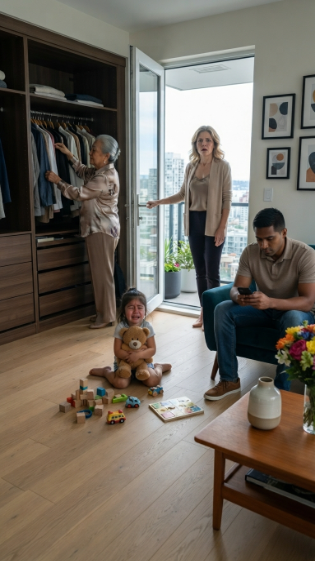
When Renata opened the door to her apartment in Tlaquepaque, the first thing she heard was the wailing of Sofi, her 3-year-old daughter.
The little girl sat on the living room floor, clutching a doll and staring down the hallway as if someone had come in to frighten her.
Mauricio, her husband, was sunk into the couch, his phone in hand. He didn’t get up. He didn’t even ask how her day at work had gone.
—What happened here? —Renata said.
Then she caught the smell.
Naphthalene. An old, stale odor that didn’t belong in her home.
At 10 AM, Mauricio had told her that his mother, Doña Elvira, would be coming for “a few days.” According to him, she had had a fight with her other daughter-in-law and needed some time to cool off.
What he hadn’t told her was that he had already given his mother a key.
Renata had spent the entire ride home on the bus telling herself she needed to be patient. The apartment was small, yes, but family was family.
However, this no longer felt like her home.
The pots were in a different cabinet. The glasses were on top of the refrigerator. Sofi’s dishes had vanished from the drawer where Renata kept them.
In the bedroom, she found her underwear piled on the bed.
The closet was filled with Doña Elvira’s dresses, blouses, and sweaters. Not clothes for a short visit, but practically her entire life hanging on hangers.
In Sofi’s room, there was a thick, burgundy blanket spread over the toddler bed. It smelled so strongly of naphthalene that Renata opened the window immediately.
Doña Elvira emerged from the kitchen, smiling.
—Honey, I organized everything because you had it all piled up. This way, it’ll be easier for you.
Then she lifted a bottle of detergent.
—I also changed the soap. The one you use is giving the girl rashes. With the years, one learns.
Renata looked at Mauricio, expecting him to set a boundary.
He lowered his eyes to his phone.
Anger surged from her stomach, but she didn’t yell. She picked up Sofi, calmed her down, and then went into her bedroom.
She took her mother-in-law’s empty suitcase and folded each piece of clothing with a calmness that scared her more than any scandal.
When she finished, she left the suitcase by the door and called a taxi.
—Doña Elvira, you entered without my permission, moved my things, and frightened my daughter. I respect you, but this house is mine too. Your taxi will arrive in 8 minutes.
The woman stopped smiling.
She looked at the suitcase. Then at Mauricio.
—I thought it would fit here —she murmured.
Renata believed it was another attempt to manipulate her.
Mauricio accompanied his mother to the taxi and returned furious. He said Renata had humiliated them, that a good wife didn’t treat her husband’s mother that way.
She only asked:
—Did you ask me for permission before giving her my key?
Mauricio didn’t respond.
For 3 days, Renata believed she had defended her home correctly.
Until she called the supposed cousin where Doña Elvira was staying.
The woman who answered insisted she didn’t know anyone by that name.
Then Mauricio, pale and with tears in his eyes, confessed where his mother had slept since they put her in that taxi.
And Renata felt the floor vanish beneath her feet.
PART 2
—At the Central New Station —Mauricio said, not daring to look at her—. She slept on a bench for 3 nights.
Renata held the phone so tightly her fingers hurt.
She imagined Doña Elvira hugging her suitcase on a bench so no one would steal it from her.
—Why didn’t she go with your brother? —she asked—. Why did you make up the fight?
Mauricio covered his face and began to cry.
It was the broken sob of a 40-year-old man.
—My mom has cancer —he managed to say—. Pancreatic cancer. It has already spread. They gave her a few months.
The phone fell to the floor.
Renata didn’t bend down to pick it up.
Mauricio had known the diagnosis for 3 weeks. Doña Elvira had forbidden him to tell her because she didn’t want anyone to take her in out of pity.
She had left her older son’s house before dawn, without saying goodbye. She didn’t want her daughters-in-law to bathe her, change her diapers, or watch her fade away slowly.
—And why did she come here? —Renata asked, her voice breaking.
Mauricio took time to answer.
—She said the only person in the family she still needed to know for real lived here.
Renata looked toward Sofi’s room.
The girl slept, hugging her doll, oblivious to everything.
—She came for her —Mauricio continued—. She wanted to spend the time she had left with her granddaughter.
Every detail of that afternoon returned like a slap.
All the clothes in the closet. The empty suitcase. The phrase “I thought it would fit here.” The old blanket on Sofi’s bed.
She hadn’t come to stay for comfort.
She had come because there was no tomorrow.
Renata felt shame, but also rage.
—That doesn’t justify her entering without permission —she said, almost defending the woman who had been there 3 days before—. It also doesn’t justify your lying to me.
—I know.
—You could have told me something. Not everything, but something. You could have stopped me from putting her in that taxi.
Mauricio lifted his gaze.
—She made me swear I wouldn’t tell you. She said she wanted to know if she could live here without being treated like a sick person. I thought we would talk later. But when you started packing her things… I froze.
Renata wanted to call him a coward, but she also saw a son caught between his mother’s last wish and the trust he owed to his wife.
—Where is she now? —she asked.
Mauricio looked down again.
—At the IMSS. She fainted this afternoon at the station. A cleaning lady called the ambulance.
It was nearly 2 AM when they left the apartment.
Renata was in her pajamas, with a sweater over it and her hair thrown up haphazardly. On the way, she called 11 times. No one answered.
In the emergency room, they were greeted by a hallway of green walls, white lights, and the smell of bleach.
Doña Elvira was in a bed at the back, smaller than Renata remembered.
The suitcase lay beneath the stretcher.
When she opened her eyes and saw her daughter-in-law, she tried to smooth her hair with a trembling hand.
—Honey —she whispered—. Forgive me.
That word finished disarming Renata.
Doña Elvira breathed laboriously.
—I shouldn’t have moved your things. It’s your home. You were right.
—Please don’t say that.
—The soap wasn’t to make you feel like a bad mother —she continued—. Mauricio had the same rashes when he was little. They went away with that detergent.
Renata held onto the railing.
The phrase she had interpreted as an insult had been a mother’s memory.
—And the kitchen… —Doña Elvira paused to catch her breath—. I arranged it the way my mom had it. I thought that when you all got here tired, you’d find everything faster.
Mauricio cried silently, pressed against the wall.
—And the blanket? —Renata asked.
The sick woman’s eyes changed.
—I knitted it when I found out Sofi was coming. It took me 7 months. I stored it with naphthalene so the moths wouldn’t eat it.
She smiled faintly.
—I wanted to give it to you myself, but I was afraid you wouldn’t want it. That’s why I left it on her little bed. So my granddaughter could sleep with something made by my hands when I was no longer here.
Renata covered her mouth.
She remembered how she had folded that blanket with disdain, trying to touch it as little as possible.
—I didn’t want to be a burden —Doña Elvira said—. I still wanted to be useful for something.
The doctor explained that they could discharge her under palliative care. She needed supervision, medicine, and someone to watch her through the night.
Mauricio asked if they could take her to his brother’s place.
Renata looked at him.
—She’s coming with us.
Doña Elvira wanted to protest.
—Not out of pity —Renata clarified—. She’s coming because this can also be her home, but with rules. No one enters without notice. No one moves other people’s things. And no one hides a disease like that again.
The woman closed her eyes and nodded.
Before leaving the hospital, Renata opened the suitcase.
She took out the burgundy blanket and spread it over Doña Elvira. It was the same one she had wanted to expel from her home along with her.
This time, she adjusted it to cover her shoulders.
Doña Elvira lived 5 more weeks in Sofi’s room.
The little girl insisted on sleeping next to her grandmother and filled the bed with dolls, stories, and puzzle pieces.
Sometimes she talked to her for half an hour without anyone understanding anything. Doña Elvira listened as if she were receiving the most important news.
From the kitchen, Renata could hear them laugh.
She never moved the glasses again.
It angered her to admit it, but the woman was right: they were more accessible there.
The early days weren’t easy.
Doña Elvira still wanted to get up to sweep, fold clothes, or prepare beans even though she could barely walk.
Renata had to force her to rest.
—I didn’t come to become a burden —the woman repeated.
—Then help me teach Sofi her songs —Renata replied—. That you can do sitting down.
So, each afternoon, Doña Elvira sang old rounds while her granddaughter danced around the bed.
One night, when Mauricio and Sofi were asleep, Renata sat next to her.
—I never treated you with kindness —she confessed—. I respected you because you were Mauricio’s mother, but every time you came, I counted the hours until you left.
Doña Elvira let out a weak laugh.
—I was also a bit nosy.
—A lot.
—Well, a lot.
They both laughed.
Then Renata apologized for the taxi, for the station, for not even having asked where she would spend the night.
Doña Elvira shook her head.
—You took care of your home and your girl. You did what you thought was right with what you knew.
—But I could have listened to you.
—And my son could have talked. And I could have asked for help without coming in like a mistress. We all made mistakes here, honey.
It was the first time Renata truly believed that word didn’t carry mockery.
Doña Elvira died on a Tuesday, before dawn.
Sofi was sleeping beside her, with a hand on the burgundy blanket.
Renata managed to hold her fingers while her breathing became slower.
Mauricio whispered that she could leave in peace.
The woman opened her eyes one last time, looked at her granddaughter, and then at Renata.
—Take care of the girl for me.
—With my life —she replied.
After the funeral, Brenda, Mauricio’s brother’s wife, sought out Renata outside the cemetery.
For weeks, Renata had believed that Brenda had expelled her mother-in-law. Now she knew that Doña Elvira had escaped so no one would see her sick.
—I have to tell you something —Brenda said—. She told me in the hospital before she went to your house.
Renata felt a knot in her throat.
—She said she was at peace because you had kicked her out.
—What?
Brenda took a deep breath.
—She said: “That girl defends what’s hers like a lioness. She wouldn’t even let me walk all over her daughter. My granddaughter will be safe with her.”
Renata couldn’t respond.
The woman she had sent to a bus station turned that humiliation into a testament of love.
She chose to carry another version of that night: one in which her granddaughter remained protected.
Since then, the blanket remains on Sofi’s bed.
The girl drags it through the apartment, uses it to build little houses, and says it smells like her grandmother, even though each week the scent fades a little more.
Renata doesn’t wash it.
Sometimes she brings the fabric to her face to seek the last trace of naphthalene she had once hated so much.
And every time she opens the drawer where Doña Elvira put the glasses, she remembers that setting boundaries wasn’t her mistake.
Her mistake was believing that behind an invasion, there could only be malice and that asking for help always resembles asking for permission.
Mauricio also paid his part.
For months, Renata couldn’t forgive him for the lie. They went to therapy, and he had to accept that keeping a secret didn’t give him the right to abandon two women in the midst of conflict.
One died believing she was a burden.
The other was almost led to live convinced that cruelty was strength.
Sofi grew up hearing a simple version: her grandmother came with a suitcase, organized a kitchen, left a blanket, and managed to love her for 5 weeks.
She would learn the complete truth later.
Because in that family, no one ever confused silence with respect again.
And although Renata still wonders what any other woman would do upon finding her home invaded and her daughter crying, there’s one question that pains her much more:
How many people seem to be crossing our boundaries when, in reality, they don’t know how to say they have nowhere else to go?