PART 1
—Invite the girl who cleans the bathrooms too —said Fernanda Alcántara, swirling her drink—. But tell her to come dressed up. I want to see which borrowed dress she shows up in.
Laughter echoed between the marble and the windows of the Montoya mansion in Zapopan.
Isabela Montoya glanced toward the outdoor corridor. Valentina Cruz was mopping the floor in her blue uniform, her hair tied in a braid, wearing the calm of someone who had learned not to react to humiliation.
—You’re right —Isabela replied—. This will be the best entertainment for my birthday.
Lucía Pedraza and Consuelo Bárcenas laughed out of obligation. The four women gathered every Tuesday to boast about trips, destroy reputations, and call their cruelty “sense of humor.”
Valentina had worked in that house for three years. She arrived at seven in the morning, cleaned rooms where no one greeted her, and washed glasses that cost more than six months of her rent.
She was 28, with honey-colored eyes and a calmness that irritated Isabela.
—Valentina —the lady called from the gallery.
The young woman left the mop and approached.
—Is there something you need?
Isabela extended a cream-colored invitation, with golden letters.
—I’m celebrating my birthday on Saturday. There will be 300 guests. I’ve decided to invite you.
Valentina took the card without showing any surprise.
—Thank you, Mrs. Montoya.
—Don’t forget to come dressed up —Isabela added, savoring each word—. I don’t want any misunderstandings or awkward scenes.
Valentina held her gaze for two seconds.
—Don’t worry. I understood perfectly.
As she walked away, her friends burst into laughter again.
—Did you see her face? —Fernanda said—. She’s probably already looking for someone to lend her something.
—People like that never understand when they’re invited to be mocked —Isabela replied.
No one noticed Valentina tucked the card into her pocket like someone receiving a long-awaited signal.
That night, in her apartment in the Santa Elena neighborhood, she placed the invitation on the table, took off her uniform, and opened a wooden box.
Inside was an old photograph, an emerald brooch, and a last name written in a letter: Vidal de los Monteros.
She dialed a number she knew by heart.
—Hello? —a deep voice answered.
—Grandpa —Valentina said—. It’s time.
There was a long silence.
—Are you sure, dear?
—Completely.
—Then tomorrow we’ll prepare everything.
For the first time in months, Valentina smiled.
The next morning, Isabela had breakfast with Rodrigo, her 34-year-old son, who had managed the family businesses since his father’s death.
—I invited Valentina to the party —Isabela commented—. Fernanda says it’s going to be hilarious.
Rodrigo set down his cup.
—Did you invite her to humiliate her?
—Oh, don’t exaggerate.
—That’s not right, Mom.
—I didn’t ask for your opinion.
Rodrigo stood up.
—I just wanted someone to tell you before it was too late.
On Saturday, the mansion filled with white flowers, businessmen, politicians, influencers, and big names.
At 8:30 PM, a black car stopped in front of the main entrance.
The chauffeur opened the door.
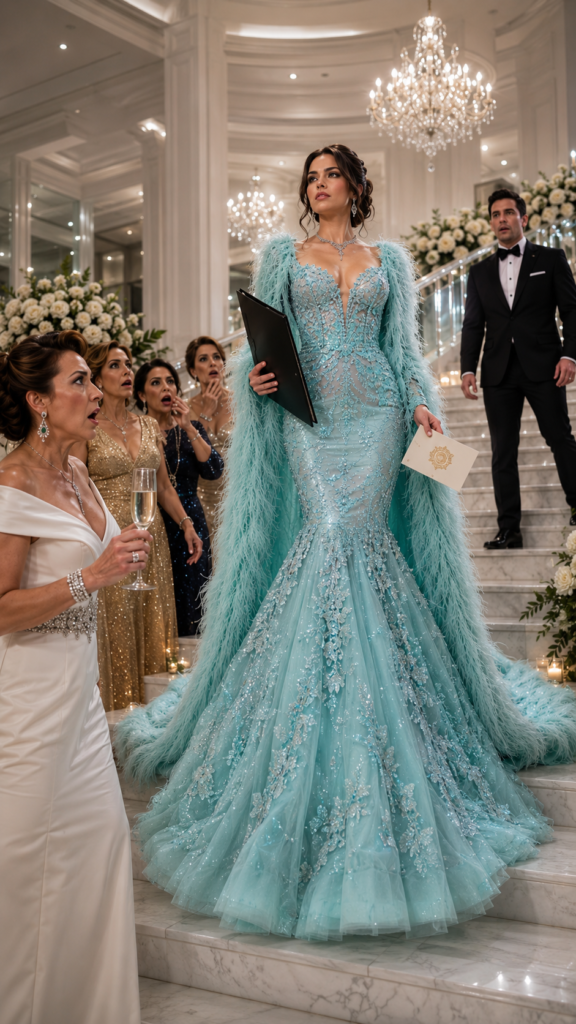
Valentina stepped out in an emerald green dress, antique jewelry, and an elegance that couldn’t be bought last minute.
The music continued playing, but 300 people began to fall silent.
Isabela took several seconds to recognize her.
And when she saw who was stepping out from the other side of the car, she felt the floor drop out beneath her.
PART 2
Out of the car stepped Don Aurelio Vidal de los Monteros, dressed in a dark suit and leaning on a wooden cane.
His name needed no introduction in Jalisco: he had built an agricultural and logistics consortium from Tepatitlán to Manzanillo, and his word could still open or close million-dollar deals.
He positioned himself next to Valentina, not in front of her.
Isabela lost her color.
Fernanda let out a whisper.
—No way… what is Don Aurelio doing with the maid?
Valentina walked through the main entrance. The silk dress seemed to flow like water, and the emerald necklace didn’t look rented or ostentatious.
It looked inherited.
—Good evening, Mrs. Montoya —she said calmly—. What a lovely party.
Isabela swallowed hard.
—Valentina… you… where did you get that?
—You invited me dressed up. I came dressed up.
Murmurs grew. Some guests asked who she was. Others recognized the jewelry that had belonged to Don Aurelio’s wife.
Rodrigo watched from the bar. He knew a part of the truth.
Three weeks earlier, he had found an old photograph in a business report. It featured Don Aurelio, his daughter Cristina, and a young woman with honey-colored eyes who was impossible to confuse.
Valentina Vidal de los Monteros.
The only granddaughter of the most influential man in Jalisco’s agro-industrial sector.
Rodrigo said nothing because he understood that if she worked in that house wearing a blue uniform, it was by her own choice.
That same morning, Don Aurelio had called him.
—My granddaughter has been living in your mother’s house for three years —he told him.
—I know.
—Tonight you will decide which side you’re on.
Now Rodrigo understood the warning.
The butler waited for the song to finish and took the microphone.
—Ladies and gentlemen, let’s welcome tonight’s special guest: Miss Valentina Vidal de los Monteros.
The silence was brutal.
Valentina appeared at the landing of the main staircase. She had climbed up the service stairs, the same ones she had carried buckets and baskets up for three years.
She descended the 16 steps slowly.
She knew the dark vein on the third step, the small crack on the ninth, and the loose board next to the last.
Isabela had never noticed those details. Valentina had, because she had cleaned them on her knees.
Don Aurelio extended his hand toward her.
—Thank you for inviting my granddaughter, Isabela —he said—. It’s a gesture our family will not forget.
Isabela tried to regain her smile.
—Don Aurelio, I had no idea she...
—Of course you didn’t know —he interrupted—. You never took the trouble to ask her anything.
The phrase fell before everyone.
Fernanda leaned closer to Isabela and murmured:
—Tell them it was a misunderstanding.
—Shut up —Isabela replied without looking at her.
Don Aurelio took the microphone.
—My granddaughter decided to live for a while without a last name, without bodyguards, and without privileges. She wanted to know who she was when no one had reasons to flatter her.
He paused and looked at Valentina with pride.
—Starting tonight, she resumes her place in the Vidal de los Monteros family and will be the future director of the group.
Conversations exploded immediately.
Those who minutes earlier would have ignored Valentina now sought to greet her. A businessman offered her his card. A woman who had never greeted her pretended to recognize her from always.
Valentina accepted nothing.
—I didn’t come here for you to treat me better after knowing my last name —she said—. I came because Mrs. Montoya wanted to show 300 people how much a domestic worker is worth.
She looked directly at Isabela.
—I think it’s fair that everyone sees the result.
Isabela clenched her jaw.
—You’ve made your point. We can talk privately.
—For three years, everything happened in private —Valentina replied—. The insults in the kitchen, the unjustified deductions, the unpaid extra hours, and the mockery of people who couldn’t defend themselves.
Rodrigo walked to the central table with a black folder.
Isabela looked at him in alarm.
—What do you have there?
—The other reason this conversation cannot wait.
He opened the folder and placed several documents in front of her.
—Inflated invoices for charity events. Incomplete donations. Contracts awarded to companies related to Fernanda Alcántara and Consuelo Bárcenas.
Rodrigo pulled out several copies.
—Money from the Montoya Foundation used to pay for trips, dinners, and personal favors.
Fernanda let out a nervous laugh.
—That’s nonsense. I don’t know anything about accounting.
—But you do know how to sign —Rodrigo replied, showing a copy.
Consuelo paled.
—Isabela said it was normal. That everyone did it.
—Shut up! —Isabela screamed.
The command resonated with such violence that even the orchestra stopped playing.
Lucía stepped away from the group.
—I never signed —she said—, but I knew something was wrong.
Fernanda shot her a withering look.
—So now you’re a saint.
—No —Lucía replied—. I was just cowardly.
Valentina took the microphone.
—I’m not here to destroy families or invent crimes. For these three years, I heard conversations because you spoke in front of me as if I were a piece of furniture.
She looked at the documents on the table.
—I also saw open envelopes, abandoned receipts, and papers that then appeared with different amounts.
Isabela took a step toward her.
—Did you spy on me?
—No. You became invisible to yourself. You believed that the people cleaning your mess couldn’t understand it either.
Rodrigo showed emails, transfers, and certified copies.
—Everything was reviewed by independent auditors. The files are already in the hands of the lawyers and will be delivered to the corresponding authorities tomorrow.
Isabela’s face crumbled.
—Rodrigo, I’m your mother.
He closed his eyes for a moment.
—Precisely because of that, I warned you many times. I asked for transparency. I asked you to stop using the foundation as a personal cash box.
Rodrigo looked around the room.
—And today you invited a woman to humiliate her for fun.
—I did it all for our family!
—No, Mom. You did it to maintain the image you created.
The phrase hurt more than the documents.
Don Aurelio announced that his group would suspend any negotiations with the implicated companies until every peso was clarified.
Other businessmen did the same.
In a matter of minutes, Isabela’s social power began to collapse amid WhatsApp messages, rushed calls, and people avoiding being near her.
Isabela looked at her guests in desperation.
—Are you all going to judge me now? Half of you have done worse things.
No one responded.
Maybe because it wasn't a lie.
Maybe because no one wanted to sink with her.
Then Isabela turned to Valentina.
—What do you want? For me to kneel? A public apology?
Valentina shook her head.
—I don’t want an apology born from fear.
—Then what the hell do you want?
—I want you to remember each person you made feel small tomorrow. Teresa, who serves you coffee and supports two children alone. Julián, the gardener you blame when you’re in a bad mood.
Valentina pointed toward the entrance.
—I want you to remember Ernesto, the chauffeur who waits hours without being able to eat. I want you to understand that no one loses dignity by cleaning a house. Dignity is lost by humiliating others to feel important.
Consuelo started to cry. Lucía lowered her gaze. Fernanda left the hall without saying goodbye.
Isabela stood still under the crystal chandeliers.
Her white dress still looked impeccable, but it no longer seemed elegant. It looked like an expensive costume for a woman who had just been left alone.
Rodrigo approached Valentina.
—I’m sorry.
—you didn’t make the invitation.
—But I lived here and preferred not to look at many things.
Valentina held his gaze.
—Then start to look.
She didn’t completely forgive him. Nor did she condemn him.
Some apologies need time and actions before they deserve a response.
The party ended before midnight.
The guests left the mansion in luxury cars, but no one spoke of the cake, the flowers, or the music.
They talked about the maid who knew every step of the house, the last name that no one suspected, and the black folder that had turned a birthday into a public trial.
Valentina exited through the main entrance alongside Don Aurelio.
Rodrigo accompanied them to the car.
—Tomorrow, I will deliver all the remaining records —he said.
Don Aurelio looked at him seriously.
—Don’t deliver them to me. Deliver them where they belong.
Rodrigo nodded.
Before getting in, Valentina looked back at the mansion. She felt neither nostalgia nor hatred.
She had spent three years washing their glasses, cleaning their stains, and listening to their secrets.
Yet that house had given her something money could never buy: the certainty that her dignity didn’t depend on her last name.
—Are you okay? —Rodrigo asked.
Valentina took a deep breath.
—I’m whole.
Three weeks later, she signed her first contract as the operational director of the Vidal group.
The agreement protected small producers in Jalisco and Michoacán from late payments and abuses by intermediaries.
Don Aurelio watched her from the back of the room, proud and silent.
Rodrigo delivered all the documentation to the auditors. Consuelo agreed to testify. Fernanda lost important contracts.
Lucía distanced herself from the social circle that had confused elegance with cruelty for years.
The investigation against Isabela progressed.
Months later, she sold the mansion to cover debts and legal responsibilities. She never organized another party again.
Valentina kept the blue uniform.
She folded it neatly in a box next to the cream-colored invitation.
One reminded her of work. The other, of humiliation. Neither caused her shame.
Because that night, in front of 300 people, it became clear that class doesn’t live in a dress, in an expensive glass, or in a famous last name.
True class appears when you treat someone you think you don’t need with respect.
And so, when in Guadalajara they told the story of the invited maid as a joke, everyone ended up repeating the same phrase:
The woman who entered through the service door for three years walked out that night through the main door.
And those who laughed at her never felt superior again without remembering the price of their cruelty.