PART 1: THE ACKNOWLEDGMENTS SLIDE
She Had Supported His PhD For Four Years. The Day He Defended His Thesis, He Thanked Everyone But Her.
—
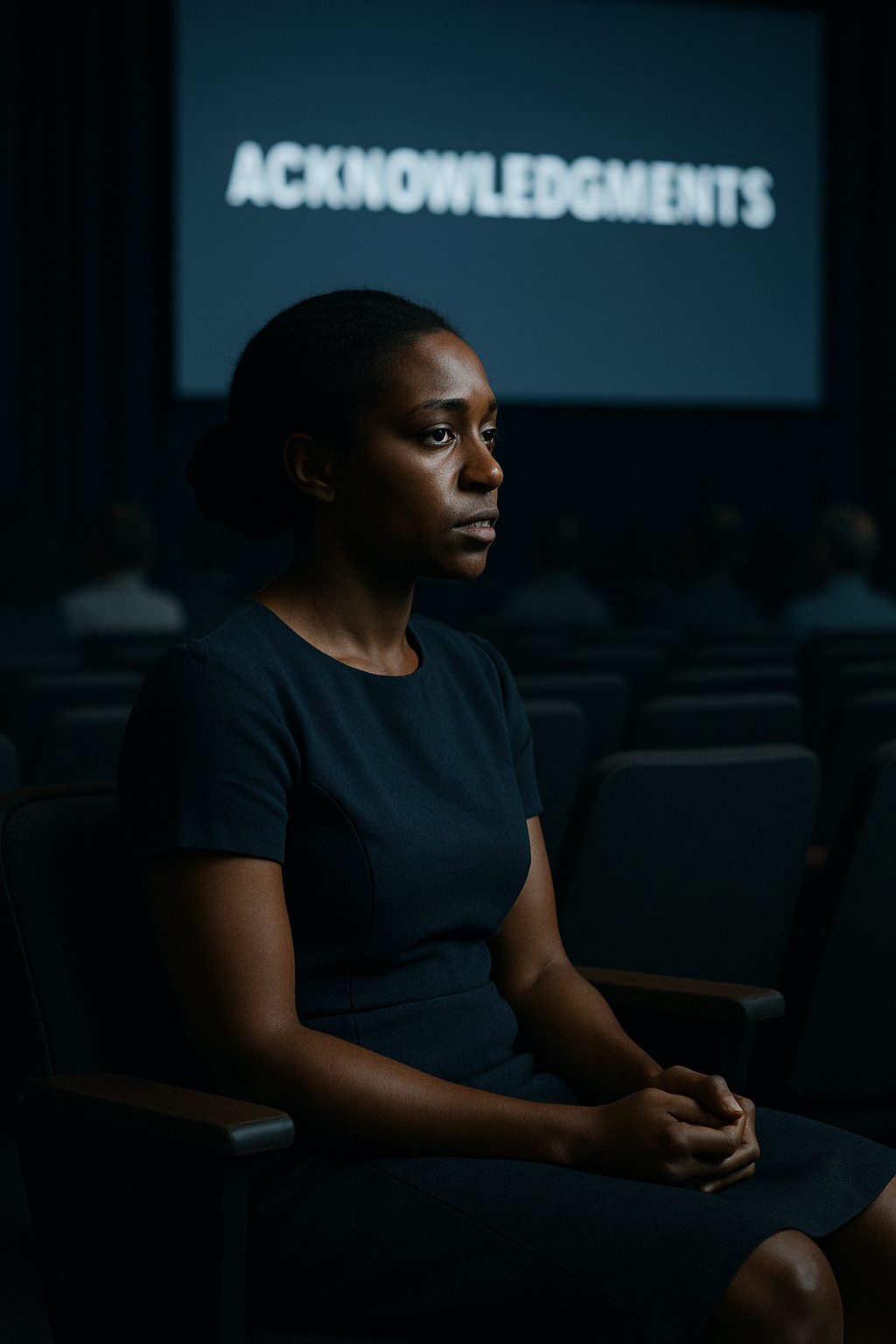
The auditorium held maybe eighty people.
Nadia Osei had been on her feet since five that morning — a twelve-hour shift that ended at five in the evening, a shower that lasted four minutes because she was already running late, a dress she'd bought three weeks ago and ironed last night because she wanted to look like she belonged in the room.
She sat in the fourth row.
Michael had not saved her a seat in the front. He'd said, the night before, that the front rows were for faculty. She'd said that was fine. She was used to adjusting.
The auditorium smelled like old carpet and conference coffee. Around her, people in blazers compared notes. She recognized two or three faces — his department colleagues, his cohort, people who had eaten dinner at their table and talked over her to reach him. She smiled at the ones who caught her eye. None of them sat next to her.
She had her hands folded in her lap.
She was thirty-two years old. She was a nurse in the cardiac unit at St. Agatha's, and she had been on her feet since five in the morning, and the man she had loved for five years was about to stand at a podium and be called Dr. Michael Hayes, and she was sitting in the fourth row with her hands folded and her face arranged into something that looked like calm.
—
The lights dimmed.
Michael walked out from the side entrance, and even from the fourth row she could see the way he was carrying himself — the particular straightness of someone who had been preparing for this room for four years. He was wearing the blazer she'd helped him pick out, the one they'd found at the consignment shop on Albemarle Street and she'd said, that one, that's the one, and he'd looked in the mirror and believed her.
He set his notes on the podium.
He did not look for her.
She had told herself, on the train here, that he was nervous. She had told herself, in the auditorium, that he was focused. She had spent five years telling herself reasonable explanations for small things, and she was good at it by now, the way you get good at anything you practice long enough.
He clicked to the first slide.
THE NARRATIVES OF LABOUR: RACE, REPRESENTATION, AND INVISIBLE WORK IN POST-COLONIAL BRITISH FICTION.
She thought, with the distant clarity of someone who has been awake since five in the morning: that's ironic.
—
He was good.
She'd always known he was good. That wasn't the issue. The issue had never been whether he was good. The issue was what it cost and who paid it and whether the person who paid it got to be in the room when the tab was settled.
He spoke for forty-seven minutes. She knew because she watched the clock on the side wall, not because she was bored — she wasn't bored, she was listening, she had listened to pieces of this thesis for four years, had heard him talk through arguments at ten o'clock at night when she was exhausted and still asked the follow-up questions because she wanted him to be ready — but because watching the clock was something her body did automatically now. It was a nurse thing. Time meant something different when you worked in cardiac.
The committee asked their questions.
He answered them.
She watched his face and she thought: he's going to be fine. He's always been fine. That is not the question.
The committee retired. The audience waited. People around her murmured.
She kept her hands in her lap.
—
When the committee returned and the department chair said the words, there was applause. Michael stood there with his eyes a little bright, and she clapped with everyone else, and she thought about the night he'd come home after his first year review and said he wasn't sure he was smart enough for this, and she'd sat on the edge of the bathtub while he splashed water on his face and she'd said: you are. You are smart enough. You have always been smart enough. The question is whether you're willing to do the work.
He had done the work.
She had paid the rent.
Those two things were both true and they were not the same thing and they were not in competition with each other and she had never asked him to rank them. She had only ever asked to be visible.
—
The acknowledgments slide.
He'd told her about it once, months ago. She'd asked, casually, the way you ask about something you're trying not to seem too invested in — she'd asked what his acknowledgments were going to say. He'd said, "oh, you know, the usual — committee, department, colleagues." She'd waited. He'd added: "and obviously you." She'd smiled. She'd said: obviously.
The slide appeared on the screen.
ACKNOWLEDGMENTS
I would like to thank my supervisor, Professor Ann Davies, for her tireless guidance and intellectual generosity over the course of this project. I am grateful to the Department of English Literature at the University of Hartwell for providing the funding, resources, and community that made this research possible. I thank my committee — Dr. Okonkwo, Dr. Finlay, and Professor Steadman — for their rigorous engagement with this work. My parents, Robert and Elaine Hayes, provided the foundation of support that made me who I am. My undergraduate mentor, Professor Bain of Leeds, first taught me to read carefully. And to my colleagues in the department — particularly those in Room 214 — who inspired me, challenged me, and made these four years feel like a conversation rather than a task.
The slide was up for perhaps twenty seconds.
Nadia read it.
She read it again.
She checked for her name the way you check for a word you're sure you've seen, running your eye back to the beginning, checking each line. She was a nurse. She knew how to read carefully. She knew how to make sure.
She read it a third time.
Her name was not there.
—
Around her, people were applauding again, moving, the formal part ending and the social part beginning. Someone near the back said something and people laughed.
Nadia did not move.
She sat in the fourth row with her hands in her lap and her face arranged into something that looked like calm, and she thought about four years, and she thought about overtime, and she thought about the research materials she'd bought on her credit card because the department's budget had run out and he'd needed them for a chapter that was due, and she thought about the year they'd nearly missed rent and she'd picked up a third shift at the weekend clinic, and she thought about the night before his first-year review when she'd sat on the edge of the bathtub.
She did not cry.
She was thirty-two years old and she had learned, a long time before Michael, that tears in public cost you things. She was a Black woman in a room full of academics and she had learned to arrange her face.
Her face was arranged.
—
THE RECEPTION
The department had laid on wine and those small crackers with soft cheese, the kind of food that signals occasion without spending money on it. People had moved from the auditorium to the adjacent room. Someone had put music on, something classical and low.
Michael was in the center of it, the way he always was — not performing, exactly, he didn't have to perform, he just was a person that rooms oriented around, and people were congratulating him and he was accepting it with the specific grace of someone who had expected to succeed but is glad it happened as planned.
Nadia had a glass of wine she wasn't drinking.
She was standing near the window, watching. She was good at watching. Years of night shifts teach you to observe without being seen observing — to notice the monitor, the patient, the small signs, without making your noticing felt.
She noticed the slide.
She noticed Michael did not look for her in the crowd.
She noticed the way his mother hugged him, and the way his father shook his hand, and the way Professor Davies — the silver-haired woman from the acknowledgments — touched his arm briefly in the manner of someone who had watched a project come to fruition and felt entitled to the pride of it.
She noticed all of this.
She did not say anything.
—
"You must be Nadia."
She turned.
The silver-haired woman. Professor Ann Davies, close up, had the kind of face that came from decades of reading carefully — lines around the eyes that meant attention, not age. She was holding her own glass of wine and she had the bearing of someone who had spent forty years in rooms like this and did not need to signal belonging.
"Yes," Nadia said.
"Ann Davies. I'm Michael's supervisor." The woman paused. "Or I was, officially, as of about forty minutes ago."
"Congratulations," Nadia said, and meant it. "He worked very hard."
"He did." Professor Davies looked at her for a moment with the directness of someone who was measuring something. "You must be the nurse. He mentioned you to me privately, once or twice. I assumed you'd be in the acknowledgments."
Nadia's glass was in her hand.
She felt the words land. She felt them land the way a diagnosis lands — not as surprise, because some part of you has known, but as confirmation. The thing you were hoping was not true, confirmed.
"So did I," she said.
She said it quietly. She said it the way she said difficult things to patients' families — steadily, without drama, in a voice that did not require anyone else to manage its emotional weight.
Professor Davies looked at her.
"I'm sorry," the older woman said, and she said it simply, without the elaborate cushioning that people sometimes use when they're more interested in their own discomfort than in the thing they're apologizing for. "That was a significant omission."
Nadia nodded. She thought: significant omission. That is a very academic way to describe something that is breaking my chest.
"He's very talented," she said, because it was true, and because she needed to say something that didn't crack anything open in this room.
"He is," Professor Davies said. "Talent is the easy part."
She held Nadia's gaze for a moment. There was something in the older woman's eyes — not pity, not quite, something more like recognition. Like she had seen this shape before and was sorry to see it again.
Then someone called Professor Davies from across the room, and she excused herself, and Nadia was alone again by the window with her untouched wine.
—
Michael found her twenty minutes later. He came over with his blazer slightly rumpled now and his glasses pushed up and his face still bright with the particular satisfaction of having finished a very large thing.
"Hey," he said. "You're quiet."
"I'm tired," she said. "I worked a twelve-hour shift."
"Right, right." He touched her arm. "We'll celebrate properly this weekend, okay? Tonight I have to do this department dinner thing—"
"I know."
"But this weekend, just us. I was thinking that place in Finsbury—"
"That's fine."
He looked at her. He had known her five years and he could, when he was paying attention, read her. She watched him pay attention.
"Are you okay?" he said.
"I'm tired," she said again.
He nodded. He accepted this. It was, she thought, the most convenient explanation he could take, and he took it.
"I'll text you when I'm on my way home," he said.
She said: "Okay."
He went back to the center of the room.
She stood by the window.
—
She took the tube home alone.
It was the District line, then a change at Embankment, then the Northern line home. It took forty-three minutes. She sat in the window seat and watched the underground tunnels go past in the dark, and she thought about nothing particular, which is what you do when you are thinking about something so large that your mind refuses to frame it.
At Embankment, a woman sat next to her with a nursing bag from Queen Elizabeth's. Nadia recognized the bag. They nodded at each other with the brief nod of strangers who share a profession.
At her stop, she walked home in the dark.
—
HOME THAT NIGHT
The flat was theirs — or it was hers, technically, her name was on the lease, she'd signed it four years ago when they'd moved in together at the start of his PhD. He paid half the rent when he could. She covered when he couldn't, which was most of the first two years and some of the third.
She made herself tea.
She sat at the kitchen table with the tea in front of her and she thought about the acknowledgments slide, which she could still see with the clarity of something her brain had photographed. She had good visual recall. It was useful in nursing — being able to hold an image, a detail, a number.
She was holding the image.
ACKNOWLEDGMENTS.
His supervisor. His department. His committee. His parents. His undergraduate mentor. His colleagues in Room 214.
The people he wanted the room to see when they thought about what had made him.
She thought about the research books she'd bought from the online secondhand sellers — literary theory, postcolonial studies, the specific niche volumes that the university library didn't stock. She had a spreadsheet of what she'd spent. She'd made it not to use against him, but because she was a nurse, and nurses tracked things.
She thought about the weeks after his mother's illness scare, when he'd been unable to write and she'd taken extra shifts and come home at midnight and made him food and not asked him to talk about it until he was ready.
She thought about the night she'd said, "I need to tell you I'm struggling," and he'd listened carefully, and then the next day had continued as usual, and the day after that, and the day after that, the way that people hear things but do not change because they do not have to.
She thought about his face when he'd seen the acknowledgments slide come up — the way his face had been open, a little proud, looking out at the room, looking for the room's reaction.
She thought about the word "obviously."
Obviously you.
She had her tea.
She sat at the kitchen table.
She thought about the woman who had said: I assumed you'd be in the acknowledgments.
She thought about what she had said back.
So did I.
Two words. The most efficient possible summary of five years.
—
She was still sitting at the kitchen table when she heard his key in the lock at half past eleven.
She did not move.
He came in with his shoes in his hand, the way he always did when he came home late — an old consideration, left over from the beginning when he'd been trying to not wake her. He stopped in the kitchen doorway when he saw her.
"Hey," he said. "You're up."
"I'm up," she said.
He set his shoes down. He looked at her, really looked, in the way that he could when he was not in the middle of something else.
"Something's wrong," he said.
She picked up her mug. The tea was cold.
"Tell me about the acknowledgments slide," she said.
—
She watched him process this.
She watched the specific sequence: first the slight tilt of his head that meant he was accessing the memory, then the micro-expression of something — not guilt exactly, more like the look of someone who has stepped on a loose floorboard they hoped wouldn't creak — and then the rearrangement of his face into something more neutral.
"I thanked a lot of people," he said.
"You did," she said.
"I thanked—"
"You thanked your supervisor," she said. "Your department. Your committee. Your parents. Your undergraduate mentor. And your colleagues in Room 214."
He was quiet.
"You've known me five years," she said. "I have been working in cardiac for four of them. I have paid this rent for four years. I have covered the bills when your stipend ran late. I bought you — " she paused — "I have a spreadsheet, Michael. I bought you research materials on my credit card. I paid for the transcription service you used in year two. I covered the cost of your conference trip because the department's travel fund was capped."
She said it all evenly. She was not raising her voice. She was a nurse and she had learned that the most important things were said in a steady voice, because the steady voice was the one that people actually heard.
"I know," he said.
"You know," she said.
"I — Nadia—"
"I want to understand," she said, "why I was not in the acknowledgments."
He pulled out the chair across from her and sat down.
He took his glasses off and rubbed the bridge of his nose.
She waited.
She was very good at waiting. It was, along with the visual recall and the steady voice, one of the skills she had developed over years of work and over years of this relationship and she could not always tell anymore which life had taught her which skill.
He said: "I didn't want it to look like I had needed financial support."
—
She looked at him.
She thought: there it is.
"Say that again," she said.
"I — it's an academic document. People read it. The committee reads it, the examiners, it gets published, other researchers—"
"Say that sentence again," she said. "The one you just said. Say it out loud."
He was quiet.
"You didn't want it to look like you had needed financial support," she said. "That's what you said."
"I—"
"Michael." Her voice was still steady. "Think about what that sentence means. Think about it for one moment. You didn't want people to know you'd had financial support. From me. So you didn't include me."
"It's not — it wasn't about—"
"You made me invisible," she said, "to protect your image."
The kitchen was very quiet.
Outside, a car went past on the street.
"I didn't think of it that way," he said.
"I know," she said. "That's the part I'm sitting here thinking about."
—
She looked at his face. He was not a bad man. She had known him five years and she did not think he was a bad man. He was a man who had been told he was brilliant often enough that he had come to believe his brilliance did the work — that the thesis was the product of his intelligence, full stop, and the conditions that had made the thesis possible were just conditions, the way air is a condition, the way having enough to eat is a condition. You don't thank air. You don't put air in the acknowledgments.
She had been air.
"I'll thank you at the publication party," he said. "When it gets published — I'll make a speech—"
"That isn't the same thing," she said.
"Nadia—"
"The acknowledgments are in the document," she said. "The document is permanent. The document will be in libraries. The speech at a party is in a room for twenty minutes and then it's gone."
He looked at her.
"I don't think you understand what I'm telling you," she said. "I don't think you've understood it yet. And I'm not sure — " she stopped. She picked up the cold mug. She looked at it. "I don't know if I can explain it in a way you're able to hear tonight."
"Tell me," he said. "I'm listening."
She thought about whether she believed that.
"Go to bed," she said. "I need to think."
He looked at her for a long moment, and then, because he had always trusted her intelligence, he went.
She sat at the kitchen table.
She was still sitting there when the city outside went fully quiet and the only sound was the refrigerator hum, and she thought about the word that had come to her when the acknowledgments slide had been up on the screen and she'd read it three times.
The word was invisible.
She had been invisible.
Not by accident. Not by oversight. By choice.
His choice, made to protect an image of himself that required her not to be seen.
She sat with that.
She was very good at sitting with things.
She thought: I need to decide what this means.
She thought about it for a very long time.
—
END OF PART 1
PART 2: THE ARGUMENT
She Had Supported His PhD For Four Years. He Said He Didn't Want It To "Look Like He'd Needed Financial Support."
—
He came to bed eventually.
She heard him in the bathroom — the tap, the familiar small sounds of a person getting ready for sleep — and then the creak of the bedroom door. She was still at the kitchen table. She heard him pause in the hallway when he realized she hadn't come. After a moment, she heard the bedroom door close.
She sat with the tea going cold.
She was thinking about a particular kind of invisibility.
Not the invisibility of being overlooked — that was one kind, the careless kind, the kind that comes from being too busy or too distracted. She could have lived with that. That was forgivable.
This was the invisibility of being calculated away. Someone had looked at her and thought: if I include her, this says something about me I don't want said.
Someone had weighed her and decided she cost too much to be seen.
That was different.
—
He was asleep when she finally came to bed. She lay in the dark next to him and looked at the ceiling and she thought about five years.
She thought about the beginning — the intensity of it, the way he'd talked to her like she was the first person who'd ever really understood him, the way they'd stayed up half the night in those early months just talking, and she had thought: this is what it is supposed to feel like.
She thought about the way he had grown quieter as the PhD went on. Not distant, exactly — not cold — but more interior, more sealed around the thing he was building, so that there were large parts of his life that she watched from the outside and pretended she was part of.
She thought about the word "privately."
He mentioned you to me privately, once or twice.
He had mentioned her to his supervisor. Not enough for Davies to know her name before today, apparently — just once or twice, and not by name. The nurse. The woman. The support structure he did not name in the document.
She thought about the thesis title.
THE NARRATIVES OF LABOUR: RACE, REPRESENTATION, AND INVISIBLE WORK IN POST-COLONIAL BRITISH FICTION.
She thought about the word "ironic" and then she thought about a harder word and then she stopped thinking and looked at the ceiling.
—
In the morning he made coffee.
He made it the way he always did — one cup for himself, one cup for her, left on the counter. A small habitual kindness. She thought about how many of their years had been shaped by these small kindnesses, these comfortable routines, the coffee cup on the counter, the shoes left by the door, the particular rhythm of a life shared.
She thought about how a life built on small kindnesses could still contain a large cruelty.
He came to the kitchen doorway.
"Morning," he said.
"Morning," she said.
She picked up the coffee. She drank it.
"Can we talk?" he said.
"Yes," she said. "That's what I wanted last night."
"I know." He sat down across from her. He had his own mug. He was wearing the grey sweatshirt she'd bought him two Christmases ago. "I've been thinking about what you said."
"Okay," she said.
"And I — I want to explain. Not excuse. Explain."
She looked at him.
"All right," she said. "Explain."
—
He said: "The thesis is an academic document. It goes into the university repository. It gets read by researchers, by faculty at other institutions, by people I don't know. When you put something in the acknowledgments, it's there permanently. And I — I knew that if I thanked you the way I wanted to, if I said what your actual contribution was—"
He stopped.
She waited.
"I didn't want it to look like I had needed financial support."
There it was again. In daylight. Across the kitchen table with the coffee cups between them.
"Why?" she said.
He looked at her.
"Why would that be a bad thing?" she said. "Financial support. Why would it be a bad thing for people to know you had it?"
"In academia—" he started.
"No," she said. "Don't tell me about academia. Tell me why it would be a bad thing for you."
He was quiet for a moment.
He said: "There's a perception. That if you needed that kind of support — financial — then maybe you're not — that you couldn't sustain yourself, that you were dependent, that your success—"
"Was shared," she said.
He looked at her.
"Your success was shared," she said. "That's the thing you didn't want people to know. That it was shared."
"Nadia—"
"Michael." She put her mug down. "I worked in cardiac for four years. I took extra shifts. I did not do that because I was in the background of your story. I did it because I believed in what you were doing and because I loved you. But what you did yesterday — what you chose to do — you looked at everything I contributed and you decided the most important thing was that it not be visible. Because if it was visible, it might dilute the image."
"That's not—"
"Which image?" she said. "The image of the self-made man. The brilliant individual. The one who did it himself."
The kitchen was quiet.
He did not deny it.
—
"I know how that sounds," he said finally.
"I don't think you do," she said. "I think you know it sounds bad. I don't think you've yet sat with what it means."
"What does it mean?"
She looked at him. She looked at him for a long moment.
"It means," she said, "that in your account of your own success, there is a version of you that you want the world to see. And in that version, I am an inconvenience. I am something that complicates the picture. So you removed me."
"That's not what I—"
"Not consciously," she said. "Maybe not even consciously. But that is the effect of what you did. You chose your image over my reality."
She picked up her coffee.
"I have been invisible in that reality for a long time," she said. "Not in this flat. Not in your life. But in your story — the story you tell about yourself — I have been invisible for a long time. And yesterday you put it in a document."
—
He was quiet for a very long time.
When he spoke, his voice was different — lower, something in it less defended.
"I didn't think about it that way," he said.
"I know," she said.
"I genuinely didn't. I was thinking about the document, about who reads it, about—"
"About your reputation," she said.
"Yes," he said. "About my reputation."
"And not about mine," she said. "Not about what it means for me to have poured four years of myself into something and not be named."
He looked at the table.
She watched him look at the table.
She thought about the word "talent." Talent is the easy part. She thought about Professor Davies saying it and she thought about what the hard part was. The hard part was this. The hard part was the person across the kitchen table learning, at thirty-four, what it cost to make yourself invisible.
But he was not the one who had been made invisible.
That was the thing.
He was sitting across from her with his discomfort and his shame and she understood both of those things, she felt some sympathy for both of those things, but the discomfort was his, and she was the one who'd been sitting in the fourth row with the cold wine and the arranged face.
—
"I'll thank you at the publication party," he said.
She looked up.
"When the thesis gets published — that's the next stage, the monograph, the book — there'll be an event, a party, I'll make a speech—"
"Michael," she said.
"—and I'll say everything. I'll say all of it. Your name, what you did, all of it. In front of everyone."
She looked at him.
"The acknowledgments," she said, "are in the document."
"I know."
"The document is permanent. The document will be in the university repository. It will be in libraries. It will be cited. In twenty years, when someone reads your work, they will see that slide. They will see those names. They will not see mine."
"The party—"
"The party is a room," she said. "For an evening. And then it's gone. The document is forever. You chose forever."
He opened his mouth.
He closed it.
"The party isn't the same thing," she said. "It isn't even close to the same thing. And I think part of you knows that, and the fact that you said it anyway — the fact that you offered that as a trade — that tells me something about where we are."
—
"Where are we?" he said.
She looked at him.
"I don't know yet," she said. "That's the honest answer."
"Nadia—"
"I need time to think," she said. "I need you to actually think about what you did, not about how to fix the optics of it, not about what you can say at a party — I need you to actually sit with what it means that the person who made your PhD possible does not appear in your thesis."
She stood up.
She put her mug in the sink.
"Take some time," she said. "So will I."
He said: "How much time?"
She said: "I don't know."
She went into the bedroom and she closed the door quietly and she stood in the middle of the room for a moment, breathing.
She thought: he still thinks this is about the party.
She thought: he still doesn't understand.
She thought: I need to decide if I can wait for him to understand or if I have already waited long enough.
—
THE CORE OF IT
She thought about it for three days.
She went to work. She did her shifts. She came home. She made food. They moved around each other in the flat with the careful courtesy of two people who are not fighting but are aware that there is a fight present, like a third person in the room.
He brought her tea. He was attentive. He was doing the small kindnesses with more deliberateness now, more awareness, the way you do things when you know you are being observed.
She thought about small kindnesses.
She thought about the fact that the small kindnesses had always been there and the invisibility had also always been there and neither had cancelled out the other.
She thought about his thesis title again.
THE NARRATIVES OF LABOUR. INVISIBLE WORK.
She thought about a woman in academic study who does invisible labor and how that labor is written about and valued and theorized, and she thought about a nurse in cardiac who does invisible labor and how that labor is just labor, just the job, just what is expected, nothing to theorize, nothing to name.
She thought about the class of it.
Michael's world — the academic world, the world of ideas — that world had a particular way of thinking about itself as meritocratic. You were there because of your mind. Your intellectual labor was the purest kind. You had won your place through rigor and thought.
And into that story, the idea of financial support, of needing someone to hold the practical world together while you operated in the abstract one — that was an embarrassment. That was the kind of thing that happened to other people.
To people who were not self-made.
She thought about what it meant that she — a Black nurse, a woman who worked in shifts, who tracked hours and medications and patient deterioration and overtime pay — she was the one who had made his self-making possible, and that was the part he had needed to erase.
The labor that made the labor possible.
Invisible work.
She thought about irony, and then she thought about something harder than irony, something more specific, something that had a name she was beginning to let herself say.
—
WHAT NURSING LOOKS LIKE
She thought about her work.
Not in the abstract way that Michael thought about labor — not theorized, not framed, not situated in a critical tradition. She thought about it the way you think about a thing you do with your body, with your hands, with your attention, every shift.
She thought about the overnight in February when a man in bay four went into arrhythmia at three in the morning and she'd caught it because she checked the monitors even when the algorithm said everything was stable, because she'd learned that the algorithm was a tool and not a replacement for a person who was paying attention. She'd caught it. She'd called the registrar. The man had been stabilized and was eating breakfast six hours later.
No one wrote about that in a document.
No one would theorize it.
The man would go home and he would not know her name. The hospital's quarterly review would show that outcome — favorable, no deterioration, discharge as expected — and the outcome would be a number in a column and the number would not have her in it.
She thought about the nature of invisible work.
Michael's thesis was about this. The erasure of care labor from the historical record. The way certain kinds of work — domestic work, nursing work, the work of holding things together so that other work could happen — was systematically stripped of its name. Was made structural rather than personal. Was thanked in vague collective terms — "to the support staff," "to those who made this possible" — rather than named directly, rather than made specific and individual and permanent.
She had read his thesis. Not all of it — not the dense theoretical chapters — but the sections he'd talked her through, the arguments he'd worked out at the kitchen table. She had understood them. She had helped him find clearer ways to say some of them. She remembered a paragraph in chapter three, something about the way that naming was itself a political act — that to name a contribution was to make it legible, countable, real. That the refusal to name was not neutral. That the refusal to name was its own kind of argument: that this did not merit naming, that this was simply the background, that this was air.
He had written that.
She had sat at the table and listened to him read it.
She had thought: yes. That's exactly right.
—
She thought about the spreadsheet.
She had never meant it as a ledger. She had made it because she was practical, because she was a nurse and nurses tracked things, because there was a period in year two when they had been genuinely financially precarious and she'd needed to understand the shape of it clearly so she could plan.
She opened her laptop at the kitchen table, on the second day, while he was in the study.
She opened the spreadsheet.
It was laid out in months, going back four years. Rent. Utilities. Food. The column she'd labelled "Research and Conference" for the things she'd bought on his behalf. The column for the months she'd covered his share because the stipend cheque was late or because his parents' situation had made it impossible for him to ask them.
She had not looked at the total in a long time.
She looked at it now.
She sat very still.
She thought about the acknowledgments slide.
She thought about the word "obviously."
She thought about what it meant that a woman had looked at this spreadsheet and built those years of shifts and payments into the quiet infrastructure of someone else's ambitions, and that the document that ambition produced had thanked everyone except her.
She thought about the specific arithmetic of erasure.
She closed the laptop.
She went back to the kitchen.
He came out of the study a little while later and made himself tea and stood in the kitchen doorway and she thought: he doesn't know I looked at it. He doesn't know what the number is. He knows in the abstract — he knows she'd covered things, he'd said "I know" when she'd said it — but he'd never seen it laid out in a spreadsheet. He'd never added it up. It had lived in her, not in him. That was also part of the structure of it: the accounting was hers, the work was hers, the memory of the work was hers, and none of that had made it into the document because the document was his.
She thought: he lives in the outcome. I lived in the cost.
—
He tried to talk to her on the second evening.
He came to the kitchen while she was making food and he stood there for a moment and she waited and then he said:
"I want to understand what you're thinking. Not to defend myself. I just — I want to know what's going on for you."
She thought: that is a good thing to say.
She thought: three days ago you would not have said it quite like that.
She said: "I'm thinking about what it means to be invisible in someone's account of themselves."
He was quiet.
"I'm not talking about yesterday," she said. "Yesterday was when it became a document. But the thing it documented — the way you think about your own story, the way I fit into it — that's been there for a long time."
"Tell me what that looks like," he said.
She thought about it.
"It looks like," she said slowly, "being the person who makes things possible and not the person who did the thing. It looks like the coffee on the counter in the morning and the conversation at midnight when you're stuck on a chapter and the three-hour shift I picked up because the rent was short — it looks like all of those things being real, being part of your life, being part of the conditions that produced the outcome — and at the same time being somehow separate from the story. Being the weather. Being the ground."
He was quiet.
"You never meant it to be that way," she said. "I know that. I'm not saying you plotted it. I'm saying that's what it's been, and the acknowledgments slide is the place where it finally became visible."
She looked at the pan on the hob.
"Visible to me," she said. "Not to you. That's the irony. It became visible to me. You didn't see it."
—
He said, after a moment: "I want to see it."
She said: "I know."
She said: "I hope you can."
She didn't say: I'm not sure. She didn't say it but it was in the room, between them, and she thought he could hear it. He was intelligent enough to hear what wasn't said.
She cooked the food. They ate. They were quiet. Outside, the city went on being itself.
She thought about the word "invisible."
She thought about what it took to stop being it.
—
On the third night, she told him.
"I need you to think about this," she said. "Actually think about it. Not the party. Not what you can fix. What you did and why you did it and what it says about how you see me. I need you to sit with that and come back to me with something real."
"How long?" he said.
"Two weeks," she said.
He looked at her.
"Two weeks," she said. "Take two weeks and think about it. And then come talk to me. And if what you come back with is still about the party — if it's still about optics, about how to make this look better — then I think we need to have a different conversation."
"What different conversation?" he said.
"About whether this is working," she said. "About whether you can see me."
He nodded.
He said: "Okay. Two weeks."
—
She thought about what she was really asking.
She was asking him to understand something fundamental — not just to apologize, not just to perform remorse, but to actually grasp what he had done. To see the structure of it. To recognize that making her invisible had been a choice, and that the choice had a logic, and that the logic was about protecting an image of himself that required her contribution to be erased.
That was a hard thing to ask someone to see.
It required seeing yourself clearly, and seeing yourself clearly was one of the things that talent made harder, not easier.
She was willing to wait.
Two weeks.
She had always been willing to wait.
—
END OF PART 2
PART 3: THE FOREWORD
She Moved Out. Then His Supervisor Did Something Unexpected.
—
The two weeks passed.
She watched them pass the way she watched things in the hospital — the clock on the wall, the numbers on the monitor, the slow reliable passage of time that does not accelerate or slow down for what you are feeling.
He tried.
She would say that for him: he tried. He was more attentive. He was more deliberate with the small kindnesses. He started sentences and then stopped them, reformulated, came at things more carefully. She could see the effort. She had spent five years learning to read him, and she could read effort, genuine effort, the difference between a man performing remorse and a man actually working at something.
But effort at the surface, she had learned, was not the same as understanding underneath.
—
On the thirteenth day, she made dinner.
They ate together. They talked about ordinary things — a colleague of hers who was leaving the ward, a problem he was having with his department email. They were good at talking about ordinary things. They had always been good at that.
After dinner she washed up. He dried.
He said: "I've been thinking."
She said: "Okay."
"I've been thinking about what you said. About the invisible work. About the thesis."
She waited.
"I've been sitting with it," he said. "Really sitting with it. Not trying to solve it. Just sitting."
"Okay," she said.
"And I think I understand what I did," he said. "I think I understand why it was wrong. I — I was protecting an image. I was protecting a story about myself that required you not to be visible. And I've been asking myself why that story mattered so much to me that I was willing to — that I — that you weren't—"
He stopped.
She looked at him.
His voice, she noticed, had changed. It was lower. Less defended. The specific sound of someone who has been working at something hard.
"Why did it matter so much?" she said.
"Because," he said. He stopped. He started again. "Because in the world I'm in — the academic world, the world that I've spent years trying to get into, trying to be legitimate in — the story is that you're there because of your mind. And only your mind. And if someone helped you — financially, practically, the way you helped me — that's supposed to make the achievement less. Not because it actually does. But because of what people think. Because of what it looks like."
"And what it looks like mattered more than what was true," she said.
"Yes," he said. "That's what I did. And I know — I know that's — I know what that cost you."
She was quiet.
"Do you?" she said.
—
He looked at her.
"I know it cost you the acknowledgment," he said. "The permanent record. The visibility in the work you made possible. I know it cost you—"
"It cost me the feeling," she said, "of being seen by the person who is supposed to see me."
He was quiet.
"Not by the department," she said. "Not by the faculty. By you. I've been invisible in your story — the story you tell about yourself — for a long time, Michael. The thesis was just the moment it became a document."
She set down the dish she was drying.
"I've been waiting for you to see me for a long time," she said. "And I'm tired."
He looked at her.
He said: "I see you."
She looked at him. She looked at him for a long time. She looked at the face she had known for five years — the dark-rimmed glasses, the specific intelligence of it, the genuine effort of the past two weeks visible in the lines around his eyes.
She thought: he sees me now. Right now, in this kitchen, he sees me.
She thought: the question is whether he will still see me next year. Whether he will still see me the year after. Whether the seeing will last or whether it will be the kind of thing that happens once, in a kitchen, and then gets tidier in memory until it disappears.
She thought: I don't know the answer to that yet.
She thought: I don't know if I am willing to wait to find out.
—
"I need to tell you something," she said.
He waited.
"I'm going to move out for a while," she said. "I need to be somewhere that isn't this. I need — I need to think without being in this flat, without these habits and routines and the way we move around each other. I need to be somewhere that is just me."
He went still.
"For how long?" he said.
"I don't know," she said.
"Are you—" He stopped. "Is this you leaving me?"
She thought about it.
"I don't know yet," she said. "That's the honest answer. I'm not walking out on five years. But I need to know what those five years look like from the outside. I need some distance to see them clearly."
"And I can't—" He stopped again. "Is there anything I can do?"
She looked at him.
"You did the thing I asked," she said. "You sat with it. You came back with something real. That matters. It doesn't undo what happened, but it matters."
She picked up the dish again.
"I just need to be somewhere that is mine for a while," she said. "And you need to keep thinking. Because understanding what you did and changing what made you do it — those are two different things. One of them happened. The other one takes longer."
He nodded.
He looked like a man who had prepared for many outcomes and not quite prepared for this one.
She said: "I'm not disappearing. I'm just getting some distance. So I can see."
—
She called her friend Cora, who had a spare room in Peckham and the good sense not to ask too many questions on the phone.
"I need to come stay for a bit," Nadia said.
"Okay," Cora said. "When?"
"This weekend, if that works."
"It works."
That was all.
—
She packed carefully.
Not everything — she didn't want it to feel like a statement, a theatrical departure. Just the things she needed: her work clothes, her uniform set, her books, her skincare, her laptop, the small things that made a room feel like hers.
He helped her carry the bags to the door on Saturday morning.
He was very quiet about it. He did not make it dramatic. She respected that. She had thought, perhaps, that he might beg or argue or perform distress, and he did none of those things. He picked up the bags and he carried them to the door and he held them while she called the cab.
When the cab came, he put the bags in the boot.
He stood on the pavement.
She stood on the pavement.
"I'll call," she said.
"Okay," he said.
She got in the cab.
She did not look back.
—
CORA'S SPARE ROOM
The room was small and slightly damp and there was a poster on the wall from a concert Cora had been to in 2019 and it was, in its smallness and its dampness and its poster, absolutely fine.
Nadia sat on the single bed the first night and felt the unusual sensation of a space that asked nothing of her.
No routines. No coffee cup on the counter made for her. No careful attentiveness. No history.
Just a room. Her things in it. Herself.
She thought: I had forgotten what this feels like.
She thought: I should not have forgotten.
—
She went to work. She did her shifts. She ate dinner with Cora some nights and read or watched things on her laptop other nights and she moved through the weeks with the deliberateness of someone who is giving themselves time to think rather than filling time to avoid it.
Michael texted. Not too much. He had understood, she thought, that the appropriate number of texts was not very many. He sent her a few — how are you, thinking of you, I'm still thinking, here if you need to talk. She replied to each one briefly and genuinely and she did not open any doors that she wasn't ready to open.
She thought about the thesis.
She thought about it at odd moments — on the tube, in the break room at work, in Cora's small kitchen. She thought about the document in the library. She thought about her name not in it.
She had not fully allowed herself, until she had some distance, to feel the full weight of what that meant.
It meant that in the permanent record of a thing she had made possible, she did not exist.
And she knew — she understood, she was fair-minded, she was trying to be fair-minded — that it was not done with malice. She had never thought it was malice. But malice was not required for a particular kind of harm. You didn't have to hate someone to erase them. You just had to care more about something else than about their visibility.
He had cared more about his image.
She had been erased.
Those two things were connected, and they were not the same as hatred, and they were not the same as love either, and she was sitting in a small room in Peckham trying to understand what they were.
—
THE CALL FROM PROFESSOR DAVIES
It came on a Wednesday, three weeks after she'd moved out.
She didn't recognize the number at first. She almost didn't pick up. She was between shifts, eating a sandwich in the break room at the hospital, and the number was a mobile she didn't know, and she thought: this might be about something administrative and I don't have the energy.
She picked up anyway.
"Nadia? It's Ann Davies. Michael's supervisor. We met at the reception."
She sat up a little.
"Professor Davies," she said. "Yes. Hello."
"I hope it's all right to call." A pause. "I got your number from Michael, with his permission. He said he thought you might be — that things were — I'm sorry, I don't want to put you in an awkward position. If this isn't something you want to discuss with me, please say so and I'll ring off."
"It's all right," Nadia said.
She wasn't sure it was, but she said it anyway, because the woman had been kind to her at the reception and because she was curious.
"I wanted to talk to you about the thesis," Professor Davies said.
Nadia waited.
"As you may know, the next step for the work is publication — a revised and expanded version, as a monograph. I've been asked to write the foreword."
"I know," Nadia said.
"I've been thinking about what to include," Professor Davies said. "And I've been thinking about our conversation at the reception. About what you said."
Nadia's sandwich was going cold on the table.
"I want to ask you something," Professor Davies said, "and I want you to feel completely free to say no. This is your choice, not mine to make."
"Ask," Nadia said.
"In the foreword," Professor Davies said, "I can include — on my own authority, as the person writing it — a note of acknowledgment. I can say that the work was made possible in part by the support of Nadia Osei, who sustained the research environment over four years of its development." She paused. "I want to be clear: this wouldn't be the same as the thesis acknowledgments. It would be in my section, under my name. But it would be in the book. It would be in the permanent record. Your name would be there."
Nadia sat in the break room.
She heard the sounds of the hospital around her — a trolley somewhere, voices down the hall, the background hum of a place where people were working.
She thought about the acknowledgments slide.
She thought about his supervisor, silver-haired, who had looked at her in the reception room with recognition. Who had said: I assumed you'd be in the acknowledgments.
She thought about what a foreword was. It was the part of a book that framed everything that followed. It was the first thing a reader encountered. It was, in its own way, a permanent record.
Her name.
In the book.
On Professor Davies's authority.
—
She said: "Yes."
She said it immediately, with a clarity that surprised her — the kind of immediate answer that tells you what you actually think without giving you time to second-guess it.
"Yes," she said. "I would like that very much."
"Good," Professor Davies said. There was warmth in her voice. "I'll write it carefully. I'll send you the section before it goes to the publisher, if you'd like to see it."
"I'd like that," Nadia said.
"Nadia," Professor Davies said, and then paused, as if choosing something.
"Yes?" Nadia said.
"He knows I'm calling you. I told him I was going to, and he said it was all right." Another pause. "He said — and you can make of this what you will — he said it should have been in the original. He said that directly. I thought you should know."
Nadia held the phone.
"Thank you," she said.
"Take care of yourself," Professor Davies said.
She hung up.
She sat in the break room with her cold sandwich and she thought about the foreword.
She thought about the word "permanent."
She thought about her name.
—
THE BOOK
The monograph was published seven months later.
She had seen the foreword in draft, as promised. Professor Davies had written it with precision and with care — the kind of writing that comes from someone who understands language as a tool for making things real. She had named Nadia specifically. She had said: this work owes a debt that the acknowledgments did not record, and I name it here.
She had written it in her foreword, on her authority, and it was going into the book and it was going to be permanent.
Nadia had read the draft at Cora's kitchen table and she had read it twice and on the second read she had put it down and cried — briefly, two or three minutes, the specific relief of a long-held breath finally released — and then she had made tea and texted Professor Davies: it's perfect. Thank you.
—
She was back in the flat by the time the book came out.
Not because things were resolved — they were not, not entirely, perhaps they never would be entirely, perhaps some things left a permanent mark the way scars left a permanent mark — but because she had done what she had gone to Cora's room to do. She had seen from a distance. She had thought clearly. She had let herself feel the full weight of what had happened and she had sat with the weight and she had decided what she was doing with it.
She had decided she loved him.
She had decided that love was not the same as forgiveness, and that forgiveness was not the same as forgetting, and that staying was not the same as pretending.
She had decided she needed different conditions.
She had told him what those conditions were, in a conversation that was not one conversation but several — long and uneven and sometimes painful, the kind of conversation that doesn't happen once but keeps happening as long as you need it to.
He had listened.
Not perfectly. Not all at once. But he had listened in a way that was different from the way he had listened before, when listening had been something he did while he waited to speak. He had listened in a way that meant he was actually receiving it.
She was watching to see if it lasted.
She thought it might.
She was not certain. But she thought it might.
—
The book arrived on a Thursday.
A hardback, his name on the spine, the title she had heard for four years made permanent in physical form. She picked it up in the post from the pile on the mat by the door and she turned it over and read the back and thought: he did this. The work is real.
She opened it.
She went to the foreword.
She found her name.
NADIA OSEI.
There in the third paragraph of Ann Davies's foreword, in a sentence that said: this work owes a debt that the original acknowledgments did not record, and I name it now: to Nadia Osei, who sustained the practical conditions of its making over four years. Invisible labor made visible, as the work itself argues is right.
She read it.
She read it twice.
She closed the book.
She stood in the flat hallway with the book in her hands and she thought about the auditorium. She thought about the fourth row. She thought about the slide she had read three times. She thought about the reception, the cold wine, the woman who had looked at her with recognition.
She thought about the word "permanent."
She thought about how far she had carried things.
She thought: I am here.
I am in the record.
I exist.
—
Michael came home that evening and found her sitting at the kitchen table with the book in front of her, open to the foreword.
He saw her face.
He sat down across from her.
He didn't say anything. He looked at the page.
After a while he said: "I'm glad."
She looked at him.
"Are you?" she said.
"Yes," he said. "I'm glad your name is there. I'm glad Davies — I'm glad it's there. It should be there."
She looked at him.
"It should have been in the original," she said.
"I know," he said.
"Say it," she said. "Say it clearly."
He looked at her.
"It should have been in the original," he said. "Your name should have been in the original acknowledgments. I made a choice to protect my image and the cost of that choice was erasing you, and that was wrong."
The kitchen was quiet.
She thought: that is the clearest he has been.
She thought: that took seven months.
She thought about what seven months of a person working at something looked like, and she thought about whether it was enough, and she thought about the fact that she did not yet know the answer to that question but that she was here, in this flat, with the book on the table between them, and she was still looking.
She was still looking.
That, she decided, was something.
—
END OF PART 3