She had been preparing for this day for eighteen months.
Not in the way people mean when they say that — the spreadsheets, the venue calls, the back-and-forth with the florist over whether ivory and champagne were meaningfully different colors. Helen Carter had been preparing for this day the way a woman prepares for anything she intends to do exactly right: by paying close attention, by not leaving things to chance, by making herself quietly essential to every decision until the day itself would not have been possible without her.
She was fifty-two years old, and she had done this her whole life.
The morning of Sophie's wedding, Helen was up at five forty-five.
Richard was still asleep. She could hear him — that slow, soft breathing he'd had for as long as she could remember, the sound that meant everything was fine. She lay there for a moment and listened to it, the way she sometimes did when she couldn't sleep, cataloguing the familiar sounds of her marriage like items on a list she kept for reassurance.
Twenty-eight years.
It didn't feel like twenty-eight years. It felt, most days, like the life she'd been living since she could remember, the kind of marriage that had become so much a part of her that she couldn't tell anymore where it ended and she began.
She got up carefully so as not to wake him.
The hotel suite was large and pale in the early light. They'd taken it for the three nights of the wedding weekend — Richard's idea, a small extravagance that Helen had not objected to. Sophie was getting married in the venue's garden room in six hours, and they were three floors up with a window that showed the estate grounds all the way to the treeline.
Helen stood at that window for a moment with her coffee.
She was not a woman who cried at things. She found it embarrassing, the display of it, the way it asked something of the people watching. But she felt something standing there in the grey morning light, something that she would not have been able to name if someone had asked her — a fullness, maybe. A sense of a thing completed.
Her daughter was getting married today.
Her daughter, who had been born in the January of the year Helen turned twenty-five, who had weighed seven pounds and four ounces and had Helen's exact nose from the moment she arrived, who had grown up to be a woman Helen didn't entirely understand but loved in the total, uncomplicated way that she'd only ever managed with Sophie.
She drank her coffee and watched the estate grounds lighten.
By eight o'clock the suite had become a particular kind of organized chaos.
Sophie arrived with her three bridesmaids at eight fifteen, already in the mood she got sometimes — bright, slightly wired, talking faster than she meant to. Helen recognized it as nerves, though Sophie would never call it that. She watched her daughter fill the room with energy and felt, briefly, like the still point in a turning wheel.
"The flowers are here," one of the bridesmaids announced from the doorway.
"Tell them to put them in the — actually, no, I'll come down."
"Sophie." Helen's voice was not loud. It never needed to be. "The flowers are arranged. You don't need to go down."
Sophie stopped. Looked at her mother. Then laughed, a short burst of it, like a valve releasing.
"Right," she said. "Okay. Right."
The bridesmaids flowed in and out. Sophie's dress was hanging on the wardrobe door, ivory silk that had required three fittings and a conversation with the seamstress that Helen had attended alone while Sophie was at work. The hairdresser arrived at nine. Richard knocked and came in at nine thirty, already dressed, looking exactly the way Richard always looked on occasions — polished, unhurried, moving through the room like a man who belonged wherever he stood.
"You look beautiful," he told Sophie.
"I'm not dressed yet."
"I can tell," he said, and smiled in that way he had, the easy generosity of it. "The dress is just confirmation."
Sophie rolled her eyes but was pleased. Helen watched from the chair by the window where she'd positioned herself out of the way.
This was how she worked at things — by watching, by knowing where she was needed, by never being in the way until she was required. Twenty-eight years of marriage had refined this to an art. Richard was good at the gestures, the warmth, the delivery of the right thing at the right moment. Helen was good at everything else.
She didn't mind. It had never occurred to her to mind.
The ceremony was set for two o'clock.
The venue had a large drawing room off the garden entrance that served as a holding space in the hours before — somewhere for guests to arrive, collect drinks, mill about on the manicured lawn if the weather held. It was holding. A pale June morning with that particular English quality of refusing to commit to either sun or cloud.
Helen came down at eleven thirty to check that the seating cards were correctly placed.
They were. Of course they were. She'd checked them herself the previous afternoon and then rechecked them this morning by calling the venue coordinator, but there was a kind of reassurance in standing in a room and seeing that the thing you'd planned was in fact exactly as you'd planned it.
She was standing there, looking at the arrangements, when the door at the far end of the room opened.
Several guests had already arrived — close family, the sort who come early and are useful for filling space. Helen registered the opening door without fully looking up, the way you register movement in your peripheral field.
Then Richard made a sound.
It wasn't a loud sound. It was barely a sound at all — more of an absence, a break in the ambient noise of him shifting his weight and speaking to his brother at the edge of the room. Helen noticed it the way you notice when a familiar engine sound changes. She didn't know yet what she was noticing.
She looked up.
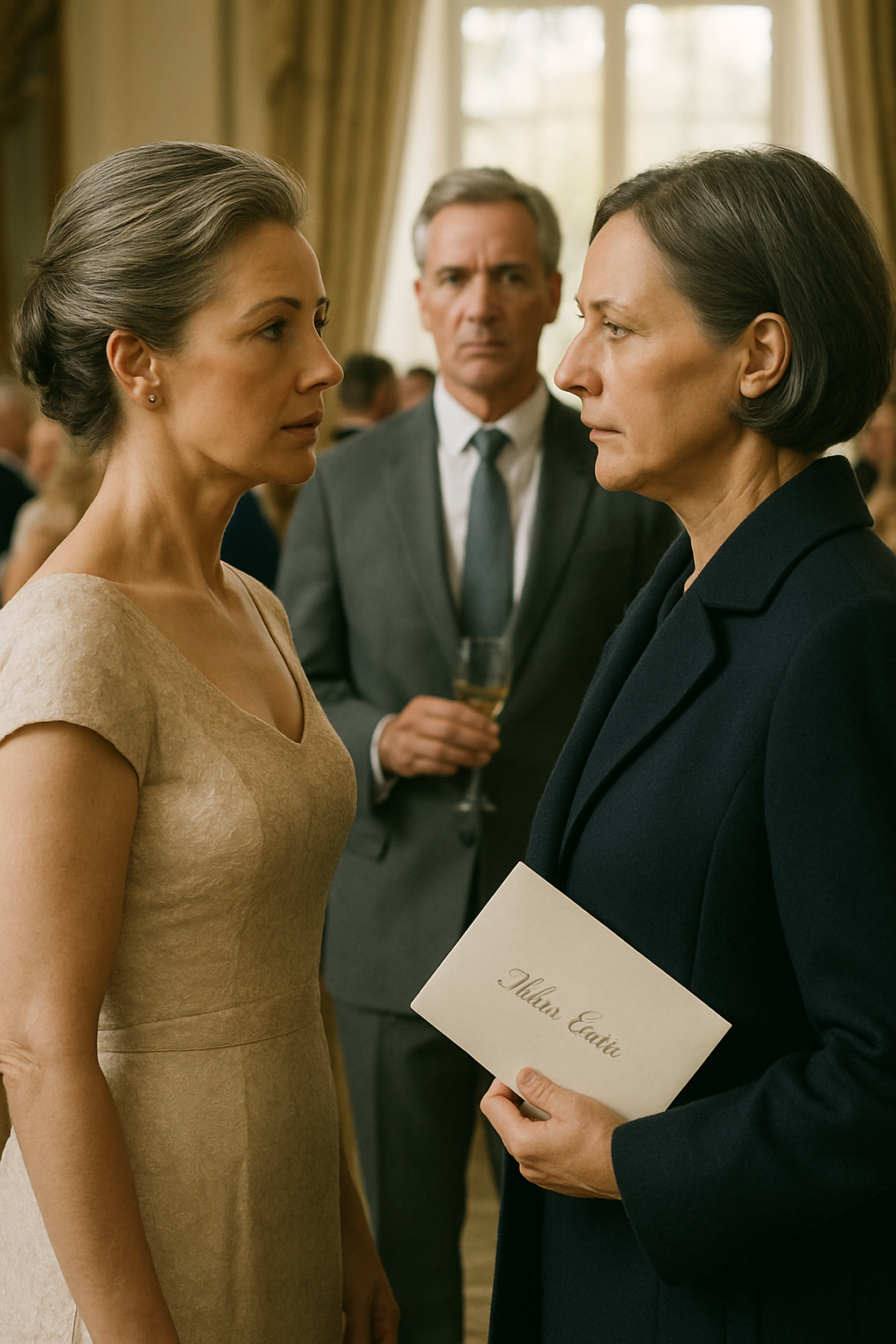
The woman who had come through the door was perhaps fifty, perhaps older. She was wearing a dark coat — not formal enough for a wedding, but good quality, the kind of coat a woman wears when she wants to look composed rather than dressed up. Her hair was dark with grey threaded through it, cut neatly. Her face was — not hard, but settled. Like a face that had made its peace with the things it knew.
She was standing just inside the doorway, looking around the room with careful, unhurried attention.
Helen looked at her without recognition.
Then she looked at Richard.
Richard had gone still.
He was still standing beside his brother, who was still speaking — but Richard had stopped hearing whatever was being said. His glass was in his hand and he was not moving and his face had done something that Helen, in twenty-eight years of reading that face, had never seen it do.
It was not surprise, exactly. It was more like the look of a man who has been waiting for a knock on the door he'd hoped would never come, and has just heard it.
Helen looked back at the woman.
The woman was looking at Richard.
She was not angry. That was the thing Helen would think about later, replaying the moment — there was no anger in the woman's face. There was something else, something quieter and harder to name. The expression of a person who has carried a thing for a long time and has come, finally, to set it down.
Helen set down her seating card.
She walked toward the woman. She didn't know why. There was nothing in her that said she needed to — the woman was just a guest, most likely, arrived early, possibly at the wrong event. Helen moved toward her the way she moved toward anything that had become unclear, which was calmly, and with purpose.
"Hello," Helen said. "I don't think we've been introduced."
The woman looked at her. Something shifted in her expression — a small, involuntary thing, quickly controlled.
"No," she said. "We haven't."
"Are you a friend of Marcus's?" Marcus was the groom's side. Helen was running through the guest list in her head with the efficiency of someone who had assembled it.
"No," the woman said. "I'm — " She paused. "I'm here because of an invitation."
"Of course. Who were you invited by?"
The woman looked at her directly. Her voice, when she spoke, was very quiet.
"I'm sorry," she said. "I received an invitation. I thought perhaps you knew."
Everything in the room continued as before.
Someone laughed at the far end. A glass clinked. The door to the garden opened and a brief cool draft moved through.
Helen stood very still.
She was not stupid. She had never, in her entire life, been a woman who did not understand what was happening around her. She understood that this woman was not a lost guest, not a wrong-event arrival, not any of the benign explanations her mind was moving through with the automatic speed of a woman who had spent her life solving problems before they became visible.
She understood that whatever this was, Richard knew about it.
She looked at the woman's face.
The woman looked back at her without flinching.
"My name is June," the woman said. "June Marsh."
Helen repeated the name in her head once. Twice. Turned it over, looking for the place where it fit. Found nothing.
"I'm afraid I don't — " Helen began.
"I know," June said. "I didn't think you would."
She reached into her coat pocket and withdrew an envelope. She held it out.
Helen took it.
It was an invitation. Cream card, Helen's own careful calligraphy across the front — the style she'd worked on for three months to get right, the style on every invitation they'd sent.
It was addressed to June Carter.
Not June Marsh.
June Carter.
Helen looked at the name. Something went very quiet in her.
"There's a woman on my daughter's guest list," Helen said carefully, "a cousin of Marcus's, named June Carter. The invitation — it seems it was sent to the wrong June."
The woman — June Marsh — looked at her with the expression of someone watching someone else realize something and choosing to wait.
"I used to be June Carter," she said. "Before I went back to my own name."
The room was still loud. Still cheerful. Still the morning of her daughter's wedding.
Helen did not look at Richard. She knew, with the precision of a woman who has spent twenty-eight years reading a room, that if she looked at Richard now, whatever was happening would become impossible to manage.
She looked at June instead.
"I see," she said. Her voice was exactly as it always was. "Would you like to sit down?"
They sat in the small anteroom off the main hall — a space that was not being used, a pair of upholstered chairs beside a window, the sounds of the gathering muffled behind the closed door.
Helen had closed the door. She was the kind of woman who always thought to close doors.
She sat across from June Marsh and looked at her and waited.
June looked back at her without deflection.
"I should explain," June said, "why I came."
"Please," Helen said.
"I received the invitation three weeks ago. I thought at first it was a mistake — my name, but the wrong family." June's hands were in her lap, clasped but not tight. "Then I saw the surname. Carter. And I thought — it could be coincidence. There are other Carters."
"Yes," Helen said.
"But then I looked at the name of the bride's father. Richard."
Helen heard the name land in the room.
"And I knew," June said simply. "That it wasn't coincidence."
Helen was quiet for a moment.
"How do you know my husband?" she asked. Her voice was measured. The voice she used in board meetings, in difficult conversations with difficult people, in the twenty years she'd spent managing other people's crises before she'd retired to manage only her own household.
June looked at her for a long moment.
"I was married to him," she said.
Helen heard the words.
She processed them with the part of her mind that was always processing, always categorizing, always finding the place where new information sat.
She said nothing.
June continued: "We were married for a year. I was twenty-three. He was twenty-four. It was — " She paused, looking for the right word with the care of someone who has given the wrong word too many times. "Brief. It ended."
"When?" Helen asked.
"1997," June said.
Helen calculated without meaning to. Automatically. She and Richard had met in 1996.
She had not moved. Her posture had not changed. She was sitting the way she always sat — back straight, hands folded, chin level. The expression on her face was the expression she wore in every difficult situation: controlled, attentive, giving nothing away.
Inside, something had gone very, very quiet.
"I see," Helen said.
"I don't think he ever mentioned it," June said. Not cruelly. Not gloatingly. Simply.
"No," Helen agreed. "He didn't."
They sat in the anteroom with the sounds of the wedding filtering through the walls, and June Marsh looked at Helen Carter with the composed expression of a woman who had carried a thing for thirty years and had come, finally, to set it down in the right place.
"I wasn't sure whether to come," June said. "After I recognized the name, I wasn't sure for two weeks. I kept thinking — what would it accomplish? He's built a life. There's a daughter getting married. Who does it help?"
"And yet you came," Helen said.
"And yet I came." June's mouth moved in something that was not quite a smile. "Because I kept thinking: what if she doesn't know? And I decided that if there was a woman who had built a life without knowing — I would want someone to have come for me."
Helen looked at her.
"That was kind of you," she said.
The words were precise and sincere and revealed nothing.
June looked slightly surprised — as if she had not expected the conversation to go this way, to stay this measured, this contained.
"I'll go," June said. "I didn't come to disrupt the wedding."
"No," Helen said. "I don't think you did."
She stood. June stood.
Helen held out her hand. June, after a brief pause, shook it.
"Thank you for coming," Helen said.
She walked June to the door of the anteroom, opened it, and watched June Marsh walk through the crowded drawing room and out through the main entrance without stopping.
Then Helen turned back toward the room.
Richard was standing twenty feet away, watching the door where June had just left, his face still wearing the expression she'd seen when June walked in — the particular stillness of a man who had been calculating for thirty years whether a door would open and had now discovered that it had.
Helen looked at him across the room.
He looked back at her.
Nothing in her face moved.
She walked toward her husband, past the guests who noticed nothing, past the flower arrangements she'd chosen, past the seating cards she'd written by hand, toward the man she'd been married to for twenty-eight years.
When she reached him she said, very quietly, so that only he could hear: "Find us somewhere private. Now."
Richard said nothing.
He led her toward the small office at the back of the venue that the coordinator had offered them for the day — the kind of thoughtful provision that Helen had noted and filed away when they'd toured the venue, another thing she'd organized, another contingency she'd planned for.
She had not, she thought, planned for this.
She closed the door behind them.
"Tell me," she said.
Richard turned to face her. He looked the way he always looked in the first moments of a difficult conversation — slightly watchful, gathering himself, reaching for the register that had always served him best, the warm, reasonable, I can explain this register that had gotten him through every hard thing he'd ever faced.
"Helen," he said.
"No," she said quietly. "Don't start with my name. Start with the truth."
He looked at her for a long moment.
Then he said: "I was married before. Very briefly. Before us. I should have told you. I didn't."
Helen was quiet.
"Her name," he continued, "was June. We met when I was twenty-three. We were married for about a year. It was — it wasn't a good marriage. It ended. I got the divorce."
"In 1997," Helen said.
He stopped.
"You and I met in 1996," Helen said.
The sentence sat in the room between them.
Richard was very still.
"Helen—"
"When," she said, "exactly — when did the divorce finalize?"
He did not answer immediately.
She watched his face go through something.
"April," he said finally. "April 1997."
Helen and Richard had married in June 1997.
She heard that fact move through her body like cold water.
She stood in the small office at the back of the wedding venue, in the dress she'd bought for her daughter's wedding, and she looked at the man she had been married to for twenty-eight years, and she understood — with the terrible clarity of a woman who has always been very good at understanding — exactly what had happened.
"Were we," she said, and her voice was completely level, completely controlled, the way it always was and had always been and would always be regardless of what she was feeling, "were we already together — you and I — when you were still married to her?"
Richard looked at her.
He said: "It was over between June and I long before the paper was filed."
Helen heard what he'd said. She also heard what he hadn't.
She turned toward the window.
Outside, the estate grounds were bright in the morning light. The lawn where her daughter would be married in three hours was being set with chairs. A groundsman was moving carefully between them, straightening each row.
Helen watched him work.
"All right," she said. "I need a few minutes. Please go back to the guests."
"Helen—"
"Please," she said. Not loudly. Not harshly. Just with the absolute finality of a woman who has set the terms of something and will not be negotiated with.
She heard him move behind her. She heard the door open and close.
She stood at the window and watched the groundsman set the chairs and did not think about anything at all for a long moment, because some things are too large to think about immediately and must be held at a distance first, like heat.
Then, carefully, she began to think.
She had been with Richard since 1996. She had been — she counted back — twenty-two years old when they met. She had been twenty-three when they moved in together. She had been twenty-three when she believed herself to be with a single man who had only ever wanted her.
He had been married.
Not to a previous person in a previous life he'd disclosed and moved on from — that was the version of the story that would have been fine, that would have been the kind of past anyone is allowed to have. No. Married secretly, simultaneously, overlapping with the first years of their relationship. Divorced two months before their own wedding.
She thought about 1997. About the year she'd been twenty-three, eager, certain she understood everything she needed to understand about the man she was marrying.
About June Marsh, twenty-four years old, who had been Richard's wife while Helen was Richard's girlfriend, and who had received a wedding invitation thirty years later because her name was on a guest list meant for someone else.
Helen turned from the window.
She straightened her dress. She checked her hair in the small mirror on the office wall. She arranged her face into the expression it was required to wear for the next several hours.
She opened the door.
Outside, the guests were gathering. The flowers were perfect. The chairs on the lawn were straight.
Her daughter was upstairs, getting ready to be married.
Helen walked back into the room.
Richard had always been good at explanations.
This was the thing Helen had observed most clearly in twenty-eight years: when something needed to be explained, Richard explained it beautifully. He had a way of organizing the facts into a shape that felt coherent, felt reasonable, felt like the only shape the facts could have taken. She had watched him do it with difficult clients, with Sophie during hard years of adolescence, with her own mother the one time her mother had expressed reservations about him.
She had never, until now, been the person who needed to be explained to.
They stood in the small coordinator's office at the back of the venue.
The door was closed. The sounds of the wedding — the arriving guests, the faint music playing in the drawing room, the occasional burst of laughter — filtered through the walls as a kind of ambient evidence that a normal day was continuing on the other side.
Richard faced her.
He had gathered himself on the walk from the drawing room to here. She could see it in his posture, his expression — the slight recalibration that happened in him when he moved from social mode to explaining mode. She had always found it reassuring before. It meant he had thought about the thing. It meant he had something to say.
Now she watched it happen and felt nothing except a very clear attention.
"Helen," he said.
"No," she said. "Start with the facts."
A brief pause.
"I was married before," he said. "Before us. Very briefly. Before I met you — " He stopped. Corrected himself, just slightly. "Before things became serious between us."
Helen noted the correction.
"Her name was June," he continued. "June Carter — she was June Marsh before, she went back to it after. We met when I was twenty-three. We got married quickly. It was — " He shook his head slowly. "It was a mistake. Both of us knew it within months. It wasn't cruel, it wasn't a disaster, it just — it was two young people who had no idea what they were doing."
Helen said nothing. Let him continue.
"We separated within the year. The divorce was — it took a while to finalize. These things take time, the paperwork, the — "
"When did it finalize?" Helen said.
He looked at her.
"April 1997," he said.
The room was quiet.
"We married in June 1997," Helen said.
"Yes."
"We had been together since 1996."
"Yes."
She heard him waiting for the next question. She could see him waiting, that particular stillness of a man who has prepared himself for a specific hit and is bracing.
She asked it.
"So she was still your wife," Helen said, "when we met."
He exhaled slightly.
"The marriage was over," he said. "Long before the paper was filed. We were living separately. There was no — Helen, the legal aspect of it was just a formality at that point. The marriage was done."
"She was still your wife," Helen said again.
"In a — in a technical, legal — yes."
Helen looked at him.
He was wearing the same grey suit he'd chosen for this day — she'd seen him pack it, had thought when he put it on this morning that he looked well in it, had felt the ordinary small satisfaction of a woman whose husband looks exactly as she'd want him to look on an occasion that mattered.
She thought: I didn't know anything.
"Tell me why you didn't tell me," she said.
He looked at her carefully. She could see him assess the question — hear the genuine inquiry in it rather than the accusation, decide how to meet it.
"Because it was over," he said. "Because by the time I understood that you and I were going to be something real, the marriage was already — in every way that mattered — in the past. I thought — " He paused. "I thought it would complicate things. For no reason. Because it had nothing to do with us."
"It had nothing to do with us," Helen repeated.
"That's not — I mean it wasn't going to affect us. It didn't change anything about what we were to each other."
Helen was quiet.
"What I'm trying to say," Richard said, and something shifted in his voice — the expert management of tone, the reaching for something that would land, "is that I made a stupid decision when I was twenty-three years old, and I was ashamed of it, and I didn't want it to be the first thing you knew about me. By the time it would have been appropriate to tell you, so much time had passed that telling you felt more like creating a problem than solving one."
Helen looked at him.
He believed what he was saying. That was the thing. She knew this face, this voice, and she could tell when he believed himself and when he didn't. He believed this. He had assembled the story of that decision into a shape he could live with, and he had been living with it for thirty years, and he believed it.
"That's a very reasonable explanation," she said.
He looked slightly relieved.
"There's one thing I need to understand," she said.
"Anything."
She held his gaze.
"Did you marry me," she said quietly, "while you were still legally married to her?"
The question sat in the room.
Helen watched his face.
She watched it with the precision of a woman who had been watching this face for twenty-eight years — who knew every shift in it, every small movement, the exact set of his jaw when he was about to be truthful, the particular quality of his stillness when he was about to be careful.
He was very still.
The answer should have been immediate. The answer, if the answer was no, should have taken no time at all — a simple no, followed by the explanation, the timeline clarified. It would have taken two seconds.
It took seven seconds.
In those seven seconds, everything changed.
"The divorce was filed months before," he said. "It was in process. It was—"
"That's not what I asked," Helen said.
"Helen—"
"I asked if you married me while you were still legally married to her."
His jaw moved slightly. The exhale again.
"The filing had been done," he said. "The—"
"Richard." Her voice was still quiet. Completely level. "Yes or no."
He looked at her for a long moment.
He did not say yes.
He did not say no.
He looked at her with the expression of a man who has been asked a question he has spent thirty years not asking himself, and the silence of that not-asking had been so complete, so practiced, so insulated from the actual light of day, that he did not know — standing there in the coordinator's office in the venue for their daughter's wedding — he did not actually know anymore whether he had or hadn't.
Or whether he had known, once, and had made himself forget.
Helen understood this too.
She turned away from him.
She stood at the window, looking out at the garden where the chairs were set in neat rows on the lawn, where her daughter would walk in two hours.
"I need you to go back to the guests," she said.
"Helen—"
"I am going to stand here for a few minutes," she said. "And then I am going to go upstairs and see my daughter, who is getting married today. And the two of us are going to walk out there and watch our daughter get married. And we are going to do it properly."
Richard was quiet.
"And after," she said, "we will continue this conversation."
She heard him.
She heard him trying to decide whether to push, whether to apologize now, whether to fill the silence.
She heard him choose not to.
The door opened and closed.
Helen stood at the window.
She thought about April 1997. She thought about June 1997. She did the calculation again, as if doing it a second time might yield a different result. It did not.
She thought about a twenty-three-year-old woman named June Marsh who had been Richard's wife. Who had received an invitation to a stranger's wedding because of a clerical error, had recognized a name, had deliberated for two weeks, and had gotten in her car and come.
Because she thought Helen deserved to know.
Helen pressed her fingers against the window glass. Cold.
She had built everything. The life, the marriage, the daughter they'd raised together, the house they'd lived in for twenty years, the quiet confident assumption that she knew, at minimum, the basic facts of the man she'd married.
She had not known one of the most basic facts.
The question now was not what she felt about that. She knew what she felt. She would not let herself feel it here, not today, not in the coordinator's office with the wedding beginning in two hours.
The question was what she did.
Helen was a practical woman.
She had always been a practical woman. It was the thing that had gotten her through everything — the early years of their marriage when money was tight and Sophie was small and Richard was still finding his footing in his career and Helen was working two days a week and managing the household with the other five. The middle years when Sophie was a teenager and difficult in the specific way that smart, sensitive girls are difficult, and someone had to hold the structure steady. The years after Sophie left home when it had just been the two of them again and Helen had needed to remember who she was outside of organizing other people's lives.
She had always been the practical one.
Practical meant: you did what the situation required.
What the situation required, in the next two hours, was that she be the mother of the bride. That she go upstairs and see Sophie, who did not know any of this and must not know any of this today. That she walk out onto that lawn with her husband and watch her daughter get married with her face arranged in the expression appropriate for the occasion.
She was very good at appropriate expressions.
She checked her appearance in the small mirror.
Then she went upstairs.
Sophie was standing in the middle of the suite in her wedding dress, and when Helen came through the door, Sophie turned and looked at her with the particular anxious brightness of a young woman on the biggest day of her life, and said: "Do I look okay? Tell me honestly."
Helen looked at her daughter.
Sophie Carter, twenty-seven years old, in ivory silk, hair pinned, slightly flushed, looking at her mother the way she'd always looked at her mother — with the assumption that her mother would know the right thing to say.
"You look exactly right," Helen said.
And she meant it. And it came out exactly as it should have.
She crossed the room and adjusted one small thing about Sophie's veil — a tiny correction that wasn't strictly necessary but gave her hands something to do — and Sophie stood still for it, and they looked at each other in the mirror, and Helen thought: I will get through this. I have always gotten through everything.
The ceremony was what Helen had planned it to be.
Marcus's face when Sophie walked out. Sophie's hands, trembling slightly, which Helen noticed and no one else did. The vows, which were Sophie's own words and were entirely Sophie — direct, slightly funny in one part, then suddenly very sincere. The moment when the officiant said "you may kiss" and Marcus kissed Sophie and everyone who was watching made the involuntary human sound that a wedding draws from people.
Helen watched it all.
She was sitting in the front row beside Richard, and she sat very straight and her face was the face of a woman watching her daughter marry, which was in fact what she was doing. She was doing all of it correctly. She had been doing things correctly for twenty-eight years, and she was doing it now.
Beside her, Richard reached for her hand.
She let him take it.
She looked forward.
What she was thinking — what she had been thinking through the ceremony, through the vows, through the moment the rings were placed — was this:
The divorce finalized in April 1997.
They married in June 1997.
Two months.
She thought about the woman who had come through the door with a wedding invitation in her coat pocket. The woman who had deliberated for two weeks and come anyway. The woman who had shaken Helen's hand and thanked Helen for receiving her with dignity.
I would want someone to have come for me, June had said.
Helen understood that.
She sat with her husband's hand in hers and watched her daughter become a wife.
She did not squeeze his hand. She did not pull it away.
She held it exactly as she always had.
But she was thinking.
She was thinking: two months.
She was thinking: thirty years.
She was thinking: the calligraphy on the invitations, the three months she'd spent perfecting it, the way she'd written "June Carter" without knowing what those words meant.
She was thinking: what else don't I know?
And: is this the shape of my marriage, from the beginning?
And: am I the kind of woman who can decide what to do about this?
She thought she was.
She wasn't sure yet what doing something would look like.
But she thought she was.
After the ceremony, during the reception, Sophie found her.
"Mum," Sophie said, slightly breathless, the way she got at events — overstimulated, glowing, not quite sure where to put the feeling. "You okay? You've been—" She looked at Helen with the sharpness she'd always had. "You look like you're thinking very hard about something."
"I'm fine," Helen said. "I'm watching your wedding."
"You look like you're doing maths."
Helen laughed. Just a small sound. "I'm always doing maths."
Sophie studied her for a moment. Something in her expression shifted — the sharpness deepening, a question forming.
"Is Dad okay?"
Helen looked at her daughter.
"Your father is fine," she said. "Go back to your husband, Sophie."
Sophie went.
Helen watched her go, across the room to where Marcus was waiting, and she thought: today is hers. Whatever this is, it is not happening to her today.
She held that thought very carefully.
She held the whole day very carefully.
That was, as it turned out, the easy part.
Later, Helen would think about the word "practical."
She had used it to describe herself her whole life — in job interviews, in the way she explained herself to new acquaintances, in the private conversations she had with herself when she needed to understand her own behavior. Practical. It had always felt like a compliment. A description of someone who could be relied upon.
Standing in the coordinator's office after Richard left, she understood for the first time that it could also be a description of someone who had agreed, for twenty-eight years, to operate on incomplete information and called it self-sufficiency.
She had been practical about Richard's silences.
There were things he didn't talk about. His early twenties — she had accepted this as the territory of a man who'd had a difficult stretch, who'd sorted himself out, who didn't need to drag the past into the present. She had thought it was maturity. The ability to close a door.
She understood now what closing a door meant.
Upstairs, in the suite, she found Sophie's bridesmaid — the eldest one, the one who'd known Sophie since university — standing in the corridor with a glass of water and an expression of mild agitation.
"Oh, Helen," she said. "I'm glad — Sophie's looking for you. She's got a thing about the veil."
"I'll go in," Helen said.
She did not need to be told what the thing about the veil was. She had anticipated it — a tendency of Sophie's to come apart over small technical difficulties when the large emotional fact of what was happening was too much to hold directly. Helen had been managing this since Sophie was seven years old.
She went through the door.
Sophie turned.
She was in the dress, veil already pinned, and the thing about the veil was that it had shifted two centimeters to the left and Sophie had been staring at it in the mirror and working herself into the belief that it was ruined.
Helen looked at it.
"Sit still," she said.
She adjusted the clip. Smoothed the silk. Stepped back and considered.
"There," she said.
Sophie looked in the mirror. The relief in her face — the immediate, involuntary release of a body that had been braced for something bad — was one of the most Sophie things Helen had ever seen.
"I panicked," Sophie said.
"I know."
"It looks okay now?"
"It looks perfect." Helen held her gaze in the mirror. "You look perfect."
Sophie exhaled. And then, because she was Sophie, and had always been able to feel the temperature of a room: "Are you okay?"
"I'm your mother," Helen said. "I don't get to not be okay until tomorrow."
Sophie laughed, short and startled. "That is extremely efficient of you."
"Yes," Helen said. "I've always been very efficient."
She reached out and pressed her daughter's shoulder briefly. The silk was cool under her fingers, and Sophie's shoulder was warm, and Helen thought: this. This part is real. Whatever else is true, this is real, and I am here for it, and it is enough.
For the next three hours, it was.
The wedding was over.
That was the thought that kept arriving as Helen stood in the hotel suite, alone, the door closed behind her, Richard's side of the room visible from where she stood — his jacket on the chair, his watch on the nightstand, the small familiar debris of a man she'd been living with for twenty-eight years.
The wedding was over.
Sophie was in her suite two floors up with Marcus. The guests had dispersed in the particular gentle dissipation of a successful wedding, gathering coats and congratulations, making promises to keep in touch. Richard had lingered at the bar with his brother, which Helen had allowed because she had wanted, for a little while, to be alone.
She sat on the edge of the bed.
She had been performing all day — not falsely, not cruelty to Sophie or to anyone else, but performing in the sense that she had been doing what the day required rather than what she required. She had done it perfectly. She had not cried in the wrong moments or said the wrong things or allowed any of what she knew to leak into any of the spaces where it would have done damage.
Now she was alone, and she could stop performing.
She sat very still on the edge of the bed.
Outside, the estate grounds were dark and quiet. The chairs on the lawn had been cleared. The fairy lights in the trees had been turned off. It was after eleven, and the world outside was settled into the ordinary darkness of a night after an event, and Helen sat in the room and let herself, very carefully, feel what she had not allowed herself to feel all day.
It was not anger. Not precisely.
Helen had been angry before — had known the hot, sharp quality of it, the way it moved through you when something was genuinely unfair. This was not that.
What this was, she thought, was grief.
Not for the marriage, not yet — she was not there yet, did not know where she would be, was refusing to answer that question in this hotel room at eleven o'clock on her daughter's wedding night. But grief for the twenty-three-year-old woman she had been when she met Richard Carter. Grief for that woman's certainty. Her confidence that she understood what she'd walked into.
She had been so certain.
She had always been certain, and it had served her, and she had never had reason to doubt it.
She thought about the things June Marsh had said. The calm, settled way she'd said them. The deliberation — two weeks of it — before she came. The handshake at the end, which Helen had offered and June had accepted, and which had been — Helen thought — the most dignified exchange she had ever participated in without fully understanding it.
I would want someone to have come for me.
June had come for her.
Thirty years late, in a dark coat, with an envelope in her pocket. But she had come.
Helen thought about what it cost a person to do that. To drive to a stranger's wedding, knowing what you know, carrying what you carry, and walk through a door because you decided someone deserved to know.
She looked at the wall.
She thought about Richard.
Not Richard as he'd been in the coordinator's office, not the careful explaining version — but Richard as she'd known him for twenty-eight years. The way he was with Sophie. The way he'd been in the hard years, the real hard years, when Helen's mother was sick and Helen was doing all of it and Richard had been there in the reliable, solid way that she'd relied on. The trips. The ordinary evenings. The breakfast table.
She thought about all of it, and then she thought about April 1997, and she thought about the silence he'd maintained around that fact for thirty years, and she thought about what that meant about who she'd been living with.
She thought: I don't know if the silence was cowardice or cruelty.
Then she thought: I don't know if that distinction matters.
The door opened.
Richard came in quietly. He'd been at the bar long enough that there was a slight looseness about him, the faint edges taken off, the kind of thing you only know to look for after twenty-eight years. He set his jacket on the chair and looked at her on the edge of the bed.
"Helen," he said.
"Sit down," she said.
He sat in the chair across from her. They looked at each other the way people look at each other after a long day of performing other things.
"I want to say something," he said.
"Go ahead."
He was quiet for a moment. Then:
"I know that what I did was wrong. I know that not telling you — I know it was wrong, and I've known it for thirty years, and I have told myself so many different things to explain why I didn't, and none of them are good enough. I know that."
Helen listened.
"I was twenty-four years old and I was ashamed and I was afraid that if I told you, you'd leave, and I couldn't — " He stopped. "I couldn't risk that. You were — you were the thing I'd found that I hadn't expected to find, and I couldn't risk it."
"So you protected yourself," Helen said.
"I told myself I was protecting us."
"I know what you told yourself."
He looked at her.
"I should have told you," he said. "I should have told you before we married. I should have told you a hundred times in twenty-eight years. Every time would have been better than now. I know that."
Helen held his gaze.
"I'm not asking you to forgive me tonight," he said. "I'm not — I'm not going to tell you what to do or how to feel. I just want you to know that I understand what I did."
Helen was quiet.
She sat with what he'd said. Turned it over.
The thing about Richard was that he was not a bad man. She had never thought he was a bad man. He was a man who had done a thing that bad men do, but who was not, in his fundamental nature, the kind of person who set out to damage other people. He was the kind of person who protected himself first and told himself it was something else.
She had loved him for twenty-eight years.
She thought about that.
She thought about what twenty-eight years of loving a person was, the weight and the texture of it, the accumulated fact of it. She thought about whether that could be set against this thing, whether the scales worked that way, whether there was a calculation that came out one way or the other.
She thought: I don't know yet.
"I need more time," she said.
He nodded.
"I'm going to sleep," she said. "This is not the night to continue this conversation."
He looked at her carefully.
"Do you want me to —" He gestured, vaguely, toward the door.
Helen thought about it.
"No," she said. "Tonight you sleep in the chair."
He nodded again. He didn't argue. She noticed that.
She got up and went to the bathroom and took off the dress she'd bought for the occasion, the dress she'd spent four weekends finding, and she hung it carefully because she was always careful with things, and she washed her face.
She looked at herself in the mirror.
Fifty-two years old. Silver in her dark hair, the kind she'd decided years ago not to hide because it was what she was. The face of a woman who had spent twenty-eight years building something and had just discovered that the foundation included a room she'd never been shown.
She did not cry.
She looked at herself for a long time, and then she turned off the light.
In the morning, they drove home.
Sophie and Marcus were flying to Portugal the next day and Helen had said her goodbyes at breakfast — Sophie radiant, Marcus generous, the ease of two people in the first hours of a marriage they hadn't yet had time to test. Helen had held her daughter and thought: this at least is real. This is exactly what it is.
In the car, she and Richard did not speak for a long time.
Then Richard said: "What are you thinking?"
"I'm thinking," Helen said, "about what I'm going to do."
He waited.
"I'm not going to make a decision today," she said. "I'm going to go home, and I'm going to think, and I'm going to take as long as I need. And you're going to let me."
"Yes," he said. "Of course."
She looked out the window.
"I want to talk to someone," she said. "A counselor. Alone first, then together if that becomes relevant."
"Yes," he said.
"And I want you to understand," she said, "that I don't know what I'm going to decide. I don't know whether this is something I can come back from or not. I don't know whether what you did thirty years ago changes what we've been for twenty-eight years, and I don't know how long it's going to take me to figure that out."
"I know," he said.
"But I need you to stop explaining," she said. "I've heard your explanation. I understand your explanation. What I need now is not more words. What I need is space to figure out what I think."
He nodded.
She looked out at the motorway. The ordinary Sunday morning traffic.
"She was a decent woman," Helen said.
He didn't need to ask who she meant.
"Yes," he said. "She was."
"She came because she thought I deserved to know."
He said nothing.
"She was right," Helen said.
Six months later.
Helen Carter lived alone in the house she'd chosen.
Not the family home — she'd left that. Richard had the house, which was practical because he needed the space for when Sophie visited, and Helen had found a flat in the city, three rooms, a view of rooftops, genuinely hers in a way that the family home had not been for years.
She had started working again. Not the high-pressure position she'd left in her forties — something smaller, a consultancy role, three days a week, the kind of work that used her without consuming her. She found she was good at it in a new way, a looser way, the way of someone who no longer needed the work to be the structure holding everything else up.
Sophie knew.
Helen had told her six weeks after the wedding, calmly, with a care for Sophie's experience of it that had required Helen to set her own entirely aside for the duration of the conversation. Sophie had been — complicated. Upset in the way of someone who doesn't know how to place the grief, who loves both parents and doesn't want to choose. She'd tried, initially, to be the person who fixed it.
"Have you talked to him? Have you actually talked, not just—"
"Sophie," Helen had said. "I am not asking you to take a side. I am asking you to let me make my own decision."
Sophie had been quiet for a long moment.
Then she'd said: "Are you okay?"
And Helen had said, honestly: "I'm getting there."
She was getting there.
It did not look the way she'd thought it would look. She had thought, in the hotel room on the night of the wedding, that getting there would involve more anger, more grief, more of the loud things. But what she found was quieter than that. A kind of ongoing clarification. A process of working out what she actually thought, felt, wanted, separate from what she'd always been moving toward in the context of the marriage.
She was finding she had opinions she didn't know she had. She was finding she had preferences that had always been smoothed over by the easier default of going along. She was finding that the woman who had always been quietly essential to everyone else's requirements had, underneath that, an entire person she hadn't had occasion to meet properly.
She met her now.
The flat was hers. The mornings were hers. The Sundays, the decisions, the small pleasant choices about what to have for dinner, who to see, where to be.
She had written a letter to June Marsh.
She had taken a week to write it. She had gone through four drafts. The final version was not very long — two pages — and it said what she needed it to say, which was:
Thank you. I know what it cost. I know you came for me. I want you to know that it mattered.
She did not know if June would reply.
She had told herself that it didn't matter whether June replied or not. She had written the letter because it was the true thing to do, and she had spent enough of her life doing the expected thing instead of the true thing, and she was done with that now.
Three weeks later, a reply arrived.
It was shorter than Helen's letter. One page.
It said: I'm glad you knew. And then, at the end: I hope you find yourself a life that suits you. I did, eventually. It takes longer than you'd think. But it's worth it.
Helen read it twice.
Then she put it in the drawer where she kept the things that mattered.
Then she made herself a cup of coffee and stood at the window of her flat and looked at the rooftops, and the sky above them, and the particular morning light, and she thought:
I am fifty-two years old.
I built something for twenty-eight years.
Some of it was real.
Some of it was not.
I am working out the difference.
She drank her coffee.
She felt, not happiness exactly — that was too simple a word for what this was — but something close to the sensation she'd stood with on the morning of Sophie's wedding, before she'd known, looking out at the grounds.
A fullness. A thing she was in the middle of.
Her own life, for once. Entirely hers.
She decided it would do.
There was a version of this that Helen had seen other women live.
She had watched it, over the years, at a distance — the slow crumbling of a marriage after an uncovering, the way people rallied and tried and then stopped trying, the particular sadness of two people who had once known each other well and could no longer stand to be in the same room. She had always observed it with the composed sympathy of a woman who believed, at her core, that such things were the result of insufficient attention. That if you paid close enough attention to the right things, you could maintain the thing you'd built.
She had paid close attention for twenty-eight years.
She was revising her theory.
Sophie called on a Sunday, six weeks after she and Marcus had come back from Portugal. She was at their new flat — Helen had been once, had sat on the sofa with a cup of tea and looked around and thought: good. A new thing. Sophie's own.
"Dad rang me," Sophie said.
"I know," Helen said. "He told me he would."
"He seems — " Sophie stopped. "He's trying. He wants to know if I think you'll come back."
Helen thought about that.
"Did he ask you to ask me?"
A pause. "Not exactly."
"Sophie." Helen kept her voice even. "What did he ask you, exactly?"
"He said — he said to tell you he was sorry. That he knows saying it again doesn't change anything but that he wanted you to hear it again."
Helen sat with that.
Richard, in the months since she'd moved out, had been — she had to acknowledge it — quite different from the man she'd expected. She had expected the campaign. The grand gestures, the managing of her back toward a conclusion he wanted. She had braced herself for it, had her responses prepared, had the name of her counselor ready as a shield.
Instead, he had been quiet.
He had done what she'd asked: let her be. Answered when she called. Did not fill the space between them with words.
She didn't know what to do with that.
"Tell your father," she said, "that I heard him."
Sophie was quiet for a moment. "That's all?"
"For now," Helen said. "That's all."
The counselor's name was Patricia, and she had a small office in a Victorian building two streets from Helen's flat, and she said very little in sessions — a quality that Helen had initially found frustrating and had come, over ten weeks, to understand as a gift.
"You keep returning," Patricia said one afternoon, "to the word practical. What does it mean to you?"
Helen had thought about this before being asked. She'd known it was coming.
"I think," she said slowly, "that for a long time it meant I could be trusted to handle things. Any thing. Without falling apart."
"And now?"
"Now I think it also meant I gave myself permission not to feel things that might have been worth feeling."
Patricia said nothing. Let the sentence sit.
"I was twenty-three," Helen said. "And I was so certain. I was so absolutely certain I understood what I was building."
"What do you think you were building?"
"A life. The right life. The one I'd looked at the shape of and decided was correct."
"Whose shape was it?"
Helen looked at her.
"That's the question, isn't it," she said.
In April — eight months after the wedding — Helen drove to the coast.
She went alone, on a Tuesday, with no particular plan except to be somewhere that was not the flat and not the old house and not the city. She found a small hotel in a town she didn't know, checked in, and spent two days walking on the beach in weather that couldn't decide what it was.
She thought about June Marsh on the second morning, standing at the edge of the water.
June had said: I hope you find yourself a life that suits you. I did, eventually.
Helen wondered what June's life looked like. She had not asked — the letter had not been that kind of exchange, had been something more contained, more deliberate than that. But she wondered.
She wondered what it looked like to be a woman who had been Richard's wife, who had been set aside in the quiet private way that June had been set aside — not cruelly, Richard had said, and she believed him; not cruelly, but with the absolute self-interest of a young man who wanted what he wanted next and filed the paperwork when he got around to it.
She wondered what June had done with that.
She seemed — from the letter, from the composed dark-coated woman who had stood in the drawing room of her daughter's wedding and said I would want someone to have come for me — to have done something real with it. Something worth doing.
Helen stood at the edge of the water and felt the cold air come off the sea.
She was fifty-two years old.
She had months behind her now of working out what she actually thought, separate from the architecture of the marriage. She had found opinions she hadn't known she had. She had found that without the constant low-grade effort of managing a household around another person's preferences, she had time — real time, time with no one in it but her — and she did not know what to do with it and was beginning, very slowly, to learn.
The sea was grey and restless.
She thought: I am not done yet.
Not with the question of Richard — that was still unresolved, still living in the careful in-between space they'd created, might stay there, might not. But with herself. With whatever the next chapter of this was.
She had never, in fifty-two years, lived a chapter that was entirely her own authoring.
She intended to write one now.
She stood there for a long time, watching the water, and then she turned back toward the hotel for breakfast.
She had a full day ahead.
She intended to use it.