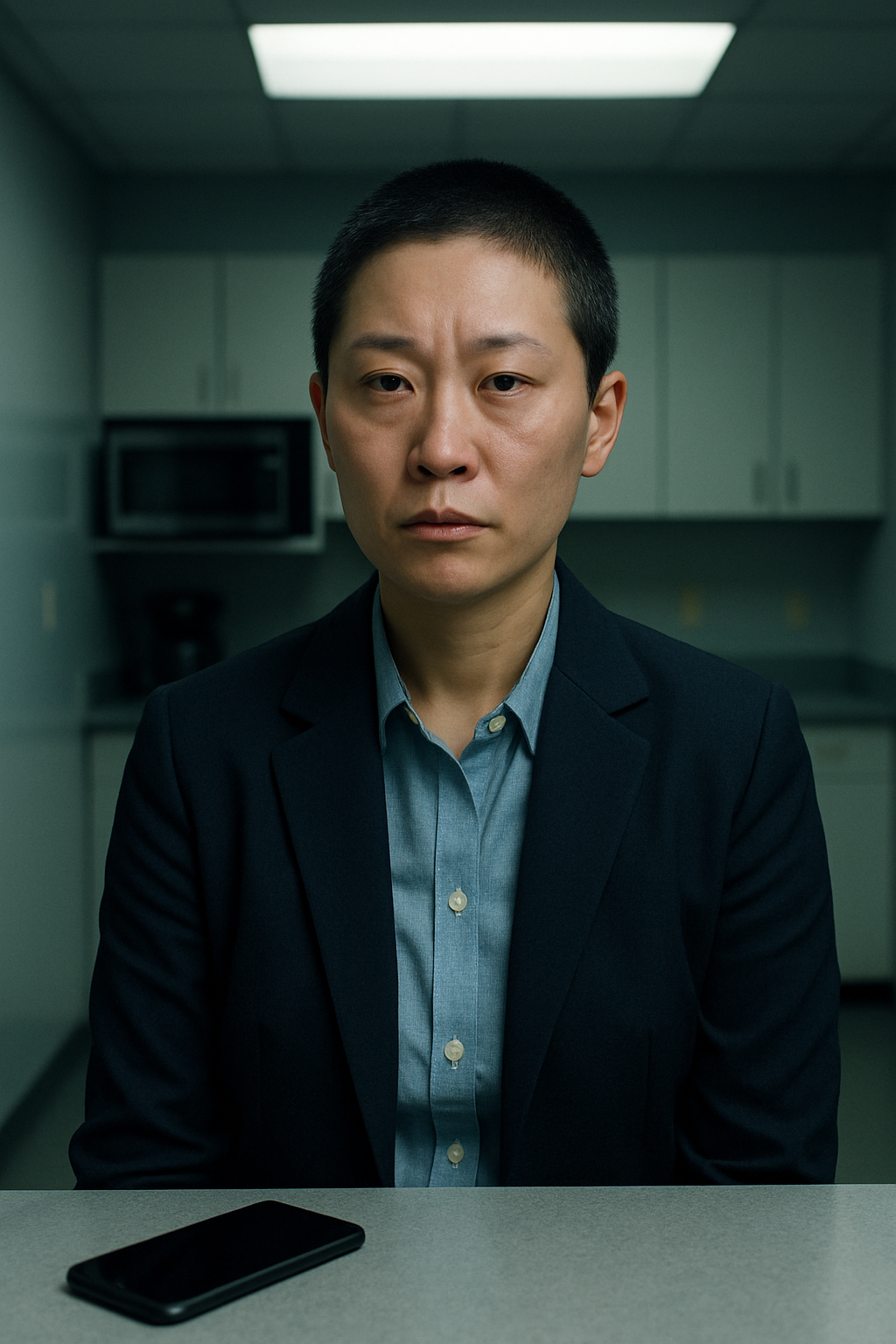
The email arrived on a Thursday morning. Sarah read it at 7:43 a.m., standing in the break room with her coffee still too hot to drink. She read it twice. Then she put her phone face-down on the counter and stood very still for a moment.
Then she picked it up and read it a third time.
The subject line said: INTERNAL ANNOUNCEMENT — CONGRATULATIONS TO OUR NEW VP OF PRODUCT DEVELOPMENT.
The name in the body was Daniel Marsh.
Sarah had been at Caldwell Analytics for eight years. She'd started as a senior data analyst six months before Daniel did. For the first two years, they'd worked side by side on the client delivery team — same title, same salary band, same manager. By year three, Sarah was running the methodology on every major engagement. By year four, Daniel was presenting that methodology to clients while Sarah built the next one.
It wasn't a conspiracy. It wasn't that anyone decided Sarah should be invisible. It was more ordinary than that.
Daniel was good in rooms. He had a way of filling a conversation without crowding it — asking the right question at the right time, making a client feel like their problem was the most interesting problem in the world. He remembered names. He followed up. He was present in a way that registered.
Sarah was good at the work. She had a mind that moved through complexity cleanly, that found the load-bearing element in any analytical problem and put pressure on it until it cracked open. She wrote documentation that other people's careers were built on. She fixed errors nobody else caught until they would have become disasters.
She just did it quietly.
She'd told herself that was fine. The work would speak. Good work always speaks eventually. She believed this the way people believe things that have never actually been tested.
The announcement email had been sent at 7:41 a.m. By 7:44, replies were already coming in. Congratulations, Daniel. So well-deserved. Couldn't be happier. The thread was long by the time Sarah reached her desk.
She set her coffee down and opened the project dashboard. She had three deliverables due by end of week. She started working on them.
An hour later, her manager, Tom, knocked on her glass office door.
Tom was fifty-one, a mild man who managed by staying carefully neutral about everything. He had never, in four years of managing Sarah, told her she was doing excellent work, or that her work was poor, or that there was something she should change. He operated entirely in the middle register.
"Sarah," he said. "Do you have a minute?"
She did.
He sat down across from her and clasped his hands on the desk. "I assume you've seen the announcement."
"I have."
"I want to check in with how you're feeling about it."
Sarah looked at him. "I'm fine, Tom."
"Okay," he said. "I know you may have had some expectations around this cycle."
She hadn't said that to anyone. She'd kept her own counsel about the VP opening. But apparently it was known that she had expected — what? To be considered? To be told she'd been considered? "I don't know that I had formal expectations," she said carefully.
Tom unclasped his hands and re-clasped them. "The committee felt — and I want to be clear, this is feedback that's meant to be constructive — that Daniel demonstrated stronger leadership presence. In terms of his visibility across the organization. His stakeholder relationships."
Sarah waited.
"The committee felt that you might benefit from focusing on developing that executive presence piece. Visibility, relationship-building at the senior level. That's something HR can support you on, if you'd like."
"What specifically," Sarah said, "did I fail to demonstrate?"
Tom looked slightly pained. "It's not a failure, Sarah. It's a developmental area. Leadership presence is about how you show up in rooms, how you carry the weight of —"
"Tom." She kept her voice very even. "I've run the methodology on every major engagement for the past four years. I've trained six analysts who are now on the senior team. I built the quality framework this organization uses. What specifically did I not do that Daniel did?"
Tom looked at his hands. "Leadership presence is difficult to quantify."
"Yes," Sarah said. "It is."
He left shortly after. She closed her door and looked at her screen. Outside the glass, the office was moving — people making coffee, having hallway conversations, the ordinary machinery of a Thursday morning.
She had not cried. She noted this as a fact. She was not going to cry.
She opened the project dashboard and kept working.
That evening she went home to her apartment, which she had lived in alone since her marriage ended two years ago. She made dinner — the same quick pasta she made when she couldn't think about food — and sat at her kitchen table and looked at the wall.
The thing about the "leadership presence" explanation was that it had a logic to it. She could even, if she worked at it, understand the logic from the committee's perspective. Daniel was visible. Daniel built relationships. Those were real skills that had real organizational value.
But.
The work they were describing as Daniel's had been built by both of them, with the balance tipping steadily in one direction over eight years. And the explanation they'd given her — leadership presence, executive visibility — those weren't descriptions of a skill gap. They were descriptions of a performance gap. The way you showed up in meetings, how you carried the room, how you occupied space.
Which meant: you didn't get the promotion because you didn't look like someone who should have a promotion.
She sat with that for a while.
Then she washed her bowl, changed into old clothes, and cut her hair.
She'd worn it long for years — shoulder-length, practical enough but still soft. She stood in her bathroom with a pair of scissors and cut it close to her skull. Not styled, just short. The kind of short that said: I am not performing for you anymore.
She didn't photograph it. She didn't post about it. She went to sleep at ten-thirty.
The next morning she was at her desk at seven.
The announcement came on a Thursday. The new CEO started on a Monday, three weeks later.
Her name was Margaret Cole, and nobody in the company had ever met her. She'd been brought in from outside — a turnaround specialist with a background in industrial operations who'd spent the last eight years scaling a logistics company. She had no history with Caldwell Analytics. She had no debts to the existing culture.
Sarah heard her before she saw her.
Margaret's voice carried. Not because she was loud, but because she chose her words with precision and projected them clearly, the way someone does when they've spent decades in rooms where they needed to be heard. Sarah was at her desk when Margaret's voice came through the open door: "I'll need the full team roster by this afternoon. Not the org chart — the work output log. Who's been responsible for what, for the past three years. Deliverables, clients, methodology."
There was a pause. Then Tom's voice, slightly strained: "I can put together a summary —"
"Not a summary. The logs."
Another pause. "That's quite a lot of data."
"Yes," Margaret said. "I imagine it is."
Sarah turned back to her screen. She felt, for the first time in three weeks, something that was not entirely dull.
The email came the following Tuesday. From Margaret's assistant: all team members were asked to submit a personal work log covering the past three years. Not a CV, not a performance review summary — a direct accounting of deliverables. Projects led or contributed to, in order. Methodology developed or applied. Client relationships owned or supported. Decision points and their outcomes.
The email specified: "Please do not curate. Include everything, complete or incomplete. This is not a performance review."
Sarah opened a blank document.
She started typing at nine in the morning. She was still typing at four in the afternoon. Not because she was padding — because the list, once she started pulling it up from memory and from her records, was genuinely that long. The frameworks that had become company standard. The client crises she'd resolved before they became client exits. The analysis that had reversed a strategic decision the executive team had been moving toward for six months. The documentation. The training. The six analysts she'd built from junior-level into senior-level.
She submitted it at 4:47 p.m. It was nineteen pages.
She didn't think about what would happen when Margaret read it. She just hit send and went back to her deliverables.
Margaret read it.
Sarah knew this because on Thursday morning, two days after submission, she received a calendar invite from Margaret's assistant. A fifteen-minute meeting, Friday at two p.m.
The subject line said: Your work log — follow-up questions.
Sarah looked at the invite for a long moment. Then she accepted it and went back to work.
The rest of Thursday passed. Friday morning arrived. She wore the same thing she always wore — dark trousers, a clean white shirt, flat shoes. Her hair was very short now, and she'd stopped apologizing for it even internally.
At 1:58 she walked to the conference room on the executive floor. At 2:00 exactly, Margaret Cole came through the door.
She was exactly what Sarah had expected from her voice: a woman who took up the amount of space she needed and not one inch more. Silver hair cut efficiently, a dark blazer, flat heels. She had the eyes of someone who had stopped being surprised by what she found when she looked at organizations.
She sat down across from Sarah. She had a printed copy of Sarah's work log in front of her. It had tabs in it — the physical kind, colored adhesive tabs, placed at specific pages.
She looked at Sarah for a moment. Not appraising, exactly. More like she was confirming something.
"You submitted nineteen pages," Margaret said.
"Yes."
"Daniel Marsh submitted four."
Sarah said nothing.
"I've been cross-referencing the logs with the client files and the delivery records for the past three years," Margaret said. "I want to ask you some questions." She opened to the first tabbed page. "The Meridian methodology. Page three of your log. You list this as work you led."
"That's correct."
"Daniel's log doesn't mention it."
"No," Sarah said. "It wouldn't."
Margaret looked at her. "Walk me through how that happens."
Sarah took a breath. "Daniel presented it to the client. He did the client relationship. I built the methodology. The presentation included my work without attributing it to me. That was the standard arrangement."
"For how long?"
"About five years."
Margaret turned to another tabbed page. "The Chen Framework. You named it yourself — that's in your log."
"I named it internally," Sarah said. "It's called the Caldwell Analytical Standard in all public documents."
"Because —"
"Because Tom felt personal attribution would seem self-promoting."
Margaret closed the log.
There was a pause. Not a comfortable one. Margaret was looking at the table, which Sarah had come to understand meant she was thinking, not avoiding.
"I'm going to ask you one more question," Margaret said. "And I want you to answer it honestly, not diplomatically."
"All right."
Margaret looked up. "Did you expect this outcome? When the VP decision was made, were you surprised?"
Sarah looked at her. "I was disappointed," she said. "I wasn't entirely surprised."
"Why not?"
Sarah was quiet for a moment. "Because I understood how the decision was made," she said. "I just didn't think it would be made that way."
Margaret nodded slowly. "I want to schedule a longer conversation," she said. "Next week. An hour."
She stood and held out her hand.
Sarah shook it. Margaret's grip was firm and brief.
"Get some sleep this weekend," Margaret said. It wasn't a pleasantry. It sounded like a directive from someone who'd looked at a person and diagnosed exhaustion.
Sarah walked back to her desk. She sat down. The office was the same as it always was — the same lights, the same hum of keyboards, the same Daniel across the floor in his new VP office, currently on a call, laughing at something the client had said.
She opened her deliverable. She kept working.
But for the first time in three weeks, something had shifted. Not fixed. Not resolved. Just — shifted.
Like a window had opened in a room that had been sealed too long.
That weekend, Sarah cleaned her apartment.
Not tidied — cleaned. She moved furniture. She pulled books off shelves and put back only the ones she'd actually read in the past two years. She filled three bags for donation and two for the bin and stood in the middle of her living room at ten on a Saturday morning with her short hair and bare feet and looked at the space she'd made.
She felt nothing in particular about it. But she did it anyway.
She had not told anyone about the meeting with Margaret. Not her sister, who called on Sunday and asked how work was going. Not her friend Priya, who worked in HR at a different firm and would have understood the significance immediately. She said: work is fine. She meant: something is happening that I don't want to name yet in case naming it makes it fragile.
She made tea. She sat by the window.
Outside, the weekend city moved at its weekend pace — couples walking dogs, a man on a bicycle, two teenage girls laughing at something on a phone. Sarah watched without feeling separate from it. Just watching.
She thought about the fifteen-minute meeting. The tabs in the printed log. The way Margaret had said: I've been cross-referencing the logs with the client files and the delivery records.
Cross-referencing. Not reviewing. Not glancing at.
Whoever Margaret Cole was, she was doing actual work.
Sunday afternoon, Sarah opened her laptop and did something she hadn't done in eight years: she pulled up her original employment contract.
She'd filed it in a folder called ADMIN — WORK that she hadn't opened since year one. She found the contract, the offer letter, the original role description. She read through them slowly.
Then she opened the folder she kept for completed projects. She'd been meticulous about this — not out of strategy, but out of habit. She kept records the way some people kept receipts: not because she expected to need them, but because disorder made her uneasy.
The files went back seven years. Every major deliverable, timestamped. Every methodology document in its original form, with her name in the document properties, before the files were standardized and the author field was cleared. Every email chain where she'd sent a draft and received, in return, no credit and no objection.
She hadn't looked at all of it together before.
It was, seen as a whole, a long record of invisible work. Not suppressed work — nothing as dramatic as that. Just work that had flowed in one direction and been received without acknowledgment, for so long that the receiving had become structural. The way a river carves a channel: not through malice, just through repetition, until the shape of the land assumes that the water will always move this way.
She copied all of it into a single organized folder on her desktop.
She labeled it: DOCUMENTATION.
She did not think about why. She just did it, the same way she'd cut her hair — not as a plan, but as a clearing.
Monday morning she arrived at seven.
Daniel's light was on. She could see it across the floor from her desk — the VP office, his new office, a corner room with a view of the street. He was already in there, phone to his ear, laughing. He laughed frequently, easily. It was one of his genuine skills and she had always, privately, given him credit for it.
But she'd also noticed, over eight years, that Daniel's laughter increased proportionally to the seniority of the person he was speaking with. With clients: high laughter. With the executive team: very high laughter. With Sarah, or the junior analysts, or anyone who didn't hold organizational power over him: pleasant, mild, collegial. Present but not performed.
She noticed this without bitterness. It was information.
He saw her through the glass at one point and raised a hand. She raised one back. They had been professional for eight years and they would continue to be professional. That was not performance either. It was just the decision she'd made about the kind of person she was going to be at work, which was: precise, fair, and not distorted by her own grievances.
But she'd also sent herself the DOCUMENTATION folder.
She hadn't done that by accident.
That Monday, she received another email from Margaret's assistant.
Not a meeting notice — a question. One line: Margaret would like to know: do you have documentation of your analytical work predating the Caldwell Analytical Standard's public release? Specifically anything with original authorship metadata.
Sarah looked at the email for a moment.
Then she looked at the folder she'd organized the day before.
She wrote back: Yes. I have documentation going back seven years.
The reply came within four minutes: Please bring it to the meeting next week. Print or digital, whichever you prefer.
Sarah closed the email. She looked at the open project dashboard — two deliverables due by Thursday, one by end of next week.
She opened the first deliverable and started working.
But the question had landed differently than she'd expected. Not the content of it — she'd half-expected Margaret to want documentation. What had landed was the specificity. Authorship metadata. Not "your notes" or "any records you have." Metadata. The technical, traceable kind that lived inside files, that didn't lie about who'd created what and when.
Someone had told Margaret what to look for. Or Margaret already knew what to look for, because she'd seen this before.
The thought sat quietly at the edge of Sarah's mind while she worked.
She didn't push at it. She let it rest there.
That was enough for now.
The news traveled the way all institutional news traveled at Caldwell Analytics: sideways, in pieces, never officially confirmed until it already was.
By Monday of the following week, Sarah was aware that something was circulating. She could feel it in the way people paused when they passed her desk. The way Kezia had made eye contact that morning and given her a small, contained nod. The way Tom had not come to check in on her, which he usually did on Mondays, and which she took as a sign that he had been asked not to.
She didn't seek out any of it. She didn't ask questions. She worked.
Her deliverable went out at nine-thirty. She started the next one at ten.
Margaret called a division-wide meeting for Wednesday at two p.m.
The calendar invite went out Tuesday morning, to the entire product development team — thirty-seven people. The subject line said: Team Structure Review. No other information.
Sarah read the invite. She noted the time and date. She accepted it and went back to her screen.
At her desk across the floor, Daniel had gone still.
She didn't look at him directly — she didn't make it a thing — but she registered the change in his posture the way she registered most things: peripherally, accurately. He was standing in his glass-walled office, phone in his hand, not moving. The call he'd been on had ended. He was reading something on his screen.
Then he moved. He walked toward HR — the direction of Robert Chen's office.
Sarah watched him disappear around the corner.
She turned back to her deliverable.
Tuesday afternoon, Margaret's assistant sent her another message.
Margaret would like you to know that the documentation you submitted has been formally logged into the organizational review record. It will not be altered or removed. She wanted you to be aware of this before Wednesday's meeting.
Sarah read the message twice.
Then she replied: Thank you.
She didn't write anything else. There wasn't anything else to write.
But she sat with it for a moment — the fact that Margaret had thought to tell her. Not because she was required to. Because she'd understood that Sarah needed to know the ground was solid before she stood on it in public.
That was not nothing.
Wednesday. Two p.m.
The conference room on the second floor was large enough for the whole team. People filed in. Sarah took a seat in the middle of the room — not at the front, not in the back, just where she always sat. Kezia sat two chairs down from her. Tom was at the far end of the table, very still.
Daniel came in last. He sat at the end of the row nearest the door.
Margaret entered at two exactly. Diane Walsh was not with her. Robert Chen was, standing to her left, slightly behind.
"Thank you all for coming," Margaret said. She didn't wait for the room to settle — it settled for her, quickly, the way rooms did around someone who carries actual authority.
"I've been at Caldwell for three weeks. In that time I've reviewed the full delivery record for the product development division going back five years. Work logs, client files, methodology documentation, attribution records." She paused. "What I found requires me to make some organizational corrections."
The room was completely quiet.
"Effective immediately, the Caldwell Analytical Standard will be formally attributed to its original architect: Sarah Chen."
A beat of silence.
Sarah looked at the table.
"The Meridian methodology, the Chen Framework, and four additional analytical tools currently listed under the generic Caldwell Standard were developed primarily by Sarah. That will be corrected in all internal documentation and in the next public capability statement we issue to clients."
She did not look at Daniel. She looked at the room.
"I also want to say clearly that this organization's success over the past five years has rested substantially on work that was not correctly attributed. That is a leadership failure, not an individual one. I'm naming it as such."
Robert Chen was looking at the floor.
"There are structural changes to follow," Margaret said. "You'll receive individual communications from HR over the next two days. That's all for today."
She closed the meeting at 2:08.
The room moved slowly afterward. People didn't rush out the way they usually did. There was a quality of suspension — everyone recalibrating, no one quite sure of the new shape of things.
Kezia found Sarah in the corridor. "Are you okay?"
"Yes," Sarah said.
"That was —" Kezia stopped. Started again. "It was a lot."
"It was accurate," Sarah said. "That's different from a lot."
Kezia looked at her for a moment. Then she nodded. She understood the distinction.
That afternoon, HR sent the individual communications.
Sarah's arrived at three-fifteen. She read it once, then put her phone face-down, then picked it up and read it again.
It was a formal title correction: effective Monday of the following week, Sarah's title would be changed to Principal Architect, Analytical Methodology. This was a newly created role, reporting directly to the CEO. Compensation adjustment to follow within the pay cycle.
She sat with that.
Principal Architect. A title that had not existed at Caldwell before this week. A title that had been invented for her specifically — not a rebranding of something old, but a recognition that what she'd been doing didn't have a name in the existing structure because the existing structure hadn't made room for it.
She put the phone down and looked at her screen.
Then she started composing a reply to HR, requesting the formal compensation discussion.
She sent it before she could second-guess it.
What she didn't know — what she wouldn't know until two days later — was what Daniel's individual communication had contained.
She learned it from Kezia, who'd heard it from someone in finance.
Daniel's title as VP of Product Development remained, technically. But the scope had been restructured. The analytical methodology function — the substantive core of the role, the part that had been built on Sarah's work — had been carved out and placed under the new Principal Architect role. What remained of Daniel's VP title was client relationship management and business development. Significant, real, not nothing. But not what he'd been announced as. Not what the company had celebrated.
The VP office stayed his. The nameplate stayed. But the work beneath the title had been redistributed with surgical precision.
Kezia said: "I heard he's been in Robert Chen's office twice today."
Sarah said: "Okay."
"Is that all you have to say?"
Sarah thought about it. "What would you like me to say?"
Kezia was quiet for a moment. "I don't know. Something. You've been here eight years."
"I know," Sarah said. "I was here for all eight of them."
Thursday, Sarah was at her desk when Daniel knocked on her door.
She had expected this. She'd been waiting for it since Wednesday's meeting, not with dread, not with anticipation — just with the neutral readiness of someone who knows a conversation is coming and has decided to let it be what it is.
He came in and stood. He didn't sit down. She noticed that.
He was a good-looking man, Daniel — tall, well put together, the kind of physical ease that came from growing up with the kind of parents who took you to tennis lessons. He looked, at that moment, like someone who had been running a calculation in his head for forty-eight hours and hadn't reached a comfortable answer.
"I just wanted to come by," he said.
"Okay," Sarah said.
"I know this has been — I know the past few weeks have been a lot."
She waited.
"I want to be clear that I didn't — that the presentation structure, the attribution arrangements, those weren't decisions I made unilaterally. Tom set that up. The way work was packaged for clients, how the methodology was presented —"
"Daniel," Sarah said.
He stopped.
"I know," she said. "I was there."
He looked at her. Something moved behind his eyes — not quite guilt, not quite relief. Something more complex.
"I presented work that you built," he said finally. "For years. And I knew it was your work and I didn't say so."
"Yes," Sarah said. "You didn't."
"I'm sorry."
She looked at him. He meant it — she could tell, the same way she could tell most things: carefully, accurately, without projection. He was genuinely sorry. He was also, she understood, aware that being sorry did not undo five years of invisible labor or reverse a promotion that had been announced to the whole company three weeks ago.
"I accept your apology," she said. "I want you to understand that accepting it doesn't mean nothing happened."
"I know," he said.
"Good," she said. "Then we're clear."
He left.
Sarah looked at the door he'd closed behind him. She thought: that is the most honest conversation we've had in eight years. Then she turned back to her screen.
Friday afternoon, Margaret called.
Not through her assistant — directly, her own number, a call rather than a meeting.
"I want to check in," Margaret said.
"I'm all right," Sarah said.
"You've been at your desk the whole week."
"There's work to do."
"There always is," Margaret said. There was something in her voice — not quite dry, not quite warm. A quality that Sarah was beginning to recognize as Margaret's version of approval. "I want to talk about the new role. What it should actually look like."
"I'd like that."
"The scope I wrote into the formal HR document is deliberately broad. I left it broad because I wanted you to have a hand in defining it. That's not a standard thing to offer — I want to be clear that I'm offering it."
Sarah was quiet for a moment. "Why?"
There was a pause on Margaret's end. Not long. "Because the work you've been doing already defines the function. I'm just naming it. It would be strange for me to name it without asking the person who invented it what it should be called."
Sarah looked at her window. Outside, the city was moving through a late Friday afternoon — the sky going gold and gray, the street below filling with people heading somewhere else.
"I'll put together a scope document," she said. "By Monday."
"Good," Margaret said. "One more thing."
"Yes."
"The Meridian client — they've been asking for an analyst consultation for six weeks. It's been on hold while the restructure resolved. They've asked for you specifically."
A beat.
"They asked for me?"
"They remember you from the original engagement. They asked for the person who actually understood the methodology." A pause. "It seems someone told them the truth."
Sarah felt something that was hard to name exactly. Not triumph — something quieter than that. The specific feeling of a debt being settled that you had stopped expecting to collect.
"I'll take the meeting," she said.
"I thought you would," Margaret said. "Have a good weekend."
She hung up.
Sarah sat for a moment.
Then she opened a new document and started drafting the scope for the Principal Architect role.
She wrote for two hours. She described the function clearly, precisely, without hedging. The analytical methodology function. The quality framework. The training structure. The client-facing capability statements. The internal attribution standards that would ensure that going forward, work would carry the name of the person who created it.
She didn't editorialize. She described what the work was.
When she finished it was nearly seven. The office had emptied. The lights in Daniel's office were off. The floor was dark except for her desk, and the light that came in from the street, and the glow of her screen.
She read back what she'd written.
It was good work. She knew it the same way she'd always known it — not from external confirmation, not from a name on a door or a title in an announcement. Just the clear, quiet recognition of a mind that had done what it set out to do.
She saved it.
She went home. She made dinner. She sat by the window.
She thought about Monday, when her new title would be official. When her name would be on the methodology, publicly, in the documents that the company sent to clients.
She thought about Kezia, who had stood in her doorway and said: I know who did that work.
She thought about the eleven people who had told the truth in writing, to a woman they'd known for three weeks, because that woman had asked the right question.
She thought about Daniel's apology. She thought about Margaret's call. She thought about the Meridian client asking for her by name.
She didn't think about the past eight years in their entirety — that was too large. But she thought about the specific feeling of being seen accurately, and what it did to the body to be finally, precisely seen.
Outside, the city settled into its Friday night.
Sarah finished her tea.
She had a scope document to finalize. She had a client meeting to prepare for. She had a title that was, for the first time in her career, a precise description of what she actually did.
But under all of it, something else.
The thing she hadn't let herself feel in three weeks, or eight years, or since the morning she'd stood in the break room and read the same email three times and put her phone face-down on the counter.
She felt it now.
Not loudly. Not in any way that would embarrass her.
But she felt it.
She deserved this. She had always deserved this.
And now it was beginning to be true.
That weekend, she worked.
Not from anxiety — that was the difference. She had worked weekends before from a kind of compressed dread, the sense that if she stopped moving the whole structure would come apart. This was different. She worked because she wanted to, because the scope document was interesting, because she was building something that actually had her name on it.
She made coffee. She sat at the kitchen table with her laptop and her notes. She worked.
On Saturday afternoon, she called her sister Yemi, who lived in Nottingham with her husband and their two-year-old.
"How are you?" Yemi said. It was her usual opening, but she said it with the specific weight she reserved for conversations after something had happened.
"Better," Sarah said. "Something changed this week."
"Tell me."
She told her. Not all of it — some of it was still company-internal, and some of it didn't have clean edges yet. But the shape of it: the meeting with Margaret, the new title, the scope document.
Yemi was quiet for a moment. Then she said: "Did you actually push for that, or did it come to you?"
"Both," Sarah said. "I pushed. Then it came."
"That's how it usually works," Yemi said.
"I know," Sarah said. "I've known that for a while. It just took — I don't know. A moment where someone with power was paying attention."
"Margaret."
"Margaret."
"You should send her something," Yemi said. "Not a gift. Just a note. People like that — the ones who use their authority well — they don't hear that enough."
Sarah thought about this. "Maybe."
"I mean it. She didn't have to do any of that. She noticed, she acted, she didn't make it about herself. That's rare."
After the call, Sarah sat with her coffee going cold and thought about Yemi's observation. Not the send-a-note part, which she would probably do. The other part: she didn't make it about herself.
Daniel had made everything about himself. Not maliciously, she understood now — he'd genuinely believed his version of the story, the one in which he was the primary intelligence and she was the capable support system. He hadn't set out to take credit. He'd simply never stopped to question whose name belonged on what.
The harm wasn't cruelty. It was the absence of curiosity.
He'd never asked: whose work is this, actually?
Margaret had asked.
On Sunday, she reviewed the Meridian brief for the third time.
Meridian Logistics had been a client of the firm for six years. They were in the middle of a regional expansion — four new distribution hubs, all requiring market analysis, all with aggressive timelines. It was the kind of work Sarah had been doing, in various forms, for eight years. She knew it. She was good at it.
What was different this time: her name would be on the proposal.
She read the brief again. She made notes. She thought about the client's specific anxiety — they weren't worried about the analysis, they were worried about implementation speed — and began to shape the framing around that.
By Sunday evening, she had a structure she was satisfied with.
She saved the document. She closed the laptop.
She thought: I have been preparing for this meeting for eight years without knowing it.
The thought didn't come with bitterness. Just recognition.
And then, because she was tired and it was Sunday, she went to bed.
The Meridian renewal was the first one with her name on the contract.
Not in a footnote. Not in the internal attribution record. On the contract itself — the document that Adaeze's team and Sarah's team both signed, that would live in both organizations' files indefinitely. Chen Analytical Framework, developed and maintained by Sarah Chen, Principal Architect, Caldwell Analytics.
Sarah signed it on a Thursday morning. She used a pen — an actual pen, not a digital signature. She didn't know why that felt important. It just did.
The weeks that followed had a different texture than anything Sarah had experienced at Caldwell before.
It wasn't celebration — she was not a person who lived in celebration, and the culture of the organization wasn't given to it either. But there was something that registered as change. Not in the large, announced way of the Wednesday meeting, but in the accumulation of small, daily things.
Junior analysts coming to her directly now, rather than routing through Daniel or Tom's empty chair. Her name in the header of capability documents. The way the executive team — people she'd worked in the same building with for eight years without being introduced to — now acknowledged her in the elevator, in the kitchen, in passing. Not effusively. Just accurately: as someone who was there, who had always been there, and who was now visible in the way she'd always been present.
She registered this without making too much of it.
But she registered it.
Six weeks after the restructure, Margaret called another meeting.
This one was smaller — just the senior leadership team and Sarah, who was not technically senior leadership but had been included anyway, which was itself a statement Margaret had made without saying anything.
The agenda item was growth strategy for the following year.
The question on the table: should Caldwell Analytics expand its analytical methodology offering into a licensed product — a tool that other organizations could purchase, rather than an engagement-dependent service?
It was a significant strategic question. It had been floating around the organization, informally, for two years. Sarah knew this because she'd been the one who'd written the original internal memo about it, in year six, which had gone into Tom's drafts folder and stayed there.
Margaret put the memo on the table.
The original one. With Sarah's name on it.
"This was written two years ago," Margaret said to the room. "I'd like to hear from its author about where the thinking has gone since."
Sarah looked at the memo. She had not seen it since she'd sent it — she'd never known if Tom had read it.
He had, she realized now. He'd kept it. Margaret had found it in the files.
She looked up at the room.
"I've been developing it," she said. "Not formally. But I've been thinking about it." She paused. "I can have a full proposal by end of month."
Margaret said: "Take three weeks. Do it properly."
She did it properly.
Three weeks of evenings at her kitchen table, her laptop open, her tea going cold. Not because she'd been asked to work evenings — no one required that. But because the problem interested her in the specific, alive way that the best analytical problems interested her. She could feel the shape of the thing: what it could be, what it would need, what would make it work and what would make it fail.
She interviewed six of the junior analysts. She interviewed Adaeze at Meridian. She called two former colleagues who'd left the company and asked them, honestly, whether the methodology had traveled with them and what they'd missed when they couldn't use it.
The answer, consistently, was yes and a lot.
She wrote the proposal. It was thirty-one pages. She'd started to be mildly amused by the fact that she always submitted more pages than anyone else.
She submitted it on a Monday morning.
Margaret read it and scheduled a meeting for the following Thursday.
The meeting was two hours. Sarah had expected to present, defend, answer objections. Instead, Margaret read through it with her section by section, asking questions, probing assumptions, challenging projections — not dismissively but with the focused energy of someone who was genuinely interested in getting it right.
Sarah answered every question. She acknowledged three places where her projections were speculative and said why. She defended four places where she was confident and said why.
At the end, Margaret sat back and said: "I want to move on this."
"By when?"
"I want a pilot client by Q3. I want a licensing model drafted by the end of this quarter." She looked at Sarah. "You'd lead this."
"Yes," Sarah said. "I would."
"Not as a project lead," Margaret said. "As the architect of the product. Your name on it. Your ownership."
Sarah looked at her. "What does ownership mean, in practice?"
"It means you build the team. You set the strategy. You're accountable for outcomes, and you receive proportional recognition when the outcomes are good." Margaret paused. "Including financially."
"That's — that's a significant commitment."
"It's a proportional one," Margaret said. "You built the thing. You should own the thing."
That evening Sarah called her sister.
She hadn't told her sister much about any of it — not the promotion announcement, not the work logs, not the Wednesday meeting. She'd said: work is busy. Work is fine. She'd kept the rest inside the sealed room where she kept things she wasn't ready to name yet.
But tonight she called.
"I have something to tell you," she said.
Her sister was quiet for a moment, the way she always was when she could tell something significant was coming. "Okay."
Sarah told her. Not everything — it would have taken too long and her sister would have asked too many questions about Daniel, which was not the part that mattered most right now. But the shape of it: the work she'd built for eight years, the invisibility, the correction, the proposal, the meeting that afternoon.
Her sister was quiet when she finished.
Then: "You built all of that?"
"Yes."
"For eight years."
"Yes."
"And now it has your name on it."
"Yes."
Her sister made a sound that wasn't quite a word. Then: "I don't know how you held all of that so quietly for so long."
Sarah thought about that. "I didn't think about it as holding it," she said. "I just thought about the work."
"You always do," her sister said. "That's the thing about you. You just work."
"Is that a criticism?"
"No. It's — it's the most you thing I can imagine." A pause. "I'm proud of you."
Sarah didn't say anything for a moment.
She was surprised to find, suddenly, that her throat had tightened.
"Thank you," she said.
The following month, Daniel got a new opportunity.
He announced it himself, on a Monday morning, with a brief email to the team: he'd been offered a Chief Revenue Officer role at a mid-size tech firm in another city. He was grateful for his time at Caldwell. He wished everyone well.
He left two weeks later.
His VP office was repurposed as a second conference room — someone removed the nameplate the same day he cleaned out his things. Sarah noticed, and she noticed that she felt something about it that was harder to categorize than she'd expected.
She hadn't wanted him to fail. She hadn't wanted him to be humiliated or to suffer. She'd wanted accuracy — she'd wanted the work to be attributed correctly, the record to be true. That had happened. What happened to Daniel as a result of the accurate record was separate from what she'd wanted.
He was good at relationships. He'd find his footing.
She thought: I hope so. And meant it.
Three months after the restructure, the pilot program launched.
The first licensed client was a financial analytics firm in Chicago, selected after a competitive assessment. They paid for access to the Chen Framework — the name was now formal, legal, official — and Sarah's team spent a week on-site transferring the methodology.
She flew to Chicago on a Tuesday morning.
The firm's head of analytics, a man named Jerome, met her at the door of their offices on the twenty-third floor. He had the focused, slightly wary demeanor of someone who had been promised a lot by vendors and was waiting to see if this was different.
Sarah said: "I built this methodology for a complex organizational environment. Walk me through what your environment looks like."
He looked at her for a moment. Then he started talking.
By the end of the week, Jerome had said to her: "You're different from how we expected."
"In what way?"
"Most people who sell methodology frameworks can't explain how they work from the inside. You can explain every decision." He paused. "You built it, didn't you. Not just designed it. Actually built it."
"Yes," she said. "I did."
"I can tell," he said.
She flew home on a Friday evening. The city came up below the plane — the familiar grid of lights, the lake, the neighborhoods she'd driven through a thousand times. Her city. Her home.
She had her laptop open the whole flight. Not because she was anxious — just because there was always more to do and she liked doing it.
But she did look out the window as the plane descended. Just for a moment.
The year-end review was held in the last week of November.
Margaret presented the annual results to the full senior leadership team. Sarah was in the room — she'd been in the room for these presentations for three years without being on the leadership team, as an analytical resource brought in to respond to questions. This was the first year she was in the room as a member of the team.
Margaret presented the product development results. When she came to the Chen Framework licensing program, she paused.
"First-year pilot revenue: $2.3 million," she said. "Client retention across the first cohort: one hundred percent. Expansion requests from four of the five pilot clients." She looked at the room. "This program didn't exist a year ago. It came from a memo that was written in year six of this organization's existence and then filed away without action."
She looked at Sarah.
"It's now the fastest-growing revenue line in the company."
The room looked at Sarah too.
She didn't smile. She didn't perform modesty. She just held their gaze.
"It works," she said. "Because the underlying methodology is sound."
Margaret said: "Because the underlying methodology is sound and because the right person is leading it."
After the review, Sarah walked to the kitchen on the third floor and made herself a cup of tea.
She stood at the window with the mug in both hands and looked at the street. It was late November — cold, bare trees, a low gray sky. The kind of day that felt clean rather than bleak.
She thought about the Thursday morning a year ago when she'd read the announcement email three times and put her phone face-down on the counter. She'd stood in this same building, in the other break room, in the early morning quiet, and absorbed the information that the work she'd built was going to belong to someone else.
She thought: that was the last morning of one version of my life.
Not the last morning of something that had been fine. It hadn't been fine. It had been sustainable and she had sustained it, for years, because she was the kind of person who did not stop working. But it hadn't been fine.
She thought about Margaret asking, in the first short meeting, whether she'd expected the outcome. I was disappointed. I wasn't entirely surprised.
She thought about cutting her hair at midnight with a pair of scissors. Not as a statement — she hadn't been performing it. Just as a decision about what she was not going to carry anymore.
She thought about the Sunday afternoon when she'd organized the files into a folder she'd labeled DOCUMENTATION, not knowing yet what it was for. As if some part of her had been preparing, quietly, for the version of events in which someone would finally ask the right question.
Someone had asked.
She'd answered.
Her name was on the methodology now. It was in the contracts, the proposals, the licensed product. It was in the company's capability statements, which went to every client. It was in the formal record of the organization's most significant analytical work for the past eight years.
It was just accurate.
That was the thing she kept coming back to: it wasn't reward, exactly. It wasn't justice in some large, dramatic sense. It was accuracy. The work had been hers and now it said so. That was the right state of things. The right state of things was what she'd wanted all along.
She finished her tea.
She rinsed the mug. She put it back in the cabinet.
She walked back to her office, which had a nameplate now — Sarah Chen, Principal Architect — and which faced the street and got good light in the afternoons.
She sat down.
She had deliverables to finish. A Q1 strategy to draft. Three new client meetings to prepare for. A quarterly review with her team on Friday. A conversation with Margaret next week about expanding the pilot to the European market.
She had, in other words, a great deal to do.
She opened her laptop.
She started working.
The same way she always had. The same way she always would.
Just — finally — with her name on it.
Months later, a new analyst started on her team.
Her name was Yuna. Twenty-six years old, a year out of graduate school, precise and quiet and exceptionally good at the work. She reminded Sarah of no one in particular, and of everyone Sarah had ever known who was good at the work and didn't yet know that being good at the work was not enough on its own.
On Yuna's second week, Sarah stopped by her desk.
"How are you finding it?" she asked.
Yuna looked up. "Good. It's a lot to learn."
"Yes," Sarah said. "It always is."
She paused.
"Keep records," she said. "Everything you build, every methodology you touch, every decision point. Write it down. Keep the originals. Don't curate."
Yuna looked at her. "Why?"
Sarah thought about the folder on a Sunday afternoon. The seven years of files. The nineteen pages.
"Because good work deserves to be traceable," she said. "And because someday someone will ask who did it."
She smiled, briefly.
"When they ask — you want the answer to already be written down."
She went back to her office.
Outside, the city moved in its ordinary way — the people, the light, the cars, the bare trees coming back into leaf. The machinery of a world that didn't particularly notice individual moments of justice, because it was always moving on.
But Sarah noticed.
She sat at her desk.
She opened her deliverable.
She kept working.
And her name was on everything.
She stayed until seven.
Not because she needed to — the deliverable was done, the notes were written, the attribution policy had been filed with Margaret's office before five. She stayed because she wanted to be in the room with it for a little while. The quiet of the office after everyone had gone. The city view from the seventh floor. Her name on the things she'd made.
She had a habit, from early in her career, of writing down the day's one thing. Not a task. A fact. Something that was true at the end of the day that hadn't been true at the start.
She opened her notebook.
She wrote: They are using my name correctly now.
She looked at it.
It was small. It was specific. It was exactly the kind of thing that didn't make headlines — no dramatic reversal, no public apology, no viral thread. Just seven words in a notebook, in her own handwriting, in an empty office at seven on a Wednesday evening.
She thought: this is how most things actually change.
Not in the moment. Not in one conversation. But in the accumulation of correct facts.
She closed the notebook.
She put on her coat.
She walked to the lift, pressed the button, and waited.
Outside, the city was moving in its ordinary Friday way — the lights and the crowds and the particular energy of a city done with work for the week. She joined it. She walked to the tube. She got on her train.
Across the carriage, a woman was reading something on her phone, laughing quietly to herself. A man in paint-spattered work trousers had his eyes closed, resting. A group of students were arguing pleasantly about something none of them would remember.
Sarah sat with her bag on her lap and watched London pass in the window.
She thought: I have done harder things than this.
She thought: but this one matters.
Then the train pulled into her station, and she went home.