The letter arrived on a Tuesday, which was the kind of detail Emma Walsh would remember afterward — not because Tuesday was significant, but because everything that followed made her want to reconstruct the ordinary parts, the parts before, the unremarkable texture of a morning that had no idea what it was about to become.
She had been standing at the kitchen counter sorting through the week's post when she found it: a white envelope with the logo of Meridian Property Solutions printed in the upper left corner, her name typed with the formality of a company that had managed her existence for fifteen years without ever needing to actually meet her. She opened it with the same calm she applied to most things, pressing her thumb along the fold, noting that the paper was heavy stock, the kind companies used when they wanted to communicate solidity.
The letter was brief. The property at 14 Claremont Road, Henleigh — her home, the home she had painted twice, the home where she had planted a Japanese maple in the back garden that now stood taller than the fence — had been placed on the market. The owner, the letter explained, had decided to sell. As a sitting tenant with an assured tenancy, Emma had the right to first refusal. A representative of the owner would be in contact to discuss options.
She set the letter down on the counter. She looked out the window at the garden.
Fifteen years.
She had moved in at thirty-one, newly divorced, working as a social worker for the county council, with two bags of clothes, a box of books, and the specific, deliberate numbness of a woman who has survived something and decided not to look at it directly for a while. The house had been the first place she looked at, which felt like either laziness or fate, depending on the day. It was too big for one person — three bedrooms, a sitting room that got the afternoon light, a kitchen with a garden door that stuck in winter — and she had thought, at the time, that she might fill it. She hadn't, not in the literal sense. She had not remarried. She had not had children. But the house had filled itself in other ways — with her things, her habits, her particular arrangement of furniture, the draft that came through the window in the upstairs bathroom that she had learned to account for rather than fix, the rose along the back wall she had inherited from whoever lived there before and maintained without ever quite claiming as her own.
She had made herself at home here in the way that only happens by accident, through time rather than intention. You didn't decide to belong somewhere. It happened around you while you were busy with other things.
And now someone was selling it.
She picked the letter back up and read it again. The representative of the owner. Not the owner himself. She had never spoken to the owner. Fifteen years of direct debit to Meridian Property Solutions, occasional emails about maintenance requests — a leaking pipe in 2019 that took three weeks to fix, a new boiler in 2022 that required two visits from a man named Gary who tracked mud on the kitchen tiles and apologised about it each time. She knew the company well enough. She did not know the person behind it. The owner had been, to Emma, a theoretical entity, the source of a bank transfer each month, a name on documents she had signed at the beginning and not looked at since.
She thought about this, standing in her kitchen on a Tuesday morning, and then she put the kettle on.
Her mother had been a woman who communicated primarily in silences. Not hostile silences — Patricia Walsh, née Okafor, was not a cold woman — but the specific, protective silences of someone who had decided that certain stories were not worth telling, or perhaps not safe to tell, or perhaps so tangled in her own shame and grief and unresolved feeling that she had simply put them in a room and locked the door and eventually lost the key. She had raised Emma alone in a two-bedroom flat in Coventry, worked as a nursing auxiliary for thirty years, grown orchids on the windowsill with a patience and attentiveness she had not always managed to apply to other areas of her life. She had been good to Emma. She had also withheld things.
Emma had understood this from early on. Children understand the shape of an absence long before they can name it. She had grown up knowing there was a room she was not supposed to enter, a question that produced a particular quality of silence in her mother — not anger, not quite grief, but something more complicated, a compression, as if Patricia were pressing her hands flat against something to keep it in place.
Her father's name was James Walsh. This was the sum total of what she had been told that she could verify. Patricia had taken the surname Walsh when Emma was born — a decision Emma had never fully understood, given that James Walsh had apparently not been present for most of what followed — and had declined to change it back, and had declined, for reasons she never explained, to discuss this choice. When Emma was a child she had asked once, simply and directly in the way children do: why do we have his name if he's gone? Patricia had said, very evenly: because it's your name. It's what I gave you. And that was the end of that.
He left when Emma was two. This was the phrasing her mother used, the one time Emma had pressed her properly, at fourteen, in the kitchen after dinner, deliberately, having thought about how to ask for several days beforehand. He left. Not he walked out, not he abandoned us, not he chose to go, not he was asked to go. He left, as if he had simply been passing through and had one day continued on his way. Her mother's face during this conversation had been the face of a woman pressing down on something with considerable effort, and Emma, who was fourteen and intuitive and already skilled at reading rooms — she would become a social worker, it was already in her — had understood that further questions would not yield more information. They would only yield more silence, and the specific discomfort of watching her mother maintain composure under pressure.
She had tried once more, at twenty-two, the year before her mother died. Patricia had been ill by then — not gravely ill, not yet, but ill enough that Emma had begun to feel the pressure of the things unasked, the particular urgency of a closing window. She had driven up from her flat in Bristol on a Saturday, and they had eaten lunch, and in the afternoon she had sat with her mother in the living room of the Coventry flat, orchids on the windowsill as always, and she had said: Mum. Can you tell me anything? Anything about him? I'm not looking to find him. I just want to know something real.
Patricia had looked at her for a long moment. The orchids were pale yellow. The afternoon light was thin. She had the look of a woman considering, genuinely, whether to open a door she had kept closed for decades.
Then she had said, very quietly: he was a good-looking man. He had — she paused. He had unusual eyes. And he was not a bad man. He was a young man who was frightened, and he made a decision that I have never fully understood, and I stopped trying to understand it a long time ago because it was making me into someone I didn't want to be.
That was all. More than before, less than Emma needed.
She had died six months later, in February, quietly, in the same flat, with the orchids still on the windowsill. Emma had cleared the flat alone, over three weekends, and she had found very little that told her more — a photograph of Patricia as a young woman, beautiful, laughing, standing next to a man whose face was partially cut off by the frame. A rental agreement from the early eighties. A name on a utility bill. But no letters, no photographs with full faces, no written record of whatever had happened between Patricia Okafor and a man named James Walsh in a flat in Coventry in 1982.
Emma had been left with a name, a vacancy, and the particular loneliness of a question that would never fully be answered.
She had not looked for him. This surprised people sometimes, when it came up — friends, her therapist for a while in her thirties, the occasional well-meaning stranger who learned the bare outline of the story. But it did not surprise Emma. She was a social worker. She had spent twenty years watching what happened when people were found by family members who had hoped for more than what was actually there. She had also spent twenty years watching the weight that secrecy carries, the way it shaped children into particular kinds of adults — watchful, self-reliant, trained to read between lines. She understood both things simultaneously, and she was careful not to mistake the desire for resolution for a guarantee of it.
What she carried about her father was not grief, exactly. It was more like a room she had agreed not to enter. She knew it was there. She had made a kind of peace with leaving the door closed.
The name Walsh, she had long decided, was enough. She kept it. She did not entirely know why.
The representative from Meridian called on Friday. His name was Daniel, he was professionally sympathetic, and he explained that the owner of the property — a Mr. Walsh, he mentioned, which Emma registered but did not allow herself to pause on, because Walsh was not an uncommon name and she had trained herself over many years not to reach for patterns that weren't there — was hoping to meet with her in person. He was aware this was unusual. He was aware she had been in the property for a long time, and the owner wanted to discuss the options directly, if she was amenable.
Emma said: fine. She said it the way she said most things, which was without drama.
They arranged for the following Wednesday at four o'clock. Emma would be home from work by then. She thought about cleaning the house more thoroughly than usual and then thought about why she was thinking about cleaning the house and decided not to. The house was her home. It was reasonably clean. If someone was selling it out from under her they did not deserve the extra effort.
She told herself this was practical, all of it. She had options: she could buy the property, which she had looked into before and which was possible, just, if the price was right and the mortgage terms were manageable. She could negotiate an extended tenancy. She could, in the worst case, leave — find somewhere else, start over in a new house, which she had done before and could do again. She had survived worse than leaving a house.
She told herself all of this on Friday evening, and Saturday, and Sunday, and it was all true, and none of it was why she found herself, on the Tuesday night before the meeting, sitting at the kitchen table at half past ten with her laptop open and the cursor blinking in an empty search bar.
Walsh. James Walsh. She had never searched for him. She had actively decided not to. The decision had felt important, deliberate, a form of self-protection.
She sat with her hands on the keyboard for a long moment.
Then she closed the laptop without typing anything.
She went to bed. She lay in the dark in the house that had held her for fifteen years and listened to the familiar sounds of it — the boiler in the airing cupboard, the creak on the third stair that she had simply accepted as part of the house's vocabulary — and she thought about nothing in particular until she fell asleep.
Wednesday was grey, the way that English Junes sometimes are — not cold, but flat and directionless, the light going nowhere. Emma finished her caseload notes in the car before going into the office, ate lunch at her desk because there was a safeguarding review at two that went on longer than expected, and arrived home at ten past three with enough time to change her jumper, put the kettle on, and stand in the kitchen for a few minutes with nothing particular to do except be aware of herself standing in the kitchen.
She heard the car pull up at five to four. She was not watching from the window — she had specifically not positioned herself to watch from the window, had noted the impulse and set it aside — but she heard the engine slow and stop, the car door, the sound of footsteps on the path. The steps were careful, measured. An older person's gait, she thought. Someone who did not move at speed.
She opened the door before he rang the bell.
He was in his late sixties. Silver-haired, neat, slightly shorter than she had imagined, which was a strange thing to notice because she had not consciously imagined him at all. A dark blue jacket, slightly rumpled at one elbow as if it had been worn on a long drive. Good shoes, well-maintained. His hands — she always noticed hands — were the hands of a man who had worked carefully with them at some point in his life, not recently but formatively, the knuckles slightly enlarged, the fingers blunt. He was carrying a folder and he looked, when she opened the door, briefly startled, as if he had expected someone else or had not expected the door to open quite so quickly.
Then he looked at her.
And Emma Walsh, who prided herself on stillness, who had trained herself over many years and many difficult rooms to receive information without immediately reacting to it, felt something happen in her chest that she did not have immediate words for. It was not a thought. It was prior to thought. It was the kind of knowledge that arrives before the mind has had time to form the question.
His eyes.
They were grey. Not the grey that could as easily be called blue or green depending on the quality of the light, not the diluted grey of an overcast sky. A specific shade — cool, almost pewter, with a quality that was almost translucent at the outer edges, as if the colour were lit from behind. She had seen those eyes her entire life. She saw them every morning in her own mirror. She had always thought they were unusual. She had never known where they came from.
The recognition was not conscious. It preceded thought. It moved through her like a current, a physical event, a piece of information her body received and processed and knew with complete certainty before her mind had time to intervene.
She stood in the doorway and looked at him, and he looked at her, and neither of them said anything for a beat that was perhaps two seconds long and felt considerably longer.
Then he said: Ms. Walsh? I'm James — James Walsh. I believe we spoke through Daniel at the agency?
His voice was West Country, softened by time and education. Careful. Apologetic already, she noticed, before there was anything to apologise for, as if apology were his default register, something he had learned to carry in front of him like a small shield.
Emma said: yes. Come in.
She stood back. She kept her face the way she kept her face at work — present, attentive, giving nothing away. Her hands were entirely steady.
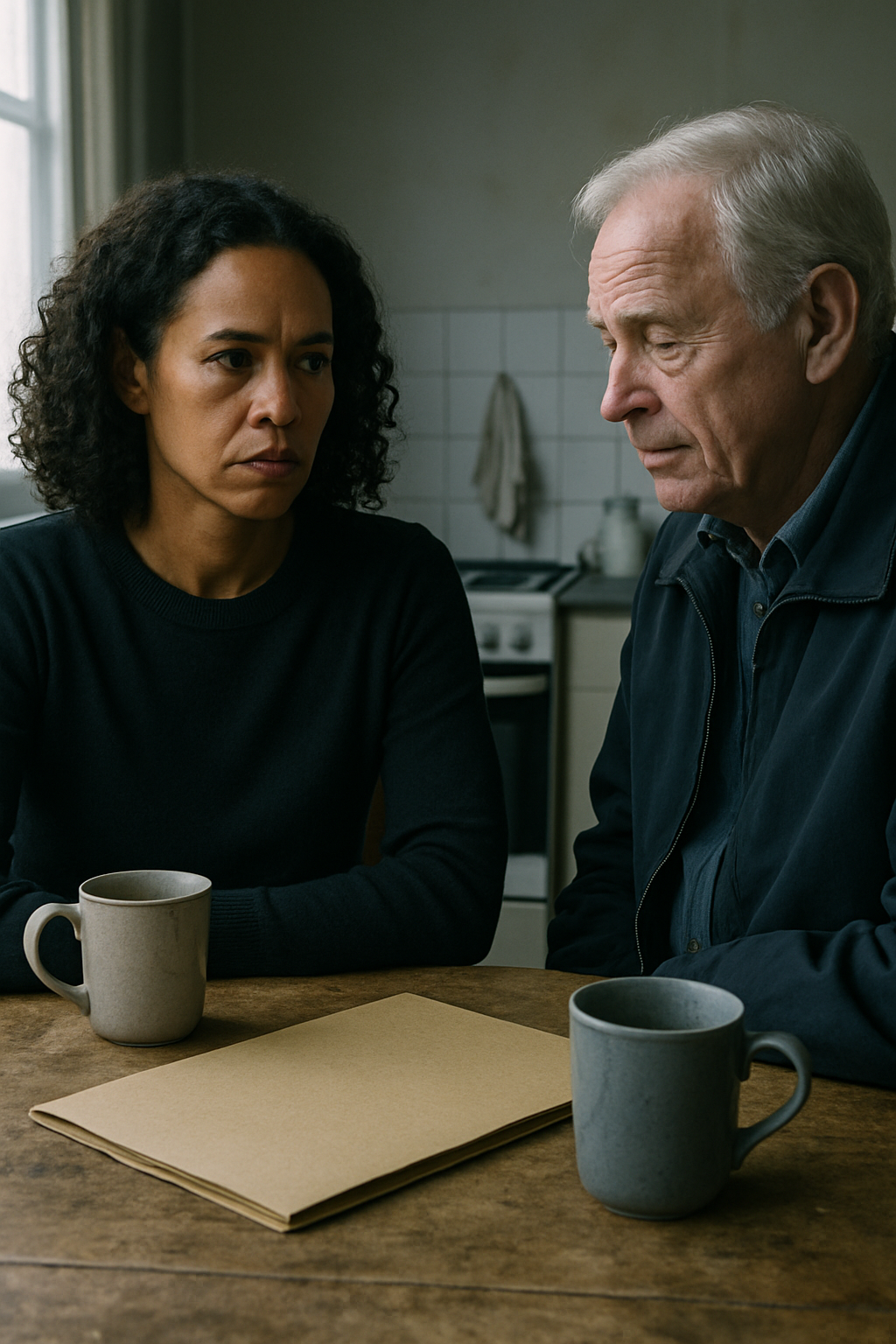
She made tea. She did this because it was what you did, because it gave her something to do with her body while her mind worked on what had just happened at the door. He sat at her kitchen table — her table, with its ring-marks and the slight wobble on the left leg she had been meaning to fix for approximately twelve years — and he set his folder down and looked around the room with an expression she identified, professionally and without difficulty, as a man making himself not say something. Not anything suspicious. Just something human. The expression of a person who is inside a stranger's home and is trying to locate themselves in it.
She put two mugs on the table and sat across from him.
I appreciate you agreeing to meet, he said. I know this must be — it's a difficult situation. The house has been in my family for some time. The decision to sell has not been an easy one.
How long have you owned it? Emma asked.
He considered this. Coming up to twenty years, he said. I inherited it from my mother. She was — she liked this part of the county. She moved here when she retired. I couldn't quite bring myself to sell it straight away.
And in those twenty years, she said, this is the first time we've met.
It was not an accusation. She kept her voice entirely neutral, factual, in the register of someone stating an observable truth. He seemed to hear something in it anyway, because he shifted slightly in his chair and looked at the surface of the table.
I know, he said. I know. I'm — I'm aware that's not ideal. The agency handled everything. I suppose I found it easier to keep a distance from it. From the administrative side of things.
A distance, Emma said.
He looked up. He had the expression of a man who had just heard his own words returned to him and was examining them carefully, perhaps for the first time.
Do you have family nearby? Emma asked. She asked it precisely the way she asked families during initial assessments — practical, interested, entirely without judgment, the question of someone gathering information.
No, he said. I live in Dorset now. I was in Bristol for a long time. I don't — there's not much nearby. I never had — He stopped himself. He made a small, slightly embarrassed gesture and looked at his mug.
I was married once, he said. Briefly, a long time ago. It didn't — He made a small, deliberate closing gesture with one hand. It was complicated.
Emma looked at his hands on the table. Her own hands were folded in her lap, still.
Do you have children? she asked.
The question placed itself on the table between them with the quiet weight of something placed with intention. Not thrown. Set down.
He was quiet for a moment that was one beat too long.
Then he said: that's — not a simple question to answer.
Most questions aren't, Emma said.
He looked at her. Something was moving across his face — not recognition, not yet, but something more uncertain, the expression of a man who has walked into a room and found it arranged differently than he expected.
I had a child, he said. I was very young. There was a relationship that — that I didn't handle well. I made decisions that I have had to live with. He said it with the particular flatness of a confession rehearsed so many times it has lost its edges.
His voice was steady but only barely.
How old would she be now? Emma asked.
Another silence. Longer this time, and different in quality — the silence of a man doing arithmetic he doesn't want to do.
Forty-three, he said. She would be forty-three.
Emma was forty-three.
She looked at him across the table. The folder sat between them with its papers and options and the practical machinery of property transfer, all of it suddenly beside the point. The tea was cooling in both their mugs, untouched.
She was born in Coventry, wasn't she, Emma said. Her voice was so even she could hear it herself and not quite believe it was hers. Her mother's name was Patricia.
He went very still.
It was a complete stillness — not the stillness of someone thinking, but the stillness of someone who has just stepped onto a surface they were not sure would hold and is waiting to learn if it will.
She watched his face. She had spent twenty years watching faces for the precise moment when something shifted, when the managed version fell away and the actual person became briefly visible. She had learned to wait for it without rushing it. You couldn't rush it. It arrived when it arrived, in its own time, and it always looked different than you expected.
It arrived now.
The colour left his face by degrees, from the jaw upward. His hands, which had been flat on the table, made a small involuntary movement toward her and then stopped, arrested, as if he had caught himself.
How — he said. He stopped.
He looked at her with the particular quality of attention a person gives something they have been working very hard not to see.
You have her eyes, he said, and his voice was different now, stripped of its careful, apologetic social register, just a voice, just a man's voice, unguarded. She had — Patricia had the most extraordinary brown eyes. Warm. I used to think — He stopped himself. And you have those. But you also have —
Yours, Emma said.
He closed his eyes.
For a moment neither of them said anything. Outside, the flat grey light lay over the garden. The Japanese maple she had planted — fifteen years ago, her first summer in the house, a small thing in a pot that she had put in the ground on a weekend when she needed something to do — was visible through the kitchen window, its leaves a deep, particular red, the only vivid colour in a grey afternoon.
She had been a tenant in this house for fifteen years. The man who owned it was sitting across from her and could not quite look at her and could not quite stop looking at her, and between them on the table was a folder of papers that she was no longer thinking about at all.
She thought about her mother. About the Coventry flat and the orchids and the particular silence that had shaped her, had made her precise and watchful and careful with her words. She thought about all the years Patricia had pressed that silence down, kept it contained, maintained it with effort she had never acknowledged. And then she thought: Mum. You knew whose house this was.
The thought arrived quietly, the way the most devastating thoughts do. Not a blow. A settling.
Meridian Property Solutions. Her mother had given her the name of the management company, fifteen years ago, when Emma first moved to this part of the county and was looking for something to rent. Patricia had mentioned it casually — try this company, I've heard they're good, I think they have a property near Henleigh. Emma had been thirty-one and newly divorced and not in a state to ask many questions. She had not thought to ask how her mother knew this specific company in this specific county. She had not looked at the owner's name on the tenancy agreement. People never looked at the owner's name.
Patricia had known.
She had known whose house it was, and she had sent her daughter here, and she had never explained why, and she had died without explaining, and now Emma was sitting in the kitchen of the house her mother had guided her to and looking at the man her mother had loved and lost and never spoken of, and the years between them were enormous and also, somehow, nothing at all.
She looked at James Walsh across the table.
His grey eyes — her grey eyes — were wet.
I didn't know, he said. I swear to you I didn't know you were — I never connected it. The name — Walsh is common enough, I thought — and Meridian handles everything, I never see the individual files, I would have had no reason to —
Did you know she died? Emma asked.
He stopped mid-sentence.
My mother, Emma said. Patricia Walsh. Did you know she died?
His mouth opened. His hands moved to the edge of the table, gripping it.
I didn't, he said. I didn't know. I — I lost contact. After. I lost contact with everyone from that period of my life. I was — I was ashamed. I told myself the distance was —
Kinder, Emma said.
He flinched as if she had struck him, though she had not raised her voice, had not moved, had delivered the word with no particular emphasis.
I was going to say easier, he said, very quietly. I know how that sounds.
Yes, Emma said. I imagine you do.
The silence that followed was not empty. It was full — years, and distance, and the particular, quiet cruelty of good intentions poorly expressed and then defended for decades. She sat in it and let it have its weight and did not move to end it.
He had been, she thought, a man who ran. Not a violent man, not a cruel man in any deliberate sense. A man who had encountered something difficult — a woman who loved him, a child he had not planned for, a life that was moving faster than he knew how to handle — and who had chosen absence as his answer, and had then spent the following forty years constructing a version of that choice he could live with. She knew this type in the way she knew most human types: thoroughly, without contempt, and without illusion.
The strange part — the part she was only beginning to reach, sitting across from him in her kitchen — was that she also saw a man who had not sold this house. Twenty years of ownership, and he had not sold it. Had let someone live in it, had maintained it at a distance, had not been able to bring himself to let it go. She could decide that was meaningless coincidence, a sentimental accident, a man too disorganised to get around to selling a property he had no use for. Maybe it was. But she had also spent twenty years watching what people did instead of what they said, and she had learned not to dismiss the evidence of what someone could not bring themselves to do.
She said: when Meridian arranged my tenancy, did you see my name?
He shook his head slowly. I'm not closely involved in the day-to-day management. I receive quarterly statements. I sign when I need to sign. But I don't review individual files, I don't read tenant correspondence, I —
Emma Walsh, she said. Same surname as you.
I thought — He stopped. He looked at the table. I suppose I didn't think. I was very good for a very long time at not thinking about it. I — I'd made something of a practice of it.
She said: I have a photograph.
He looked up.
Of my mother, she said. When she was young. When she was around the age she would have been. She looked at the table, not at him. I don't look much like her in photographs. Everyone always said I had my father's colouring. She said the word colouring with great care, neutrally, setting it down without weight. She never told me what she meant by that. I assumed it was just something people said.
He was crying. Not loudly, not with drama — just the quiet, unmanaged tears of an old man who had not prepared for this afternoon. She observed it without moving toward it and without moving away from it. She sat across from him and let him be what he was.
I'm sorry, he said. He said it twice, and the second time there was more breath in it, more realisation. It wasn't enough, and he knew it wasn't enough, and she could see that he knew, and they both sat with that knowledge in the room between them.
Emma looked at the folder. The papers. First refusal, extended tenancy, fair market valuation. All of it waiting for her signature.
She said: I'm not going to sign anything today.
Of course, he said. Of course. Take whatever time you —
I'm not going to sign anything today, she said again, and this time she said it differently, without the inflection that permitted a response about time and options and process, and he heard the difference, and he stopped.
She stood up. She picked up both their mugs and carried them to the sink, because that was what you did, because she needed to move, because standing at the sink looking out at the garden was something she could do while she contained what was happening inside her. She looked at the Japanese maple. The fence she had painted herself, her second summer here, white gloss in the August heat. Fifteen years of ordinary life, conducted on top of something she had not known was there.
She said, to the window, to the maple, to the grey afternoon: my mother sent me here. She gave me the name of the company. I never asked her why and she never told me.
She heard him make a sound behind her. Not a word. Just the small, involuntary sound a person makes when something lands.
She stood at the sink for a while longer. She thought about Patricia. About what her mother had thought she was giving her, arranging this without arranging anything, setting the pieces in proximity and stepping back. A chance. A door. The possibility of something that Patricia herself had not been able to give her — a father who was real, a face, a voice, a set of grey eyes across a table. She had perhaps thought: let the house hold what I cannot say. Let the years do the work. Let Emma find it herself, or not find it, as she chooses.
It had taken fifteen years. But it had arrived.
She turned around.
James Walsh was sitting at her table looking at her with the eyes she had seen in her mirror every morning of her life. He looked very old and very tired and not unlike a man who has been carrying something for forty years and has only just understood that he no longer has to.
She said: you should go. I need to think.
Yes, he said. He stood. He picked up the folder, then seemed to reconsider, and set it on the corner of the counter. For your records, he said quietly. Take your time.
He moved toward the door. At the threshold he stopped. He turned. He started to say something — she could see the beginning of it form on his face, something about being in touch, about options, about what came next — and then he stopped, because whatever he had been about to say was not adequate, and he was apparently old enough now to know when something was not adequate.
He said: is there — can I —
I'll be in touch, she said. And she meant it. She was almost certain she meant it. But she needed him to leave her kitchen now, to leave her alone in the house that had been hers for fifteen years and had apparently been something else entirely as well, so she could stand in it and breathe in it and begin, slowly, the work of understanding what she now knew.
He left. She heard the careful footsteps on the path. The car door. The engine, starting. The sound of it moving away down the road, growing smaller, and then gone.
She stood in her kitchen after the sound had gone and the street was quiet again.
The house was entirely as it had always been — ring-marks on the table, Japanese maple through the window, the familiar lean of afternoon light through the garden door, the wobbly leg on the table's left side. Fifteen years of this. Fifteen years of ordinary days in a house that had been, without her knowledge, a held thing, a deliberate placement, an act of hope or guilt or love or all three by a woman who had died without explaining herself.
All of it the same. All of it changed.
She picked up her phone. She looked at the screen for a while without calling anyone. She didn't know who she would call. She didn't know yet what she would say.
She thought about what she would carry with her from this afternoon. She thought about the weight of a name, and the rooms we agree not to enter, and what it means to finally stand in the doorway of one. She thought about her mother, who had managed her secrets so carefully and yet had done this one thing — this quiet, oblique, entirely characteristic thing — that had led her daughter, eventually, here.
She did not cry. She was not sure yet whether she needed to. There would be time for that later, and other things too — the patient, careful work of deciding what this was and what, if anything, she wanted it to become. Whether she would call the number Daniel had given her and speak to James Walsh again. Whether she would take out the photograph and look at the man cut from the frame, and try to place him against the silver-haired figure who had sat across her table and wept quietly and could not quite look at her. Whether she would one day find enough to forgive, or enough to grieve, or whether both things would simply coexist in her the way difficult things did when you'd had long enough to get used to them.
She did not know any of it yet.
For now she stood in her kitchen in the flat grey light, in the house that had held her all these years — solidly, without comment, with the patient constancy of a place that does not need to know what it means to go on being what it is — and she set the folder in the corner of the counter, out of the way.
Not today.
Today she would sit with what she knew, which was more than she had known this morning and less than she needed, and she would let the evening come in through the garden door, and she would stay very still inside the house that was hers, and had apparently always been.