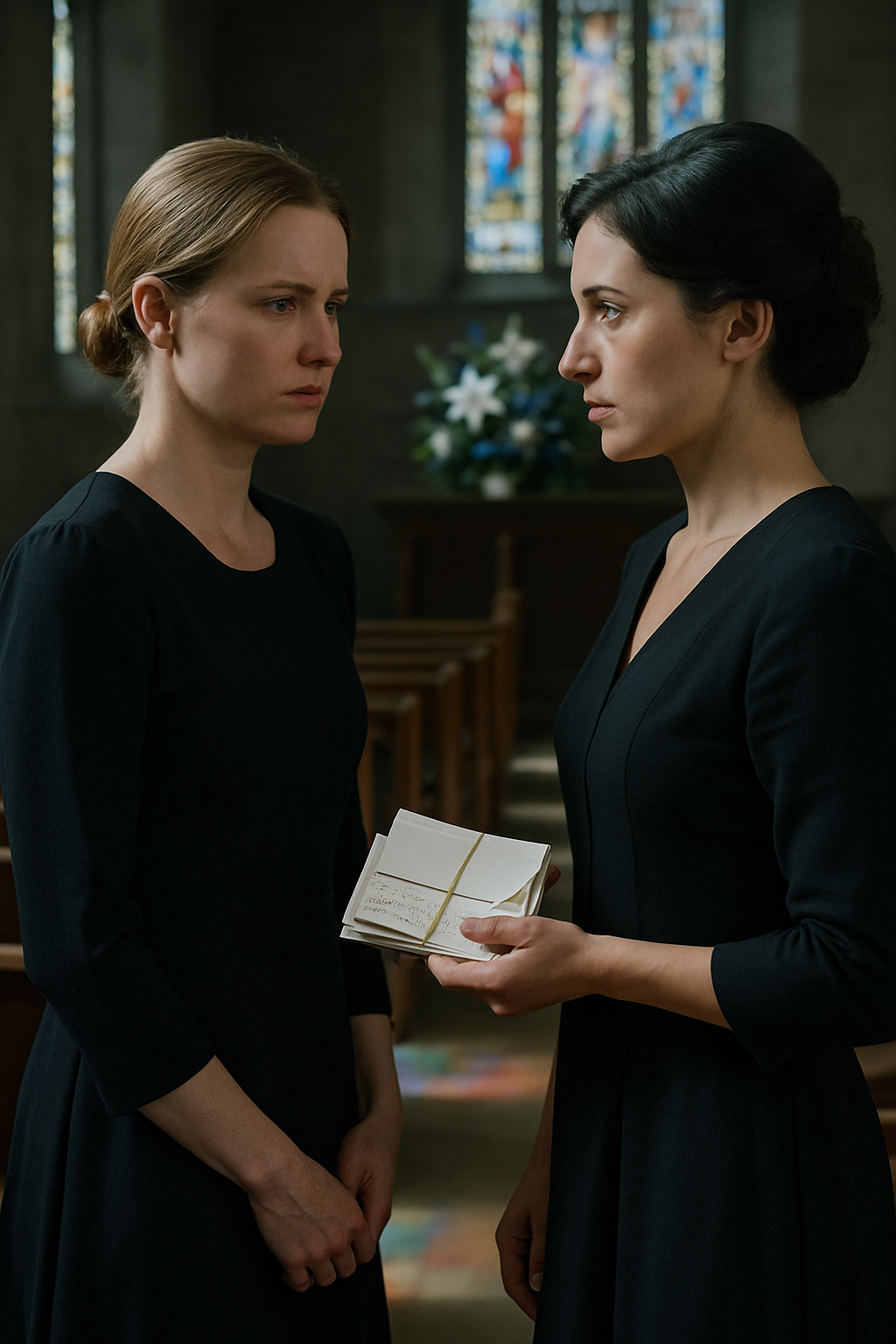
The woman was standing at the back of the church when the service ended.
Eva noticed her the way you notice something wrong in a familiar room — not immediately, not with certainty, but with a low, persistent unease that builds until you turn and look directly at it.
Everyone else was moving. Forming the slow procession toward the door. Pressing Eva's hands, saying her father's name the way people say the names of the dead at funerals — with a kind of careful tenderness, as though the name itself might break.
Eva had been shaking hands for forty minutes. Her jaw ached from holding the same expression. She had learned, years ago, how to be the composed one. It was something her father had said she got from him.
The woman at the back of the church was not moving.
She was thirty or so. Dark hair pinned up under a small black hat. Black dress, good quality, the kind of black that meant she had come prepared. She was holding something. A small bundle of cards or papers, bound with a rubber band, pressed against her side like something she wasn't sure she should have brought.
She was watching Eva.
Not the way the other mourners had watched her — with sympathy or the self-conscious discomfort of people who don't know what to say. She was watching Eva the way someone watches a face they have been trying to place for years.
Eva's cousin touched her elbow.
—Do you need a minute?
—I'm fine, Eva said.
She had said it eleven times in the last hour.
The last of the mourners filed past. The church emptied until it was just the low hum of the organ, the smell of lilies, and the woman at the back, still standing, still watching.
Eva walked toward her.
The woman didn't retreat. She stayed exactly where she was — and as Eva got closer, something happened that Eva would spend weeks trying to explain. She couldn't describe it as recognition, because she had never seen this woman before in her life. But there was something.
Some pull.
Some sense that the air between them had a different quality than the air around anyone else in the building.
They stopped about three feet apart.
—I'm sorry for your loss, the woman said.
Her voice was low, careful.
—I didn't want to interrupt the service. I wasn't sure I should come at all.
—Did you know my father?
A pause.
—I think so, the woman said.
—In the same way you did, I think.
Eva didn't understand that. She would understand it in about ninety seconds, and the ninety seconds before that would be the last ones in which her life was still the shape she thought it was.
—My name is Louisa, the woman said.
—Louisa Gray.
Eva waited.
Louisa opened the bag she was carrying — a small structured black bag that matched her dress — and took out the bundle of cards. She held them for a moment before she offered them across.
Eva took them.
The rubber band was old and slightly dry, the kind that leaves a mark on paper. There were perhaps thirty cards in the stack. Thick envelopes. Birthday card weight. Eva's hands recognized the weight before her brain processed what she was looking at.
She slid the rubber band off and opened the top card.
The handwriting hit her like a physical thing.
She knew that handwriting. She had seen it on every birthday card she had ever received. On grocery lists on the kitchen counter. On the notes her father tucked into her school bag when she was small, the ones that said have a good day, bug in his fast, left-leaning script. She had seen that handwriting her whole life.
It said: Happy birthday, sweetheart. I'm thinking of you today. Love, Dad.
The address on the envelope was not Eva's address.
Eva looked up from the card. She looked at Louisa's face. And Louisa looked back at her — with the expression of a woman who had been carrying this for a very long time and had finally, today, put it down somewhere she could look at it.
—How many of these are there? Eva asked.
Her voice sounded far away to her own ears.
—Thirty-one, Louisa said.
—One for every year. He never missed one.
Eva put the top card back. She looked at the stack in her hands. Thirty-one cards. Her father's handwriting, thirty-one times, to an address she didn't recognize, to a daughter he had never mentioned.
—He never missed mine either, Eva said.
The silence between them lasted exactly as long as it needed to.
—I think, Louisa said quietly, we should sit down.
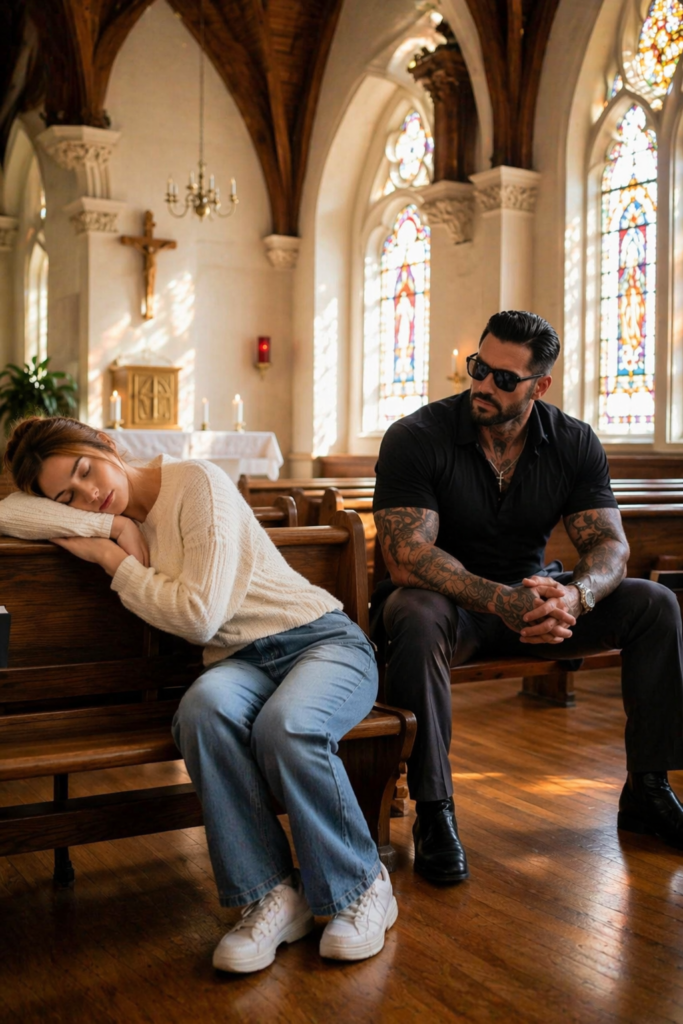
They sat in the second pew from the front, the one closest to the flower arrangement that had been on the altar during the service.
A large spray of white lilies and blue irises, her father's favorites. Eva had chosen them that morning, standing in a cold florist's shop, trying to remember what he would have wanted.
The church was empty now. The last volunteer had slipped out with a nod toward Eva, who had nodded back without seeing him.
—Tell me from the beginning, Eva said.
Louisa set her bag on the pew beside her and folded her hands in her lap. She had the kind of stillness that comes not from calm but from practice. A long history of keeping things inside.
—I grew up with my mother in Bristol, she said.
—She raised me alone. She told me my father's name was David — that they had been together briefly, that it hadn't worked out, that he wasn't in the picture. She didn't tell me much more than that. For most of my childhood, I didn't push.
—But you knew his name.
—His full name. And the town he was from. I found those things out on my own when I was about seventeen.
A pause.
—I didn't contact him. I didn't know if I wanted to. I wasn't sure what I would find.
Eva was watching her. The exact line of her profile. Something she couldn't name.
—When did the cards start?
—The first one came when I turned five, Louisa said.
—My mother nearly threw it away. She told me later that she almost did — she thought it was him trying to restart something she didn't want restarted. But it was just a birthday card. No return address. No phone number. Just his name at the bottom. Love, Dad. She stopped. She kept it. After that, every year, one came. Like clockwork.
—He sent you cards for thirty-one years and never once came to see you.
—No. He never came.
Eva looked down at the stack of cards still in her hands. She thought about her father. His face. His voice. The way he had held her hand at her mother's funeral, eight years ago, and told her that they were all the family each other needed now.
—What was your birthday? Eva asked.
—March fourteenth.
—Mine is March sixteenth, Eva said.
The two dates sat between them in the silence of the empty church.
—Same year? Louisa asked, though something in her voice said she already knew.
—Nineteen ninety-four, Eva said.
Louisa closed her eyes for a moment. Then opened them.
—Yes, she said.
—Same year.
Eva thought about her father's calendar. The way he always marked March in red. The way he would grow quieter in the first two weeks of that month — not sad, exactly, but inward, as though turning something over. She had always thought it was because of some old work stress. Some quarterly thing she didn't understand.
—He gave us both the same middle name, Louisa said.
—I found that out later, from my birth certificate. Louise Marie. Marie is the middle name. She looked at Eva steadily. Is yours Marie?
Eva's throat closed.
—Eva Marie Marsh, she said.
—Yes.
Neither of them spoke for a long time.
The afternoon light moved through the high stained-glass windows — long, slow bars of colored light across the stone floor, the empty pews, the flowers. Eva stared at them. She thought about her father. She tried to hold the image she had always had of him — a good man, a steady man, a man who had once stayed up all night to help her redo a school project because she had started crying over it — and she tried to place it alongside the thing that was taking shape in front of her.
Not cruel. Not monstrous. Just two lives, running side by side. Thirty-one years of parallel Marches.
—Did you hate him? Eva asked.
Louisa considered this with the gravity it deserved.
—I didn't know him well enough to hate him, she said finally.
—I hated the absence. I hated not knowing why I wasn't worth showing up for. But I didn't hate him specifically. I didn't know him specifically.
She looked at the flowers on the altar.
—That's the thing, isn't it. I never got to know him. And now I never will.
Eva thought about the word now. What it meant. What it contained.
—I'm so sorry, she said, and she meant it — meant it in a way that surprised her, because she was already deep in her own grief and had not expected to find room for anyone else's. But she did. It was there. The grief of a woman who had watched birthday cards arrive for thirty-one years and wondered whether they meant she was loved or whether they were just the minimum.
—I don't know why I'm here, Louisa said quietly.
—I don't think I came for answers. There aren't any now. I think I just needed to see.
She glanced at Eva sideways — a careful, considered look.
—To see whether he was real. Whether the other life was real. Whether I was real in it somehow.
Eva thought about what her father's face had looked like in the last photograph she had of him, taken at Christmas. Kind eyes. The same slight smile he had in every photograph going back forty years. A man who had looked at the camera and smiled and given away nothing at all.
She wondered how many times he had sat in this church. Whether he had ever sat in this pew. Whether he had ever looked up at these windows and thought about March.
She drove home alone.
The house was quieter than she expected — she had forgotten that she had asked everyone to give her the evening. She stood in the front hallway for a moment with her keys still in her hand, then walked to the kitchen and stood there too, doing nothing, while the kettle she had not turned on sat on the counter in front of her.
Her father had kept his study on the first floor. She had not been in it since he died.
She went in.
The room smelled of him — old paper, the cedar of his bookshelf, the particular mustiness of a room where someone has spent decades reading. It was exactly as he had left it. Eva's aunt had offered to help her go through things, and Eva had said not yet.
She hadn't known then that not yet would become something more urgent than she meant.
She sat in his chair, behind his desk, and began to go through the drawers.
The top drawers held what she expected — stationery, pens, a stapler, a small torch. Old receipts. A pocket watch he never wore but kept. She set these aside and moved to the lower drawers.
The second drawer on the left was locked.
Eva didn't know it was locked until she pulled it and it didn't open. She looked at the desk more carefully. She had not noticed a lock on this drawer before. She had sat across this desk from him hundreds of times — for conversations, for help with paperwork, for the evenings when they played cards because neither of them wanted to watch television — and she had never noticed a locked drawer.
She found the key in a small ceramic pot on the bookshelf, behind a row of dictionaries. She found it on her third pass through the shelf, when she was thinking not about the key but about whether her father had specifically put it somewhere she would find it.
She thought he might have.
The drawer opened.
Inside: a second address book, smaller than the one on the desk. Letters in a bundle, tied with kitchen twine — not rubber band, not ribbon, but kitchen twine, the same kind her father kept in the drawer by the stove. And beneath the letters, photographs.
Eva took the photographs out first.
They were not labelled. They didn't need to be. She recognized her father in each one — younger in the earlier photos, recognizably himself throughout. In many of them he was alone. In some of them he was with a woman she didn't know: dark-haired, smiling, the easy smile of someone who doesn't know she's being photographed, or doesn't care.
And in some of them — not many, five or six — there was a child.
Dark hair. A gap between her front teeth. Then slightly older: same hair, same gap grown over, the face sharpening into something Eva had sat next to three hours ago in a church pew.
Eva set the photographs down on the desk in a careful row, in what she thought might be chronological order. She looked at them for a long time. Her father's face in each one. Smiling. Always smiling. The same slight, kind smile that appeared in every photograph of him she had ever seen, and that she had always believed she understood.
She opened the address book next. His handwriting again — the fast, left-leaning script. Two columns of entries. She saw her own address in the left column, and in the right column, an address in Bristol that she had never seen before, written in the same hand, in the same ink, updated twice over thirty years as though her father had been careful to keep it current.
She left the letters tied. She was not ready for the letters yet.
She sat in her father's chair in her father's study, with the photographs in a row in front of her, and looked at them until the room went dark.
They met the second time by choice.
Louisa suggested a café near the train station, neutral ground, and Eva said yes. It was three weeks after the funeral. The time between had not been empty — there was the estate to settle, the house to decide about, the phone calls to extended family that Eva had been making in a kind of daze. But she had been thinking about Louisa every day.
Not obsessively. Just steadily. The way you think about an open question.
She got there early. Ordered tea. Watched the door.
Louisa came in five minutes later and looked around once, found her, and came to sit without ceremony.
—Thank you for coming, Eva said.
—I wasn't sure you would contact me, Louisa said.
—I found things in his study.
Louisa was quiet for a moment.
—So did you want answers? Or company?
Eva thought about this.
—I'm not sure there's a difference anymore, she said.
They ordered, and sat, and began the stranger conversation — the one that was not about grief, or not only about grief, but about the architecture of a life they had both been living inside without knowing the other room existed.
Louisa told her about growing up. A small house, a determined mother, a school where she knew almost everyone. A childhood that was, by her telling, genuinely fine — not marked by absence so much as by a particular shape around the absence, a careful not-asking. She had been a good student. She had gone to university in Edinburgh and studied something practical and become competent at it. She had friends she had known for ten years. She had, in all the visible ways, turned out well.
—But? Eva said.
—But March was always hard, Louisa said simply.
—I didn't know why for a long time. I didn't connect it to anything. It was just — every March, for about two weeks, I felt like something was slightly wrong with the air. My mother used to notice and try to take me somewhere nice.
Eva thought about her father growing quieter in March. The two-week inwardness that she had explained away as work stress. She thought about him sitting somewhere — this house, his study, the chair she had sat in three weeks ago — turning something over.
She thought: he felt it too.
—Did the cards feel like enough? Eva asked.
Louisa wrapped both hands around her cup and considered the question with the seriousness it deserved.
—No, she said.
—They felt like the minimum. Like someone saying: I know you exist. I know you were born. I haven't forgotten. But that's different from being there. That's very different.
She looked at Eva directly.
—I used to wonder — when I was a teenager, mostly — whether there was something wrong with me specifically. Whether I was the reason he hadn't come. Whether the other life was better.
—It wasn't better, Eva said, and then stopped, because she wasn't sure that was the right thing to say or even the true thing.
She tried again.
—It was just a life. He was good in it. He was really good in it. He was the kind of father who showed up. Every concert. Every crisis. Every dull Thursday when nothing was happening but he sat with me anyway. She stopped again. And none of that means you weren't real to him. I think you were very real to him. I think that's why March was hard.
Louisa was quiet for a moment.
—I'm angry, she said.
—I want you to know that. I came to the funeral because I needed to see whether it was real, but I'm still angry. I'm allowed to be.
—You're absolutely allowed to be, Eva said.
—And I don't want to take anything from you. Your grief is yours. Your version of him is yours. I'm not trying to revise him for you.
—You're not, Eva said.
—Or — you are, but I think I needed it. I think I was grieving a simplified version of him.
She turned her cup in its saucer.
—The man I knew was real. I don't think the cards were his way of wiping his hands of it. I think they were his way of not being able to let go, either.
—That's a generous interpretation.
—I know. I'm his daughter.
A pause.
—So are you.
The word landed between them quietly. Not dramatically. Not the way it would have landed in a film, with swelling music and a significant camera angle. Just a word in a café, mid-morning, over cooling tea. Just the truth of what they were.
Louisa looked at her for a long moment.
—What do we do now? she asked.
Eva didn't have an answer prepared. She had thought about this, in the three weeks since the funeral, in a variety of ways — practically, emotionally, abstractly. She had drafted and deleted several answers in her head. She had, at various points, concluded that there was nothing to do, that they owed each other nothing, that they were strangers who happened to share a biological fact.
But she had also, at other points, looked at the photographs in her father's desk drawer. The ones of Louisa as a child. The dark hair. The gap-tooth smile. And felt something she couldn't name exactly — not recognition, but something adjacent to it. Something that made her chest feel slightly different.
—I don't think we have to decide that today, Eva said.
—I don't think we have to decide what we are to each other or what we're supposed to be. I think we can just — start from here. See what it becomes. You might decide you never want to see me again, and that would be fair. Or we might find out that we have more in common than a father and a birthday month. I don't know yet.
—I don't know either, Louisa said.
—I think that's honest.
They sat with that for a while. The café filled and thinned around them. At some point Louisa ordered more tea without being asked, and Eva took it when it came, and that small ordinary thing — the easiness of it, the lack of ceremony — felt like something.
There were two griefs here. Eva had come into this understanding her grief as one shape, familiar, something she had been preparing for and had thought she knew how to hold. And then it had become a different shape entirely — not larger, not smaller, but stranger. A grief with a mystery inside it. A grief for a man she thought she knew and a man she had discovered at the same time, and the strange work of holding both at once without letting either one collapse the other.
Louisa's grief was the shape of an absence. Thirty-one years of birthdays and birthday cards and a father who stayed off to the side of her life, present enough to be real, absent enough to hurt. A grief not for the loss of something but for the non-arrival of it. For all the Marches.
Both of those griefs were true.
Both of them were sitting in a café on a Tuesday morning, holding their cups, deciding slowly and without pressure what came next.
—He had a very specific way of signing birthday cards, Louisa said finally.
—Always the same. Love, Dad. Not Love, David, not just Dad. Always both words in full.
—I know, Eva said.
—I used to think it was to remind me what he was. In case I forgot.
—Or in case he needed to say it, Eva said.
—To remind himself.
Louisa looked at the window. The street outside. People passing who had no idea what was happening inside this café.
—I wish I'd met him, she said.
—I wish he'd let you, Eva said.
That was the closest thing to an answer they had. It wasn't nothing. It wasn't enough. It was the kind of true thing that doesn't solve anything but still matters to say — the kind of sentence that two people can leave sitting on a table between them, and walk away with it, and carry it differently for having said it out loud.
Eva paid the bill. Louisa didn't argue about it. They walked out into the mid-morning street, and for a moment they stood together on the pavement in the ordinary way of two women deciding which direction they were each heading.
—Same time next week? Louisa said. Just like that. As simply as asking about a regular appointment.
Eva looked at her. The dark hair. The careful steadiness. The woman who had shown up at a funeral holding thirty-one years of proof that she had not been forgotten, and had stood at the back of a church deciding whether it was enough to go on.
—Same time next week, Eva said.
And they went in opposite directions on an ordinary street in a city where nobody knew what they were to each other yet — which was, for now, exactly enough.