The bill came on a Tuesday.
It was sandwiched between a credit card offer and a dental reminder, nothing about it remarkable from the outside. A standard white envelope, the kind that holds forms and obligations. Diane picked it up from the mail pile on the kitchen counter the way she picked up everything else — efficiently, without ceremony, already thinking about the chicken she had defrosting in the sink.
She almost put it in the folder she kept for Robert's correspondence. She was in the habit of sorting his mail for him, had been for twenty-two years. Robert was not disorganized, exactly, but he had a way of letting things accumulate that Diane had learned, over decades, to simply manage. It was easier. It had always been easier.
But the return address stopped her.
Mercy General Hospital. Columbus, Ohio.
She stood at the counter and looked at it for a moment. They lived in Cincinnati. Columbus was three hours away. She couldn't think of a reason Robert would have business with a hospital in Columbus. He was healthy — or he'd seemed healthy, his last checkup six months ago had come back fine, she'd made the appointment herself and driven him there herself and sat in the waiting room reading a magazine while the doctor told him his blood pressure was excellent for a man his age.
She opened the envelope.
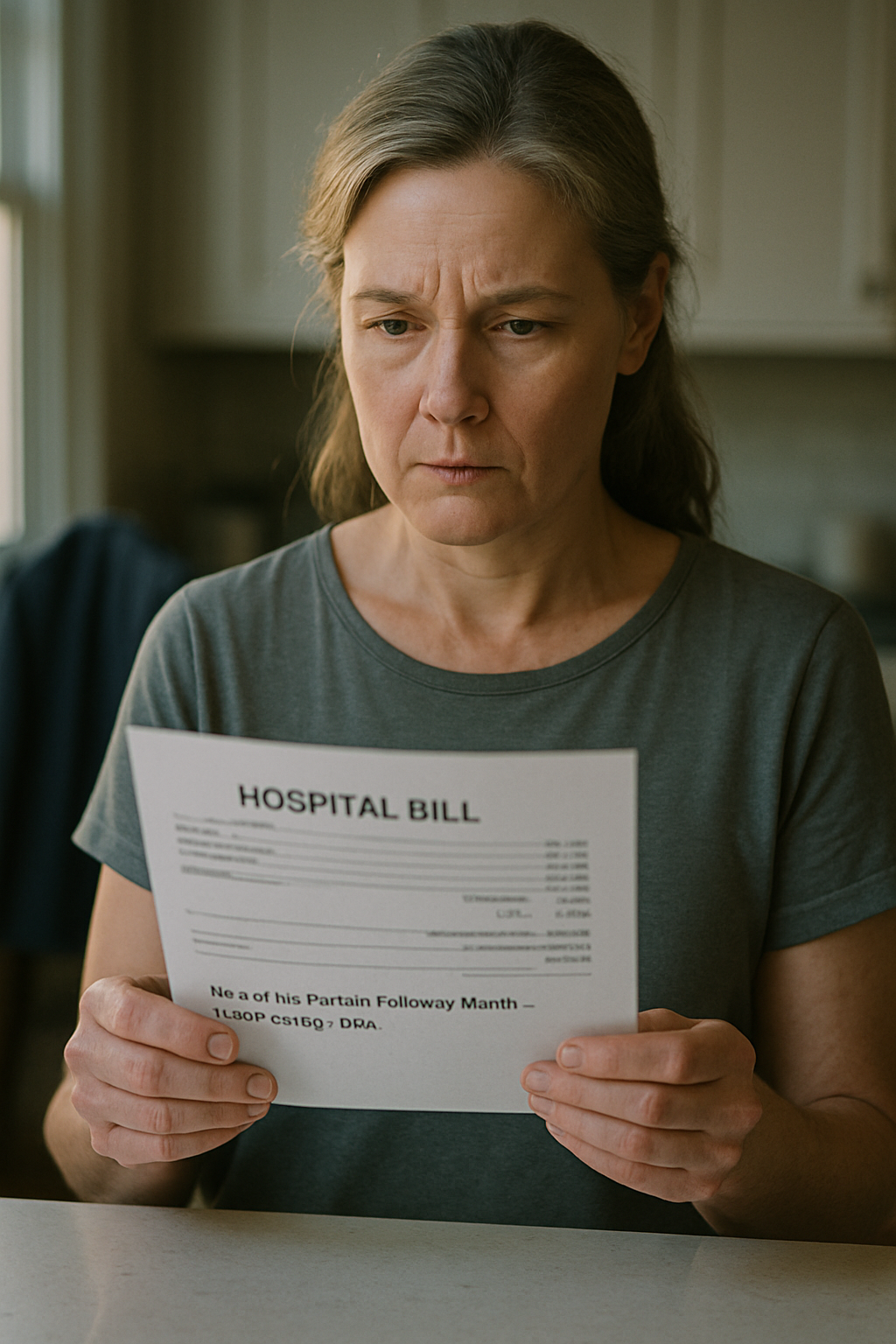
The paper inside was stiff, clinical, printed in the small bureaucratic font of institutions that deal in suffering and invoices. She unfolded it and her eyes went first to the total — $43,280.00, which made her breath catch — and then to the date of service.
March 4th.
Three weeks ago.
She stood very still.
Robert had been on a work trip March 3rd through March 6th. Chicago, he'd said. A conference for the logistics firm he worked for, the kind of event he attended two or three times a year. She'd packed his suitcase. She'd driven him to the airport. She'd texted him each evening and he'd responded, a little slowly, but she'd attributed that to the conference schedule. He'd come home on the 6th looking tired, and she'd made soup and run him a bath and not asked too many questions because he always came home tired from conferences and she had learned not to pry.
She read the bill again. More carefully this time.
Patient: Robert Alan Marsh. Date of birth: correct, September 14, 1972. Address: an address in Columbus, Ohio that she did not recognize.
Diagnosis: Acute appendicitis, emergent appendectomy.
Date of surgery: March 4th, 2026.
She thought, with a strange, floating detachment: his appendix. He had his appendix removed three weeks ago and didn't tell me.
And then her eyes moved to the section at the bottom of the first page, the next-of-kin section, the section that hospitals fill out when they admit someone, when they need to know who to call if something goes wrong, who has the right to make decisions if the patient cannot, who is the person this person belongs to.
Next of kin: Patricia Holloway-Marsh. Relationship: Wife. Phone: (614) 555-0183.
Diane read it twice.
Then she set the paper down on the counter with the same careful steadiness with which she did everything, and she stood there in her kitchen with the afternoon light coming through the window over the sink, and she understood, in the way that you understand something when your body knows before your mind catches up, what she was looking at.
Patricia Holloway-Marsh.
Wife.
The chicken was still defrosting in the sink. The credit card offer was still on the counter. Somewhere outside, a neighbor's dog was barking at something, the ordinary Tuesday sounds of an ordinary neighborhood, and Diane stood in the middle of her kitchen holding a piece of paper that had just quietly, methodically, dismantled twenty-two years of her life.
She did not cry.
She picked the paper back up. She read the address listed for Robert — the Columbus address — and she committed it to memory. She read the date again. March 4th. She counted backward to the text exchanges she'd had with him that weekend, the ones she'd thought were slightly delayed, slightly perfunctory. He'd been in a hospital. He'd been recovering from surgery. He'd been with her.
Patricia.
She folded the bill back into the envelope. She placed it in her own purse, not the folder she kept for Robert's mail. She went to the sink and checked on the chicken. She turned on the faucet and let the water run cold over her hands.
Robert would be home at six-thirty.
That gave her four hours.
She did not panic. This was the thing about Diane that she would later, when she had the distance to be objective about herself, recognize as both her greatest strength and the trait that had made her invisible for so long: she did not panic. She processed.
She sat down at the kitchen table with her laptop and she opened a browser window and she typed the name.
Patricia Holloway-Marsh.
The results came back immediately. People are not as hidden as they think they are. A Facebook profile, set to mostly public. A LinkedIn with a job title — marketing coordinator at a firm in Columbus. An Instagram account, also mostly public, the kind of cheerful domestic documentation that people do without thinking, not realizing they are building an archive that someone like Diane might one day read in a single afternoon.
Patricia was forty-one. She had shoulder-length dark hair and a wide, open smile. She had a golden retriever named Biscuit. She posted pictures of meals she'd cooked and sunsets from what appeared to be a back deck and occasionally, sparsely, pictures of herself and a man who was unmistakably Robert — Robert at a restaurant Diane didn't recognize, Robert at what appeared to be a birthday party, Robert holding Biscuit and grinning in a way that Diane could not remember seeing in years.
The most recent post was from three weeks ago.
A selfie from what appeared to be a hospital waiting room. Patricia, her face tired and worried, the fluorescent lights washing her out. The caption read: Rough night. He's out of surgery and doing okay. Thank god for good doctors. Counting our blessings tonight.
Sixty-three likes. Fourteen comments.
Diane read every comment. She looked at the timestamp. March 4th, 11:47 PM.
While she had been texting Robert asking how the conference was going.
She scrolled back further. Six months of Patricia's Instagram. A year. And there was Robert, threaded through it like a second life — a Christmas photo, a weekend trip somewhere with mountains, Patricia in a white dress at what appeared to be a courthouse, Robert beside her in a grey suit, both of them squinting in the sun.
The date on the post: April 14th, 2023. Nearly three years ago. She had been recovering from knee surgery that April, on the couch for two weeks, and Robert had taken time off work to bring her things and make her coffee the way she liked it.
He had taken a week off to marry another woman and then come home and make her coffee.
She closed the laptop. She opened it again.
She needed to be methodical.
She went to her notes app and she started a list. Not because she needed to — she could hold all of this in her head, she had always had a good memory — but because the act of writing it down made it real in a way she could manage. Concrete. Actionable.
What she knew: Robert had been admitted to Mercy General Hospital in Columbus on March 4th with acute appendicitis. He had given his address as an address in Columbus. He had listed a woman named Patricia Holloway-Marsh as his wife and next of kin. Patricia Holloway-Marsh existed, had a life, had a dog, had apparently been with Robert for at least three years, had married him on or around April 14th, 2023.
What she did not yet know: how long this had been going on before the marriage. Whether there were other women. What Robert had told Patricia about his life in Cincinnati.
Whether Patricia knew about her.
That last question sat differently than the others. She found herself holding it like something fragile.
The clock on the microwave said 3:14 PM.
She went back to the kitchen and finished preparing the chicken.
He came home at six-twenty-seven, a little early, and Diane was at the stove when she heard his key in the lock. She did not tense. She had been working on that all afternoon — the not-tensing, the continuity of her body's ordinary rhythms. She had always been good at managing her face. Twenty-two years of marriage teaches you the topography of a shared life, and she knew exactly what her face looked like when she was calm because she had worn it for decades.
"Something smells good," he said from the doorway.
"Chicken Marsala," she said. "Your favorite."
He came into the kitchen and kissed her on the cheek and poured himself a glass of water and talked about his day — a difficult meeting, a client who was unreasonable, the usual texture of a workday she had been listening to for twenty-two years. She said the right things. She asked the right questions. She kept her back to him longer than necessary, stirring things that didn't need stirring, because she needed those extra seconds to ensure her expression was exactly right.
At dinner she watched him eat. She had done this for decades without analyzing it, but now she found herself cataloguing: the way he held his fork, the way he cut his food into precise pieces, the way he looked at his phone twice under the table and thought she didn't notice. She had always noticed. She had simply, for years, chosen not to see.
After dinner she washed the dishes and he went to take a shower.
She waited until she heard the water running.
She had been thinking about this for four hours. She had debated it with herself, the question of whether to look. She was not, by nature, a person who went through other people's things. She believed in privacy. She believed in trust, or she had believed in trust, in the way that you believe in things before you have reason not to.
But she had reason now.
His jacket was on the back of the dining chair. She went through the pockets quickly, systematically. Nothing in the outer pockets. In the inner breast pocket, a phone.
Not his regular phone. A second phone, slim and dark, the screen locked.
She held it for a moment. The shower was still running — she had maybe three minutes. She pressed the home button and the screen lit up with a lock code prompt. She didn't know the code. She tried his birthday: wrong. She tried their anniversary: wrong. She tried the last four digits of the Columbus address: wrong.
The phone showed her the lock screen wallpaper while she thought. It was a photo of Robert and Patricia, candid, caught mid-laugh at what appeared to be a kitchen table. Both of them bright-eyed and unsuspecting of anything.
She took a photograph of the phone's screen with her own phone. Then she slid the second phone back into his jacket pocket exactly as she'd found it.
The shower turned off.
She was back in the living room with a book in her hands when he came out in his bathrobe, smelling of the soap she bought, the kind he'd always preferred.
"Tired?" she asked.
"Long day," he said. "Think I'll turn in early."
"Of course," she said. "I'll be up soon."
She sat with the book open in her lap and listened to him move around the bedroom, the familiar sounds of him settling in for the night, and she thought: I know what you did. I know about March 4th. I know about Patricia. I know about the courthouse in April 2023. I know about all of it.
And she thought: I need two more days.
The second day was for the finances.
Diane had always been organized about money. She kept records, understood their accounts, paid the bills. Robert handled his own income in ways she'd never examined too closely — he had a separate account for his work expenses, which he'd explained early in their marriage as simpler for tax purposes, and she had accepted this because she had accepted many things. She was seeing now that the acceptance had been the point.
She spent the morning on her laptop while he was at work, pulling up bank statements she hadn't looked at in years, building a picture she could now, with different eyes, see clearly.
The Columbus address — she had found, through a property records search that took her twenty minutes to figure out but that she completed methodically — was a house owned by Patricia Holloway-Marsh and Robert Alan Marsh, purchased in September 2022. Purchased eighteen months into whatever this was, six months before the courthouse photo, a year before his knee surgery caregiving that she now understood differently.
The house had cost $385,000.
She found, in the joint account statements, a pattern of cash withdrawals she had noticed years ago and dismissed. Every two to three weeks, between eight hundred and twelve hundred dollars. She had asked about it once, early on, and he'd said it was for work lunches, client entertainment, things he preferred to pay cash for. She had let it go.
She added up the withdrawals over three years. The number made her sit back.
Nearly $90,000.
Not enough for the house. He must have had other sources. But enough to fund a parallel life — the restaurants, the trips, the birthday parties, the ordinary maintenance of a relationship that believed itself to be real.
She was not angry yet. She kept waiting for the anger and it kept not arriving, replaced instead by something colder and more focused. The feeling of a lens being adjusted until the image snaps into clarity. She had been looking at Robert for twenty-two years through a lens that was slightly, precisely, deliberately blurred, and now she was seeing him in sharp focus for the first time, and what she saw was not a stranger. It was a man she recognized. A man who smiled while lying, who had always had an explanation, who had always been slightly just out of reach in ways she had told herself were simply the nature of long marriage and busy lives and the ordinary diminishment of intimacy over decades.
It had not been the nature of long marriage.
It had been management.
She had been managed.
In Robert's life in Columbus, Diane did not exist.
She held that thought, then turned it over.
In Robert's life in Cincinnati, Patricia did not exist.
There were two women, and neither of them knew about the other, and a man had been walking between their lives for at least three years with his explanations and his work trips and his conference schedules and his second phone and his careful management of everything.
She looked up the address of a lawyer she knew — a woman she'd met at a fundraiser two years ago, a divorce attorney, the kind of woman who had always seemed slightly too knowing in the way she watched a room. Diane had her card somewhere. She found it in the drawer where she kept such things.
She made an appointment for Friday.
Then she took out a legal pad and she started to write. Not notes this time. An account. Everything she knew, in order, with dates and amounts and sources. She wrote for two hours. When she was done she had eleven pages. She put them in a manila folder with the hospital bill and several printed screenshots and the property records and the bank statements.
She labeled the folder with a single initial: R.
She put it at the back of the drawer in her home office, under a stack of old tax returns, and closed the drawer.
Then she went to start dinner.
The third day was Wednesday.
Diane went to the grocery store, returned a library book, picked up two of Robert's suits from the dry cleaner and hung them in his closet. She stood a moment looking at his side of the bedroom — the dress shirts, the shoes on their rack — and thought: all of this is ending tonight. She felt less afraid of that than she had expected.
In the afternoon she found Patricia Holloway-Marsh's personal email address through a professional directory. She wrote an email, saved it as a draft, reread it four times, changed two words, and saved it again. My name is Diane Marsh. I have been married to Robert Alan Marsh for twenty-two years. I believe you may not know about me. I am not writing to blame you. I am writing because you deserve to know the truth.
At five o'clock she started cooking.
The menu was deliberate: braised short ribs, roasted potatoes, a green salad, the good wine from the rack that they only opened on occasions. She had been making this meal for Robert for twenty years, had made it on their anniversaries and on the nights they celebrated things, and she made it now because she wanted him to know, when he understood what was happening, that she had done him the dignity of treating this as significant. She had not made sandwiches. She had made his favorite dinner. She had set the table properly, with cloth napkins and the good glasses.
She placed the folder — the manila folder labeled R — on the counter near the dining table. She did not hide it. She did not draw attention to it. She left it there the way you leave an object that belongs in a space.
He came home at six-twenty. He commented on the smell. He poured himself wine.
They sat down to eat.
She watched him eat the short ribs. She watched him refill his wine. She let him talk about his day — another difficult meeting, a client, the ordinary narrative of a man who did not yet know that he had been found.
And then, when his plate was mostly empty and he was settling back in his chair with the comfortable looseness of a man who has been well-fed in his own home, she picked up the folder.
She set it on the table beside his plate.
She poured his wine.
She sat back down.
She said: "I need to show you something."
He looked at the folder. He looked at her face. And she watched — she had watched him for twenty-two years and she knew his face better than she knew anything — she watched something pass through his eyes. Not guilt, exactly. Not yet. Something more reflexive than guilt. The look of a man whose story has suddenly become unstable beneath him.
"What's this?" he said.
"Open it," she said.
He did not open it. He left his hand near it but did not touch it. "Diane."
"Open it, Robert."
He opened it.
She watched him look at the hospital bill. She watched him look at the property records. She watched him look at the screenshots — Patricia's Instagram, the courthouse photo, the hospital waiting room selfie with its caption and its sixty-three likes. She watched him look at the bank statements with the withdrawals circled in blue pen.
He closed the folder.
He did not look at her.
"How long have you known?" he said.
"Three days," she said.
"Diane—"
"Don't," she said. Not harshly. She had not planned to be harsh. "Don't start with my name like that. I've been listening to you say my name like that for twenty-two years and I know what it means. It means you're buying time to find the right angle. I'm not interested in the angle tonight."
He was quiet.
"Tell me about Patricia," she said.
He set his fork down. He looked at the table. He was, she noticed, gathering himself — she could see it, the way he arranged his face into something more controlled, the Robert who handled difficult meetings, the Robert who always had an explanation.
"It's complicated," he said.
"It isn't," she said. "You're married to her. You've been married to her for three years. You bought a house with her. You go there when you tell me you're at conferences. When you had emergency surgery three weeks ago and nearly — what? What happened three weeks ago?"
"My appendix," he said quietly. "I should have told you—"
"You listed her as your wife," Diane said. "At the hospital. The next of kin form. You wrote wife."
"I know."
"I'm your wife."
"I know, Diane."
"How long?" she asked.
He hesitated.
"How long, Robert."
"Five years," he said. "We've been together five years. The — the marriage was three."
Five years. She did the math quietly, efficiently, the way she had been doing math for three days. Five years ago Robert had started his current job. Five years ago they had moved into this house. Five years ago she had believed they were building something together.
"She doesn't know about me," Diane said. It was not a question.
He looked at her sharply.
"Does she, Robert."
A long pause. "No."
"You told her what?"
"That I was — that I'd been divorced. That I lived alone in Cincinnati."
"You told her you were divorced."
"Yes."
"From who?"
He didn't answer.
"From me?" she asked. "Or from someone else?"
"From — I made up a name. Someone who didn't exist."
She absorbed this. "So you created an entirely fictional ex-wife, so that your actual wife wouldn't come up in any searches."
He said nothing.
"And Patricia believes she is your wife," Diane said. "She is entirely, genuinely, sincerely your wife, as far as she knows."
"Diane—"
"She sat in a hospital waiting room three weeks ago terrified that you might die," Diane said. "She posted about it on Instagram. She said she was counting her blessings. She has a dog named Biscuit and she makes dinners and she thinks she has a husband. She thinks her life is real."
The words were not loud. She had not raised her voice once. But something in the way she said it — the flatness of it, the refusal to dress it in emotion — made him flinch.
"You have to understand," he said, "things between us — between you and me — we've been living like roommates for years. You must have felt that. We're not—"
"Don't," she said again.
"I'm just saying that the marriage wasn't—"
"I will not sit at this table and let you explain to me why I drove you to this," she said. Still calm. Still flat. "I have been sitting at this table for twenty-two years. I have cooked your meals and organized your life and sorted your mail and driven you to your doctor's appointments and packed your suitcase for every trip you took to visit a woman I didn't know existed. I will not let you tell me that's the same as nothing."
He looked at his plate.
"I found the second phone," she said. "Two nights ago. I didn't have the code. I didn't read your messages. I want you to know that — I want you to know that it wasn't enough to stop me, but I didn't read them. I didn't need to. I already had everything I needed."
Silence.
"I have an appointment with a lawyer on Friday," she said. "You should get one too."
"Diane—"
"I'm not finished," she said. "I need to tell you something else. Something you're going to want to know before this goes further."
He looked at her.
"Patricia doesn't know about me," she said. "And I am going to tell her."
His face changed. "Diane, please—"
"I've already written the email," she said. "I'm going to send it tonight. After you leave."
"She has nothing to do with this—"
"She has everything to do with this," Diane said. "She's been living a lie for five years and she doesn't know it. She deserves to know. I would have wanted to know. I did want to know. That's why I'm sitting here right now."
"You can't—"
"I'm not asking your permission," she said.
She stood up. She picked up her plate and she carried it to the kitchen and she set it in the sink and she stood at the sink for a moment with her hands braced on the edge of it, looking out the window at the backyard — the yard she'd planted, the garden she tended, the ordinary geography of a life she had believed was hers.
Then she came back to the table.
"You should go," she said. "Tonight. Get a hotel. I'll have my lawyer contact you about next steps."
He looked at her for a long moment. She thought he might argue. He had always been good at arguing — smooth, plausible, the right tone, the right framing. But she had spent three days preparing for this and he had spent three days eating her food and sleeping beside her while she built a case against him, and whatever advantage he might have had in the ordinary friction of a confrontation, he did not have it here.
He pushed back his chair.
He picked up the folder and looked at it for a moment. "Can I take this?"
"No," she said. "That's mine. I have copies of everything."
He set the folder down.
He went to the bedroom. She heard him moving around — the sounds of a man packing a bag, the sounds she'd heard hundreds of times before and had always associated with departure and return, the rhythm of a marriage that traveled and came back. This time he would not come back.
He came out with his overnight bag and his work bag and the jacket with the second phone still in the pocket. She did not tell him she had found it. It didn't matter now.
"I'm sorry," he said, from the doorway.
She was at the table, her hands folded in front of her, the folder beside her, the good wine half-drunk in the good glasses.
"I know you are," she said.
He left.
She listened to his car pull out of the driveway. She sat for a moment in the quiet house, in the smell of the dinner she'd cooked and the wine and the twenty-two years of an ordinary life that had turned out to be only half of something.
Then she opened her laptop.
She opened the draft folder.
She read the email one more time. She changed nothing. She pressed send.
Patricia called at 9:47 PM.
Diane had wondered if she would. She had half-expected silence, or a hostile message, or nothing at all — the nothing of a woman who chose not to know. She would have understood that. The choice not to know is sometimes a reasonable one.
But Patricia called.
"Diane?" The voice was lower than she'd expected, steadier. A woman who had read the email and then sat with it and then picked up the phone.
"Yes," Diane said.
"How long have you known?"
"Three days. I received a hospital bill."
A sharp exhale. "The hospital. They must have—"
"They sent it to his address here. The one on record. He forgot to intercept it."
A long pause. "I didn't know," Patricia said. "I need you to know that. I didn't know about you."
"I know," Diane said. "I looked at your Instagram. I know when you found out things and when you didn't. I know the timeline. I believe you."
Silence on the line. Then, unexpectedly: a sound that might have been a laugh, or the beginning of crying, or both at once. "This is — I don't know how to—"
"I know," Diane said.
"Did he—"
"He left tonight. I sent him to a hotel."
"He called me," Patricia said. "An hour ago. I didn't answer."
"Good," Diane said.
"What do we do now?"
"Talk to a lawyer. So will I. There are legal complexities — your marriage may have different standing than mine, given the timing."
"Yes. I know." A breath. "I just needed to hear your voice. I needed to know you were real."
"I'm real," Diane said.
"And you've been there the whole time."
"The whole time."
They were quiet together for a moment — two women on opposite ends of a phone line, connected by a man who had chosen his own convenience over the entire reality of both of their lives.
"I have a dog," Patricia said finally. "Biscuit. He loves that dog."
"He has a cat here," Diane said. "Margot. He pretends not to care about her but he sneaks her treats when he thinks I'm not watching."
"He's going to lose both animals," Diane said, and there was something in her voice that surprised her — a dryness, almost wry — and she thought: I am going to be okay.
Patricia laughed. A real laugh, uneven and ragged but real.
"Yes," she said. "He is."
"I'm glad you wrote," Patricia said, before they hung up.
"I'm glad you answered," Diane said.
She sat in her quiet kitchen for a while after the call. Then she put the short ribs in the refrigerator. She washed the good glasses. She put the folder in her home office, in the drawer with the lawyer's card, ready for Friday.
Margot the cat came and sat on the kitchen chair where Robert usually sat. She looked at Diane with the incurious patience of a cat who has observed the proceedings without comment and drawn her own conclusions.
"Yes," Diane said to her. "That's what I thought too."
She turned off the lights.
For the first time in twenty-two years, she went to bed on her own side only.
It was not the worst feeling she had ever had.
In fact, she was astonished to discover, it was something close to relief.