The letter had arrived on a Tuesday.
Miriam kept it on the kitchen table for two days before she opened it — not because she was afraid, but because she already knew what it said. You learn, after enough years, to recognize the weight of certain envelopes. The paper inside was crisp, the language polished. Dunmore & Hale Associates thanked her for her eighteen months of dedicated service to their facilities maintenance team and regretted to inform her that her position was being eliminated due to a restructuring of the custodial contract. Effective the following Friday.
She read it twice. Then she folded it neatly along its original crease and set it beside her coffee cup.
The coffee had gone cold.
She was sixty-three years old. She had cleaned hospital corridors, school classrooms, three different office buildings, and now a corporate law firm on the fourteenth floor of a glass tower in the middle of the city. She had started cleaning for money when her fostering license was suspended during a routine review — a misunderstanding about a bedroom window latch that took eleven months and two appeals to resolve. By the time her license was reinstated, the rhythm of her life had shifted. The children she had been waiting on were placed elsewhere. The house was quiet. She kept the cleaning job because it gave her somewhere to be at five in the morning, which was when she woke up regardless, out of twenty years of habit.
The letter said she had to come in for an exit meeting. HR protocol. She wrote the appointment in her calendar in blue ink.
The building was already alive when Miriam arrived that Thursday morning. She came in through the service entrance out of habit, signed in with the night security guard she recognized, and took the elevator up to fourteen. She was not wearing her uniform. She had put on her good blouse — the deep plum one she wore to church — and her black trousers that still held a clean press. She had her reading glasses in her purse and a small notebook she never ended up needing.
The HR office was at the far end of the floor, past the rows of associates' desks and the glass-walled conference rooms where she had vacuumed many times without being acknowledged. The receptionist, a young man with carefully gelled hair, told her to take a seat. Ms. Osei would be right with her.
Miriam sat. She looked at the framed prints on the wall — abstract, blue and gray, the kind of art chosen by a committee. She looked at the potted plant in the corner that someone was slowly overwatering. She had mentioned the overwatering twice to the day staff and been smiled at politely both times.
The door to the inner office opened.
"Mrs. Miriam Adeyemi?"
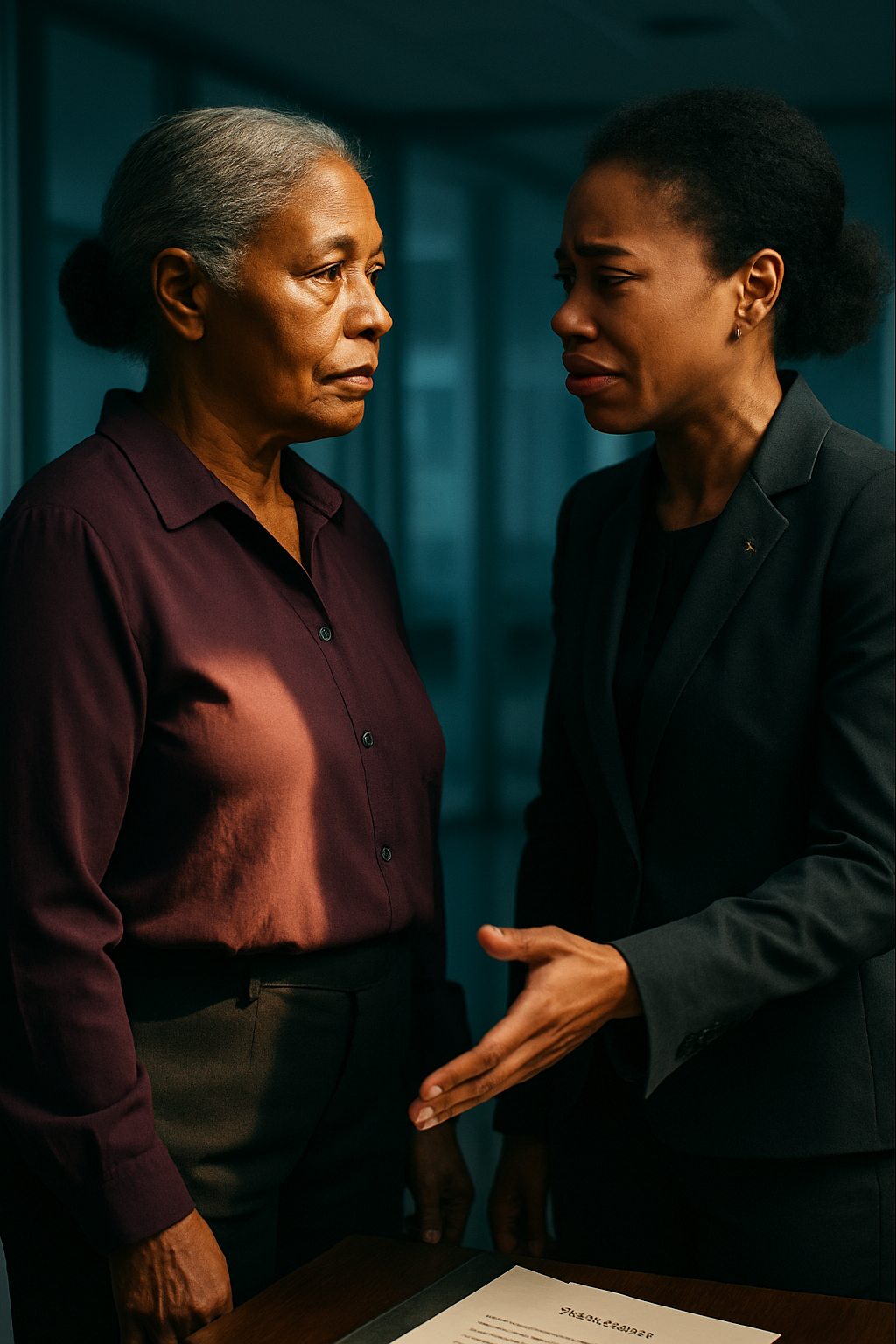
The woman in the doorway was perhaps thirty-two, thirty-three. She wore a charcoal suit that fit her precisely, natural hair pulled back in a low puff, a small gold pin on her lapel that caught the overhead light. She held a folder against her chest. Her posture was composed and professional — the posture of someone who had learned to hold still under scrutiny.
Miriam stood and extended her hand. "That's me. You can call me Miriam."
The woman stepped forward to take her hand — and stopped.
Not stumbled. Not hesitated. Stopped. Like someone had pressed pause on her entirely. Her hand was still extended, halfway across the distance between them, and her eyes — dark brown, wide-set, the kind of eyes that saw everything — had fixed on Miriam's face with an expression that Miriam could not immediately name. Not recognition exactly. Something rawer than that. Something that belonged somewhere private.
"Are you all right?" Miriam asked.
The woman blinked. The professional composure slid back into place like a curtain being drawn. She completed the handshake. Her grip was firm.
"Yes. I'm sorry. Please — come in." Her voice was steady, controlled. But something behind it was not.
Miriam followed her into the office and sat in the chair across the desk.
The nameplate on the desk read: MAYA OSEI — DIRECTOR OF HUMAN RESOURCES.
Maya set the folder on the desk and opened it without sitting down. She stood beside her chair, one hand flat on the desk, looking at the papers inside. She was not reading them. Miriam could tell she was not reading them because her eyes were not moving.
"Take your time," Miriam said.
Maya looked up sharply. Then something in her face — around the jaw, around the eyes — seemed to give slightly, like a structure under unexpected weight.
She sat down.
"Mrs. Adeyemi," she began. "Miriam." She paused. "I want to — this is a standard exit meeting. We're required to conduct them for all departing employees. I'll walk you through the paperwork, answer any questions about your final pay and benefits, and —" She stopped.
She pressed her lips together.
"I need to ask you something," Maya said. "Before we start. And I need you to know it's — it's not standard protocol."
Miriam looked at her steadily. "Go ahead."
"Were you ever — " Maya's voice dropped slightly. "Did you ever live on Aldermoor Road? In Coventry. In the nineties."
The question arrived in the room like something falling from a shelf.
Miriam went very still.
Coventry. Aldermoor Road. The house with the green door and the rose bush that flowered every June despite her best attempts to kill it with neglect. The kitchen with the yellow curtains. The narrow staircase with the third step that creaked.
She had lived there from 1994 to 2009. Fifteen years. She had been a registered foster carer for the entirety of those fifteen years and for five years after, in a different house, in a different city, when she followed her sister north.
"I did," Miriam said carefully. "Why do you ask?"
Maya was looking at her hands, which were flat on the desk, very still. When she looked up, her eyes were bright in a way that had nothing to do with the overhead lighting.
"There was a yellow curtain," she said. "In the kitchen. And you used to hum when you cooked. You always hummed the same song. I never knew what it was called."
The room became very quiet.
Miriam felt something move through her chest — not pain exactly, but the precursor to it, the way the air changes before rain.
"What was the song?" she asked, though she already knew she was about to be undone.
Maya's voice was barely above a whisper. "It went like — " She hummed four bars. Soft. Uncertain. Like someone retrieving something from a very long way down.
It was "Bring Him Home," from Les Misérables. Miriam had hummed it without knowing why for thirty years. She had hummed it over every pot of stew and every packed lunch box and every bowl of cereal at six in the morning for children who came to her in the night with nothing.
Maya's seventh placement. A girl of eight years old. Brought in February, in the dark. Wouldn't speak for the first two weeks. Ate everything put in front of her with the focused urgency of someone who had learned not to trust that the next meal was coming.
Small. Eyes too old for her face. A way of standing in doorways, assessing exits, before she came fully into any room.
Miriam had never known her last name. The caseworker had given her a first name — May, she'd said, though the file might have said Maya — and an age and a list of what not to ask about. She had been with Miriam for seven months before the state moved her to a long-term placement in Manchester. Miriam had asked to be kept informed of her progress. She was told it wasn't policy.
She had thought about that child at least once a month for twenty-five years.
"May," Miriam said.
The word came out of her like a stone dropped into water.
The woman across the desk — the Director of Human Resources, the composed young woman in the charcoal suit — made a sound that was not professional at all. It was the sound of a seam giving way.
"You remembered," Maya said.
"I never forgot you." Miriam's voice was perfectly even. This was her gift — the one she had developed over decades of sitting across from children who were terrified of being seen and equally terrified of being ignored. Steadiness. She kept herself steady so that others could fall apart if they needed to. "I never forgot any of them. But you — you were quiet in a way that worried me. I used to leave the kitchen light on at night because I thought maybe you were afraid of the dark. You never told me if you were."
"I was," Maya said. Her voice broke cleanly on the second word. "I was very afraid of the dark."
For a long moment, neither of them spoke.
Then Maya stood up from her chair and walked around the desk and Miriam stood to meet her, and twenty-five years of silence closed like a door being finally, properly shut — not in the way of endings, but in the way of something sealed against the cold.
Maya was crying. She was not trying not to. She had both her hands on Miriam's arms and she was shaking slightly, the way people shake when something they have been carrying for a very long time is suddenly set down.
"I looked for you," Maya said against Miriam's shoulder. "For years. I tried the council. I tried the fostering board. The caseworker who handled my file retired and her records were incomplete. I knew your first name and the street. I had a memory of your hands."
"My hands," Miriam repeated softly.
"You had a scar on your right thumb. From a garden fork. You told me once when I asked, and I thought — I thought that was extraordinary. That someone would just tell me the truth about a small thing like that without making it into a lesson."
Miriam looked down at her right hand. The scar was still there — faded now, a thin silver line at the base of her thumb. Twenty-three years old, that scar. She had told the story to at least a dozen children.
She had not known one of them had memorized it like a landmark.
"I should have — " Miriam started.
"You couldn't have done anything differently," Maya said firmly, pulling back slightly to look at her. Her eyes were wet but her voice had found its steadiness again, that corporate composure mixing strangely with something rawer beneath it. "I know that now. I didn't then. When they moved me, I thought — I thought I'd done something. That I'd been too quiet and you'd gotten tired of trying. But I know that's not how it worked. I've done the work to know that."
"You were perfect," Miriam said. "You were never a burden. Not for one single day."
Maya pressed her lips together. Nodded once.
They stood in the middle of the HR office with the folder of termination papers sitting open on the desk, and Miriam became aware, in the way she sometimes became aware of things happening in adjacent rooms, that the door behind her had opened.
"I'm sorry to interrupt."
The voice was measured. Male. Senior.
Miriam turned. In the doorway stood a man in his fifties — silver hair, dark suit, the particular stillness of someone who had been listening for longer than he was admitting to. His nameplate, she would later learn, was visible on the door she'd come through: JONATHAN DUNMORE — MANAGING PARTNER.
Maya stepped back and straightened. Her eyes were still bright but her bearing had shifted, the professional shutter coming half-down.
"Mr. Dunmore —"
"I was passing," he said, in a tone that suggested he had not simply been passing. "The door was slightly ajar." He looked at Miriam with an expression of careful assessment. Then he looked at Maya. "Is everything all right?"
"Yes," Maya said. "And no." She glanced at Miriam. "Mr. Dunmore, this is Miriam Adeyemi. She's — she was on the facilities contract. Custodial." A pause. "She was also my foster mother. When I was eight years old."
Jonathan Dunmore was quiet for a moment.
"I see," he said finally.
"I didn't know," Maya said. "When the contract restructure came through HR, I processed the list as I received it. I didn't know her name. I didn't — " Her voice steadied. "I would not have — "
"Of course not," Dunmore said. He stepped fully into the room and looked at the folder on the desk. Then he looked at Miriam again — at her good plum blouse and her pressed trousers and the quiet, particular dignity of a woman who had shown up to be let go with her head level and her hands folded in her lap. Something shifted in his expression. "Mrs. Adeyemi. I want to apologize for the circumstances of this meeting."
"You don't need to apologize," Miriam said. "Business is business. I've been let go before."
"Not by someone who owes you a debt they didn't know they were carrying," he said.
Maya made a sound that was not quite a laugh and not quite a sob.
They did not complete the exit meeting that day.
What happened instead was this: Jonathan Dunmore asked his assistant to hold all calls and bring three cups of tea to the HR office, and they sat — all three of them, the managing partner and the HR director and the woman who had come to be let go — and Miriam told them about Aldermoor Road.
Not everything. Not all twenty years. But enough.
She told them about the system — how it worked, how it didn't, how the paperwork was always three layers thick and the support was always one call away and somehow never there when you needed it. How you fed children in the dark and sent them off to school in the light and learned not to ask what they dreamed about because some of them would tell you and then neither of you would sleep.
She told them about the seven months Maya had lived in her house. She told it gently, without details that weren't hers to give, keeping to the edges — the yellow curtains, the kitchen light, the seven months in which a very small person had slowly, incrementally, without fanfare, begun to believe that she was worth the space she occupied.
"She used to sit in the window of the front room," Miriam said. "Not looking out exactly. Just — with the light on her face. Like she was checking that it was still there."
Maya was very quiet.
"How many children?" Dunmore asked.
"Twenty-two over twenty years," Miriam said. "Officially. There were three emergency placements that didn't make it into the final count because of the way the paperwork was handled. So I say twenty. It's a rounder number."
"And you're cleaning offices now."
Miriam looked at him without apology. "I clean well. I have always worked. When the fostering ended, the income ended. The house I had is gone. I rent a flat now, two rooms, very adequate. The cleaning work suits me. I like a task you can see the end of."
Dunmore was quiet for a moment. He turned to Maya. "What's the current situation with the foundation endowment? The community outreach arm?"
Maya blinked. "The Dunmore Foundation? It's — there's been a coordinator vacancy since March. We've been managing it from inside Legal."
"Describe the role."
"Community partnership liaison. Coordinating between the firm's pro bono commitments and the local fostering and social care organizations. Attending meetings. Building relationships with the people who do the actual work on the ground." Maya stopped. She looked at Miriam. Then at Dunmore. "It pays a full-time salary. It has its own office."
"That's not necessary," Miriam said.
"The salary or the office?" Dunmore said.
"Either. Both." She folded her hands in her lap. "I didn't come here for — I'm not looking for charity."
"It's not charity," Maya said. Her voice had found a new quality — something that combined the precision of the HR director and the certainty of the eight-year-old who had learned to assess exits. "The role has been empty for four months because we can't find anyone who understands what the organizations we're partnering with actually need. Because we keep interviewing people who have qualifications and no experience." She leaned forward slightly. "You have twenty years of experience that no qualification replicates."
Miriam looked at her for a long time.
"I'd need to know what the work actually was," she said finally. "Not the job description. The work."
"Yes," Maya said. "That's exactly the right question."
The tea went cold while they talked.
At some point Jonathan Dunmore excused himself and did not come back, which Miriam suspected was deliberate. He seemed like a man who knew when to leave a room.
Maya pulled her chair around to Miriam's side of the desk and they sat side by side, going through the foundation's existing partnerships — the fostering charities, the care-leaver support organizations, the legal aid projects that needed connecting to people who needed them. Miriam asked precise questions. She understood the funding structures and the bureaucratic knots and the ways that organizations with the right intentions could nevertheless make things harder for the people they meant to serve.
At one point Maya stopped talking and just looked at her.
"What?" Miriam asked.
"I used to wonder," Maya said carefully, "whether I'd built you into something you weren't. Whether I'd made you too — too perfect in my memory. Because I needed something to have been real."
"I'm not perfect," Miriam said. "I burned the rice at least three times a week."
Maya laughed — a real laugh, sudden and unguarded, the laugh of someone who had forgotten for a moment that they were a director of anything. "You always burned the rice."
"Always," Miriam confirmed. "I still do. Some things don't change."
Maya's expression shifted into something softer and more complicated. "I moved six times after I left your house. Six different placements in four years. Some were fine. Some were not fine. And then I aged out and I put myself through university and I worked extremely hard and I built this." She gestured at the office — the nameplate, the framed credentials, the view through the glass wall of a floor that ran on her decisions. "I built all of this and it's real and I'm proud of it. But the thing I kept coming back to, the thing that made it feel worth building, was —" She stopped.
"The light on your face in the window," Miriam said quietly.
Maya looked at her. "How did you know?"
"Because that's what I was trying to give you. All of you. Not the meals or the roof or even the safety, though those mattered. The light. The ordinary daily light of a place that expected you to be in it."
For a moment Maya looked very young. Not eight. Not thirty-two. Somewhere in between — the age at which a person understands for the first time that the kindness shown to them was genuine, that it cost something, that it was given anyway.
"The other foster children," she said. "The twenty. Are you still in contact with any of them?"
"Eight," Miriam said. "Regularly. Another four at Christmas and birthdays. The rest — I don't know where they are. I hope they're all right. You learn to hold hope for the ones you lose track of."
"I want to — " Maya started. She pressed her lips together. "I want to be one of the eight. If that's something you'd want."
Miriam looked at her for a moment. Then she reached over and patted Maya's hand once — the same gesture she had used for twenty years with children who needed to be told, without words, that they had said something true and it was safe to have said it.
"You were always one of the eight," she said. "You just didn't have my number."
She took the job.
Not immediately — she went home that Thursday and sat with her cold coffee and thought about it for three days, because she had learned over many years not to make decisions when she was still inside the emotion of a thing. She thought about the work and whether she could do it properly. She thought about the commute and whether her knees would hold up. She thought about the strange reversal of power — the woman who used to clean these floors sitting in an office on them — and whether it would feel uncomfortable or simply new.
She called her sister, who told her she was being ridiculous and to take the job.
She called one of her former foster children — a young man named Damien who was thirty now and worked in social services and who had his own strong opinions about what organizations like Dunmore & Hale's foundation got right and wrong. He talked for forty minutes and at the end said: "You could actually change things from the inside, Miriam. You know how it works. You know what's missing. Not many people get that opportunity twice."
She called Maya on the Sunday.
"I have conditions," she said.
"Name them," Maya said immediately.
"I want a written commitment that the pro bono work is ring-fenced from budget negotiations. I've seen these programs disappear when the numbers get difficult and the communities they serve don't have lobbyists."
"Done. I'll draft the clause myself."
"I want to be able to bring in people from the organizations I work with for quarterly briefings with the partners. Not just reports. Actual people, in the room."
"I've wanted that for two years. You'll have a meeting with the executive committee in the first month."
"And I want — " Miriam paused. "I want Damien Achebe's number passed along to the intake coordinator at your care-leaver legal aid partner. He's been trying to reach them for six months and no one is returning his calls."
Maya was quiet for a moment. "Miriam," she said, and there was something in her voice that sounded like wonder. "You negotiated your own job offer to get a callback for someone else."
"He needed the connection more than I needed the salary adjustment."
She could hear Maya smiling. "The number will be passed on tomorrow morning. I'll send you the contract on Monday."
On her first day in the new role, Miriam arrived through the front entrance.
She signed in at the main reception desk, not the service door. She took the elevator to fourteen and walked down the corridor past the glass-walled conference rooms and the overwatered plant in the corner — someone had finally moved it away from direct light, she noticed — and she went to the office at the end of the hall that now had her name beside the door on a small placard.
MIRIAM ADEYEMI — COMMUNITY PARTNERSHIPS, DUNMORE FOUNDATION.
She stood in the doorway for a moment, in the way she had once observed a small girl standing in doorways — assessing exits, taking stock, deciding whether the room was safe to enter.
Then she went in.
Maya appeared at ten o'clock with two cups of tea and a stack of files and did not knock before entering, which Miriam found she did not mind at all.
"The care-leaver lunch is on Wednesday," Maya said, setting everything down. "I thought you could come. As an introduction."
"Are they expecting someone from the firm?"
"They're expecting someone who understands what they actually need." Maya sat in the chair across the desk — the chair Miriam had once sat in — and opened the first file. "Which is not the same thing."
"No," Miriam agreed. "It never is."
They worked through the morning, the two of them, the door between their offices standing open.
At some point Miriam realized she was humming — the familiar four bars, low and automatic, the way she always hummed when she was focused on a task she believed in.
Maya, across the threshold, looked up from her desk.
She didn't say anything. She just smiled — not the composed, professional smile of the HR director, but something younger and simpler, a smile that belonged to a girl who had once learned to trust that a particular sound meant the kitchen was warm and someone competent was in it.
Miriam kept humming.
The work was there. The light was there.
That, she had always known, was enough.